
Do you know three Chinese provinces? To understand Xi’s China, you must leave Beijing and Shanghai. Our new series goes to meet the spaces where another figure of the future is being built. To receive this series which has already taken us from Sichuan to Zhejiang, subscribe to Grand Continent. In your inbox from 8 euros per month
The Guangxi Zhuang Autonomous Region is a territory at the edge of China. This marginality is directly expressed in the characters used to write the region’s name, Guangxi (广西), literally meaning “the expansion to the West.” It is bordered to the northwest by the plateaus of Yunnan and Guizhou, and to the south by its border with Vietnam and the Gulf of Tonkin, thus giving it access to the South China Sea. This naturally semi-enclosed bay has historically been a favored haven for navigators, especially during the annual monsoon seasons. A mountainous region whose many rivers have formed the spectacular karst landscapes of the city of Guilin, it is one of the most visited in China. Guangxi is one of the five autonomous regions, alongside Inner Mongolia, Ningxia, Tibet, and Xinjiang. It is home to 14 million Zhuang, the largest ethnic minority among the 56 officially recognized by the People’s Republic of China.
The region possesses numerous mineral deposits and, as such, is one of the country’s major bases for non-ferrous metal production. It is particularly known for its abundant reserves of manganese and tin, the largest in China. Fortified by this natural capital, Guangxi is a hub for metallurgical products and derivatives, a substantial share of which is located in Liuzhou, the historical economic capital. The fusion and forging of ferrous and non-ferrous metals thus constituted the main economic sector in terms of revenue in 2022 (26%). Since the 2000s, the city has become a hub of automotive production (9%), notably around the joint venture founded by American General Motors with the state-owned SAIC Motor Corp., Ltd. The subtropical climate of the region fosters dense vegetation and many species of tropical and subtropical fruits. Thus, 80% of the species and varieties of these fruits found across China are present in Guangxi. It is one of the leading provinces for agricultural production, notably of sugarcane. The autonomous region also has strong potential in decarbonized electricity production. This is especially true for hydroelectric power, Guangxi hosting since 2009 the Longtan Dam (龙滩大坝), one of the largest in the world.
Despite its natural endowments and its favorable geographic position for exchanges, the region remained until the early 2000s relatively on the margins of national development. Guangxi’s geostrategic position during the Cold War made it, like Yunnan, a national security issue, greatly limiting trade with neighboring countries. Guangxi served as the rear base for the Chinese army in its support for Vietnam during the wars against France and the United States, but also during its 1979 offensive against its southern neighbor in response to Cambodia’s occupation by the latter. Due to persistent tensions between China and Vietnam, security concerns continued to hinder trade after the launch of the Reform and Opening Up policy. This is one of the reasons why the port city of Beihai, although among the 14 port cities open to foreign investment in 1984, did not experience the economic development of cities like Tianjin, Shanghai, or Guangzhou.
Only in the 1990s, with the end of the Cold War and the normalization of relations with Southeast Asian countries, did Guangxi begin to experience economic growth, notably thanks to trade with its neighbors. This was driven by the China-ASEAN Free Trade Area (CAFTA) signed in 2004 and whose implementation was fully completed in 2010. From 2005, the autonomous region also strengthened its connectivity with the Southeast Asian peninsula by becoming an official member of the Greater Mekong Subregion cooperation framework, a transnational development program launched by the Asian Development Bank. The objective is, through infrastructure financing along economic corridors, to revive the old trade routes that fell into disuse during the Cold War.
Becoming the interface for exchanges between China and Southeast Asia: the making of a multimodal corridor
C’est dans ce nouveau contexte que les autorités du Guangxi déploient une stratégie de développement visant à faire de la région autonome la principale interface d’échange entre la Chine et l’Asie du Sud-Est. Elles font ainsi la promotion depuis 2006 d’une zone de coopération économique autour du golfe du Tonkin, incluant la mer de Chine méridionale, le Vietnam, la Malaisie, Singapour et l’Indonésie. Celle-ci a été renforcée en 2010 par le corridor économique entre Nanning et Singapour, une excroissance de ceux promus par la BAD. À travers ces initiatives, les autorités provinciales explorent diverses formes de coopération commerciale et maritime avec les pays de l’ASEAN, telles que la coopération portuaire, le tourisme maritime et l’exploitation conjointe des ressources énergétiques.
The local authorities secured from the outset the backing of the central government, whose actions were then framed within the national Western Development Strategy (西部大开发), a priority during the administrations of Jiang Zemin (1993-2002) and then Hu Jintao (2002-2012) to reduce wealth gaps between coastal and inland provinces. Guangxi was granted greater autonomy in managing its foreign trade, as well as funds for infrastructure financing. These funds come notably from the China-ASEAN Investment Cooperation Fund created in 2010 to support connectivity initiatives in the region. This endorsement by Beijing was not only financial; the autonomous region also acquired a near-monopoly on organizing the major annual events dedicated to China-ASEAN cooperation. This includes the China-ASEAN Expo (中国-东盟博览会), launched in 2004 and held every year in Nanning. The arrangement also extends into a multitude of specialized forums, such as the China-ASEAN Mining Cooperation Forum (中国—东盟矿业合作论坛).
Building on preexisting initiatives while granting significant resources, the Belt and Road Initiative (BRI) launched by Xi Jinping in 2013 accelerated the implementation of the regional connectivity agenda. It was reinforced by the new international land-sea trade corridor (国际陆海贸易新通道) in 2015, a project designed to connect the city of Chongqing to Singapore by land via a rail network, and also by sea through a framework of cooperation among the major ports of the South China Sea. This national strategy aims to make the autonomous region a commercial hub between western Chinese provinces and Southeast Asian countries, under the slogan “one zone, two sites, one park, one corridor” (一区两地一园一通道). It seeks to redirect trade and logistics flows by offering a route that reduces transportation time by nearly a week compared with conventional routes via Guangdong and Fujian ports.
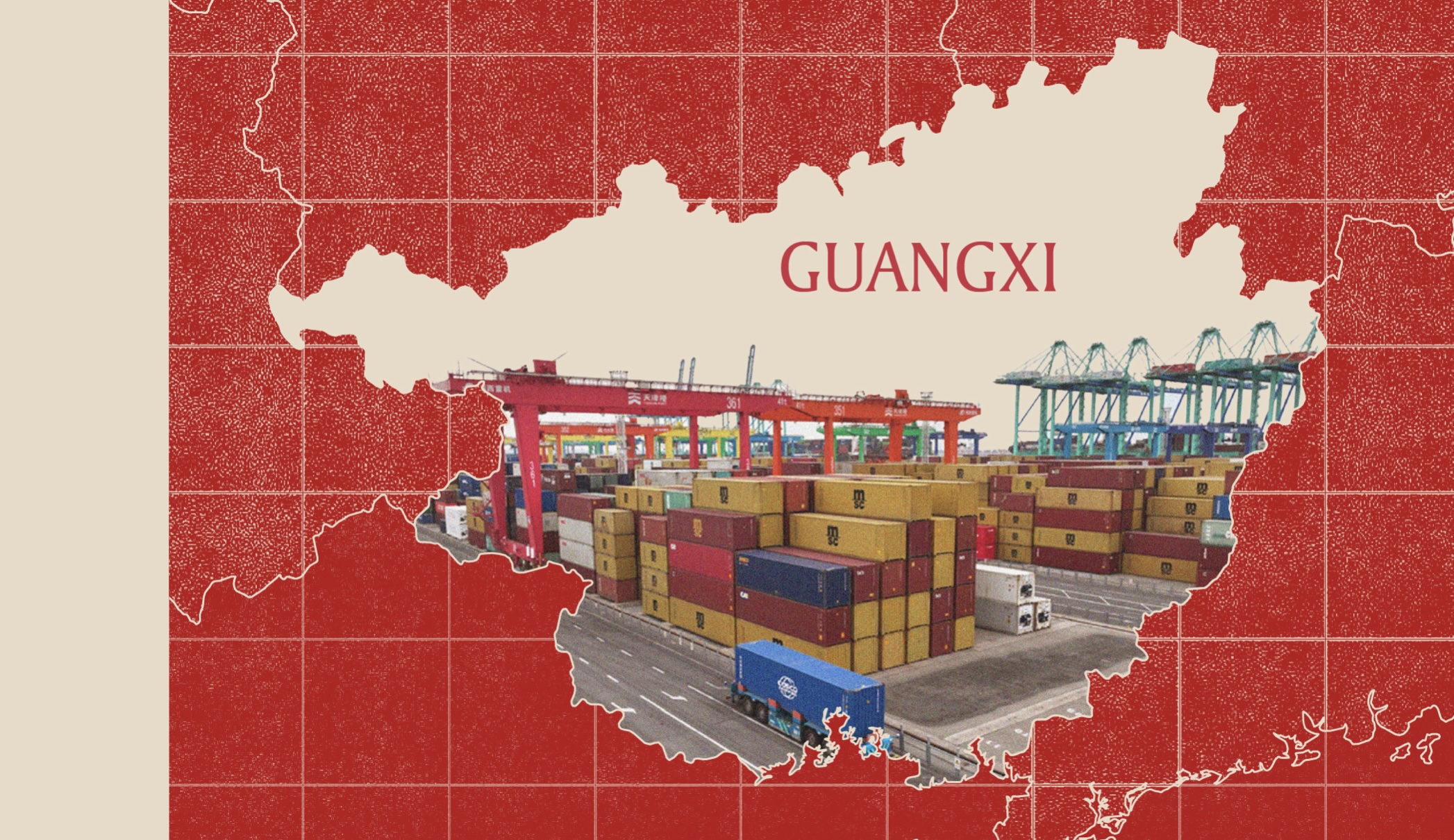
This national development strategy reinforces Guangxi’s strategic position as a nexus within a multimodal corridor linking maritime, rail, and river infrastructures. To boost the capacity of coastal transit, tens of billions of dollars have been invested in modernizing and expanding port infrastructure. Fangchenggang, Qinzhou, and Beihai are now connected to more than 200 ports in over 100 countries and regions and cover almost all the ports of ASEAN member countries. They are operated by the Guangxi Beibu Gulf International Port Group Co., Ltd., a state-owned company under the authority of the regional government. The group also invests in the development of port infrastructure and industrial zones in several Southeast Asian countries, notably Kuantan in Malaysia and Muara in Brunei. To benefit from technology transfers and strengthen maritime links, Qinzhou’s central port benefits from the cooperation of the state-owned COSCO Shipping and the Singapore state-owned PSA International. For the deployment of the first automated container terminal combining maritime and rail in China at Qinzhou, the port group also benefited from the involvement of Shanghai Zhenhua Heavy Industries, one of the subsidiaries of China Communications Construction Company, one of the major state-owned enterprises involved in building the Belt and Road infrastructure.
These technological advances notably enable connectivity with the two rail lines linking the Sino-Vietnamese border, in addition to the ten highways built to reach border crossings. Special Economic Zones have also been deployed along the border with Vietnam to facilitate exchanges. For example, Pingxiang and Dongxing, the two main crossing points, host Border Economic Cooperation Zones to strengthen exchanges with neighboring countries. These two cities have also become important experimentation hubs for development and opening up. Dongxing has implemented numerous institutional innovations, such as the first monetary service platform with ASEAN and the first national center for RMB and Vietnamese dong exchange. In 2014, it also rolled out the first transnational insurance center and the first cross-border cereal exchange port. The aim therefore is not only to facilitate trade but also to build a cross-border industrial space where logistics and manufacturing activities are integrated into a single regional production chain. Guangxi thus seeks to position itself as a crucial intermediary in the overflow of supply chains from southern China to northern Vietnam, a movement that accelerated after the first Trump administration triggered a trade war in 2018.
Regional integration as the engine of local industrial transformation
The local authorities are leveraging the strengthened connectivity with ASEAN to develop the autonomous region. New infrastructure is aimed at attracting more investment and advancing the local industry toward higher value-added activities. The objective is to make Guangxi the gateway for natural resources from Southeast Asia, before they are processed and sold in China or re-exported within the region. This strategy is reflected in the autonomous region’s foreign trade figures, where imports (excluding mechanical and electronic products) are largely dominated by natural resources. The vast majority of exports are manufactured intermediate goods such as electronics and household appliances, automotive parts, construction equipment, textiles, and lithium batteries toward ASEAN.
In traditional sectors such as agro-food and metallurgy, the province’s ambition is to invest in processing activities and to reserve energy-intensive and lower-value activities for regional partners. The China-Malaysia Qinzhou Industrial Park, an emblematic cross-border industrial cooperation project, illustrates this phenomenon. It is intended to enable the local processing of strategic products such as soybeans and palm oil imported from Malaysia and Indonesia, before redistributing them on the Chinese market in semi-finished or finished forms. In the field of ore processing, Guangxi also encourages and facilitates investments in infrastructures designed to transform domestic and imported raw materials before exporting semi-finished or finished products, such as iron and manganese foundries that are developing especially within the framework of mining cooperation with ASEAN countries.
To diversify its economy, Guangxi has invested heavily in infrastructure to strengthen digital integration with ASEAN. Within the framework of the model “R&D in Beijing, Shanghai and Guangzhou + integration in Guangxi + applications within ASEAN” (北上广研发+广西集成+东盟应用), Guangxi localizes, tests, and exports Chinese technologies, notably to Laos, Malaysia, and Indonesia, through the China-ASEAN Center for Cooperation in Application and Innovation in the field of Artificial Intelligence (AI). To serve as the digital gateway to ASEAN, Guangxi has had to invest in training developers, in training large language models (LLMs), in creating AI platforms, and in computing capacity. By linking local digital capabilities to ASEAN demand, Guangxi seeks to build a regional market for Chinese AI products.
As with other Chinese provinces, Guangxi has in recent years sought to evolve its automotive industry toward electric vehicle (EV) production. Thus the Liuzhou cluster, formed around the GM-SAIC joint venture, has expanded with cooperation with Wuling to produce EVs, including microcars that sold over 1.2 million units in China in 2024. Again, local authorities aim to make ASEAN cooperation the engine of sector development. The China-ASEAN New Energy EV production base in Guigang, aiming to create a complete value chain between the autonomous region and its neighbors, hosted 40 operating sector companies in 2019.
Persistent limits
Despite the significant improvement in infrastructure and the support it receives from the central government, the region struggles to implement its industrial transformation strategy. Many infrastructure and business investment projects prove economically unviable. As in other Chinese provinces, local authorities have publicly been blamed for offering excessive incentives to attract investment projects. Nanning thus poured 2.4 billion RMB into Hozon New Energy, the parent company of Nezha electric vehicles. The company accumulated 18.3 billion RMB in losses between 2021 and 2023, before ceasing operations in 2024, and creditors in 2025 sought judicial restructuring of the company.
Guangxi also struggles to attract foreign investors, who are increasingly scarce. The causes include, notably, a legal environment and local human resources less attractive than those in coastal exporting provinces, which are also pursuing more cooperation with ASEAN countries. To address these structural weaknesses, cooperation agreements have been signed with the governments of Hong Kong and Singapore, particularly in legal services and in training local executives.
Lying at China’s edge, Guangxi’s development had been hampered until the end of the 20th century by the Cold War. Since relations with ASEAN countries warmed, the autonomous region has sought to capitalize on its resource-processing industry to become a hub of exchange between the region and China’s western provinces. To do so, it is building, with the political and financial backing of the central government, a set of infrastructures and cooperative institutions capable of strengthening exchanges with neighboring countries, to the point of acquiring an institutional centrality unparalleled among Chinese provinces in organizing economic diplomacy with ASEAN.
From the late 20th century to today, Guangxi has thus acquired an institutional centrality unmatched among Chinese provinces in organizing economic diplomacy with ASEAN. Yet this institutional and infrastructural success has not yet translated into industrial development commensurate with the ambitions declared, and Guangxi struggles to transform its geostrategic position into a durable economic advantage. This case thus illustrates the limits of a regional development strategy that relies primarily on infrastructural ambition and central government support: building corridors and cooperation institutions alone is not enough to generate the upgraded industrial capabilities sought by local authorities. The realization of the province’s ambitions remains contingent on several unknowns: the completion and profitability of the Pinglu Canal, Guangxi’s ability to bet on AI and EVs in the face of better-positioned provincial competitors, and finally the persistence of geostrategic frictions, which remind us that regional economic integration does not completely dissolve inherited tensions.