
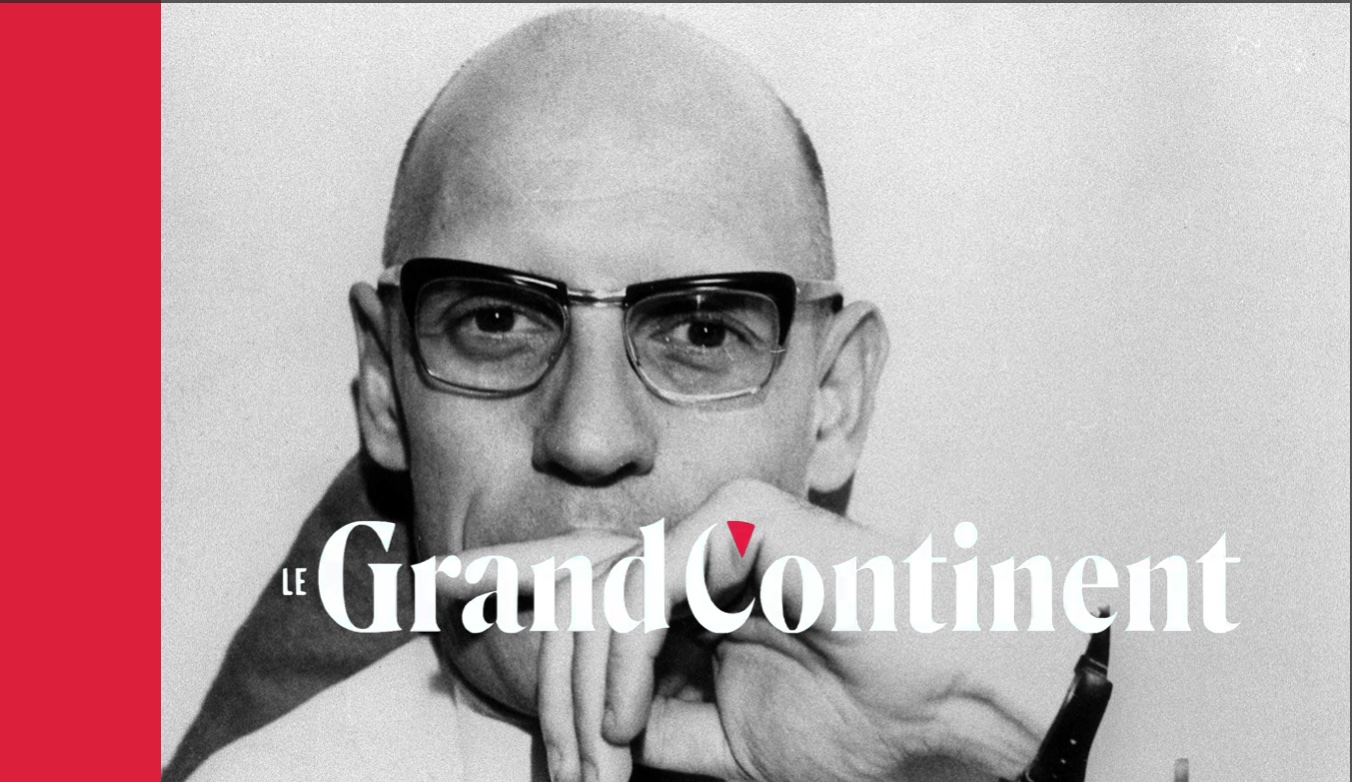
The year 2026 marks the centenary of Michel Foucault’s birth, but also the fifty years since the creation of the journal Hérodote, whose first issue opened with a lengthy interview given by the philosopher to geographer Yves Lacoste. Then a student of the latter, geographer Béatrice Giblin, now editor-in-chief of Hérodote, witnessed the sole encounter between these two towering intellectuals of the twentieth century. On the occasion of the study day on Michel Foucault and geopolitics, organized on 13 October 2026 by the Institute for Advanced Geopolitical Studies, she revisited this pivotal episode in a testimony whose transcription we publish.
Test the Grand Continent. The ideas and analyses you cannot find anywhere else. But you will see them everywhere soon. In your inbox from eight euros a month
Not being a philosopher at all and possessing only a fairly limited familiarity with Foucault’s works—having read in their own time The Order of Things, Archaeology of Knowledge, and Discipline and Punish—I can only offer a personal testimony of the meeting between these two figures, Michel Foucault and Yves Lacoste, which the latter asked me to accompany. This meeting took the form of an interview, conducted in November 1975 and published in 1976 in the first issue of the journal Hérodote.
I would first like to revisit the context that led to this encounter.
First, one must recall the existence of the Experimental Center of Vincennes, created in the wake of May ’68, where Lacoste and Foucault taught. The latter founded the philosophy department, from which he recruited Gilles Deleuze, Alain Badiou, Étienne Balibar, Jacques Rancière, and François Châtelet.
Michel Foucault taught at Vincennes for only one year, as he joined the Collège de France in 1970—an institution far more prestigious and located in the heart of Paris. Yves Lacoste, for his part, chose to remain at Vincennes until the end of his academic career, including after the university’s move to Saint-Denis in 1980.
In truth, Lacoste and Foucault never met at Vincennes, even though the philosophy department was adjacent to the geography department and the organization of studies, modeled on the American university system, encouraged cross-disciplinary exchanges. Contacts with the philosophy department were therefore easy. Moreover, Lacoste bore a strong interest in philosophical questions, particularly the epistemology of knowledge, with geography at the forefront, of course.
It was actually with François Châtelet that he established an intellectual and friendly relationship. He even wrote the chapter on geography in the book The Philosophy of the Social Sciences: from 1860 to the Present, edited by François Châtelet and published in 1973.
Interested in epistemology, Lacoste had read Archaeology of Knowledge, published in 1969, and it is certainly this book, more than Discipline and Punish, that sparked his wish to meet Foucault. Indeed, I think Lacoste was deeply intrigued by Foucault’s analysis of discourses as a set of rules that determine what can be said at any given moment. Studying the history of geography with this approach proved fruitful. The discourses of university geography, established at the end of the 19th century, were indeed a set of rules shaping what could be said. Among these rules was the exclusion of the political field. Thus it represented a break with the geography that had preceded it, which, from its inception, had proven useful and even indispensable to political and economic actors.
Another contextual element explaining this request for an interview: the place of Marxism in the analyses of the human sciences. Lacoste was interested in Foucault’s view of the relative scarcity of spatial references in Marx’s texts compared with the numerous references to time. Not that Lacoste was a staunch Marxist, but given his reflections on underdevelopment—which, in his view, could hardly be explained solely through Marxist analysis as most economists did—he wanted to hear from a philosopher like Foucault about why space occupies so little space in Marxist writings, which might illuminate the limits of economists’ analyses.
To my memory, Lacoste secured the appointment with Michel Foucault through François Châtelet. It took place at the philosopher’s home on rue de Vaugirard. I accompanied him, struck by the prospect of witnessing this meeting between two great minds.
I recall the room as very long, narrow, and bright, yet rather cold.
The interview’s early moments were rather tense; evidently Foucault wondered what Lacoste wanted from him, since geography had never clearly figured in his concerns. Perhaps, like anyone, he had the classic image of a school discipline of little interest. Yet, as a courteous man, Foucault listened politely, with a trace of boredom. Facing him, Lacoste, confident in the relevance of his questions, did not let the philosopher’s distant interest derail him. From the outset he asked why, in his work, he shows little interest in geography, why he rarely refers to it, why he relegates it to the natural sciences and thereby separates what lies at geography’s very foundation—the linkage of natural and social sciences in a single reasoning. And he asked: what place could geography have in his archaeology of knowledge?
Foucault replied that this way of posing the question did not interest him. He had no project to undertake the archaeology of every science, but he aimed to “write a history that makes sense, that has use, and political effectiveness” and that “one cannot do this properly unless one is bound, in some way, to the struggles taking place in this field.”
A little later in the interview he also said: “One can very well refrain from talking about something simply because one does not know it,” a sign of his lack of knowledge or disinterest in geography.
Lacoste pressed the point, arguing that philosophers’ disinterest in geography might stem from the absence of discernible lines of force, tensions, or points of clash, unlike what Foucault had perceived in psychiatry, which had led him to perform genealogies. Foucault’s sharp reply: “Don’t ask me to do your work on the archaeology of geography. It is up to you, who are directly connected to what happens in geography, who are confronted with all these power struggles that pass through geography, to face them, to give yourselves the instruments that would enable you to fight there. If one or two ‘things’ (an approach or a method) I used in psychiatry, in punishment, or in natural history can be of use to you, I’m delighted.”
Yet Lacoste persisted, returning to the importance of time in his own work and his rigorous concern with periodization, whereas with regard to spatializations, things were different—blurred, with the cited spaces not justified or specified. Lacoste spoke of an uncertain spatialization in Foucault. In fact, Lacoste was deeply interested in Foucault’s method of periodization, which he thought could be applied to space.
“Each periodization slices history into a certain level of events, and conversely, each layer of events calls for its own periodization, because depending on the level chosen, one must delineate different periodizations, and depending on the periodization one adopts, one reaches different levels. This is how one accesses the complex methodology of discontinuity.” Lacoste thus explained to Foucault that one must conceive and build a methodology of discontinuity with respect to space and spatial scales, and be as rigorous as one is with periodization.
Foucault defended this uncertain spatialization by saying that it stems from the work of a single man and that a more precise spatialization would require collaborative work, though I sense that this was not what truly interested him.
Lacoste continued on the issue of spatialization, now highlighting the abundance of spatial metaphors: position, movement, place, field, and even the geographic metaphors: territory, domain, ground, horizon, archipelago, geopolitics (first cited in Hérodote), region, landscape.
At that moment, at least in my memory, Foucault became animated.
And he asked Lacoste: “Are you sure I am borrowing these notions from geography and not the other way around—what geography itself borrowed from them?”
Lacoste clarified that these spatial metaphors are both geographic and strategic, because geography developed in the shadow of the military. The classic question-and-answer format of the interview thus evolved into a genuine exchange.
Foucault observed: “I have been reproached enough for these spatial obsessions, and they indeed haunted me. But through them, I think I have discovered what I was ultimately seeking: the relations that can exist between power and knowledge.”
“Deciphering the transformations of discourse through spatial, strategic metaphors allows us to pinpoint precisely where discourses transform, within, through, and from power relations.”
The convergence between Foucault’s and Lacoste’s thinking began to take shape.
It is precisely at this point that the reflection on Discipline and Punish begins to engage the state apparatus and the dissemination of micropowers—a dispersed network of devices, with power not solely localized within the apparatus of the state; power in its exercise extends far beyond, moving through finer channels and becoming “much more ambiguous, because everyone is, in essence, a bearer of power,” a concept Elisée Reclus had described as the hierarchy of powers that flows from the most dominant to the most subordinate. Lacoste then cites the conclusion of Discipline and Punish in which Foucault speaks of the “imaginary geopolitics” of the carceral city.
To be frank, I’m not sure either Lacoste or Foucault had a precise sense at the time of what they meant by the term geopolitics.
Then, by analogy with examples from psychiatric knowledge that bore within it the closure of the asylum, with disciplinary knowledge that bore within it the model of the prison, with Bichat’s medicine, bearer of the hospital’s enclosure, and political economy bearing the enclosure of the factory, Lacoste asks—as a quip and as a hypothesis—whether geographical knowledge might not itself carry within it the circle of the border, whether national, departmental, or cantonal: “To the figures of confinement of the madman, the delinquent, the sick, the worker, should we not also add the figure of the citizen-soldier? The space of confinement would then be infinitely larger and less sealed.”
“That is very seductive,” Foucault replied, adding: “And in your view, would this be the man of nationalities? For that geographical discourse that justifies borders is the discourse of nationalism.”
Then the discussion turned to the three techniques distinguished by Foucault—measurement in the Greeks, inquiry in the Middle Ages, examination in the eighteenth century—and how these three techniques influenced one another, and, above all, how inquiry and examination crossed, interfered; the natural sciences and the human sciences thus interwoven their concepts, methods, and results to yield Foucault’s conclusion: I think geography provides a clear example of a discipline that systematically uses inquiry, measurement, and examination.
They converged on the importance of information gathered by travelers, merchants, explorers, geographers, and strategists—true intelligence operators at the service of power apparatuses.
At the end of the interview, Lacoste returned to the absence of controversy in geography, attributing it to the weak influence Marx had on geographers, asserting that there is no Marxist geography, because geographers who claimed Marxism tended to turn toward economics or sociology and favored planetary and intermediate scales. By prioritizing the time factor in economic writings, like Capital, spatialization was probably overlooked. Both agreed that there are, nonetheless, entire swaths of Marx’s oeuvre that reveal a spatial sensibility.
To close this testimony, I will cite the ending of this exchange, in which Michel Foucault expresses the full benefit he gained from the dialogue with Yves Lacoste: “I really enjoyed this interview with you, because I changed my mind between the beginning and the end. It is true that at the start I thought you were claiming geography’s place in the same way as professors who protest when they are offered a reform of teaching: ‘You have reduced the hours of natural sciences or music…’ So I told myself: ‘They are kind to want us to do their archaeology, but after all, let them do it themselves.’ I hadn’t at all grasped the meaning of your objection. I realize that the problems you raise about geography are essential to me. Among a number of things I connected, there was geography, which was the support, the condition of possibility for the passage from one thing to another. I have left some things unresolved or I have made arbitrary connections.”
“The more I go on, the more it seems to me that the formation of discourses and the genealogy of knowledge must be analyzed not from types of consciousness, modes of perception, or forms of ideologies, but from tactics and strategies of power. Tactics and strategies that operate through implants, distributions, segmentations, territorial controls, and the organization of domains that could well constitute a kind of geopolitics, through which my concerns would align with your methods. There is one theme I would like to study in the coming years: the army as a matrix of organization and knowledge — the need to study the fortress, the ‘campaign,’ the ‘movement,’ the colony, the territory. Geography must indeed lie at the heart of what I study.”
Foucault indeed speaks of geography, not geopolitics; it is useful to remember this when one reasons about a geopolitical situation.