
Test Le Grand Continent. The ideas and analyses you won’t find anywhere else. But you’ll soon see them everywhere. In your inbox from 8 euros per month
In the West, Russia’s 2022 invasion produced an effect that neither Maidan nor the Donbas war had been enough to yield: to bring Ukraine to the forefront and place it at the center of international attention. By that date, the eastern regions of the country were emerging from eight years of a low-intensity conflict that had profoundly altered the lives of its inhabitants, starting with those in the occupied territories.
Since February 2016, photojournalist Marion Péhée has been documenting the consequences of this conflict on civilian populations from an angle that is new to the field: the ten-year trajectory of a group of teenagers from Chystia, followed across political, social, and cultural borders. Since the city’s occupation in the Donbas by the Russian army, the once-tight-knit group has dispersed into Ukraine, the occupied territories, Russia, and abroad: some have become soldiers in the Ukrainian army, others in the Russian army; several have died.
After receiving the Union of Professional Photographers prize in 2022 and being shortlisted the same year for The Economist’s Courage in Journalism award, this work on the Donbas earned Marion Péhée the Canon Female Photojournalist Grant in 2025. We speak with her again about the tragedies and paradoxes of a generation shaped by war.
How did the idea for this first project on Ukrainian soil come to you at the outset? Was it part of a broader research or inquiry?
Marion PéhéeMy arrival in Chystia in April 2016 happened a bit by chance. I happened to be in Ukraine visiting a friend who worked at the French Institute in Kiev. It was then that I began looking into an organization, the Vostok SOS association, which helped internally displaced people. Its members conducted missions in the Donbas and invited me to join them. A logistical snag on the road forced us to stop in the Luhansk region, precisely in Chystia – a town whose name ironically means “happiness” in both Ukrainian and Russian.
I was dropped off at the home of a history teacher who taught at the town’s high school, a place where I would soon spend long hours for my interviews. In talking with him, he quickly mentioned young locals who had joined a volunteer battalion two years earlier, when they were only fourteen. This story struck me as extraordinary, and I immediately wanted to learn more. Gradually, the idea of telling their story through photography took hold. Yet I started rather awkwardly; I had just completed a master’s in photography and contemporary art and worked at the Jacquemart-André museum. I had no background in photojournalism. I arrived on the ground without a definite project, and certainly not with the intention of staying there for the next ten years of my life.
In the context of this improvised field entry, how did your first encounters with the youths unfold?
In the end, I stayed longer than planned, hosted by the history teacher in question. He told me the town’s story, but also recounted his own arrest by the pro-Russian separatists in 2014, with a several-month stint in prison. He also spoke of his two daughters who helped in the army as volunteers in the Aidar battalion. At the time, I did not quite grasp why they had joined.
Later, the young people of Chystia explained that the army was very visible in a town that had witnessed intense fighting in 2014. For them, there was something exciting, even “cool,” about being around the soldiers, about posing with them. These teenagers were not driven by patriotic sentiment. What mattered most to them was obtaining a status by hanging out with the town’s most popular figures. One of them even boasted of climbing onto a tank at fourteen and of receiving candy as well as empty shell casings.
Intrigued by these meetings and discoveries, I decided to return to Chystia for a longer spell a few months later, in the middle of the summer, to try to better understand local dynamics. What did it mean to be fifteen or twenty years old in this town? What kind of life did they lead, what futures could they imagine for themselves?
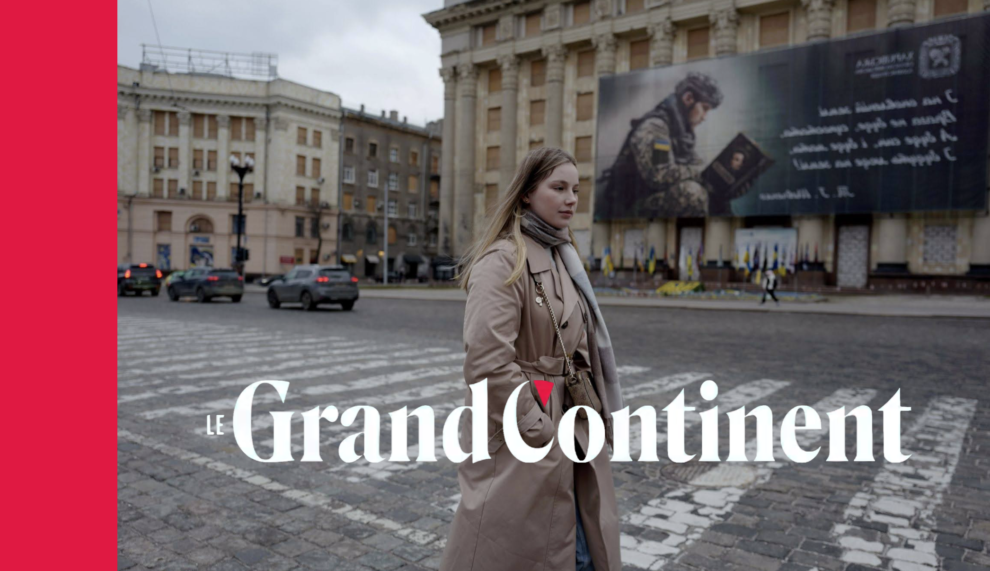
Kharkiv, Ukraine, March 2026
Sveta walks the streets of Kharkiv. Behind her stands the regional administration building, located on Freedom Square, heavily bombarded in March 2022. All the windows were blown out and the ceilings badly damaged, some areas completely destroyed. “In 2014, I was 13, I began to understand that something was happening when the Ukrainian army arrived in the city to liberate Chystia. The bombardments were intense, the noise was so terrifying for me, I was very scared. I remember two strikes: the first, I bled from the nose from fear; the second, I was under blankets as the windows exploded. And the next day, the Ukrainian army entered the city.”
Sveta lives alone in Kharkiv and holds two jobs: she works as a jeweler’s shop assistant and runs an online electronics store. She studied to be a social worker in Kharkiv. “I feel good here; I’m at peace. I love this city very much: it’s pleasant and clean, the people are wonderful, there’s no discrimination, and there are many internally displaced people.”
I spoke neither Russian nor Ukrainian. The town’s teenagers spoke neither English nor French. By chance, I was helped by one of them, who appeared out of nowhere and spoke Spanish. I was tinkering as best I could. I wandered the town, offering smiles and glances to all the young people in an effort to connect. Valya was among the first to laugh at my presence. She invited me into her group of friends where I soon met Vova, then a string of other youths. They didn’t quite understand what brought me to Chystia—and I found it hard to articulate it myself—but they enjoyed being photographed. Thus began several trips in 2016 and 2017, with periodic visits to them thereafter.
How did they perceive the burning issues of the moment, the questions surrounding territorial defense and the region’s economic and political control?
Hard to say: they didn’t mention Maidan or Crimea. They were between 16 and 18 years old at the time. These questions weren’t immediately present for them. Many told me they felt more “aside from the war” than at its center. There was almost a playful element to all these events: a girl told me that the town’s youths liked to shout “Glory to Ukraine” or “Glory to the separatists.” One even tried to tear down an Ukrainian flag and hoist the Luhansk flag in broad daylight. It was a kind of game that seemed harmless at the time.
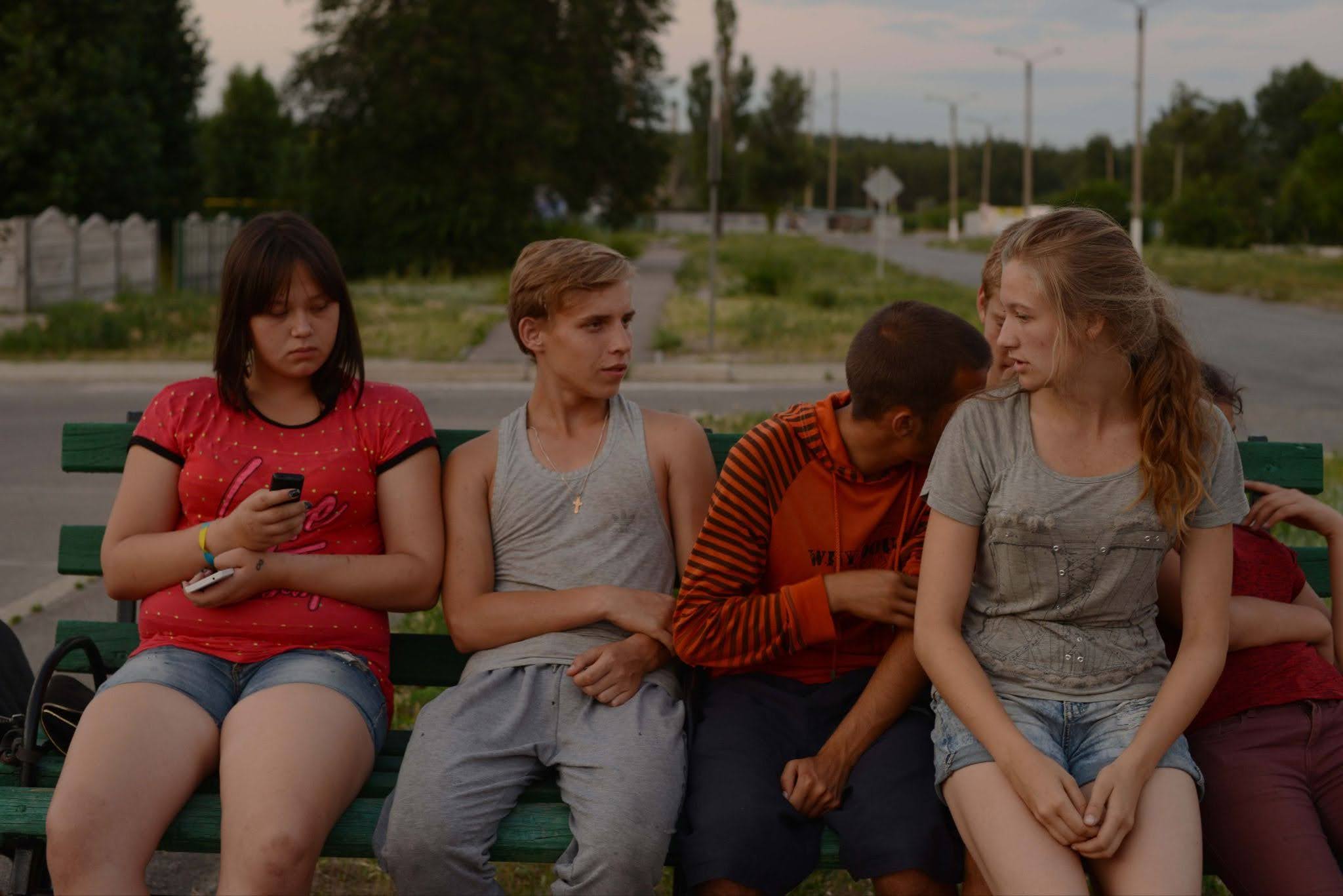
Chystia, Luhansk region, Ukraine, July 2016
Valya, Vova, Sergei, Dasha, Kostia and Nina (left to right) talk on a bench. After the large-scale invasion, the youths of Chystia remember: “None of us had real parents, none of us had money. We were with the grandparents who didn’t want to leave their homes and had nowhere to go. They lived in fear. We were alive! […] We played at choosing sides! We shouted ‘Glory to Ukraine’, ‘Glory to the separatists’, and we laughed. One of us wanted to tear down the Ukrainian flag and hoist the Luhansk flag in broad daylight. They were games we thought would have no consequences.”
In short, they were out having fun, getting into all sorts of mischief, not fully grasping the war’s reach at their doorstep. In 2014, some listened to songs that glorified Novorossiya, the People’s Republics of Luhansk and Donetsk. For them, these were simply the hits of the moment. It all felt distant to them; they lived their daily lives with a lightness, like a game with no consequences, just as any teenager in Western Europe might—except that they were in Ukraine. Since then, things have changed considerably; that carefree attitude has vanished. At the time, some youths had been paid a few hryvnias by the separatists to avert traps laid by the Ukrainian army; today, one of them serves in the same army. It’s worth noting that many of these adolescents were left to fend for themselves, sometimes without parents, frequently out of school.
Was there, conversely, an institutional framework binding them more closely to Ukraine?
All of the above doesn’t diminish their attachment to the territory. Most expressed an intention to stay in the town, which offered little real prospect. Living in Chystia meant either working at the power plant or joining the army. I sensed that some lived in the town as if it were a duty, given the Russian presence just a few kilometers away. There was therefore a certain ambiguity, which also showed up in their tattoos bearing the Ukrainian insignia or bracelets in the colors of the Ukrainian flag. If politicization didn’t appear overt, since it mingled with play and carefreeness, it nevertheless surfaced in some signs.
While spending time at their high school, I discovered a course titled “Defense of the Motherland,” which essentially consisted of assembling and disassembling Kalashnikovs as quickly as possible. On the walls of the high school, there were posters with Putin’s face in the middle of a target. Yet again, there was a gap between the expected discourse and their personal relationship to these realities.
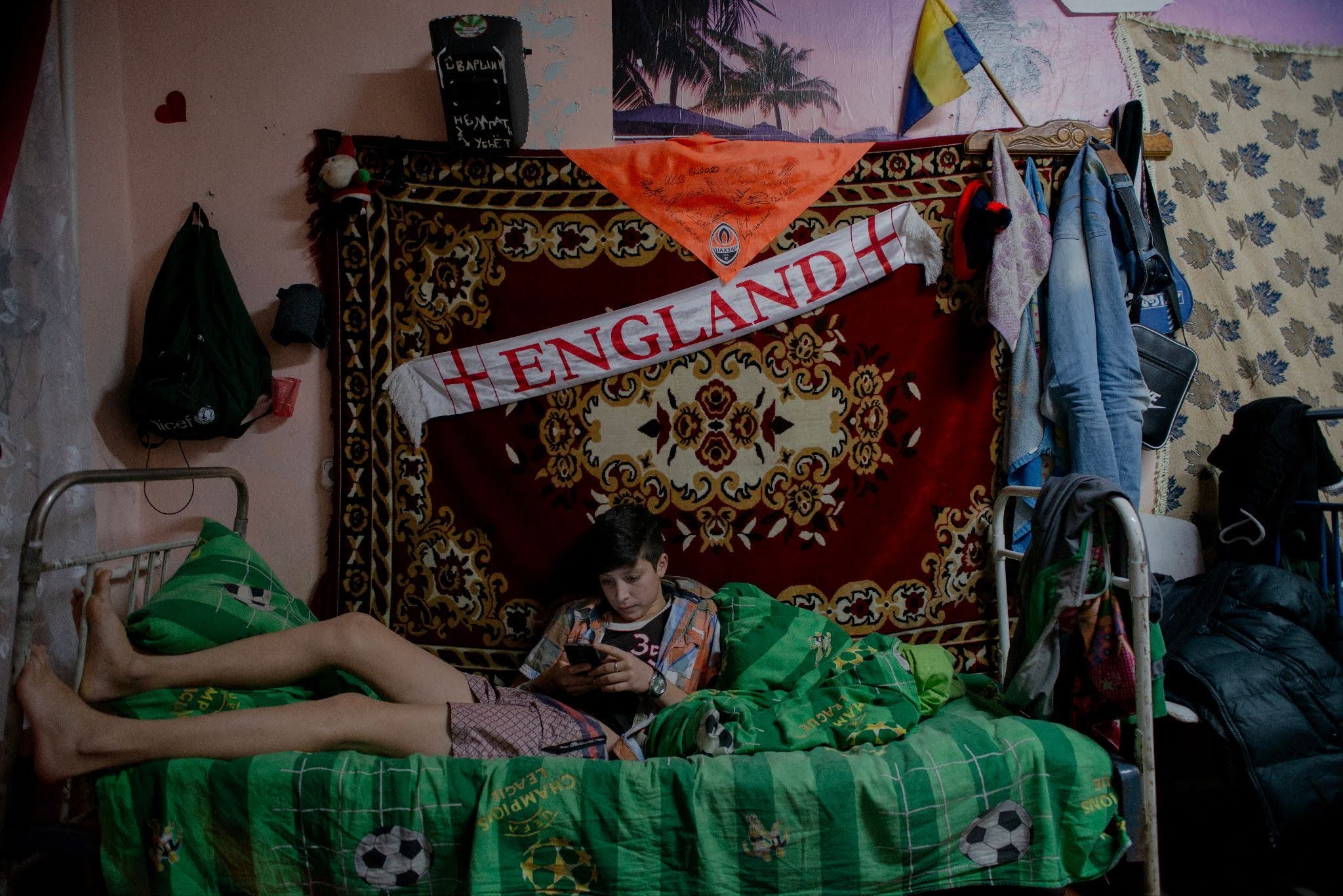
Chystia, Luhansk region, Ukraine, November 2016
Portrait of Viktor in his high school dormitory room. At the time, this student hoped to leave the town for Kharkiv. Today married, he lives in Odessa where he stays locked at home, fearing being recruited by the Ukrainian army. “It’s hard to be a 26-year-old man in Ukraine today.”
Ten years later, what brought you back to this investigation? Under what conditions did you return to the field?
The situation could not have been more different. Naturally, I could no longer go back to Chystia, now occupied by the Russian army. Security concerns were incomparable. It’s worth noting that in 2016-2017, I too carried a certain carefreeness. Today, beyond physical safety in a country at war, disseminating my archival photographs—those taken before 2022—has become a risk for some youths who still live in the occupied areas or have family and friends there. It has become impossible for me to tell certain stories, to show certain people. Until the large-scale invasion, things were much more fluid.
More broadly, when I reopened this dossier over four years ago, in early 2022, my work immediately took the form of a genuine investigation. In this field I had improvised, this time I needed a methodical approach to track down my contacts. The starting point was a young girl who, at the time, was the only person visible among my Instagram contacts. She told me that her friend Valya had been arrested by the Russian army. Soldiers had arrived in Chystia with lists of activists and former local soldiers. Valya, who had served in the Ukrainian army, had been arrested in the early hours of the invasion. I later learned she spent ten days in prison before being released, but her release was followed by a new wave of arrests. I began to gather contacts through this person, then via social media, by phone, for months and months, until my search reached a dead end. All contacts had given me the information they could, and I was treading water. It was at that moment that I began working with an OSINT specialist who helped me collect a great deal of valuable information. Soon, I learned that Valya had been killed by the Russian army. Her tortured body was found in a forest near Chystia. This discovery fueled my work: the desire to know, to document these war crimes, but also to preserve the memory and tell the story of those I photographed.
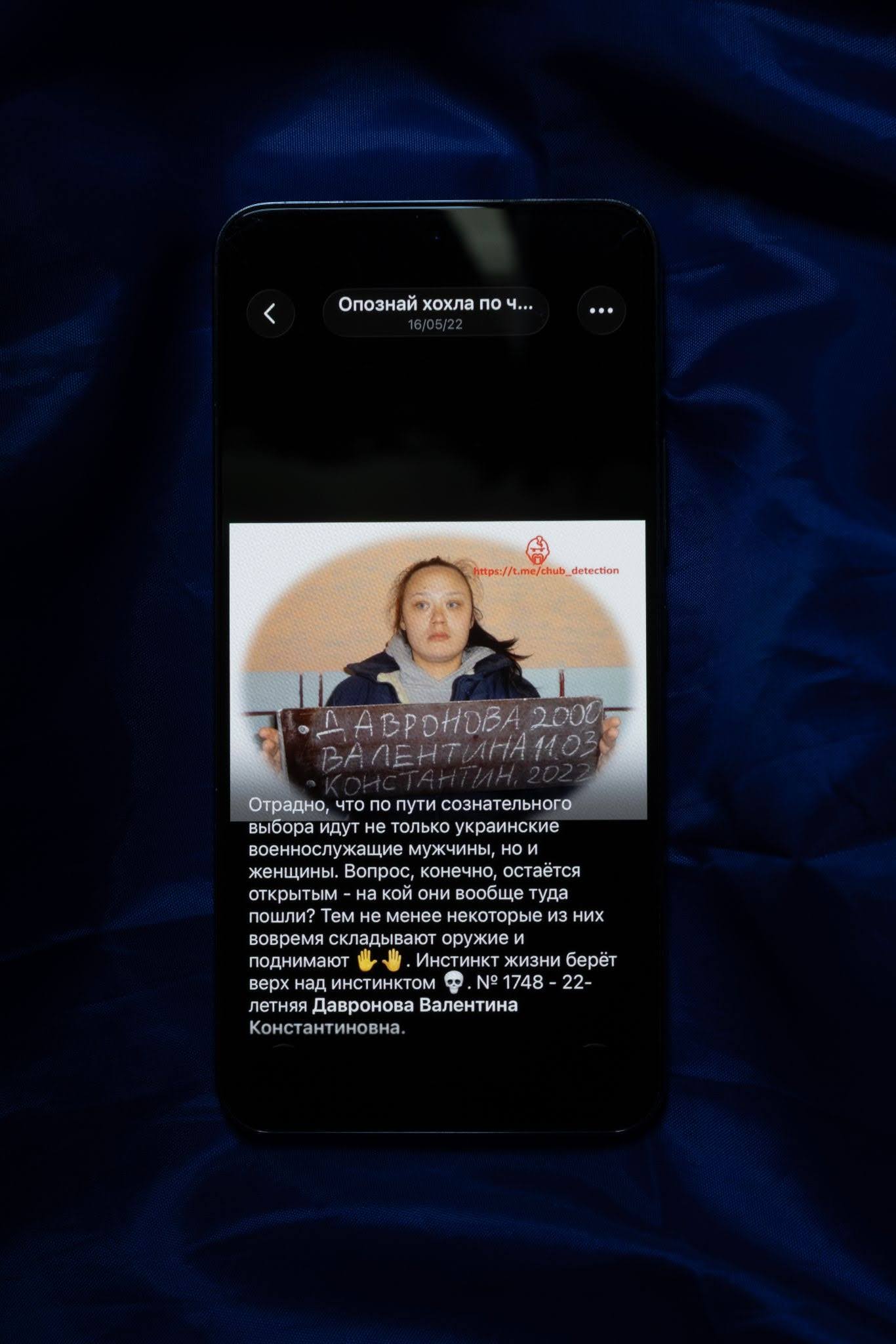
Ukraine, May 2026
A photo of Valya taken while she was a prisoner on a Telegram group titled: “You can tell Ukrainians by their hairstyles.” This chat group regularly shares images of Ukrainian soldiers in captivity, accompanied by humiliating commentary. The caption reads: “It is encouraging to note that it isn’t only the male Ukrainian soldiers who consciously surrendered, but also the women. The question remains: why did they go there? Nevertheless, some of them lay down their arms in time and raise their hands. The life instinct triumphs over the instinct of death. No. 1748 Valentina Konstantinovna Davronova, 22 years old.”
After ten days in captivity, Valya is released but subjected to frequent checks. She sometimes visits the soldiers of Chystia. It is thus that she spends the evening of January 13, 2023 with them at the Raduga cafe (rainbow, in Russian). That night, she disappears. On February 22, 2023, her mother receives a call from a Russian investigator informing her that Valya has been found in the forest. “He told me to verify her identity by photo, or I wouldn’t survive. She had a knife-wielded body and her head blown off by a grenade. She was only in underwear.”
On March 7, 2025, Rostov Military Court finds two men guilty of her murder and sentences them to 12 and 18 years in prison. They appealed. The investigation established that at least nine other soldiers had heard Valya being tortured and saw it, but did nothing to intervene.
What trajectories had the other young people you had met a few years earlier followed?
I first reconnected with Vova, one of my earliest contacts among Valya’s circle. Our reunion was particularly moving. For them, I was someone familiar, but also a keeper of their childhood and adolescence photographs, a material that has become all the more precious now that nothing remains—neither the town nor that life.
The last time I photographed Vova, it was for his eighteenth birthday with his friends. The same year, he joined the Ukrainian army and spent eight years in the trenches.
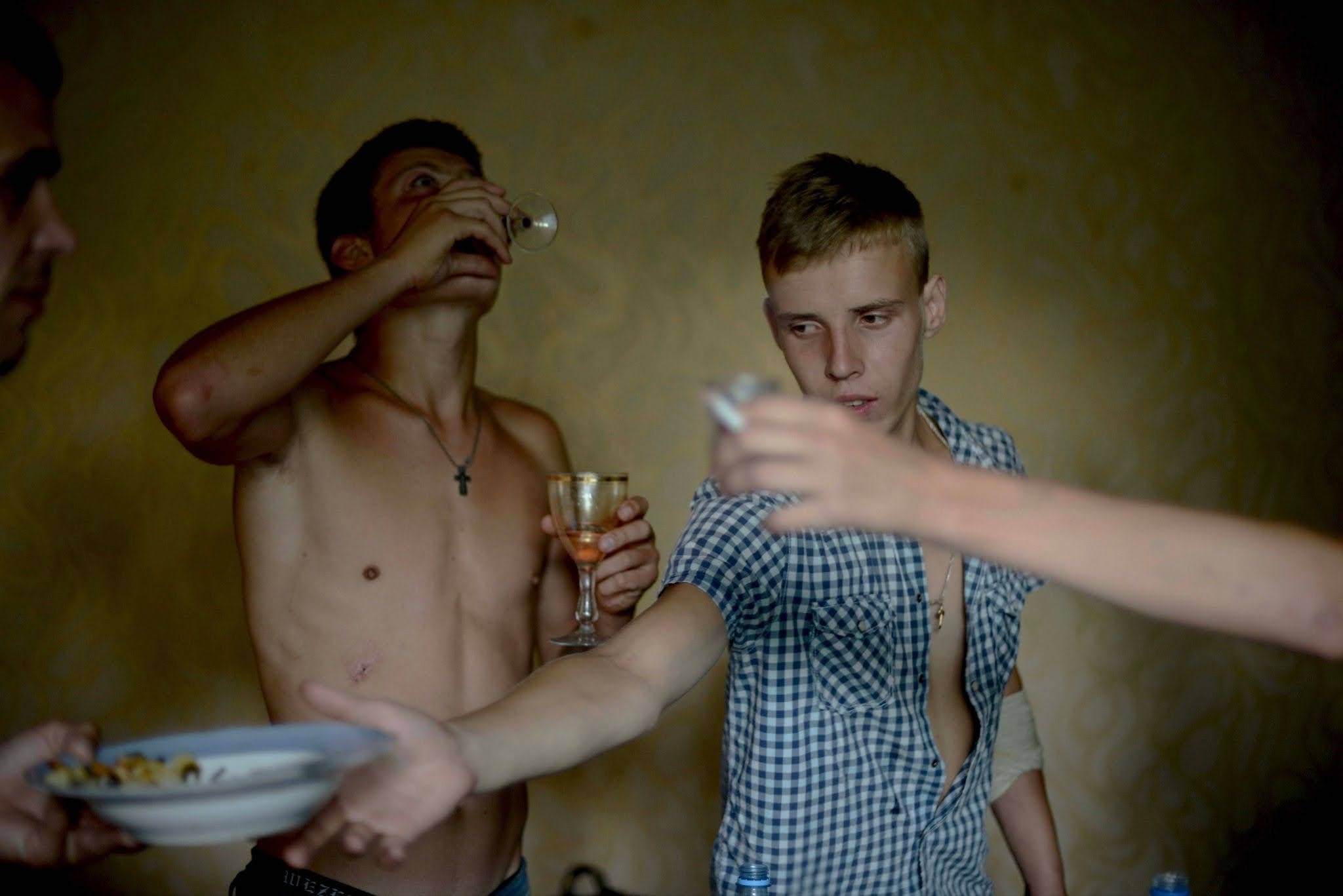
Chystia, Luhansk region, Ukraine, July 2016
Vova celebrates his 18th birthday with friends. “It was the good life, drinking, smoking, partying. Free life. My beautiful life ended the year I turned eighteen.” That night, about ten friends drank, laughed, smoked, hugged, sought each other out and kissed each other. Fifteen days later, Vova enlisted in the army, and he went into combat in the Donetsk region after a month of training. In 2025, he speaks of his frustration at being mobilized in that region, rather than defending his city and his own region.
In 2023, after an injury that cost him two fingers, he became a trainer in Zaporijia. When I found him again in 2022, of course I met someone very changed. At the time, he was married and I took the opportunity to photograph him with his wife at their home. The next morning, I accompanied him to the bus that took him back to the Donbas. I did not see him again until a year later, at the Dnipro military hospital, wounded and broken—his wife had left him in the meantime. He told me: “The war even took that from me.” He was very alone, and tried to return to civilian life. But that turning point was difficult for someone who had grown up and built himself in the trenches. He had become unable to sleep in the quiet after years of falling asleep to bombardments.
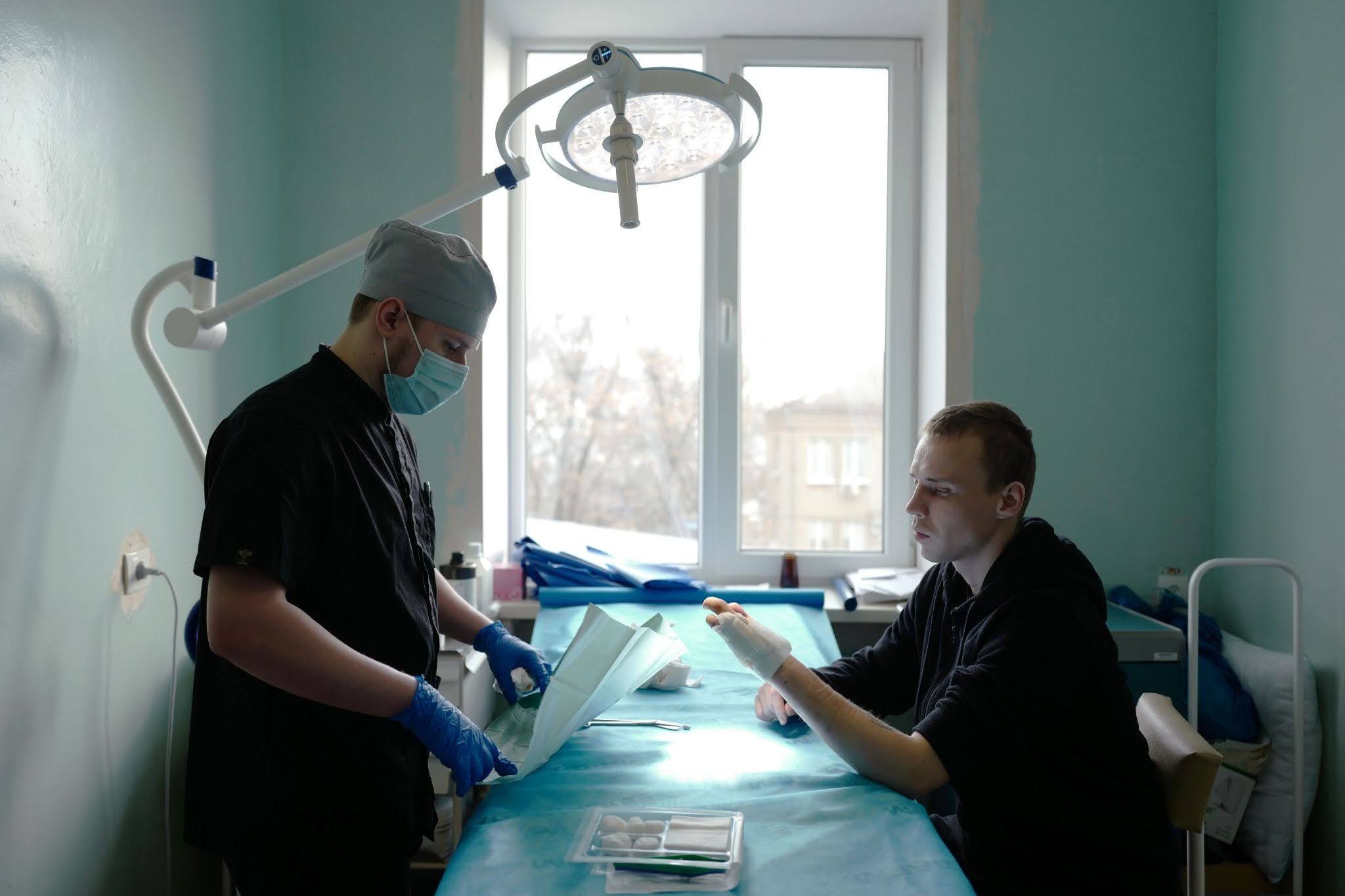
Dnipro, Ukraine, February 2024
During a medical appointment for a dressing change. “No one paid attention to my age. They told me: ‘Are you from Donbas? Forward!’”
Vova looks at his injured hand. After eight years in the army, he finds himself alone and adrift in Dnipro. He grew up in the trenches—a wartime life that remains his only frame of reference. To keep it from worrying him, Vova never told his mother that he had joined the army—or that he was now disabled. “The less they know, the better they sleep. A mother doesn’t want to imagine her son at war.”
More broadly, among those I reconnected with in Ukraine, two profiles emerge: those who joined the Ukrainian army, like Vova, and those who fear mobilization, living hidden away at home and spending their days on Telegram, watching recruiters’ movements. In both cases, it was a harsh, very harsh reality. I also contacted some people in the occupied territories, notably at Chystia. For them, communication was particularly difficult due to digital blocks: even Telegram was cut. In our early meetings, things were less compartmentalized. Now, everyone is extremely cautious about the information they share with me. Some people have literally hung up on me because I touched on sensitive topics: I could themselves become a danger to them.
Nonetheless, some still dare today to speak up about how life has become complicated, how much they miss the freedom they enjoyed in Ukraine, starting with freedom of expression, since they live in this climate of fear.
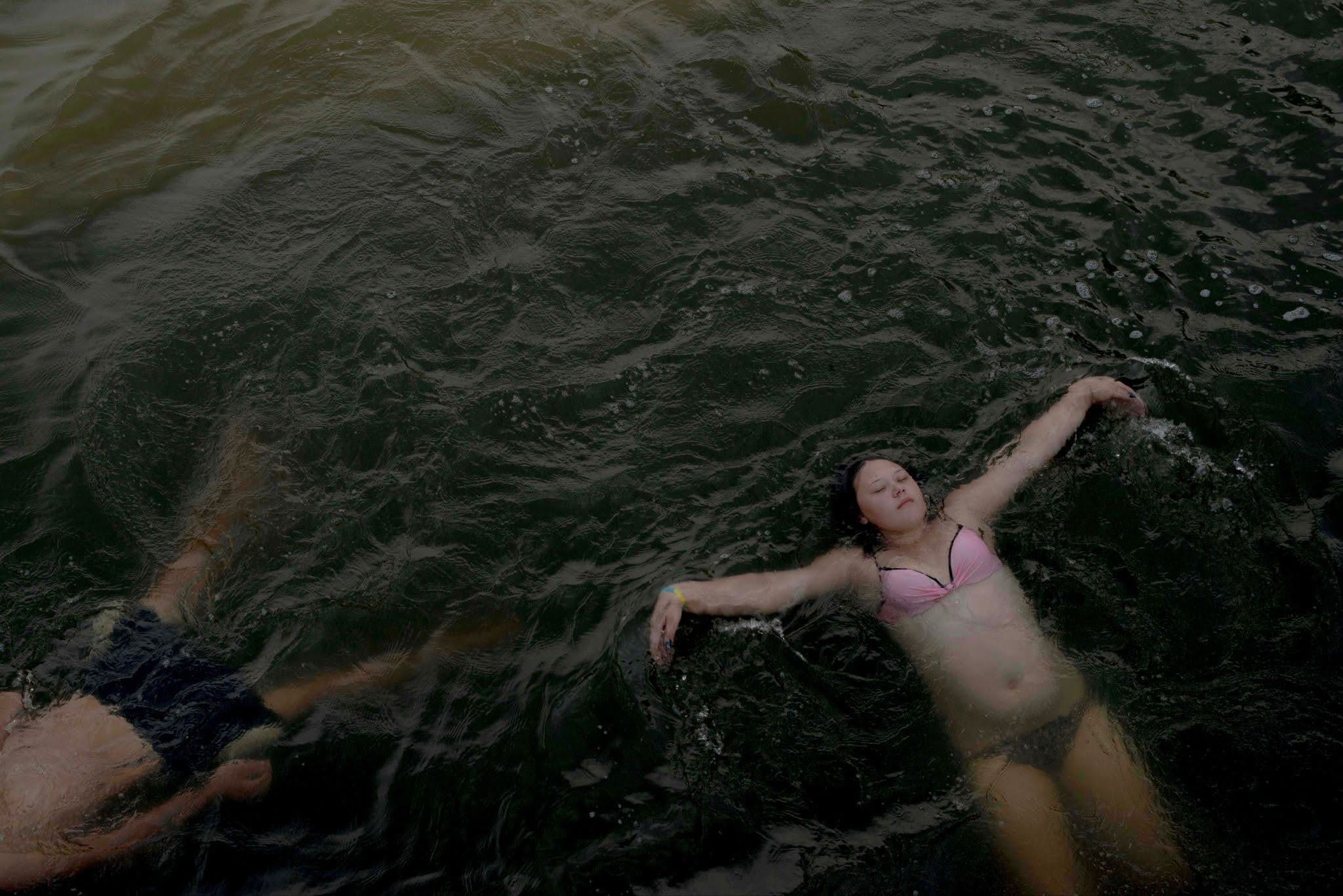
Chystia, Luhansk region, Ukraine, July 2016
Tattoo of the Ukrainian coat of arms on the neck, bracelet in Ukrainian flag colors, Valya swims with friends in a pond. The young woman wanted to stay in her town, but she was murdered by the Russian army in January 2023. Her mother, Tetyana, who still lives in Chystia, explains: “When you live very modestly, you have to maintain good relations with those who rule you. I had good relations with the Russians, then good relations with the Ukrainian army that retook Chystia, and finally good relations with the Russians who returned in 2022.”
A friend of Valya’s says: “There is no freedom of expression there anymore; it seems to me that this is one of the reasons Valya was killed, she did not hold her tongue. She could say things frankly, and she probably said things she shouldn’t have.”
I also found a few people who now live in Russia—for example, a young woman whose boyfriend, originally from Donetsk, found work there. She decided to follow him, but she herself does not work; she spends her time at home and endures the environment poorly. The common thread is that they all look back with nostalgia on the time when I photographed them. A time that, in hindsight and given everything that has happened since, now seems even happier to them—even though they lived twenty kilometers from the front line at the time.
So these trajectories are more culturally and even militarily intertwined than one might think when simply looking at a front line separating two blocks of color?
The aim of this project was precisely to show the complexity of these trajectories, which can sometimes appear almost unreal.
There is an expression I did not understand at the start of my research: because I do not speak Russian, I relied on automatic translations on my phone, and each time an expression kept returning: “to change shoes,” which means to change one’s opinion or behavior radically. It sounds like the French phrase “to change sides.” I quickly understood that many had to “change shoes” to adapt, to survive.
I think of an incredibly pro-Ukrainian teen, Evguéni, who spent his time with the soldiers and wore a small sign in Ukraine’s colors. A very proud person, who also enjoyed a certain aura, surrounded by other youths who were always nearby. Yet I learned during my research that he had joined the Russian army. I could hardly believe that someone so patriotic could have joined the Russian ranks. Then I spoke to his mother on the phone. She did not live in Chystia but in Georgia; she was convinced that her son had been forcibly drafted into the Russian army, that he would never have joined it deliberately. Yet, as I continued my investigations, I found his TikTok account and discovered videos praising Russia, and “brothers and sisters in arms.” In short, a completely pro-Russian account. I eventually understood that this mother had to construct her own story because she could not face the brutal reality. When I contacted the soldier’s girlfriend in Chystia, she outright told me that they had always been Russians, that Evguéni was Russian, and that nothing about this should have surprised me. It is these kinds of non-linear trajectories, which tell the war in unexpected ways, that I intended to tell.
Conversely, some cultural ties have hardened due to the war. It is well known that the language question has taken on a particular significance since Russian propaganda claimed to be “liberating” Russian-speaking people whom the Kiev regime would have deprived of their language. In this regard, I spent a long time talking with a young man whom I managed to locate. He told me the following: “I always spoke Russian in Chystia, and it was never a problem. I had everything: a job, a girlfriend, my family. I loved this town more than anything; I spoke Russian, and that wasn’t a question. One day, the Russians arrived, and they took everything from me. They entered my house and took everything. Today, I can no longer speak Russian. It has become impossible for me to utter a word in that language.” Indeed, many of the youths I met have since reappropriated the Ukrainian language, even belatedly. Some prefer speaking a poorly spoken Ukrainian to speaking Russian, even though their command remains imperfect and often embarrassing or shameful for them.
Thus I wanted to show the complexity of these biographies and the ways in which people are at war. At the outbreak of the invasion, my return to the field was driven by a sense of alarm: this war seemed simply unimaginable to me. Later, the project became more defined. Beyond maps, numbers, political and military decisions, I wanted to tell these individual journeys, these memories and dashed hopes, to reveal the state of the Donbas, the lived experience and feelings of these youths, in all their complexity. I hoped to present a kind of collective portrait—the portrait of a sacrificed generation.
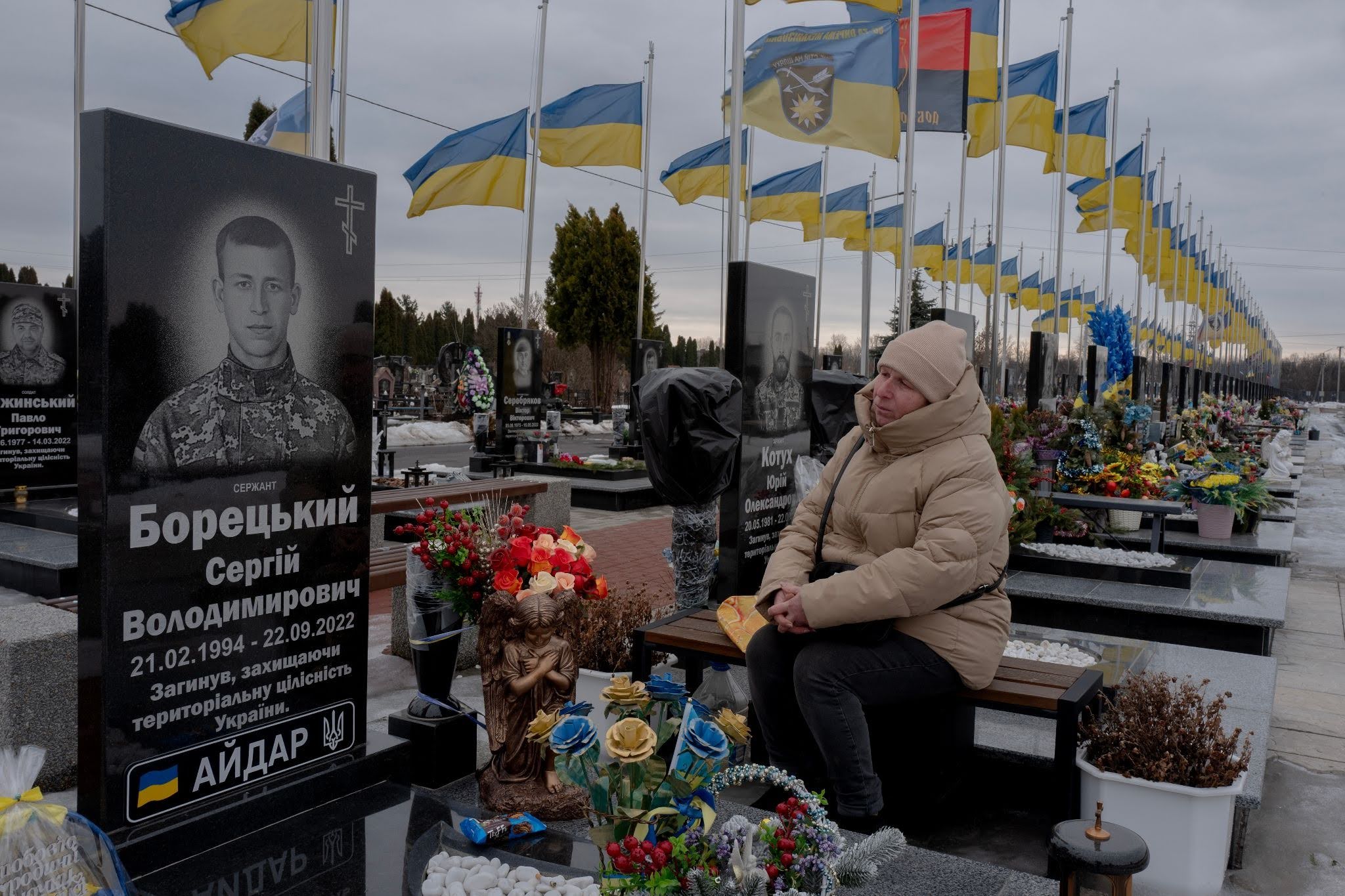
Bila Tserkva, Kiev region, Ukraine, February 2026
Natalia at the tomb of her son Serhiy, killed on a mission near Bakhmout in September 2022. She comes here two to three times a week, leaves a few cakes on the grave, and lights a cigarette for him. “It’s so quiet here—this is the moment I come, I sit down and cry a little.” Serhiy joined the Ukrainian army in 2014 following the Maidan revolution, which he took part in. At the time of the large-scale invasion, he joined a territorial defense brigade and spent several months in his hometown of Bila Tserkva. He was then sent to the East, near Bakhmout, on September 14, 2022. Serhiy was killed eight days later in an artillery strike that also took the lives of the seven soldiers with him.