
Discover The Grand Continent. Ideas and analyses you won’t find anywhere else. But you will soon see them everywhere. In your inbox from 8 euros per month
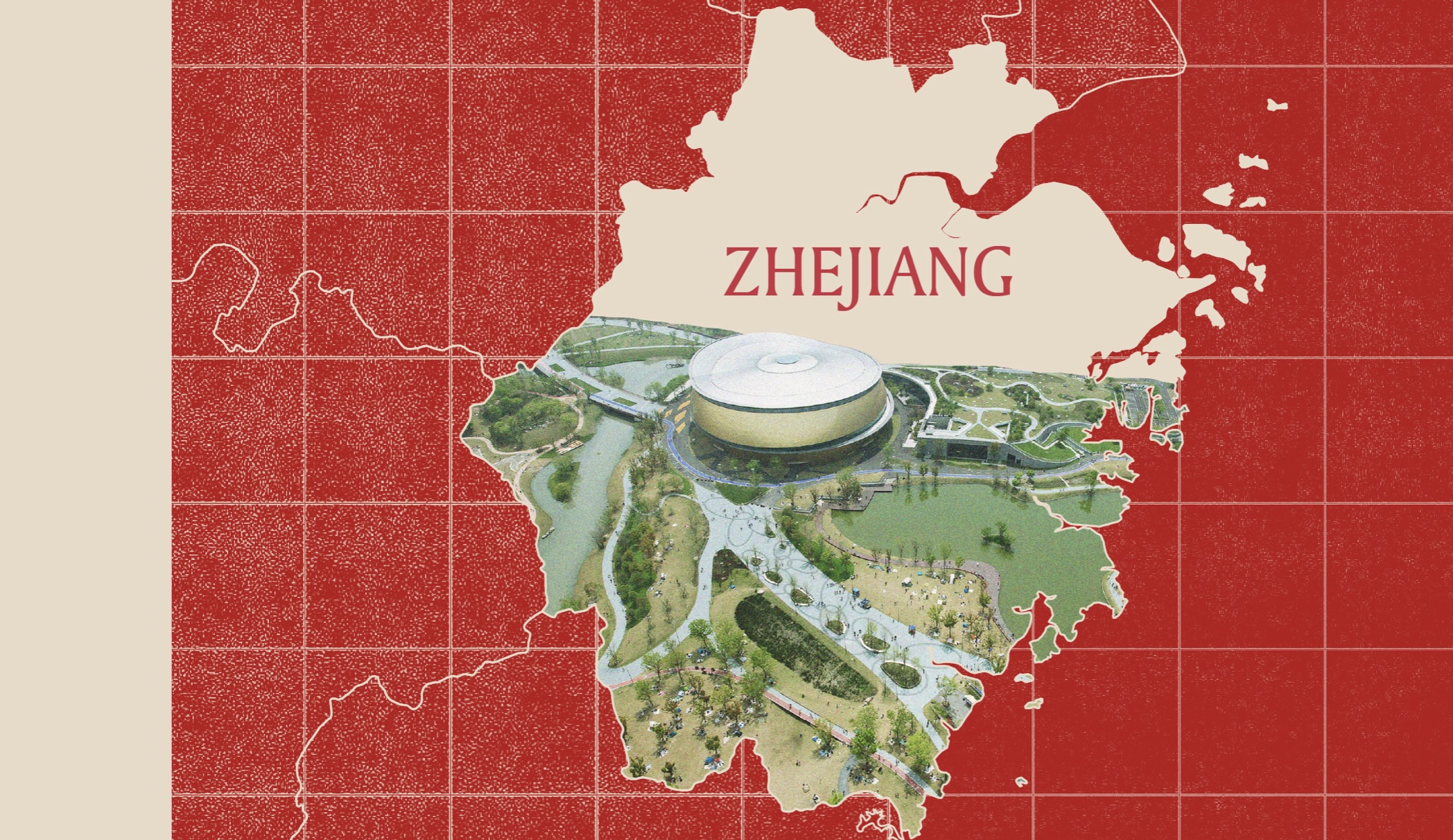
Today, Zhejiang is described as the “pioneer of modernization with Chinese characteristics” (Zhongguoshi xiandaihua de xianxingzhe). This prestigious (and unique) title was conferred by Xi Jinping himself, in September 2023, during a visit to the province. Three months later, provincial authorities began to officially use this designation. Since then, Zhejiang has been presented as a modernization model that other provinces should, if not imitate, at least study to draw inspiration from. This province in eastern China has thus become a living laboratory for future national policies across such diverse domains as employment evolution driven by technological and industrial revolutions, “common prosperity” (gongtong fuyu) and the reduction of socio-economic inequalities, the management of demographic aging, environmental protection and the respect for nature, as well as political stability. In other words, Zhejiang, elevated to model province status, is part of a comprehensive modernization strategy that originated there as an experimental ground and is now gradually being extended to the entire country. Xi’s personal role in this strategy cannot be underestimated and serves to underline, if there were any need, the concentration of power in the hands of the Chinese leader.
Zhejiang is one of China’s most developed provinces: its GDP (about 1.32 trillion dollars in 2025) ranks fourth in the country, after Guangdong, Jiangsu and Shandong; its GDP per capita (nearly 20,000 dollars) is the fifth highest, after Beijing, Shanghai, Jiangsu and Fujian. It is neither a vast province (105,500 square kilometres, 25th among Chinese provinces) nor very densely populated (67 million residents, 7th). But historically, since at least the Song dynasty (10th–13th centuries), the northern part of Zhejiang—Hangzhou briefly the capital of the Southern Song from 1138 to 1276—and the southern part of Jiangsu were more prosperous and culturally refined than the rest of the Empire. Following the late Qing era (Manchu era), Zhejiang’s proximity to Shanghai, the country’s main economic hub, greatly fueled its development. After the launch of reform and opening-up policies by the Communist Party at the end of the 1970s, Deng Xiaoping often said: “If you want to see capitalism, go to Wenzhou!” Indeed, since then, this southern Zhejiang city has become a model of private entrepreneurship, later imitated by many other regions in the country. And Hangzhou, renowned for the beauty of its “West Lake” (Xihu), is today a dynamic provincial capital housing numerous high-tech companies such as Alibaba or DeepSeek, which in January 2025 launched an open-access reasoning language model that has attracted worldwide attention.
The so-called “Two-Eight” Strategy of Xi Jinping
The elevation of Zhejiang in 2023 to the rank of “pioneer of modernization with Chinese characteristics” is no accident. Indeed, Xi Jinping served as Party Secretary of Zhejiang for nearly five years, from 2002 to 2007. He knows the province well, having run it together with Li Qiang, who from 2004 served as his chief of staff (secretary of the provincial Party committee) and is today the Premier. In Zhejiang, Xi introduced the “Two-Eight Strategy” (Ba Ba Zhanlüe) in July 2003. This strategy comprises eight measures designed to spur economic development by leveraging eight existing strengths: a mixed-ownership economy, euphemistically referring to private entrepreneurship while keeping public ownership as the main sector; deeper integration of Zhejiang into the Yangtze River Delta region led by Shanghai and a greater openness to the world; acceleration of building an advanced manufacturing industrial base; promoting urban–rural integration to reduce disparities; strengthening environmental protection and creating a “Green Zhejiang”; leveraging the provincial coastline to develop a blue economy; the construction of key infrastructures and the rule of law; and transforming Zhejiang into a cultural and scientific province and an educational hub.
It is worth mentioning these eight measures because many of them were adopted at the national level and have shaped modernization directions since 2021, the year marking the centennial of the Party. Moreover, Xi Jinping’s “economic thought” draws heavily on this experience.
On 1 July 2021, Xi Jinping declared that China had achieved its first centenary goal, namely “moderate prosperity” (xiaokang), and that it was time to move on to the “second centenary goal” of modernization, i.e., to elevate the country to the status of a “great socialist modern country” by 2049, the centennial year of the People’s Republic. Closely tied to the “great rejuvenation of the Chinese Nation,” this second stage of modernization promotes a holistic development across economic, political, cultural, social and ecological dimensions—referred to as the “five-sphere integrated plan”—which emphasizes “common prosperity,” a people-centered growth, and sustainable and peaceful progress, all under the Party’s leadership, of course.
One year later, in October 2022, the 20th Party Congress reaffirmed the five-sphere integrated plan and presented the main characteristics of China’s “socialist modernization”: a large population, common prosperity, material, cultural and ethical progress, harmony between humanity and nature, and peaceful development, which directly references the PRC’s foreign policy. The next stage of modernization also includes pursuing high-quality development, establishing a “comprehensive people’s democracy” ( a new form of “consultative Leninism,” according to political analyst Steve Tsang ), and enriching the people’s cultural life.
It is within this context that in September 2023 Xi Jinping elevated Zhejiang to the rank of “pioneer of modernization with Chinese characteristics.” This means that officially the province must focus on exploring new paths for high-quality development, building a modern urban planning framework, and revitalizing rural areas. It must do so by deepening reforms, prioritizing innovation-led development, and broadly constructing a pilot zone designed to promote “common prosperity.”
Experiments Carried Out in ZhejiangThus, various experiments conducted in Zhejiang, including several begun while Xi Jinping was at its helm, have retrospectively been presented as models for the rest of the country, some even before 2023.
The first of these experiments concerns high technology. Thanks to Alibaba, Hangzhou has become for at least two decades the “capital of e-commerce” (dianshang zhi du) in China. In 2003, Xi Jinping also launched a project called the “Digital Zhejiang” (shuzi Zhejiang), one of the central components of the “Two-Eight Strategy,” to accelerate the province’s modernization. This strategy directly contributed to the emergence of numerous high-tech companies, among which the so-called “Hangzhou Dragon Six” (Hangzhou liu xiaolong), an informal cluster of tech startups active especially in the field of AI, including DeepSeek, Game Science, Unitree Robotics, DEEP Robotics, BrainCo and Manycore Tech.
For reference, Game Science (Youxi kexue) is the developer of the hit video game “Black Myth: Wukong”; Unitree Robotics (Yushu keji) is famous for its robotic dogs and humanoid robots; DEEP Robotics (Yunshenchu keji) also builds intelligent quadruped robots; BrainCo (Qiangnao keji) is a company specializing in non-invasive brain–computer interfaces; and Manycore Tech (Qunhe keji) develops 3D design software.
Later, in 2010, Hangzhou’s government launched the “Eaglet Plan” (chuying jihua), aimed at supporting young science and technology enterprises. The project involved collaboration with incubators to identify promising tech companies and offer public funding as well as other forms of assistance, including to startups founded by young graduates or students returning from abroad. Unitree notably benefited from initial support, as well as public subsidies from Hangzhou’s Binjiang District. In 2019, Zhejiang became the first province to implement the so‑called “chain-heads” system (lianzhangzhi), a governance model originating in Changsha, Hunan, which strengthens the Party–State control over supply chains through a structure that coordinates state officials and the “chain-heads” (lianzhang) with the leading firms in each sector, the “masters of the chain” (lianzhu). That same year, Hangzhou began financing and supporting fundamental AI research. In other words, Zhejiang’s experience places the Party–State at the very center of its modernization strategy, which precisely matches Xi’s intention: while encouraging private entrepreneurship, it remains essential to keep the Communist Party atop China’s political and economic system.
The second Zhejiang experiment concerns talents, or what Zhejiang authorities called the formation of the “three teams” (sanzhi duiwu): “a high-level cadre team, a team of innovative talents and high-level entrepreneurs, and a highly skilled workforce.” A key element of the “Two-Eight Strategy,” talent development has been strongly encouraged more recently by Yi Lianhong, Zhejiang Party Secretary from 2022 to 2024, and other provincial leaders, then by Wang Hao, who served as governor and became his successor in October 2024, before serving as a national model.
The Zhejiang experiments also include an ambitious rural modernization project initiated by Xi in 2003, the “Demonstration Project of a Thousand Villages and Sanitation of Ten Thousand Villages.” On 1 January 2024, the CPC Central Committee and the State Council adopted an “Notice on Promoting the Effective Revitalization of Rural Areas Through Learning from and Applying the Experience” of this project. This decision aims notably to ensure food security, prevent relapse into poverty, and improve the level of rural development.
On the question of common prosperity, as early as May 20, 2021, i.e., before Zhejiang was promoted to pioneer status, the Party leadership and the State Council approved an “Notice on Supporting Zhejiang’s High-Quality Development and Building a Demonstration Zone for Common Prosperity”. Drawing from Zhejiang’s Two-Eight Strategy and taking Zhejiang as a model, this policy seeks to reduce regional disparities between rural and urban areas, and between different income groups, by allocating more resources to rural areas, local communities, relatively underdeveloped regions, and vulnerable populations. The strategy also aims to improve people’s well-being by facilitating access to preschool education and schooling, as well as employment, healthcare, eldercare, housing, and support for those in need. The central government’s approach is to improve the distribution of income, coordinate urban–rural development, promote a “forward-looking socialist culture,” protect the environment, and modernize social governance.
Today, Zhejiang is also presented as a model of cultural development. In late July 2025, the provincial government celebrated the 20th anniversary of Xi Jinping’s 2005 decision to designate Zhejiang as a “great cultural province.” The celebrations were echoed nationwide by a Xinhua News Agency article titled: “The Magnificent Practice of Building a Culture-Strong Nation: Chronicle of Twenty Years of Continuous Cultural Development in Zhejiang within the ‘Two-Eight Strategy’”.
Zhejiang also serves as a model for nationwide beautification efforts. In August 2005, Xi Jinping, then Party Secretary of the province, visited Yu Village in Anji District, a picturesque village and popular tourist destination. There he declared: “Clear waters and green mountains are themselves gold and silver mountains.” This gave birth to the “Two Mountains Theory” (liangshan linian), a formula that has since been replicated in many other regions of China, such as Liangjiahe village in Shaanxi, near Shijiazhuang in Hebei, or Xingli, a bay in Xiamen, Fujian. In August 2025, on the occasion of the 20th anniversary of Xi Jinping’s visit to Yu Village, a long Xinhua article concluding: “Born in China and open to the world, the theory of the ‘two mountains’ guides the gradual transformation of the beautiful Chinese dream of harmonious coexistence between humanity and nature and will undoubtedly contribute to the construction of a community with a shared future for humanity and to protecting our planet.”. Today, the reference to the “community with a shared future for humanity” has become a ubiquitous phrase in any topic addressed, underscoring both the concentration of power in the hands of the Party secretary and the emergence of a new personality cult in Xi Jinping’s China.
Finally, Xi’s choice of Hangzhou to host the G20 summit in September 2016 was not incidental. The Chinese government used the occasion to project a message of openness and integration with the broader international community, clearly aiming to present China as a country that supports economic globalization, sustainable development, and strengthened political coordination among G20 members. Zhejiang is now portrayed as a model of China’s strategy of “internationalization,” a province that has strongly encouraged its firms to expand abroad and to go international.
Learning from Zhejiang
Zhejiang has become not only a laboratory for local experimentation but also a national center for training in “Chinese-style modernization.” Xi Jinping and other former Zhejiang officials have become mentors for other provinces, a factor that has evidently aided their own ascent.
For instance, two of the four municipalities directly under central authority are now led by officials who previously worked in Zhejiang: Chongqing, whose current Party secretary, Yuan Jiajun, served as Zhejiang governor (2017–2020) and then as Party secretary (2020–2022); Tianjin, whose Party secretary, Chen Min’er, spent more than thirty years in Zhejiang and remains close to Xi Jinping. Shanghai’s mayor, from 2020 to September 2026, was Gong Zheng, who was Zhejiang’s vice-governor from 2008 to 2013 and Hangzhou’s Party secretary from 2013 to 2015.
Visits to Zhejiang for study intensified in 2025. In the first eight months of the year, seven government delegations, including those from the Hong Kong and Macao Special Administrative Regions, carried out study tours to Zhejiang to draw inspiration from its implementation of “Chinese-style modernization,” and in particular from Hangzhou’s “six small dragons.”
How Much Zhejiang Can Xi’s China Build?
The big question is whether other Chinese provinces can replicate Zhejiang’s experience, which has become a genuine success. Obviously, many are keen to develop their own high-tech industries, from artificial intelligence to robotics, from e-commerce to electric vehicles, to train or attract their own talent and to improve their social protection systems. Since May 2026, the gradual integration of some 300 million migrants who live in cities but still do not enjoy the same social benefits as registered urban residents (hukou) has begun. However, it is unlikely that all provinces can fully imitate Zhejiang. On the one hand, regional disparities in development and financial resources remain a major obstacle, especially in a real estate crisis context. In Zhejiang, the urban–rural income gap is 1.81, well below the national average of 2.31. Beijing is aware of this reality and asks other provinces to draw inspiration from Zhejiang’s “common prosperity demonstration zones” while adapting them with flexibility.
On the other hand, is it strategic for every province to replicate Zhejiang’s number of high-tech firms? Since 2025, Xi Jinping has repeatedly warned local governments not only against duplicating industries, especially in electric vehicles and AI, but also against disorderly competition and unrestrained expansion. A major issue facing China’s economy today is what is called “involution” (neijuan): fierce competition between provinces and among firms across many future industries, from EVs to solar panels to semiconductors.
Common prosperity and a better redistribution of wealth remain a key objective for Xi’s Communist Party. Yet, given the financial strains currently faced by many localities—particularly due to the real estate crisis—it is unlikely that all provinces will be able to offer the same level of affordable healthcare, free education, and broadly extended social protection. In other words, the slowdown in the economy and stagnating domestic demand could hinder other provinces’ ability to develop a social protection system as comprehensive as Zhejiang’s, or at least to sustain it at that level.
Moreover, while promoting common prosperity, redistribution, and reducing social inequalities, Xi opposes establishing a full-fledged welfare state, arguing that welfare-state policies encourage “sloth” (福利主义养懒汉). Another likely motivation for this stance is that despite its extraordinary economic growth, China does not have the means to finance such a system.
Finally, what Xi terms “comprehensive people’s democracy” aims primarily to strengthen the Party’s legitimacy within society. In Zhejiang, as in other developed regions of the country, including Shanghai, mechanisms for social consultation have gradually emerged at the grassroots level, contributing to social stability. But it will take time before such mechanisms are implemented and activated in the rest of the country. In any case, the Communist Party of China will remain the sole political decision-maker.
All in all, if Zhejiang’s experience provides a useful precedent for the rest of China, it should be seen more as a set of successes and sources of inspiration than as a universal model applicable nationwide. That does not prevent Xi Jinping from making its promotion a top priority.