
Do you know three Chinese provinces? To understand Xi’s China, you must step outside Beijing and Shanghai. Our new series goes to meet the spaces where another future figure is being built. To receive this series, which has already taken us to Sichuan, Zhejiang, Guangxi, Hunan, and also to Shanghai and Yunnan, subscribe to The Grand Continent. In your inbox from 8 euros a month
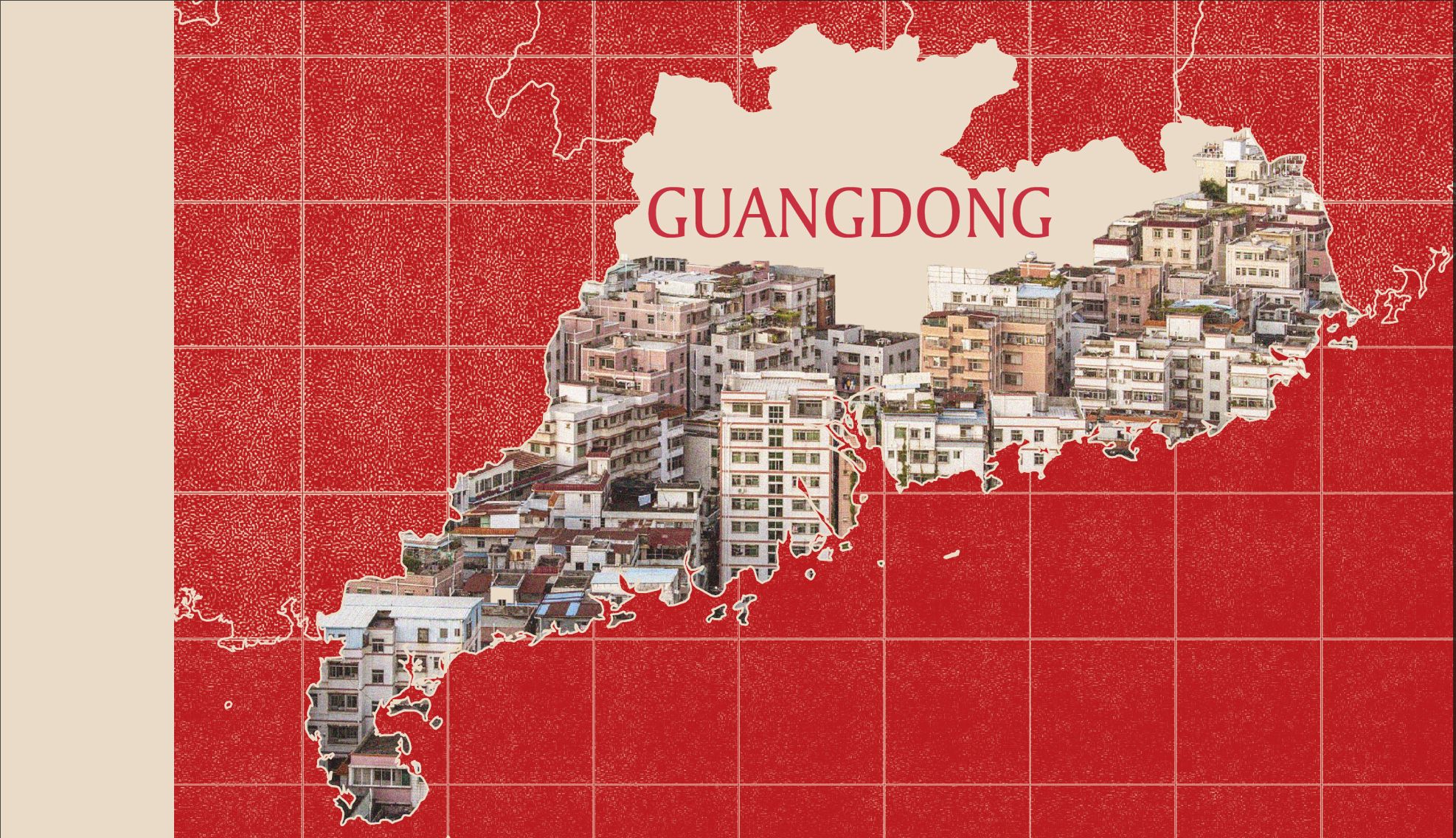
By the late 1970s, as China was emerging from nearly three decades of geopolitical isolation, three “special economic zones” in Guangdong — Shantou, Shenzhen, and Zhuhai — were designated as laboratories for reintegrating into the global economy. These sites were chosen not only because they were distant from the central authorities and thus less likely to destabilize them, but also due to their proximity to Hong Kong, then a British colony and the main gateway to international markets. Since then, Guangdong has remained at the forefront of changes in China’s political economy. This position rests first on the deployment of large-scale production capacities within the expanded Pearl River Delta metropolitan area, which fueled the rise of the “world’s factory.” More recently, it also relies on the establishment of R&D centers aimed at producing world-class technologies.
In parallel, there was growing integration of Hong Kong and Macao, which became Special Administrative Regions of China. They function as autonomous economies with their own currencies and legal systems, within what is officially designated as the “Greater Bay Area.”
From policymakers to researchers, and across media in advanced economies, there is growing scrutiny of the “China Shock 2.0,” a new wave of highly technological, heavily subsidized Chinese products that threaten the advanced industries of those countries. To understand this “shock,” one must look to Guangdong where it originates.
Beyond a Simple Linear “Progress”
At first glance, Guangdong’s rise to the status of a global actor can be read as a linear, rapid process of industrial modernization over the past two decades. The story seems straightforward: workers engaged in low-value-added or polluting activities were gradually replaced by skilled professionals involved in high-tech manufacturing and technological research. In practice, this seemingly orderly progression is riddled with tensions that highlight structural problems in China’s political economy. The industrialization of Guangdong embodies two intertwined challenges, affecting both capital (investors) and labor (workers). These pressures intensified after the Global Financial Crisis of 2008.
As geographer David Harvey has shown, capital always requires a “spatial fix” to ensure sustainable accumulation. This “fix” is expressed literally by investments in physical capital. In a figurative sense, it provides a response to surplus capital in search of new profitable outlets—in other words, it allows capital to “solve” a problem. These two dimensions are temporary, because crises inevitably arise and push capitalists to seek new “solutions.”
In Guangdong, the 2008 financial crisis reduced demand for the province’s export manufacturers. They were forced to close plants or seek new “solutions” elsewhere. Yet, this pursuit clashed with that of workers, who were trying to establish what Andrew Herod calls the “spatial fix of labor” – that is, the role of labor in shaping the spatial configurations of an economy.
Since 1978, Guangdong—or more precisely, the hundreds of industrial “specialized towns” (zhuanyezhen 专业镇) that make up the PRD—became the main destination for internal migrant workers in China. These waves of interprovincial migration gave birth to a “geography of labor.” Migrants actively sought to influence their living conditions through wage negotiations, protests, and various forms of collective action, most often informal.
When the crisis hit, Guangdong still housed the largest migrant population in the country. However, the sudden contraction in external demand made workers’ desire to maintain their spatial anchor by keeping their jobs incompatible with capital’s efforts. The capital sought either to relocate to reduce wage costs or to push workers out. This incompatibility triggered a tension that the Chinese state quickly recognized and sought to manage through an unprecedented mix of new strategies and a demographic control institution dating from the Mao era: the “urban–rural dual structure” (chengxiang eryuan jiegou 城乡二元结构).
Soon after the crisis, provincial directives encouraged the “double transfer” (shuangzhuanyi 双转移). This entailed, on the one hand, moving low-value-added industries and the more industrialized PRD labor force to peripheral regions, and on the other hand, locating new high-value-added industries expected to become the engines of tomorrow’s growth. Initiated by Wang Yang, then the Party secretary for Guangdong, the policy was summarized by the maxim “Empty the cage, change the birds” (tenglong huanniao 腾笼换鸟) — the “cage” representing the economy and the “birds” its actors. This state-led approach, aimed at reshaping both the spatial anchors of capital and those of labor, marked the start of a sustained effort of economic transformation and upgrading (zhuanxing shengji 转型升级), eventually becoming a national slogan in 2017: high-quality development (gaozhiliang fazhan 高质量发展).
Cette stratégie repose sur une gouvernance politico-économique qui mêle constamment des directives descendantes à des expérimentations locales . Les spécialistes de l’économie politique ont qualifié cette approche d’« entrepreneuriat d’État » : une forme spécifique d’intervention économique dans laquelle l’État agit dans et par les marchés pour atteindre ses objectifs politiques . Ainsi, depuis la crise financière de 2008, l’une des grandes pri orités des dirigeants du Guangdong a été la modernisation industrielle. Près de deux décennies plus tard, il convient d’évaluer si les solutions spatiales mises en œuvre par l’État – notamment la délocalisation des capitaux – ont permis au Guangdong non seulement de surmonter la crise, mais aussi de retrouver son dynamisme.
Nevertheless, as capital accumulation is inherently contradictory and crisis-generating, the state’s efforts to alter spatial anchors met with several major obstacles. Behind Guangdong’s Fortune China 500 successes, asset depreciation and deindustrialization have undermined its foundations. The most notable depreciation episode occurred in 2021, when Shenzhen became the epicenter of a fierce national real estate shock: explosive demonstrations erupted at the headquarters of Evergrande, then one of the country’s two largest developers. They followed the discovery of more than $300 billion in debts that the group could not honor. The revelation earned the company the unenviable title of “world’s most indebted developer.” Thus, Shenzhen was not only the place where investors sought to recover their funds through legal action, but also appeared as the symbol of an unsustainable bubble, built on what in China is called “land finance” (tudi caizheng 土地财政). This crisis also sparked disagreements within the central government about whether to adopt a hardline stance to manage the real estate market.
The response marked a break with how the previous major crisis had been managed by the central government. While a bailout plan had been deployed in 2015 to curb the stock market crash, this time Beijing did not rush to rescue Evergrande or other developers in trouble, such as Country Garden. However, Vanke—the developer whose primary shareholder is the public Shenzhen Metro—benefited from more than 30 billion yuan in shareholder loans in 2025.
Adopting a remarkably firm stance toward these key players who had fueled the country’s growth for more than two decades, Ni Hong, China’s Minister of Housing and Urban-Rural Development, stated in March 2024 that “severely insolvent real estate companies and those that have lost their ability to operate must go bankrupt.” Evergrande was the first to pay the price: a Hong Kong court ordered its liquidation in January 2024; it was subsequently delisted from the stock exchange in August 2025. This liquidation was decisive: it signaled Beijing’s resolve to deepen the economic restructuring. Allowing developers to go bankrupt meant accepting what is now seen as a durable decline of the national real estate market. At its peak, this market, together with related activities, accounted for about 30% of China’s GDP.
The historical-geographical parallel is striking: just as Shenzhen marked a turning point in economic governance with the creation of its special economic zone in 1980, a new turning point occurred in the same city with Evergrande’s collapse. Indeed, as this fall shows, capital accumulation through real estate speculation no longer constitutes a growth pillar, even though the new pillar—based on “high-quality” industries—has not yet fully taken shape.
Alongside the decline in real estate prices, a durable deindustrialization is hitting Guangdong’s major industrial hubs. Less publicized but no less important, this movement centers on the city of Dongguan. Spanning an area similar to Shenzhen’s, it concentrates such production capacity that it is often described as “the world’s factory within the world’s factory.” Its case is widely regarded as symptomatic of the structural challenges facing China’s economy. Further worsened by the Sino-American trade war and by the Covid-19 pandemic, the slowdown that followed the 2008 crisis led to factory closures. Consequently, it affected related sectors, such as hospitality, catering, and transport. This is the hidden face of Guangdong’s apparently linear industrialization: efforts to alter the capital’s spatial anchors have frequently inflicted devastating effects on local communities, as Doreen Massey showed in her landmark work Spatial Divisions of Labour (1984).
In Dongguan, these effects are more precisely tied to a persistent structural challenge: the difficulty for workers to establish their own spatial anchors within the urban–rural dual structure implemented in the 1950s. These workers primarily come from rural areas where they are registered as “peasants,” hence the common term “migrant workers” (nongmin gong 农民工). Rurality is not inherently problematic; the trouble arises when “rural” is institutionalized as a social category. Citizens registered as “peasants” are granted rights different from those of “urbanites.” These rights—particularly those related to housing and education—are tied to their household registration (hukou 户口); they cannot fully exercise them if they migrate elsewhere in the country.
In fact, rural migrant workers in Guangdong—and more broadly across China—have struggled to establish “spatial anchors” of labor in their host regions, because they have fewer rights. They are rightly described as the “floating population” (liudong renkou 流动人口). They are particularly vulnerable in a crisis: local authorities have no obligation to provide social benefits to them, so they are usually forced to return to their home region or seek work elsewhere. This is precisely what happened in Dongguan, where migrants accounted for more than two-thirds of the roughly 11 million inhabitants. Many had to depart; while the remaining businesses on the ground have since embarked on a broad automation drive, further reducing their reliance on this workforce.
Dongguan fully illustrates what economist Scott Rozelle and researcher Natalie Hell call the “Invisible China.” The expression designates these rural migrant workers forced to seek work elsewhere—without, or with little, support for retraining—and whose fate remains today largely unknown. While localities like Dongguan multiplied initiatives to support high-value-added industries—and, by extension, attract more skilled workers—the rural migrants faced the prospect of long-term structural unemployment arising from a skills mismatch with what employers sought. It is also largely unknown what happened to these workers after the launch of the “Empty the Cage, Change the Birds” initiative: their departure may have rendered them invisible in their former host regions, but the challenge of structural unemployment has not disappeared.
According to Rozelle and Hell, neglecting the training of these migrants during industrialization could create lasting social problems and slow future growth. These developments nuance David Harvey’s observation that “capital never resolves its crisis tendencies; it merely moves them.” What is being moved here—or, more precisely in the Guangdong case, displaced—is a “tendency toward crisis” embodied by the structural unemployment of rural migrants. The main vectors of this displacement are not the capitalists themselves, but a state institution — namely the urban–rural dual structure. It is in this sense that, as capital seeks profitable spatial solutions, it encounters the workers’ own capacity to forge solutions. Their ability to achieve their socio-economic objectives is institutionally constrained.
A Return to State “Managerialism”?
Guangdong remains today one of the leading “engines” of China’s economy. Even more importantly, it remains the main laboratory for change. This owes, on the one hand, to state-driven industrial modernization and, on the other hand, to a persistent mode of labor regulation, in a context of geopolitical tensions with the United States — long the world’s first export market for Chinese manufacturers. This transformation is neither linear nor inevitable; it feeds on the tensions involved in modifying the spatial anchors of capital and labor.
A constant through this process is the active role of the state, both in launching new initiatives (industrial modernization, robotics, etc.) and in strengthening a mode of labor control inherited from the past, namely the urban–rural dual structure. Yet, state entrepreneurship rested on a real estate market that was still dynamic. With its slowdown, and the increasing instability of export opportunities under geopolitical pressures, Beijing’s decision-makers are finding it harder to realize their vision of “high-quality development.” The question remains whether they will seek to achieve this by returning to “managerialism” — local authorities simply applying downward directives rather than innovating. How Guangdong’s public actors respond to these directives could provide early indications of the answer.