
With England’s victories over Norway and Argentina’s over Switzerland, the semifinal lineup is now complete. The matches France–Spain and England–Argentina pit the four national teams that were the tournament’s “favorites” at the outset.
- It is rare for World Cup semifinals not to include at least one surprise team.
- Four years ago it was Morocco; in 2018, Croatia; in 2014, the Netherlands; and in 2010, Uruguay.
Forty-four teams have thus been eliminated, and for some of them it is time to analyze the defeat. Some, like Egypt, attribute their elimination to a conspiracy aimed at favoring Argentina; others, like Cape Verde or the Democratic Republic of Congo, were greeted with enthusiasm and festivities upon returning home.
And then, there is Brazil, five-time champion, where many supporters and commentators have begun to develop the most complex and in-depth theory to explain why the team was eliminated so quickly.
- Thus, a few days ago, a viral Times article explained that, for many Brazilians, the elimination of the team against Norway was due to the rise of evangelicalism at the expense of Catholicism.
- The topic is complex and delicate, but many people have weighed in to defend their arguments.
- A post dated July 7 and viewed nearly 8 million times on X asserts: “Brazil was better when its players were womanizers, drunks and out of shape. In other words, when they behaved like Catholics.”
- This post, published by a user with a blue checkmark and presenting as the “Centre for Hispanic-Catholic Civilization Studies and Pan-Iberian Geopolitics,” ends with a warning: “Evangelical Protestant sterilization has impoverished their football, ruined their samba and annihilated their style.”
Brazil hosts the world’s largest Catholic community, and yet, since 2002, the year of its last World Cup victory, the country has undergone a significant transformation: about 80% of the population identified as Catholic then, but that percentage has fallen to around 55% in the latest census.
- Meanwhile, while only 15% of the Brazilian population were evangelical or Protestant in 2002, that percentage now exceeds 25%.
- To make things more interesting, but also more complex, the rise of evangelicalism is closely tied to the country’s shift to the right.
- Most Brazilian evangelicals are adherents of the neo-charismatic or neo-Pentecostal movement, an ultraconservative Protestant current that uncompromisingly opposes abortion, LGBT+ rights and feminism.
- The confession centers on reading the Bible as indisputable and not to be interpreted.
- That is why Pentecostal churches do not recognize religious authority and even tolerate aggressive and verbally violent attitudes toward those they consider opponents.
The Christian fundamentalist currents have found easy common ground with Jair Bolsonaro’s right-wing populist program, Brazil’s president from 2019 to 2023. Their visions of society converge notably on gun legalization and on proximity to anti-scientific positions.
- Bolsonaro himself joined this trend by being baptized in 2016 by an evangelical pastor in the Jordan River, in Israel, at the start of his campaign.
- The support from the evangelical church, essential to his 2018 victory, remained strong in the 2022 elections, which Bolsonaro ultimately lost to Lula. Even his disastrous handling of the Covid crisis had not shaken this support: both Bolsonaro and the core of Brazil’s Pentecostal movement indeed shared a negationist view of the pandemic.
- Aware of the evangelical community’s electoral weight, Lula had to devote a lot of time during the 2022 campaign to debunk online misinformation that claimed he harbored radical hostility to religion.
- After meeting with some progressive leaders of the movement, Lula had even signed a document in which he pledged, if elected, to preserve freedom of worship, to support the central role of the family, and not to intervene politically in the practice of faith.
Protestantism has spread widely among Brazilian footballers, to such an extent that 20 of the 26 members of the national team participating in the World Cup identify as evangelicals.
- Among them is Neymar Jr., the most emblematic footballer of the Seleção in the last decade. Regarded as a playboy, he has become an ambassador of puritanism since his 2017 baptism, and his social networks have filled with biblical quotes.
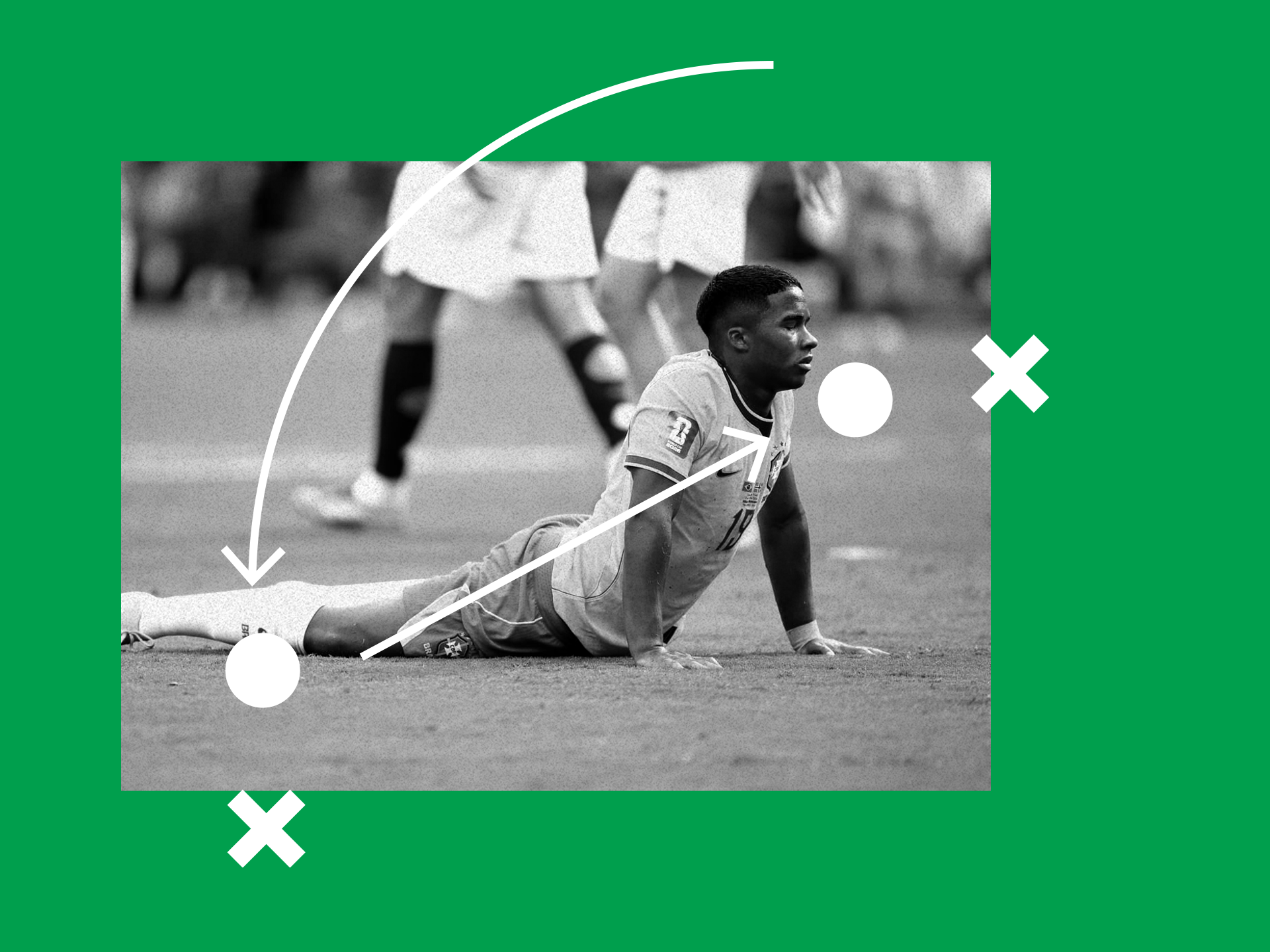
- Endrick, one of the youngest and most talented members of the squad, is also a practicing evangelical. In interviews, he often says things like: “The most important thing for me is to talk to God, to pray and to stay calm.”
There is thus a certain nostalgia for the Brazilian national team that once dominated the field, and whose players were far from exemplary Christians.
- According to The Times, Carlos Alberto Torres, captain of the 1970 World Cup-winning team, considered by many to be the greatest national team of all time, reportedly revealed in an old interview the “recipe for success” of that side: a balance between “football, samba and beautiful women.”
André Pagliarini, a Latin American historian at the University of Louisiana, goes further and notes that “the golden generations of Brazilian football were born from a culture that valued the collective and the idea that the team takes precedence over the individual.”
- This spirit would be eroding, notably under the influence of evangelicalism that emphasizes individual interest.
- Like other confessions rooted in Protestantism, evangelicalism places among its core principles the personal relationship between the believer and God, the individual responsibility of faith, and the reading of the Bible without any intermediaries.
- The correlation between Protestantism and individualism is not new to this World Cup. Max Weber had already identified, in the early 20th century, in certain Protestant ideas the trigger for the development of a “capitalist spirit.”
According to Brian Mier, an American journalist who lived 28 years in Brazil, the spread of puritanical evangelicalism in the country has also eroded the samba tradition. A rite, long before it was a rhythm, born from the syncretism between the Catholicism of the colonists and African religions.
- The lyrics of samba were licentious, raw, and full of double meanings. Everyone danced it in the favelas, and footballers translated this facet of Brazilian identity onto the pitch.
- In the 1990s, if a player was skilled at dribbling, it was said he had “samba no pé”: samba in the feet.
- For decades, people said that the best Brazilian footballers had the “ginga”: they did not run, but swayed to the rhythm of their choosing. Ginga is the basic movement of capoeira, dictated by the rhythm of the berimbau, a musical instrument brought to Brazil by African slaves.
- Mier notes that the spread of puritanism promoted by Evangelical churches changed the game: at the start of the new millennium, samba began to be replaced by a romantic music genre that eliminates any reference to Afro-Brazilian deities. A process of erasure also began regarding jongo, capoeira, and other traditions tied to syncretic religious systems.
For some, the evangelical influence on the Seleção’s crisis is even simpler. It is not a matter of sociology, but of pure nationalism: the problem is that this religion was imported from the United States, a country where the football tradition is not deeply rooted. “If you pray like a gringo, you play like a gringo,” proclaims a famous meme in recent days.