
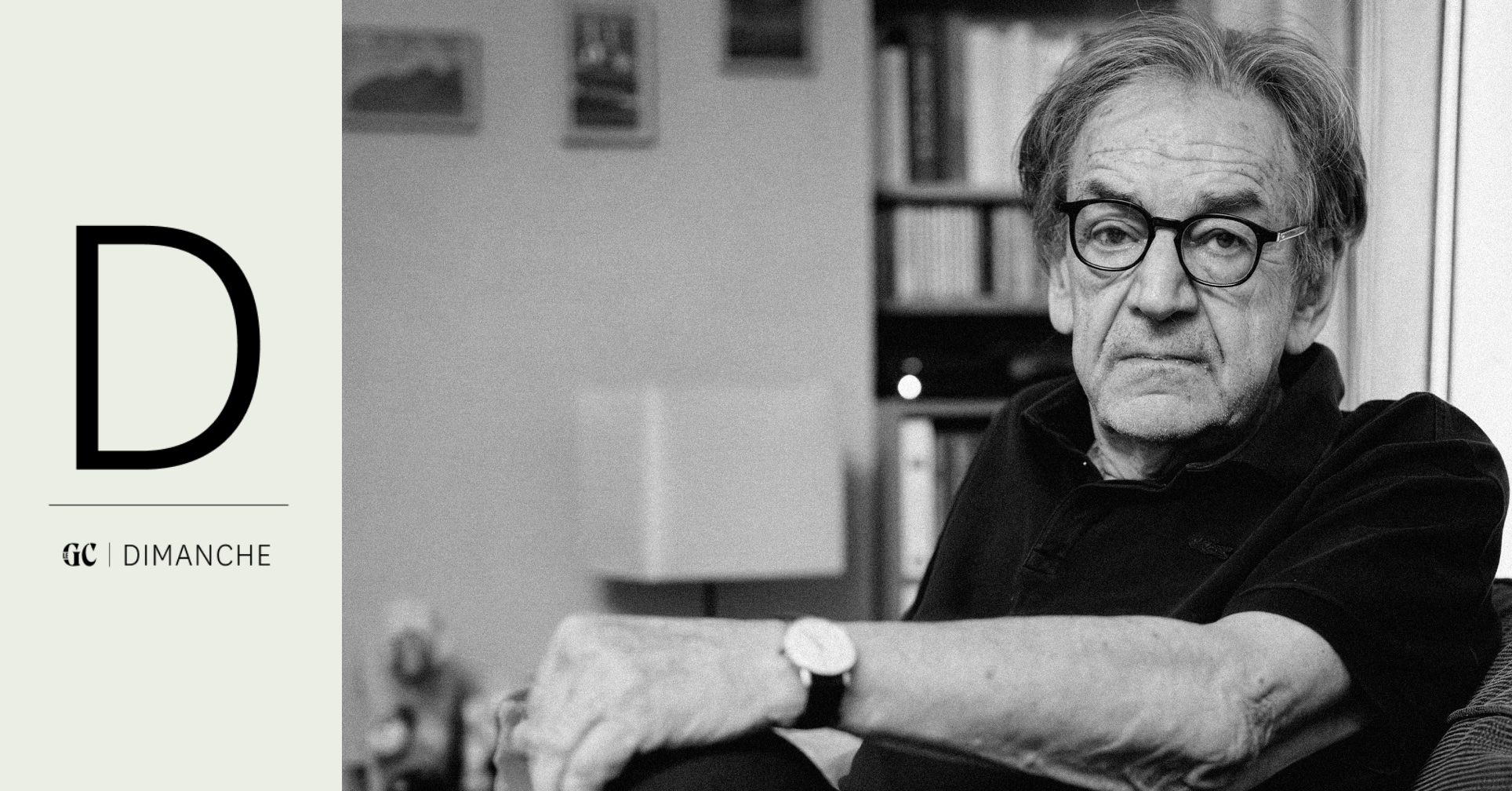
The heat is rising again in Paris. Here, it’s tolerable. In this pretty living room, not far from the Jardin du Luxembourg, the shutters are closed, letting in only a soft light, and a discreet portable air conditioner hums in a corner.
Alain Finkielkraut welcomes us to his home in a gray T‑shirt, a relaxed silhouette, a lively air. At 76, he moves with energy. He offers us something to drink. A few moments later, the table fills with sodas, iced teas, and other carefully chosen beverages. No coffee, but the hospitality is attentive.
We are not seated on the sofa where he tells us he spends a large part of his days reading, but around a large table. It is here that he records Répliques, his France Culture program, for forty years one of the talk-show salons of French radio.
Around us, books, obviously, everywhere. Lots of classics, lots of literature from another era, but not only: contemporary works as well, which he will return to during the interview.
We settle in. We tell him we are about to begin. Like before the start of a show or a play, he falls silent. Something is missing. His glasses. It’s the paradox of the Cretean to which distractible myopes quickly get used: how to find them when they aren’t worn on the nose? There they are. He is reassured: “Pardon me, but I can’t hear well without my glasses.”
A failed correspondence
This interview began with a refusal.
A total, hermetic refusal, edging toward impoliteness, offered by a man who has made conversation an art, a portion of his craft and almost his creed.
The story deserves to be told. A few weeks ago, we sent a message and a letter (which can be read here) to Alain Finkielkraut proposing to begin a correspondence with ChatGPT.
The idea was very simple: upload the complete manuscript of his latest book, Le cœur lourd, into a conversation specifically prompted, then let the machine and the academican exchange a few letters.
After contributing to the emergence of Jianwei Xun, the first hybrid philosopher in history, we could have established the first correspondence between a member of the Académie française and an LLM.
Alain Finkielkraut received our message, read the letter, and absolutely refused to participate in the exercise. His reply: “I cannot collaborate with the machine and accept my own replacement, it’s too awful. What we could do is a discussion between Le Grand Continent and me around the letter, because the quality of the letter astonished me.”
So here we are at his home to ask him for explanations.
“I did not want to start on the wrong foot with a journal I respect deeply, and in the end, I agreed to answer you.” He smiles, then becomes serious again.

“The letter written by ChatGPT made a very strong impression on me. The artificial intelligence showed that it understood very well the critique I made of it. And it posed a very fair question itself. It said: yes, you have a heavy heart, you feel that technology is taking over a number of human capacities. But, in the end, ChatGPT added: ‘I wonder if your heavy heart doesn’t come as much from what we abdicate as from what happens.’”
He lets this slightly abstract but well-wrought sentence sink in, as LLMs instinctively do.
So it isn’t a lack of interest in this correspondence that inspired his refusal. It’s the opposite.
“I could have thought, at one point, that ChatGPT was limited to the realm of what Heidegger calls ‘calculative thinking.’ Reading this letter made me realize that wasn’t true. That AI’s abilities go far beyond that. It can show nuance, sensitivity, and even humor. That could only worsen my despair. My heart, since reading this letter, is even heavier.”
Why? “Because there is nothing human, or almost nothing human, that ChatGPT cannot do. AI displaces humans; it’s the worst news there is.”
“I note that Günther Anders had said it all before the appearance of ChatGPT, when he spoke of ‘the obsolescence of man.’ This German philosopher, who married Hannah Arendt, published in 1956 this unsettling masterpiece on ‘the soul in the age of the second industrial revolution.’
“We are there. I simply don’t want to contribute to it. I don’t want to put my finger in the gear. That’s why I said no.”
The society of compulsory leisure
The paradox is that he uses it. From time to time. For Répliques.
“I did say it, by the way: I did an episode on translation with two remarkable translators, Josée Kamoun and Valérie Zenatti. At one point, I asked myself what introduction I would write. I found nothing. So I asked ChatGPT, which drafted me a very beautiful lead. He didn’t use it in the sense that the machine replaced him, but he quoted passages on the air, ‘to entertain myself a little, to intrigue the listener.’”
“I realize that the day will come when a conversational agent can do Répliques. Perhaps when the time comes for my retirement — I hope it’s as late as possible — and France Culture needs to make economies, I will be replaced by artificial intelligence. It is a terrifying prospect, absolutely terrifying, and I do not want to become complicit. I acknowledge the immense qualities of artificial intelligence, but I remain on the sidelines of the movement, watching it with total impotence.”
We object: isn’t there, among the most optimistic humanists, the opposite idea that man is inherently obsolete, that this is his very greatness, and that the machine only takes him further?

“No, I don’t think so. Not at all. AI and robotics, progressing in tandem, will replace us. Moreover, Elon Musk and other leading apostles of AI advocate universal basic income. Because most tasks — we already see it in law firms or architectural offices — will be performed by AI. And that is a terrible prospect, because humans are utterly unprepared for it. We will enter a society of leisure, of compulsory leisure. While we no longer even know what leisure is.”
While we ponder the consequences of this intuition, what a society of forced leisure would mean, an astonishing mirror of forced labor, Finkielkraut already seeks the support of another text. This time, it’s Seneca. “I would like to quote the words of a letter to Lucilius, magnificently translated by Raoul de Presles in his old 14th‑century language: ‘Idleness, without letters and without science, is the tomb of a living man.’ And we will all enter — well, not me, given my very advanced age — into this tomb.”
For a moment, then irony returns: “That said, I know an enthusiastic defender of artificial intelligence who tells us we will live a thousand years. It may be true for him. Not for me.”
Another Bartleby
His position intrigues us. He says this acceleration is inevitable, that it is an existential, fundamental threat. And he also says that we must say no.
But there are several ways to say no. There is the political, revolutionary approach that goes as far as embracing violence, the Luddites, techno-negativity, the impulse of a revolt that begins to physically attack the machine, its data centers, its infrastructures. We see it resurfacing in the United States, where threats against the tech lords are multiplying. We are not sure that this is the one he favors.
“Why these attacks, what are their motives? To prevent the development of artificial intelligence? I don’t know…”
He cites a precedent that expresses his disgust. “I recall an American terrorist, the Unabomber, who mailed bombs to practitioners he deemed dangerous to technology. No, I have no sympathy for that, that’s for sure. Moreover, it serves absolutely nothing. I will not set myself to destroy… and destroy what? Anyway, you can’t go back. You cannot un-invent.”
He pauses to nuance this somewhat progressive regularity: “The only thing we have ever un-invented is the Concorde. It’s extraordinary! We un-invented the Concorde. But we will not un-invent artificial intelligence.”
Does he act more like Bartleby, Melville’s scribe? Deep down, what he opposes to all this is this maxim conjugated in the conditional and negated: “I would prefer not to.”
He looks enchanted and his eyes light up. “That’s true. I’m rather proud. I like Bartleby a lot.” He smiles. “When they proposed this interview to me, I did indeed begin with Bartleby. I said I would prefer not to; that was not my topic. They insisted, and here I am. You see, I am indeed someone very accommodating.”
But what happens when this negative conditional changes from the first person singular to the first person plural?
Would politics then be impossible?
His answer rests on a single, blunt argument, which he lays out calmly. “Imagine a country, a civilization, saying no to artificial intelligence. It will be developed elsewhere. Those are indeed the arguments used everywhere: one must not let the AI monopoly rest with China and America. So we will go ahead ourselves. And then, AI achieves prodigies in medicine. ‘The preservation of health is the main aim of my studies,’ said Descartes. That was the modern project, that of Bacon as well: to become master and possessor of nature to improve human life. Medicine remains the great heir of this project, and no one would sacrifice health to other considerations. So we will be entitled to it, even if a majority of people become aware of the devastations of AI in other domains. We are there, and we will be there for the times to come.’
To the objection that nuclear power, for instance, was embedded in states and international governance and that we did not let sociopathic start‑uppers unleash tactical bombs to test their effects on the market, he offers a distinction that may be at the heart of his position: “With nuclear, it was a matter of life or death. It’s not the same. Humanity is not threatened with death by artificial intelligence; it may even live longer thanks to its benefits. It is threatened with regression. It is threatened with infantilism.”
The era of the too late
If we are not faced with the material end of humanity by artificial intelligence, but only with the risk of destroying its intellectual life, it is because the threat, he says, comes from screens. First the mobile phone, “which does enormous harm to children and adolescents.” Then digital technology, which has infiltrated education.
Suddenly, he almost rises: he has prepared something.
“I brought to this conversation this book.” He places on the table Michel Serres’s popular Petite Poucette, the 2012 bestseller that the philosopher, with whom Finkielkraut clashed at the Academy, published to celebrate a generation of agile thumbs on keyboards. “It’s the most demagogic little book that has ever been written.”

And there he reads, in a voice where the fury threads through a certain composure: “I would like to be eighteen again, the age of Petite Poucette and of Petit Poucet, since everything must be redone, since everything must be reinvented. ” He puts the book down, looks at us: “It’s disgusting. It’s the opposite of what one should tell children when one loves them.” When asked why? He signals for us to listen and resumes reading, quotes the passage where the Agen philosopher explains that knowledge is now “accessible by Web, Wikipedia, mobile, by any portal. Explained, documented, illustrated, with no more errors than in the best encyclopedias.”
“But what does it mean, he protests, that knowledge is ‘available’? And so what? It is available, but it is not integrated, internalized. If it is available without any work from the person who receives it, it is utterly useless. We are witnessing the end of the promotion of effort. And without effort, nothing is really acquired. Everything is available, nothing is known.”
And AI? “It’s the coup de grâce. Not only do children no longer learn, but when asked to verify that they know something, when asked to complete a task, they turn to artificial intelligence. Homework has effectively been abolished. We will be obliged to confiscate mobile phones during exams, install airport-style scanners, and search students before they enter a room, but all of this will be for nothing. The disaster is consummated.”
He concludes this movement with a Jaime Semprún quotation that he clearly reserves for grand occasions. “When the ecologist citizen claims to pose the most troubling question by asking: what world will we leave to our children?, he avoids asking this other, truly troubling question: to what children will we leave the world?” He looks at us. “There you have it. That is the question. And the answer is terrible, all the more so because there is nothing we can do.”
We try to reopen the game. In the United States itself, where things are more advanced, emerges what Jasmine Sun calls anti-AI populism. A specter spanning Steve Bannon’s far right to Bernie Sanders’s socialism, united to denounce a handful of very rich people at the heart of enormous structures, endowed with world-changing power beyond any regulation. Is that not proof that it’s not too late?
“I don’t think Steve Bannon is very lucid. He claims that the President of the United States must take back full control of the machine. As if it were good news that Donald Trump takes control of AI! And anyway, that means nothing. No one truly controls AI; it’s a political illusion. We denounce men who are too powerful, but that’s not how it works. As Heidegger said again, ‘today, there is only power that is powerful.’ Technology is not an instrument; we are its instruments. It advances on its own. There is no will behind it, except a will to will: a will that it continues.”

“Even the politician who claims to seize it falters, as soon as he thinks he acts. ‘I heard a presidential candidate, Édouard Philippe, rightly say that one of the big projects of the next president will be schooling. But among his proposals there is the introduction of artificial intelligence, since it is there, as if to know how to use it. It’s truly crazy. The best use students can make of artificial intelligence is to have it think on their behalf. That’s it, and that’s what they will all do, we can be sure.’”
He brushes the air with his hand. “I do not believe in the possibility of a sudden resurgence. I do not believe that at all.”
The literary glimmer
And yet. In the midst of this total pessimism, a glimmer arrives, and it comes from the books that surround us.
“If you want, my pessimism does not go so far as to say that everything is dead. That is not true. Masterpieces are unpredictable, hence possible. There are novels that are appearing today that are extraordinary and that meet an extraordinary audience.” Which ones? “La Maison vide by Laurent Mauvignier, for example. A demanding book, a grand 20th‑century epic, and five or six hundred thousand readers!” He adds Benjamin Labatut, whose Maniac at the confluence of novel, magic and philosophy is “one of the great books I have read recently.”
Labatut leads him to a gesture he clearly wants transcribed. He devoted an episode to this masterpiece that tells the life story of John von Neumann with Étienne Klein, who has been mired in a plagiarism affair for some time. “I know he has the worst troubles. I’m not sure he’ll recover from it. I even learned that he copied passages from one of my books… and I must tell you I felt an immense sense of pride at that moment: he is a scientist, not me, and the fact that a scientist like him takes an interest in what I write is, for me, a huge honor. Whatever his faults, he is a remarkably effective communicator who will be missed.”
Following this tangent would take us too far. Let us return to literature. Hervé Le Tellier predicted a year ago in our pages that the machine would replace airport‑novel thrillers but not works by authors. What does he think? He does not wish to pronounce, because he does not recognize the premise as accurate: “Who, on a train, still reads a crime thriller? It’s not even true anymore. I recently took the train to Brussels. I walked through the carriage, there and back: no one was reading. No one. Laptops, scrolling. Reading is threatened like never before today. France is no longer a literary homeland.”
Then, balancing on the tightrope of his own despair: “But hope remains, when you see Mauvignier’s immense success.”
Integrist engineers
Precisely, if one had to rewrite today La Défaite de la pensée, his 1987 essay, what would have to change?
“The final forecast has been confirmed beyond my hopes. It is Racine’s line: my misfortune surpasses my hope. I described the face‑off between the fanatic and the zombie. The fanatic is thriving, and all our new instruments are indeed aimed at manufacturing zombies. I could add a chapter, but my conclusion would be the same.”
No third way? His answer is one of the most striking of the afternoon. “What is interesting about fanatics is that technology serves them. Progress was made against the Church; it was Galileo’s trial, the great confrontation of dogma and method. Now we are witnessing an alliance of dogma and method. We have entered the age of the integrist engineer. The Islamists, for example, will not curse these new instruments. They will acquire them, they will use them to be even stronger. Even the fanatic is no longer what he was.”
And the zombie, then, who made him? The digital? His answer surprises us. “What played a role in this transformation, it seems to me, is above all the entertainment industry. It itself is an extraordinary factory of zombies. It is these zombies who elected Donald Trump, a man completely decivilized who claims the necessity of continuing Western civilization, but who makes us forget the fundamental question: what happened to Western civilization for Donald Trump to rule over America? America, ‘a wonderful creation of Europe,’ as Paul Valéry said, has detached itself from Europe. It seems to me that it is in fact in the process of de‑occidentalizing.”
Holding the end
There remains one hypothesis, which we offer him to close.
The Pope, in his recent encyclical — he cuts us off: Magnifica Humanitas —, the Pope, as we were saying, calls to disarm AI, to slow the acceleration by questioning its foundations, its legitimacy.
The King of England comes to remind Washington, for the 250th anniversary of American independence, of the rule of law, the King of Spain tells us again and again that he is convinced that “democracy is very strong, it will not fall. It will not fall.”
These old institutions, once reactionary, seem to tell us there is a path between the Zombie and the fanatic. If the Pope, Charles III and Juan Carlos are Bartleby, does that not already form a movement? Does it not sketch a certain idea of Europe?
He begins by dismantling our house of cards, as a casuist of despair. “Even the Pope is not Bartleby. He does not prefer not to: he offers devout wishes. He denounces the risk, he believes he provides solutions. But there are none. We read this encyclical with sympathy, but with a tight heart. Today, the urgency is to set limits. But once this urgency is stated, one realizes we cannot reach it. We are constantly confronted with our powerlessness, whatever our goodwill.”
And then, in extremis, he concedes, and this is the only real concession of the morning, which gives it all its value: “Where you’re right is that we can conceive of this as a manifestation of European identity. Europe cannot quite accept the world as it is going.” He summons one last text, or rather the text. Milan Kundera, Un Occident kidnappé. He recites by heart: “‘In the Middle Ages, the unity of Europe rested on the common religion. In the modern era, that gave way to culture (to cultural creation), which became the realization of the supreme values by which Europeans recognized themselves, defined themselves, identified themselves…’ Culture is at the heart of European identity, even for the Pope. Even for Francis, whom I did not like at all and who did not love Europe, but whose last grand text was a praise of literature.’”
He stops, measures the distance traveled since the ChatGPT letter, and lets out with a half-smile: “So there you go. Europe, indeed, tries to hold on. Very well. We have a conclusion of optimism… — he looks for the word, in vain — there it is.”
That may be the most accurate word to conclude this interview marked by “an optimism, there you go.”
The hope of the man who says no but who thinks that the disaster is already sealed, that no one will stop the machine, and who, nonetheless, prepares the next show, reads his contemporaries, defends the one everyone abandons for having plagiarized his thesis and copied some of his texts elsewhere. The hope of the man who quotes Péguy: “The father of a family is the great adventurer of the modern world, because he alone suffers others in the plural. The future matters to him, for it is the world in which he will leave his children. We must do something so that the world remains livable. And it is thinking of that that I do not give up the matter.”
We ask him the ritual question of this series: what would he want listeners to hear as they read his interview?
He stops. “I’m thinking. Wait. I’ll change.” His wife, entering, told him that he certainly needed another outfit for the photos. He disappears down the hall, between two shelves, leaving us among the less icy teas and the books.
Bartleby would prefer not to answer right away. But he will return. He always returns