
Day 1. September 1
The marshrutka carries a small dozen people to Tiraspol or Potemkin Village — a military checkpoint between Moldova and Transnistria. I learn that it would be better to name it differently; locals associate this name with Romanian fascists of 1941–1945. Taking photos there is forbidden. Yet checkpoints provoke something that resembles a sly intoxication, a troubling allure. They materialize crossing, adventure.
First night, first impressions. At the Georgian restaurant in Tiraspol, beer flows freely. The new coexists with the most dilapidated.
Here, Sheriff is everywhere, that is, the Sheriff group. From gas stations to public works, from telecom operator services to the best football club in the country, it owns, organizes, orchestrates, and gives the Transnistrian territory a semblance of reality. The group was founded by two former KGB officers, and “Sheriff” was indeed the nickname of one of the KGB founders. Two sons of the former president of the Republic, Igor Smirnov, made life easier for him: one (Vladimir) runs the Transnistrian customs, the other (Oleg) maintains close ties with members of his board. The local ruble is only valid here, and is almost as worthless as Monopoly money.
And yet, there is reality. Transnistria is the Truman Show on the scale of a region. Tiraspol is its showroom. Proof of this are the delicious khinkali, perfectly spiced, the khachapuri drenched in butter, a boat sunk in its cheese, sharp and soft. Proof again in the bartender with a neatly trimmed beard, pierced ears, deeply involved. He crushes lime, adorns glasses with a mint leaf; he crafts his cocktails, brows furrowed. Proof finally in the children growing up here, in strollers or in tidy parks.
The Boomers — that is how the BMWs have been nicknamed since the end of perestroika, quickly becoming the preferred car for the somewhat small-scale strikes of Russia under Yeltsin. At night they roam the dark streets of Tiraspol, letting their engines roar, inflating the pop of their exhaust. There are also (mostly) the old, unkillable Ladas with the look of dented sardine tins. From time to time, an antique marshrutka passes by like a tired hearse in search of corpses.
Few passersby light their way with their mobile phones. A silhouette that looks like a zombie appears, now and then, in the halo of my light, and gropes to orient itself in the dark. Perhaps he rightfully trains his gaze on the darkness, as cats do.
Day 2. September 2
Republic Day, at once a national holiday and a celebration of “independence.” It is really, to tell the truth, a celebration of dependence on Moscow.
High-security setup: an armed militiaman, masked, all in black, explains that my passport must be photographed. The area is patrolled by police and undercover militiamen with earpieces, and a heavy city-purse under the arm. On the roof of the former Pioneer Palace, I glimpse two heads. Like survivors of a toppled carnival. They are soldiers, more precisely snipers. There are also bodyguards in business attire. I feel watched. I even feel tempted to offer a selfie to my guardians.
Coronations are laid at the foot of monuments by President Krasnosselski, in the presence of notables, metropolitans, and soldiers. Their uniforms are the same as those worn in the Victory Day parade, every year on Red Square. Only a small Russian guard accompanies the ruler. No assault tanks or even armored vehicles parade. No helicopters or fighter jets. The parade is reduced to the bare minimum, to the economy. Not at all impressive, even emboldening… I pretend not to understand the rules of the game. I fall in with a bayonet-bearing detachment of Russian soldiers, I follow them closely. They sing the anthem. They salute the Transnistrian and Russian flags. Curtain.
Festival of provincial fairgrounds. Patriotic music. Barbecues. Cisterns of kvass. A lot of children.
The procession of apparatchiks has dispersed. I can approach the monument to the Fallen, to the flame of the Unknown Soldier. From 1941-45 to 1990-1992, there is veneration, the continuity of martyrdom’s glory. Monument to the Chernobyl Liquidators. Afghanistan. A great historical collage. A memory pile-up. A syrupy music blares, or rather shouts, from loudspeakers scattered along this avenue as wide as the Champs-Élysées. Here, Vladimir Putin does not even need to show his muscles. Minimal effort for maximum nuisance: only a brass band and a bayonet detachment hold the entire region. A magnificent geopolitical leverage, resting in reality on the great fragility of the Transnistrian power that depends on Moscow’s good will.
Tiraspol, capital of a post-reality avant l’heure, questions the founding myths, exposes their construction in real time. The city crystallizes the fantasy of autarky. Tiraspol is an oxymoron: the autarky assisted.
The map on my phone is written in the official language of Chișinău: Romanian. But the street signs in Tiraspol are exclusively in Russian. The toponymy remains, of course, unchanged from before the fall of the USSR. And you don’t hear a single word of Romanian in the streets.
The horizon seems strangely limited here. “And so what?” you would say, no doubt, to its inhabitants. They would not be entirely wrong. Antique wisdom in reverse, made of privations accepted, of hubris checked. The temptations are over, and so the torments here. Neither Adam nor Eve nibble the apple in Tiraspol; and as long as they keep quiet, Paradise is theirs.
On the facades of houses, marble steles to veterans are of the same kind as those along Moscow’s streets.
Flags. Banners. Coats of arms: there is in everything a charming whiff of amateurishness, like at a village festival. One senses volunteers. This decor brings to mind that pretty, sly, quietly absurd film Carbon, with its mayor who exhausts himself trying to sew together a dignified flag. The 1992 war has ended, but here and there you still find charred corpses whose sides you can hardly tell to which side they belonged.
Could Transnistria be a precursor of the eastern regions of Ukraine to come? Will Moldova and Ukraine share the same European fate? I amend: “…the Republic of Northern Cyprus has been under Turkish control since 1974, while the Republic of Cyprus is an EU member state. In light of this precedent, Ukraine [and Moldova] could join the European Union without exercising de facto control over the entirety of [their] territory. At the UN, the situation would stand as a status quo, despite possible declarative resolutions by the General Assembly, by virtue of the Russian veto in the Security Council. The constitutional claims of Ukraine [and Moldova] over the entire territory would not disappear: in other words, the war would not end legally.”
A few rare, timid graffiti, far from the city center of Tiraspol, on the walls of power generators. “перемен” (“changes”): the rallying cry of Viktor Tsoi, the rock rebel who called for change as the Soviet Union announced its end, though few there knew what was coming.
Along the road to Bender, a vast abandoned military base sits next to the Defenders’ cemetery. It’s not a proper military cemetery, for here families are buried alongside the Defender. Fresh, damp graves. The cemetery is overgrown with ferns, as if abandoned. Fluorescent, vivid, a touch ostentatious, the artificial flowers gleam in the setting sun like oaths from the beyond.
Having become a refuge for partridges and pheasants, this old military base has fully surrendered to nature. Trees and flowers slip in, grow, crack, dent, and wreck stone and asphalt.
I return to the hotel, walking on the ballast of the rail line. There is little risk of being struck. No train has run in Transnistria since the Assembly of the European Council declared the territory occupied by the Russians. A Soviet legacy, the track gauge is broad and forces trains crossing the Romanian border to change their bogies — Europe’s gauge being narrower.
This line linking Chișinău to Tiraspol is dotted with stations, some of which were built just before 2022. I reach a small level-crossing post, dilapidated, abandoned. The barriers no longer drop. One day, perhaps…
Evening. During the folk-music concert, a young man named Sergei approaches me, anxious to know what I think of the Republic, its people. Of course, I have nothing but good things to say. I don’t really understand which sector he works in, the tomatoes I think; he has lived — or perhaps only traveled — in Brussels. Does he speak French? No, and even less Dutch. He looks at me as if my questions fall from the moon. He went to Paris one day, literally just one day. That evening he is with his girlfriend. The music intensifies. He offers me a kind of sirtaki. Fine, here we go. In the pit, a giant circle forms. They dance a frenzied hora. We join in. We spin, again and again. Every time I approach one of the huge loudspeakers spewing decibels, I tuck my head between my shoulders. With no drop of alcohol, I become tipsy. Then the circle dissolves. My friends have already vanished. I shrug. Communication is difficult. It’s my fault. I am the “barbarian” here; I do not speak Russian.
Sergei had time to tell me that he wanted to see Switzerland. Yes, he loves the mountains. But no, he does not ski, he tells me with that same surprised look at the incongruity of my question. I do not know Sergei, nor the people around me. But the little they let me glimpse confirms my intuition. Transnistria is a “child” world. Its offspring have pretty sharply truncated horizons. They adapt, the desire passes. In their gaze there remains a hint of disappointment. “Many people here,” Sergei concedes, “leave for abroad. The money… — And you, Sergei? — Me? No, what a question.”
But it would be unfair to reduce the Republic to a land that longs only for Russia. The Republic is Moldovan, Romanian, Russian, Ukrainian as well. The coexistence of so many differences, come what may, on such a small territory is comforting. This possibility, however, has come at a high price: at least a thousand five hundred dead during the Dniester War of 1990–1992. The conflict is frozen. On 50-ruble notes (a little under 3 euros) the government building is printed; Lenin should stand on its pedestal, with cape to the wind. But Lenin is erased. The note I use as a standard dates from 2007; Russian influence may have increased since. It would be simplistic to map acceptance, or even promotion, of Soviet heritage to Russophilia. Heritages and memories, rites and habits: everything is always more complicated than it appears.
One of the latest numbers of song is performed by a blonde in a black satin dress, red gloves — Taylor Swift, if you will, but prettier. She sings in one of the most beautiful languages in the world, Russian. Next, a brunette from the Carpathians, Moldovan-Romanian, would hardly stand out in many parts of southern Italy. She closes the concert with a series of duets with a handsome man, also Moldovan-Romanian. Both are dressed in traditional white shirts embroidered with colorful geometric borders. They end with Italian songs. “Sarà perché ti amo.”
Day 3. September 3
Urbex. “Urban exploration.” I have always had a penchant for places that are more or less recently abandoned — age is not a criterion — for various reasons: from insolvency to the end of the world. They are places heavy with sensitive history, shrouded in mystery and prohibition, genuine ruins rather than grotesques, secular or transitional ruins, or merely stamped. Ruins of palaces and shacks. They tell stories and confess even more. The spirit of the place remains: our steps strike the lamp of the forgotten genius. Time becomes material.
I know nothing about the abandoned complex I visit this morning. Brick and concrete. Shards of glass. Three stories tall. The roof is inaccessible. Some friendly graffiti. None have a political slant. People say they want to live, that’s all; perhaps forget; maybe flee — but to where? We are five hundred kilometers from Kyiv, and a hundred from Odessa. Patiently, a trellis of once-promising ambitions is being woven here. Perhaps it is a hotel in the making, cut down by war. Today it is a maze with no Minotaur but the past.
It is impossible to be completely relaxed during an urban exploration — or, more precisely, a peri-urban one. Yet we learn. We grow used to the sound of a drumbeat of metal rattling in the wind like a plastic child’s tambourine. We acclimate to the squeak of leaves that sounds like a whisper of breath. I move forward, listening to my steps on the glass that screeches, on the fabric that sighs. My steps’ echo resounds between the empty walls like a sonic shadow. Those of the creatures tapping and hesitating as I advance, methodically.
From time to time, I clap my hands to announce myself, but also to reassure myself.
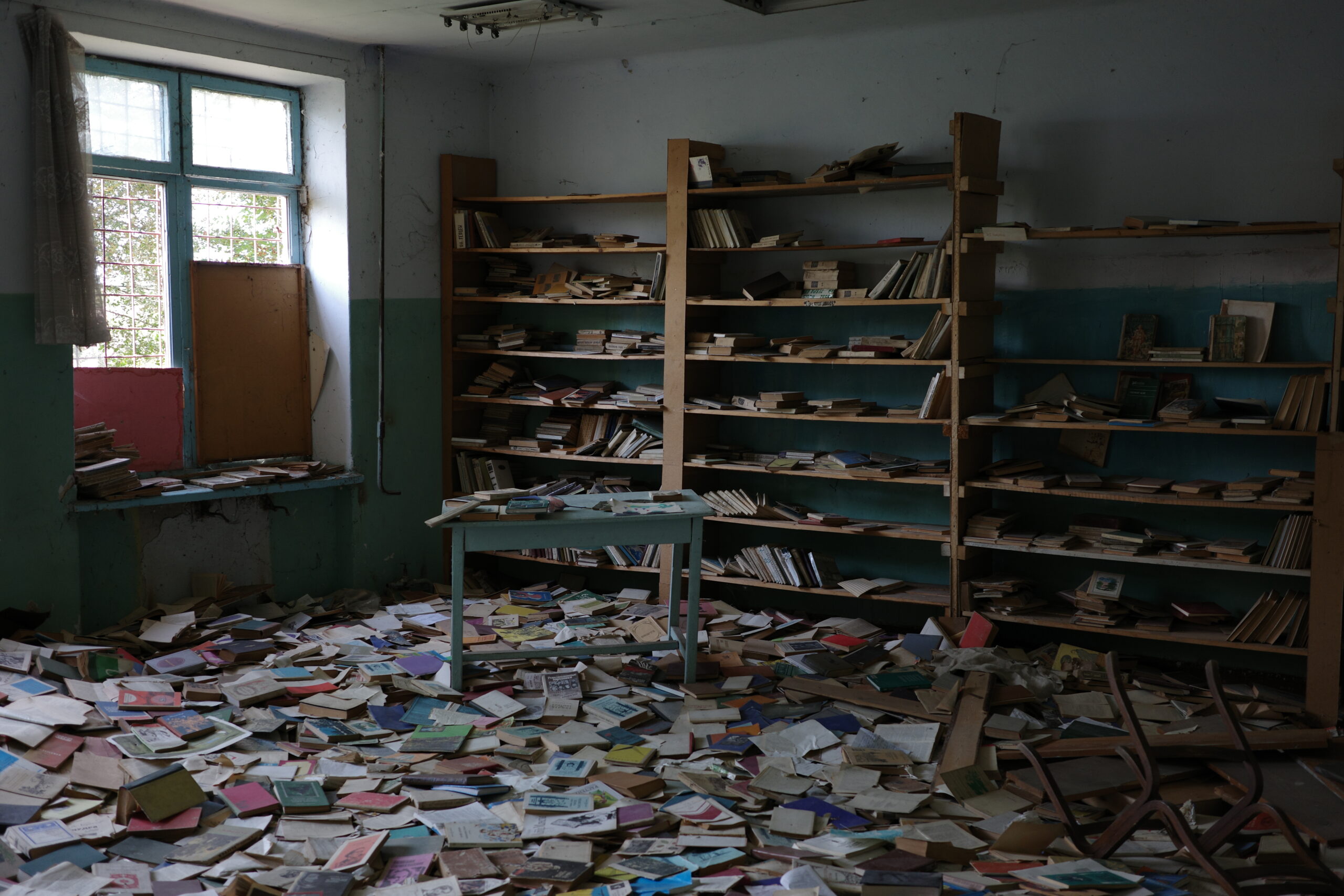
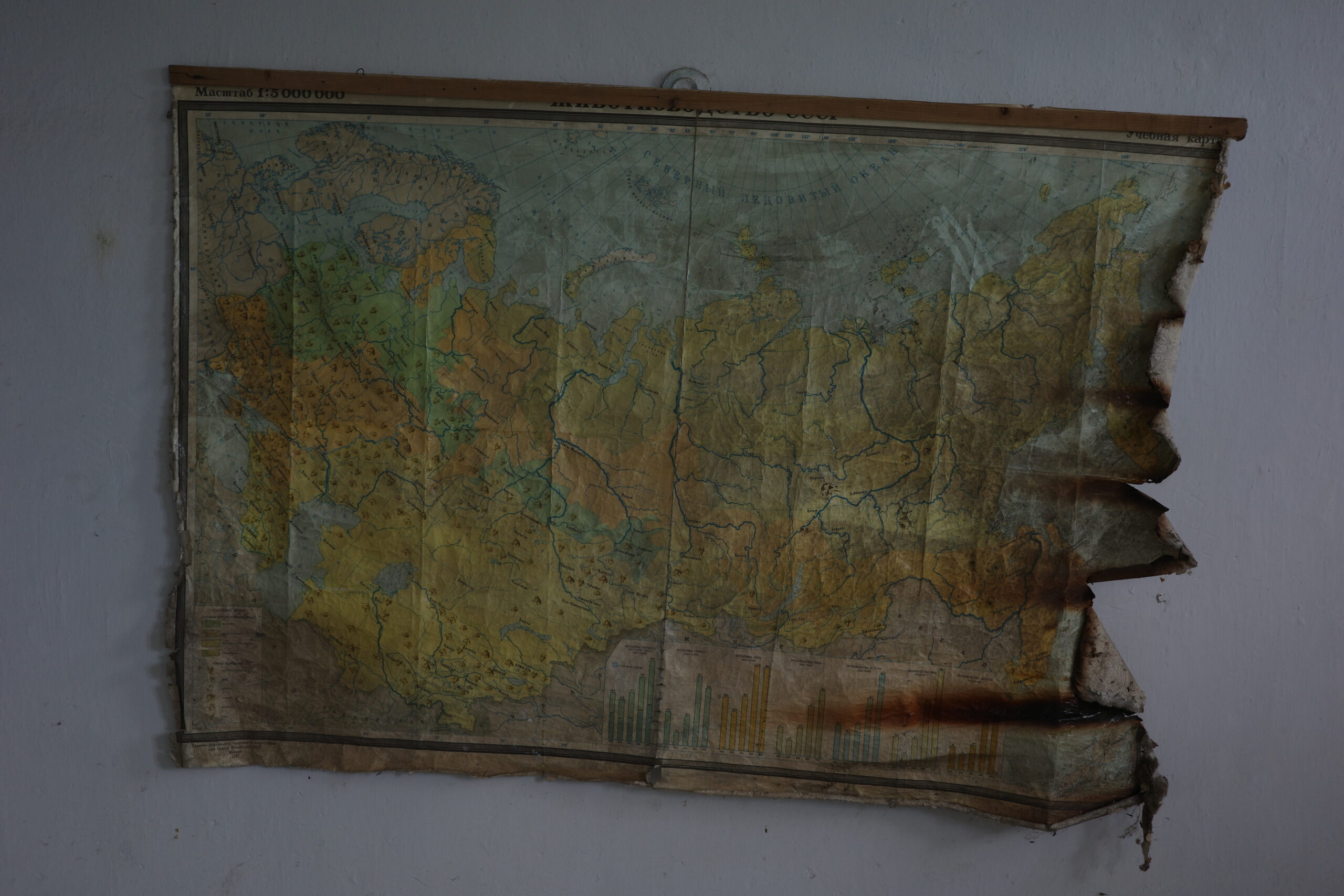
Moldova is today a tiny country, its area roughly equal to the Pays de la Loire region; it used to be among the largest countries in the world. I suddenly become aware of this as I walk the old geography classroom of an abandoned school.
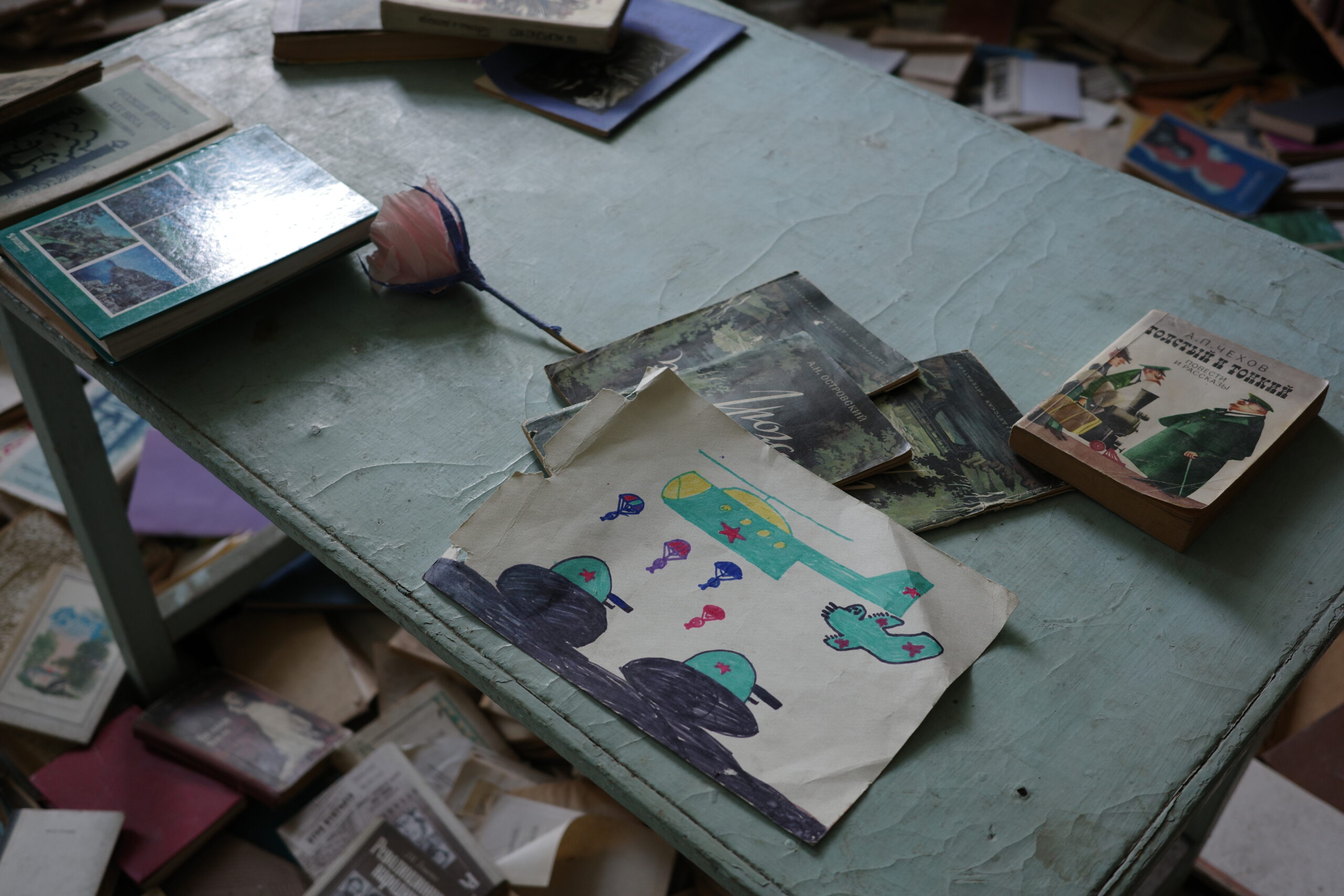
An abandoned school is a heart-wrenching place like no other. Our own childhood memories and schooldays surface. Contemplate the unkept promises of the future. And as for these citizens-models, curious, open, on the path to liberation through knowledge — call them civic, if you will — where are they? Too often there is a weapon in hand.
The abandoned school of a vanished country that has just passed through a war is even more poignant. I must muster an imaginative effort to picture these students behind this wall of thick glass, star-marked by bullet impacts.
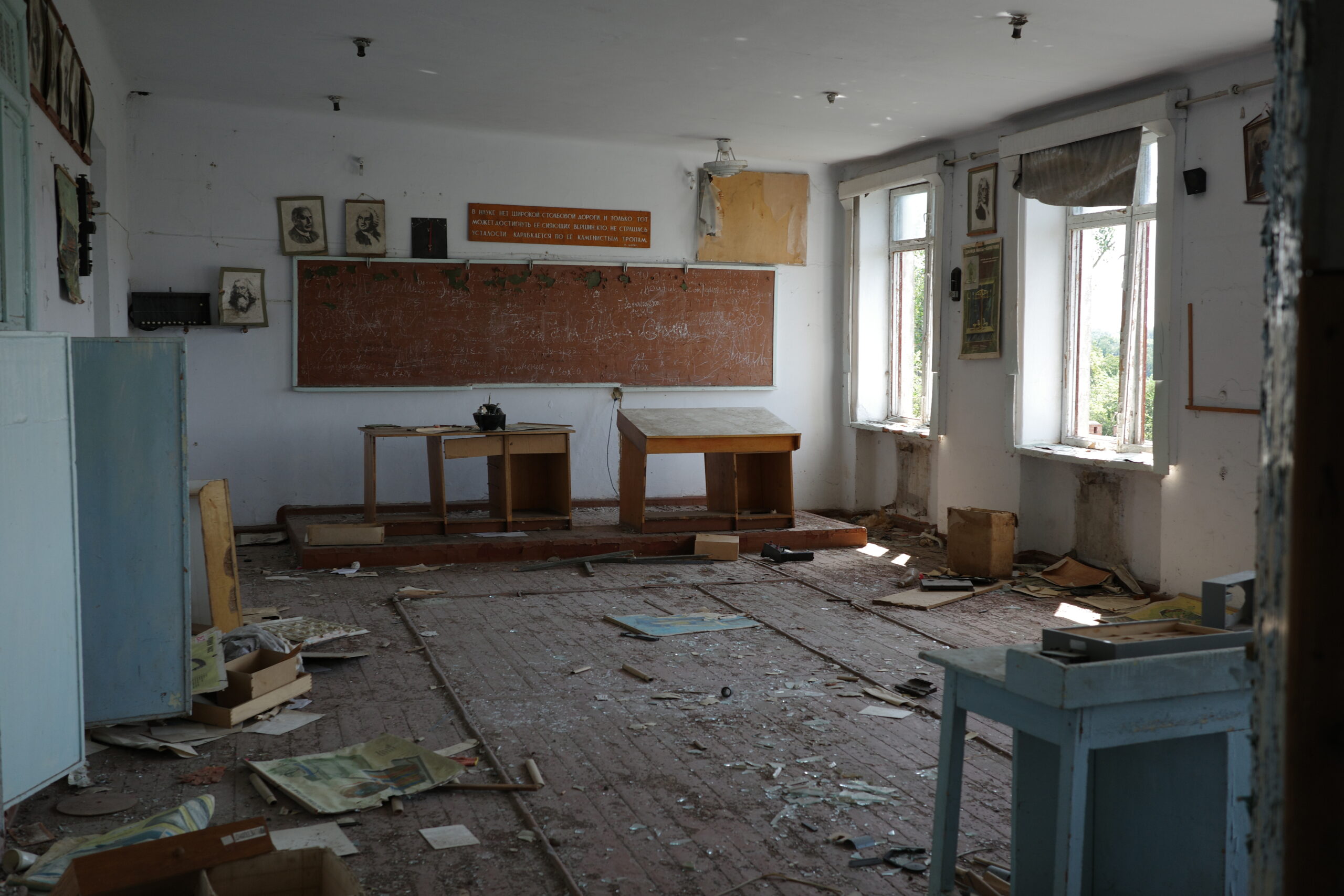
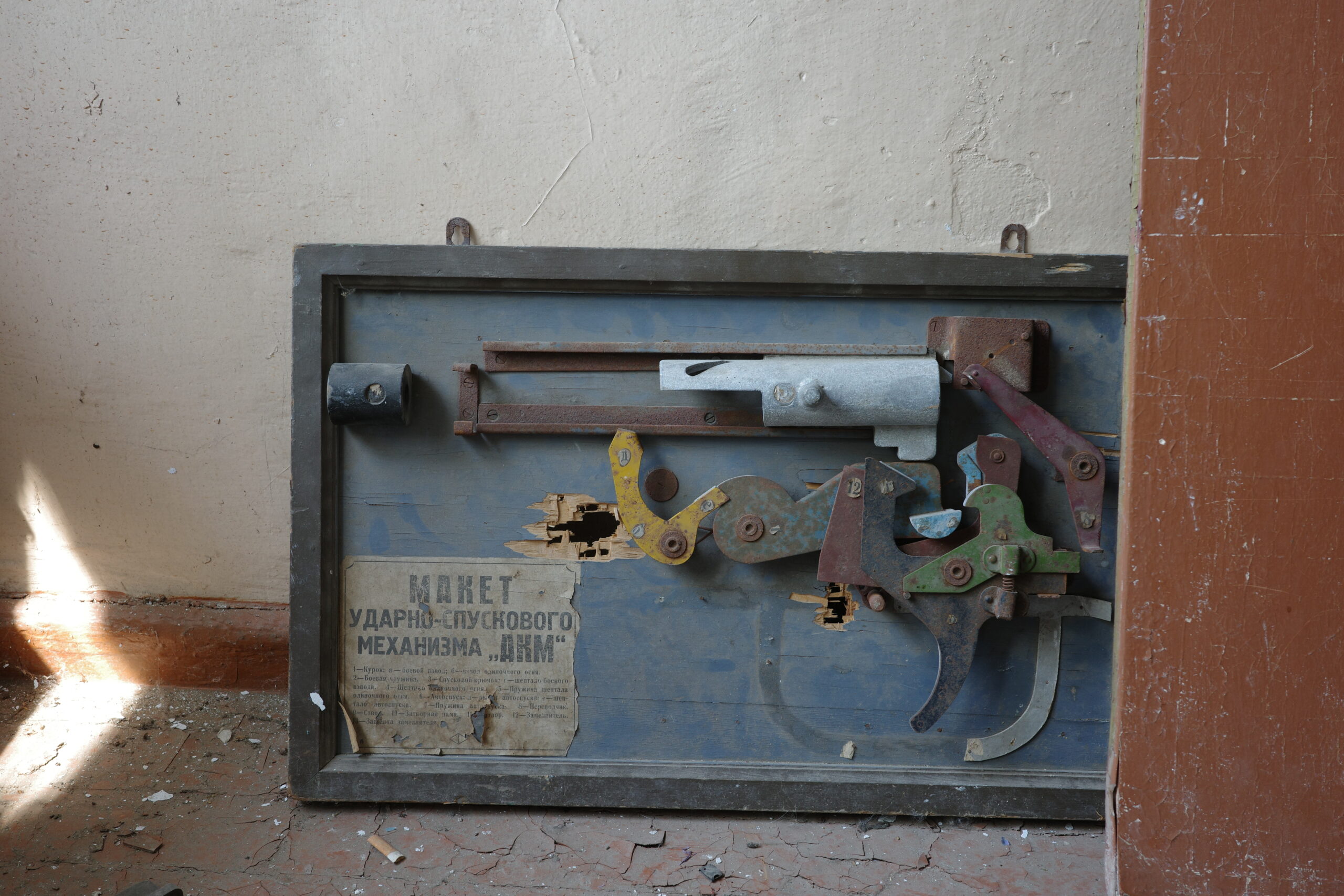
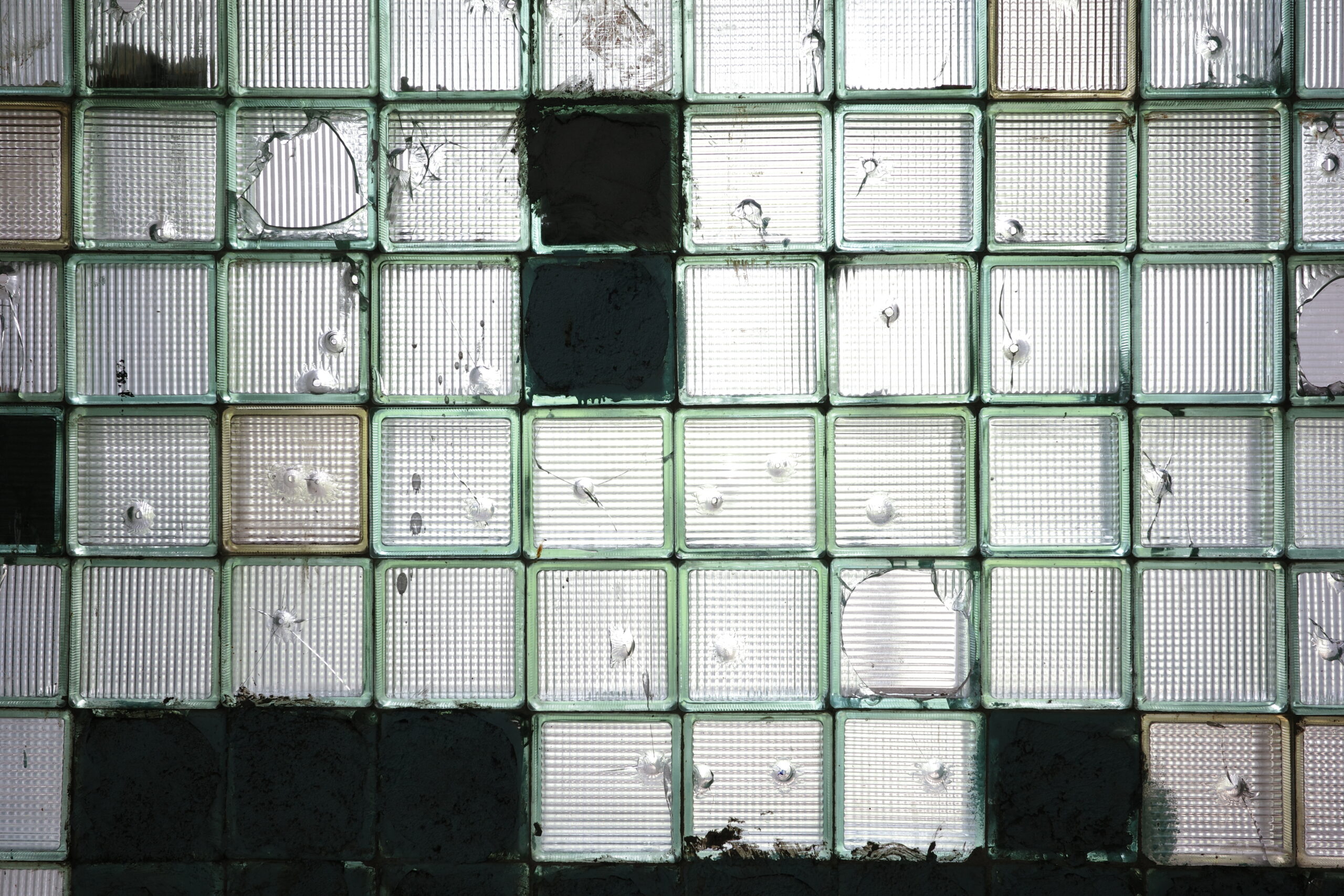
After school, back in a marshrutka, in a well-populated school, mid-morning. It’s snack time. Kebabs in a restaurant, likely run by Uzbeks. It’s in the basement. Nothing on the display. Two taciturn men seem to await the apocalypse in their bunker. Yes, it’s open. The place is filled with ambient oriental-like music and a massage-parlor vibe. The young man serves; the elder rekindles the grill’s ashes with a hairdryer, and calmly lights a cigarette. A strange, local sandwich: pickled cabbage replaces tomatoes or fries. Not something to wow you — at least, I hope so.
I vaguely wonder whether Sergei has known the school I just explored. If he had friends, and of which side they were.
I head toward the town of Bender, called Tighina on the Moldovan side. Bender is the Russian name, oddly deriving from Turkish, the language of the old enemy. See how delicate it is to write this journal, for one must often choose a side: to put the quotation marks or to remove them. Often one does not know well, in the name of which certainties one should be able to do so. So perhaps one must accept the complexity… Name it: Bender/Tighina.
The marshrutka, on which I am literally crouched beside the driver, passes a Russian barracks, in front of which a 4×3 recruitment poster calls to enlist with the armed forces.
We arrive. The braking is not the most delicate. I strike the interior mirror with my head. Not too hard, but enough for the rearview mirror to fall. The driver does not hold it against me. He kisses the mirror mount, perhaps spits on it. The oblong mirror returns to its place on the windshield. Terminus.
Bender/Tighina is bucolic. Its streets are timeless, that is to say, freed from time and lightened of its burden. The city’s fortress probably contributes to this, concentrating all of history, having sucked it in, crystallized it. The citadel guards the Dniester, and access to eastern lands. Strategic, it has passed from hand to hand. I carry with me a novel, The White Church by Ion Druță, which makes me think of Iouri Dombrovski’s The Keeper of Antiquities. A similar Soviet vein of the periphery, a human-scale view, a subtle detachment from the grand questions that mobilize, divide, and offend.
The fiercest fighting for the city took place in June 1992. It was around the Eiffel Bridge where I crossed on arriving from Tiraspol. The iron-crossed central pillar bridge sits on a central column; one side is painted with Transnistrian colors, the other with Russian colors.
In Gorky Park, pines dominate, bringing a scent of the south and holidays. In some streets there are plane trees. In this late-summer heat, in these empty, silent avenues, the sun softens, closing the eyes, breathing in deeply, it’s a delicious image of a French sub-prefecture with shutters already closed, a neo-Soviet mirage.
I head toward the central station. For several years, trains no longer depart or arrive here. I glimpse the building from afar, imposing, worthy of a true railway hub. Since the early 1950s, the station has had Stalinist features. Station for lost steps. Ghost station. Station frozen. Its proportions, its symmetry, make it a palace of travel forgotten. I must see it up close.
I notice children playing on the steps of a train-museum — on the platform, if you will, outside the prohibited station. It is a Soviet train. It has been repainted recently. The locomotive’s chimney seems about to spurt soot. I thread along the black fence that abuts the station. No access; that would be too easy. I wait for the children to leave. I climb the stairs in turn. There, between two railroad cars, the couplings spread, enabling footholds. From that position you’re higher than the black fence. Then you just place a foot there, and drop to the other side. There it is, done.
There are pedestrians on the street, on the footbridge spanning the empty tracks. Above all, there are cameras. If I get caught, I’ll play it as a fool. Not sure I fully know the local urban-exploration code — not to mention the damage vandals can cause. Yet I roam the platform with surprising calm. I wipe the windows to clear away dust and light my way. But the urgency lies mainly in the dying light, as night falls.
I have gathered all that these precious minutes of sun and this abandoned station were willing to give me. My throat tightens at the sight of this stop; I think of all the meetings it has enabled, and that it is now forbidden to offer.
I read the plaque adjacent to the train-museum. In a shiver, I discover that against this black fence I had carelessly jumped over, perhaps fifteen people were shot here in 1918 when Romanian troops took the town. The massacre would be followed by a Bolshevik-inspired uprising in Bender/Tighina. A number of residents still refused to see Bender and Bessarabia annexed by the Kingdom of Romania. In May 1919, the uprising was crushed by the Romanian army, supported by French troops under General d’Anselme. A significant number of French soldiers fraternized with the locals. They even allowed the Bolsheviks to cross the Dniester unimpeded. A commemorative plaque, its names almost vanished, pays homage to them at the city’s military cemetery.
Day 4. September 4
The 1990–1992 war. Memory, myth, fantasy. The question of reality and truth.
Just steps from the historic fortress stands the bust of the Russian General Alexander Lebed, savior of a city that looks like a boxer. The nearby monumental structure, whose bell was melted in Russia, stretches a white spire topped with the Orthodox cross. A dark-green motor vehicle marked PMR is parked there like a toad. A pole has been planted into which the red-green-red flag is set, flanked by the hammer and sickle.
As with so many of these struggles, they seem distant. They are hurled here, deliberately, so that they are not forgotten.
Fortress.
The first enclosure dates back to Ottoman works in the 17th century — its engineers and architects were French, heirs of Vauban. A few attractions (pirate ship, carousel), and a playground. But the place feels empty. Friday. One would need to return tomorrow to judge the appeal of the approach, namely to create entertainment as a lure to raise awareness of history.
I approach the second enclosure. The renovations are questionable. Everything is brand-new. Kitschy? Certainly, in the Viollet-le-Duc sense. The military buildings of the Soviet years and the Dniester War remain, but separated by barbed wire from what is now a museum. I wander. I take the ramp behind the ramparts. It’s fine, no invader in sight. I discover, as García Márquez would say, the incredible and sad tale of the guileless Viorica, a variation on the White Lady legend. Her ghost continues to haunt the place. Proof that sentinels have always seen her. The bullets from their rifles have raked the wall along which her silhouette passes on full moons nights.
Lunch. Two young women talk about going to work in Europe, in Rome, our Transalpine neighbor seems to have close ties with Moldova. Many people here also move to Chișinău… Are they traitors? Rather realists. Chișinău is the antechamber of Europe. Rome then? The Eternal City. The two young Moldovans do not mention Moscow, however.
In 1990, the Transnistria population was 730,000. Today, it’s about half that. The exodus is not over: the population declines by one to two percent per year.
The Dniester. There are beaches. There is current. The plastic bottles and various debris floating testify to it. I don’t know what the few fishermen I meet catch. I won’t bathe; I didn’t bring my swimsuit.
A rough, old black Lada appears, window drapes like in a grandmother’s kitchen. Registered in Russia, the car still runs, but cannot pretend about its age. Men in military uniforms step out. There is a “MC” sticker on the rear window. Further on, next to the House of Culture, sits a monument to the “Gardiens de la Paix” — Peacekeepers. It’s engraved, “Where we are, there is peace.” The soldier-statue wears a helmet. On it, two letters: MC. If the Russians fund the “Peacekeepers,” their fleet of cars is not the priority. They are among the first to be sacrificed by the Ukraine war. In front of this same palace of Culture, a musical fountain hums My Heart Will Go On with electronic pan pipes. Everything fades away.
An administrative building: it looks like a court, a tax center. I want to photograph the PMR emblem on the pediment. I do. A tall man in civilian clothes emerges from the building like a demon out of a box, descends the steps, and asks to see the photos. I show them. I erase. I notice, incongruously, that the man resembles GRU agents who played a trick on Skripal.
– Это всё? Is that all?
– Да. Yes.
The behemoth returns in the opposite direction. I step aside, vaguely relieved. I did not show all the photos. I stopped at the monument to the Heroes, very Soviet, very touristy, in its own way. A few steps further, the security guard, the policeman, and the militiaman (roles are blurred, sometimes interchangeable) would have discovered photographs of the traffic-check checkpoint, down below the fortress.
Every citizen ought to be a dissident. Curiosity is a vice. Its absence, a flaw.
At dinner, I drink a very average Chardonnay imported from Spain, while a DJ who looks like a first-year student plays Snoop Dogg. The waitress had assured me that the wine was Moldovan. Of course it is. Improbable (and miserable) miracles of globalization. Post-reality, still and always. Nothing is ever what it seems. Somewhere, it is strangely comforting, even hopeful.
Day 5. September 5
I take another marshrutka toward Chișinău. The driver is normally unpleasant. He forbids me the little seat next to him and gestures for me to go to the back, where there is obviously no room. I feel like showing him the Vladimir Virgin pasted on his dashboard. But there are also miniature boxing gloves hanging from the rear-view mirror. So I remain standing, for an hour and a quarter. I’ve exchanged my last Transnistrian rubles. The agent only had a 10-euro note. I took the rest in Moldovan lei. Hard currencies are scarce. A few minutes later, a woman boards and sits on the fold-down seat, without a word.
Passport control at the checkpoint. The ticket stamped by the soldier on the outward journey, which I was told never to lose, isn’t even considered by the border guards. Laxity or indifference. The roof vents are propped open with empty plastic bottles. Thank goodness. It’s already a small sauna, and I’m standing. I cool my armpits with both hands on the upper-gallery handrails. No one offers me their seat.
Chișinău, Tiraspol — it’s like an open-air experiment: one city oriented toward Europe, the other toward Russia. A tale of two cities. They are separated by only about sixty kilometers. Chișinău counts 720,000 inhabitants. Tiraspol 130,000. Chișinău’s GDP is estimated at nine to ten times the entire Moldovan region of the Dniestr. It equals that of a metropolitan area like Valenciennes or Limoges (each around 130,000 inhabitants). But money is far more visible there — whether concentrated in fewer hands or used in a more hedonistic way.
The presence of the European flag on many official buildings reassures me, perhaps foolishly. If Moldova is to become a member of the Union, it is hard to imagine the “Transnistria” to be part of it.
The streets of Chișinău: the Ladas have disappeared. In their place, gleaming luxury cars appear. It feels like Moscow, at the exit of Sanduny bathhouse, on Monday, when Duma deputies take their leisure.
The circus. Soviet institution. The cheerful counterpart of Rome’s arenas. “THE FIRST STEP OF RESTORATION/CONSERVATION OF THE CHIȘINĂU CIRCUS is underway thanks to the financial support of the European Union.” How I would like to go there once the work is finished. And if I were Moldovan, with my children, I think I would be deeply moved. Meanwhile, I yearn for the mosaics that crown the upper floor.
Ruins of a synagogue. At the beginning of the 20th century, almost every second resident here was Jewish. Fifty thousand people. After 1945, perhaps five thousand. The ruins are hidden behind a transparent construction tarp. I am reduced to photographing the tarp bearing an old photo of the synagogue.
A certain comfort accompanies the sense of returning to Europe. But the energy wanes with the feeling of reduced otherness. There is a kind of dolce vita atmosphere. It is pleasant to catch some air after the weight of the Dniestrian beyond. This weight is the sense of being crushed by history, of being nothing, or so little, compared to the centuries that preceded me, or rather the years after 1945. Forcibly, everywhere, history becomes totalizing — if not totalitarian. How good it is to be outside history. Let us beware of those who demand the before, and fantasize a golden age. They will grind us without mercy. They will saturated us with memory. The obsession with roots participates in the same delirium. I remember a graffiti on the palace of the Bulgarian Communist Party Congress: “Forget your past.”
Chișinău resembles Bucharest before Ceaușescu. It is a mid-sized Mitteleuropean city from the 19th century, with its single-story rental houses and stucco moldings, its sacred and secular temples, i.e. its national theater and its churches, Orthodox or not. But my eye tires of this old world. Brutalism, socialist modernism, often carry something pseudo-folkloric: paradoxically free architectures, even if they don’t resemble anything, or like children’s drawings turned real, for the best and especially for the worst. They have something quite glorious, really, these back-turned faces on beauty, which resurrect it better by accident, or negatively, in refreshing a dulled gaze that could no longer see the golden ratio.
Being entirely alone abroad is a nearly autistic experience. Strangely, the autism here is more bearable than elsewhere, say in Copenhagen or Amsterdam, where loneliness is all the more exasperating because it is felt as shameful.
If all the signs, all communications (advertising, official) are in Romanian, I hear Russian spoken in the streets (perhaps also explained by the influx of Ukrainian refugees preferring Russian by convenience?). One understands the dread that Chișinău might feel toward Tiraspol. Is Chișinău a future Riga, that is to say another European capital with a large Russian-speaking minority? The Russian fear in Riga may be more present than ever.
As I write these lines, another US delegation is folding up, leaving Moscow after another meeting with the Russian president. Headed to Kyiv, for an interview with Zelensky.
Day 6. September 6
At the central market, I observe the same kind of “cognitive dissonance”: the Russian-speaking minority sells and buys around me while loudspeakers broadcast in Romanian. Or is it Moldovan? On this point too, there is debate; Moldovan was the name the Soviets chose for the Moldovan Romanian. It was probably about divide to rule: Moscow had no appetite for having to support aspirations of a Greater Romania.
There may be a flawed statistical approach in the “freely spoken” Moldovan language in censuses. In 2004, the country reported 48% Russian speakers, while only 11% of Moldovans had Russian as their mother tongue. This disparity may also be explained, at least in part, by the persistence of Russian usage after the USSR’s collapse. It is quite possible, moreover, that Chișinău — which still includes one Moldovan for every three, one for four if you count the Transnistrians — is not representative of Moldova; that the Russian-speaking community (and/or Russian) is more significant there and that the capital also hosts many Ukrainian refugees.
Toward the abandoned complex that houses the former Pioneer observatory, a group of teenage boys run, hide, and startle as they run into me. We exchange the usual polite greetings. Let us give back to the children what belongs to them: the exquisite territories of forbidden games. I head toward the observatory, stepping on debris, and I climb the steep iron stairs like a lighthouse.
Just then, I am joined by G., a tour guide, a hunter of a new species who hunts on social networks. We explore together an old theater that was also to contain a cinema, vast as a Baikonur hangar, and he explains that he is a Russo-Moldovan (his mother is Russian, whom he spent most of his time with; his father is Moldovan, an officer in the Soviet navy, often away). When conscription for the “special operation” began, he managed to flee Russia. He left a son behind him in Kamchatka. They call each other from time to time. The communication networks frequently cut out. We ascend to the balconies of this concrete theater. Below, teenagers still play hide-and-seek. They pass by a giant iron wheel embedded in the ground. The scene existed there, and it could turn.
G. confirms my intuition: many Ukrainians arrived here in recent years. They most often exchange in Russian. And G. mocks the hypocrisy of many Transnistrians who loudly refuse Moldova, refuse to speak “Moldovan,” while fuming for their Romanian papers, their passports to Europe. G. has friends on the other side of the Dniester. Of course, none of them wants to lose face. All claim, with more or less conviction and sincerity, to adhere to the official narratives. Outside Tiraspol and Bender/Tighina, the region literally collapses. In the House of Culture of a small town, G. has seen a corner of the roof crash onto the stage. Few live in Transnistria and maintain it. Many dream, in muted terms, of leaving. I recall surprising conversations heard with my unguarded ear. They contained no more desire for travel than conversations among young French people who dream of London or New York. The same mechanisms at work. Unless… G. also tells me about endemic corruption, on both sides of the border, and its devastating effects.
We visit the Jewish cemetery, once immense. Only a few lanes have been preserved to this day. The bulk of the cemetery has been transformed into what is called Alunelul Park. On the wall, inside the cemetery, large panels detail the pogrom of 1903. Jostled alleys, leaning graves: a beautiful wreck of time. I have never seen so many cenotaphs. We read the steles. The death dates tell all: death in deportation, death in deportation…
The House of Purification (Beit Tahara) lies in ruins. I notice iron doors peppered with bullet impacts. We hid here. We shot at each other. Shielded from the sun by the House, we try to drink a terrible red wine that resembles hot wine cooled without spices and cut with ethanol. G. wants me to taste it, in a stopper, at the little market adjacent to the cemetery. The vintner sits on a folding chair under a parasol, awaiting the verdict, or rather not caring at all, but hoping his manipulations will lead to a bottle purchase.
— Not the worst… Not the best…, judges G.
— Not the best…, I agreed.
I instantly have a headache.
G. tells me that Chișinău, twenty years ago, was very hard, that corruption was even worse, that there was mafia, drugs, and that those one had to beware of most were the police. He recounts an anecdote. He was eighteen. At a music festival, a punk fight breaks out beside him. It wasn’t his fight, he tries to move away. But he’s seized by a policeman and thrown into a police van with the others. While he bangs to be released, a policeman pulls him out of the van and beats him, beating him again, there, in full view of everyone. No one bats an eye. He loses consciousness. He wakes up, bleeding, left for dead, in a forest he doesn’t know. Forget your past.
Day 7. September 7
I am tired of heroes and cosmonauts, tired of “progress,” of the promise of tomorrow’s songs. I need singing, a true sense of gravity, poetry perhaps, a smile — a mosaic, or real. Happiness is not to be sought in the cosmos.
Gogol High School: reds, oranges, yellows, a few shards of blue-grey, off-white, pale purple. Ribbons transform a braid into a caress that blooms into roses. The Mosaic of the Labyrinth of Knowledge warms my heart. There is a smile. Fractions, letters, geometric drawings, mathematical formulas turn the mural into a grimoire. Magic yesterday, knowledge today. Happiness, perhaps: using the latter to serve the former.
Northwest of the capital: a well-off district, neat cafes and luxury shops. The Valea Morilor Park’s pond holds a blue paddle boat that looks like a hippopotamus, above which the American Embassy’s cream-colored bunker and the former House of Nationalities, a Modernist building cantilevered out, make it hard to approach because of the proximity of the American embassy. I gather strength before heading southeast, the National Hotel turned into a brutalist pigeonnier of fifteen floors, the Romanita residence straight out of Blade Runner, a monster from War of the Worlds that has taken root, a hive of human cells.
The National Hotel: a beautiful beast. I circle it, looking for access. I stumble upon a car of “carabinieri.” The passenger wearing sunglasses stares at me for a long time, then the car turns around and drives away. I continue. I find the police car again, parked a few meters away. The officer has removed his sunglasses. It’s a rare thing, especially for a police officer on duty: I see a smile. He speaks to someone whose feet I glimpse. Two teenagers climb the hotel ramp. The officer speaks kindly. The kids descend. The driver also leaves the vehicle, records me, and deters me. Fine. I return to Paris tomorrow. I prefer the hotel to the station. On the hotel facade I notice cameras (at least three). A width of the building is lined with antennas. It must function as a relay for all kinds of signals.
Romanita, here we are. Eighteen stories of patchwork, windows with bay windows of varying improvisation, balconies with a cherished individuality. Brick or concrete cladding reinforces the structure like bandages. Laundry flaps at the windows. It must be dry. The inhabitants begin to return home, the poles will come in soon. It is indeed a perch of a tower, a concrete palm with a spiky trunk, a pinecone with closed scales, a socialist fortress to see a better world coming. I imagine lives that turn like screws in a stairwell when the elevators fail.
I finish with the Dance of the Muses. Evening falls on Chișinău. The sunset gnaws at the floating dress of the muses, or perhaps of nymphs? But I arrive a bit late; the sun is already low. The Muses retreat, slowly, fade like the dream of a late-summer night. The mosaic degrades quickly. In the lower-left corner, a blue graffiti pollutes the white, yellow, and hazelnut symphony. On the right, a elm tree has grown. It already towers over the mosaic. The Muses do not resent it. They dance with it.
Day 8. September 8, morning
Airplanes carve their trails through Chișinău’s sky like veil. From the abandoned observatory of the Pioneer Palace, one can trace a machine heading toward Paris. I do not see the observatory itself. But I know it is there, and I fly over it.
We share the elsewhere. Their desire — a transfigured past.