
Americans are voting today in thousands of races, including 470 to renew the entire House of Representatives (435 seats) and 35 Senate seats. In the evening and overnight, across Europe, to avoid scattering coverage, it’s prudent to monitor the results of a handful of contests to form a sense of the election’s overall direction.
- Jason Thielman, executive director of the National Republican Senatorial Committee for 2024, summed it up this way: “A poor showing is rarely isolated. If the Republican Party underperforms than expected early in the evening on the East Coast, that pattern should carry on as we move toward the West.”
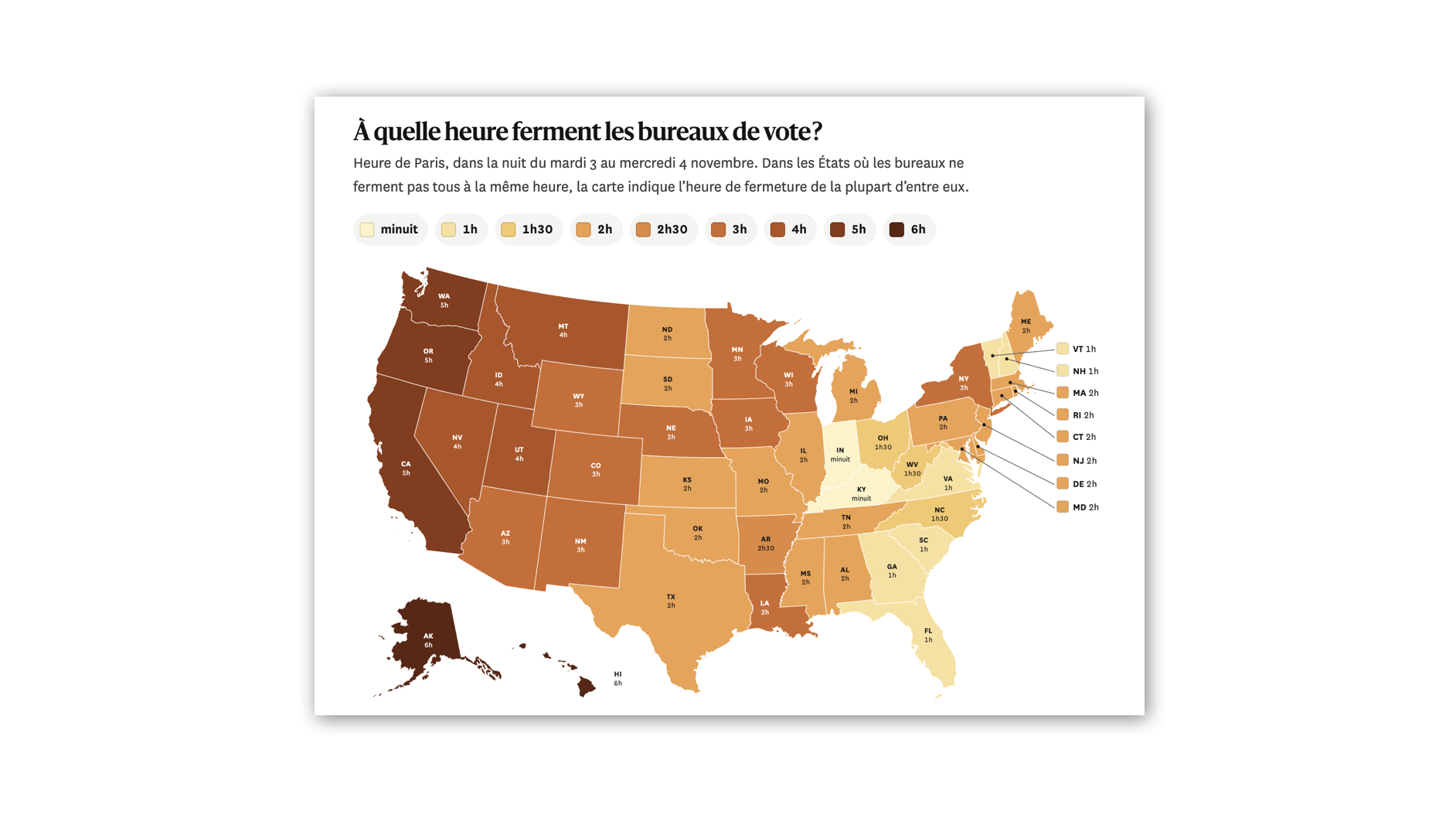
At midnight Paris time, as the first polling places close, the initial results could either reinforce or substantially dispel the notion of a Democratic tsunami.
- In Kentucky’s 6th district, a seat Trump won by 15 points in 2024, Democrats could snatch a seat that the GOP has held in the last seven elections. The Democratic Party has made Zach Dembo’s campaign one of its top priorities for the first time since 2018, following the departure of Republican Andy Barr, who has served since 2013. The first results are expected at midnight (Paris time), but vote counting is slow there.
- Starting at 1 a.m., the first results are expected in two Virginia districts. In the 1st district, which has been Republican since 1977, Republican Rob Wittman is neck and neck with Democrat Shannon Taylor, while Trump carried the district by five points. In the 5th district, which Trump won by 12 points, a defeat of Republican John McGuire by former Democrat Tom Perriello could portend a Democratic victory even larger than in 2018, when the party won 235 seats in the House.
One of the GOP’s major tests will be Florida, where two Democratic incumbents, Kathy Castor (FL-14) and Jared Moskowitz (FL-25), are running in redrawn districts that favor the Republicans: Trump would have carried them by 11 and 9 points in 2024, whereas Harris had carried them by 8 and 4 points before the redistricting. The outcomes there are expected from 2 a.m.
The control of the Senate is likely to start taking shape between 1 a.m. and 6 a.m., Paris time. Kentucky opens the night at midnight, followed by Georgia, Florida, South Carolina, and New Hampshire at 1 a.m.
- The South Carolina race, where Lindsey Graham’s sister—a senator and close ally of Trump who died in July—seeks the seat he had been named to succeed, could yield surprises. Trump had carried the state by 18 points over Kamala Harris, but polls indicate Democratic candidate Annie Andrews should narrow that gap significantly—and could even win.
- In Texas, a victory by Ken Paxton, the Republican candidate backed by a super PAC that has raised $158 million, largely from Elon Musk, would give Republicans a chance to retain their majority. The polling average shows a 3-point lead for Democratic candidate James Talarico, i.e., a result within the margin of error of the polls.
- Counts in the Senate races in Maine and Alaska, where ranked-choice voting is used, are expected to take longer: potentially several days or even weeks in Alaska. Democrats lead in polls in both states by less than 4 points, but a Republican victory cannot be ruled out.
The first results published by the Associated Press, based on ballots tallied, are expected to show a Republican lead in a number of races.
- That lead tends to narrow as the rest of the ballots are counted, and in some cases may give way to a Democratic lead.
- Since 2018, votes counted at 3 a.m. Paris time have tended to be 4 to 9 points more Republican than the final result, largely because conservative states that count quickly, such as Florida, carry significant weight in early tallies, before slower-counting Democratic states like California deliver their votes.
From one state to another, preliminary scores reflect the method of counting: where mail-in ballots and early voting are counted first (Ohio, Texas, Kansas, Iowa, Nebraska, Pennsylvania, Arizona), the early results tend to tilt more toward the Democratic side.
- Conversely, Republican voters tend to cast their ballots on Election Day at polling places.
- In states where these ballots are counted first (Virginia, Indiana, Tennessee, Maine, Alaska), Republican candidates tend to come out ahead in the early hours of counting.
- In 2020, Susan Collins led by 18 points in Maine with 16% of ballots counted; she went on to win by 9.