
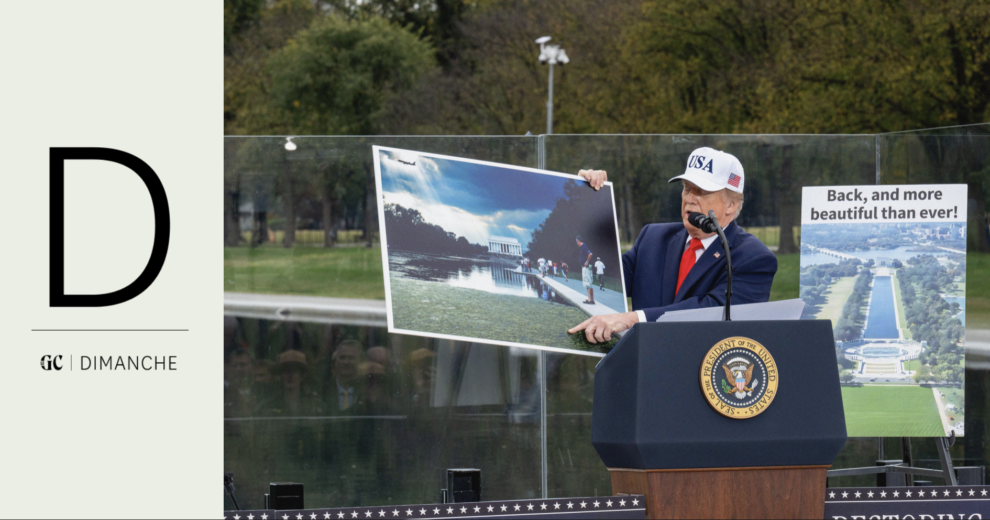
The Axis of Victory, from Grant to Lincoln
Observe this perspective. At the foot of the Capitol stands the Ulysses S. Grant Memorial, the general who won the Civil War. From there, the axis runs down to the Washington Monument, then extends, on lands reclaimed from the river, to the Lincoln Memorial. In the early 20th century, there was an effort to tell in the landscape, from one end to the other, the Union’s victory. And the narrative continues beyond the Potomac, to Arlington National Cemetery. It is precisely here, on Memorial Circle roundabout, that Trump wants to erect his Arc de Triomphe, about 75 meters tall, which would block the view of the resting place of those who died in war. It is the first, and most intrusive, of Trump’s projects in this area.
He also talks about bridging the highways that pass behind the Lincoln Memorial to create a terrace, a promenade that would descend directly to the river. This is a forgotten idea from the McMillan Plan of 1902, the one that drew the Mall as we know it. He has somehow exhumed it, and he wants to realize it. Then, he would add what he calls the National Garden of American Heroes, somewhere here, in West Potomac Park: about 250 statues of famous figures, of celebrities and heroes. It is still under study, but he mentioned it again on November 2 in front of the press.
And then there is the Reflecting Pool, which links the Washington Monument to the Lincoln Memorial. It’s probably the project that has drawn the most attention. He arrived saying: I will repair the basin. And soon after the new surface was laid, it began to peel. That cast doubt on the competence he continues to claim: he calls himself a builder, that’s his trade, he knows how to do it. And he really botched this project. And lo and behold, on the eve of the election, he stood here at the western end of the pool to deliver a speech strangely centered on this work, which is nevertheless one of the projects that gives him the most trouble.
A Fortress Around the White House
But the transformations continue. The Mall is the axis of legislative power; and perpendicularly, you have the executive axis, running from the monument to the Father of the Nation to the White House. There, he demolished that tiny building, the East Wing, which dated from more than a century ago and had been largely rebuilt during World War II. He wants to build there a ballroom of about 8,400 square meters, which would overwhelm the White House itself. It is so large that surrounding space must be trimmed to house it. And that will deeply alter one of the city’s most important axes, Pennsylvania Avenue, which connects the Capitol to the White House. The new ballroom would completely break the view.
Even more controversial, he wants to close Lafayette Square, the historic park facing the White House. It has always been public, and it’s one of the great spaces of the First Amendment. It’s where people come when the football team wins, when a disaster occurs, when one is in mourning, when celebrations happen, when protests take place. Of course, when security requires it, closing it is perfectly permissible. But otherwise, it must stay open. Closing it would deprive the public of another space. Furthermore, he wants to build next to it a building to filter visitors. It’s one more stone in the Trumpian edifice.
And then there is the north portico, right in front. It is there that, on inauguration day, the outgoing president welcomes his successor. But, next to the Little House, the ballroom will be so enormous that this portico may no longer appear as the true façade of the entire complex. What becomes clear when looking at the map is that this is a plan to transform the whole ensemble of squares and gardens into a fortress-like fortress.
A Power Without Checks and Balances
Here, in Washington, we do not have a chief architect. We have an architect of the Capitol, but he clearly answers to the legislative branch. For the White House, the law was written in such a way that the president effectively has near-total power to do as he pleases there. Normally, nothing can be built without funding voted by Congress. But by resorting to private funds, he found a loophole, and he exploited it.
That’s a bit technical, but it’s important. This building, which mirrors the Treasury on the other side of the White House, is the Eisenhower Executive Office Building. It was built in what we call the French Second Empire style: Mansard roof, granite, grandeur. And Trump decided he wanted to paint it white. Everyone knows that’s absurd. A painted stone has to be repainted constantly, and that would cost enormous sums. But behind it lies the idea of creating a uniform complex, the Executive Campus. And to make this building white, he attempted a deeply troubling maneuver.
This building falls under the GSA, the General Services Administration, which is, in a sense, the federal government’s major landholder: it manages courthouses and all major federal buildings, like those in Federal Triangle. Trump argues that the edifice, since it is part of the White House, no longer falls under the GSA, and that he can therefore do what he wants with it. To do this, he would need to establish that a project normally subject to environmental and heritage protection laws no longer falls under federal administration, but under the executive branch itself. If he succeeds, he could declare a “executive project” to basically anything: a pipeline, oil drilling, the sale of lands in national parks. He would only have to say that it falls under executive authority, and thus escapes scrutiny. If that passes, there will truly be no limit to what the federal executive can do in construction.
And then there are the masts. Again, a strange moment, without any scrutiny. Six years ago, I wrote an article about a solitary mast at Arlington National Cemetery, for which they wanted to add nighttime lighting. They had to go through the entire heritage-review process simply to light that flag. Trump, for his part, planted these two gigantic masts without consulting anyone. One man decided. He relied on a reading that proves legally plausible: if it is part of the White House, it is really up to him to do as he wishes.
A Precedent, the Roosevelt Years
To find a president who changed Washington this much, one would probably have to go back to the 1930s and 1940s, when the federal state underwent substantial growth. There is the Depression: Roosevelt arrives and creates a far vaster social protection system, a much larger federal government, a host of new departments and agencies; then World War II comes. It is necessary to build to house all these services, essentially office buildings. It is at that moment that the Pentagon is built. But that did not touch the truly emblematic buildings of Washington. It was simply about constructing infrastructure, administrative capacity.
Desecrating the Oval Office
All polls say these projects are unpopular. That is why it was so strange to see him, especially the day before the election, talk about projects that have done more to harm his reputation. They are diversions, and irresponsible expenditures at a moment when the public is preoccupied with the cost of living, because everything seems unaffordable.
My sense, if we go back to the beginning, is that it all starts with gilding the Oval Office. For the American sensibility, it is a very strange thing. There exists a certain dignity tied to the idea that political leaders are, in principle, servants of the people, not monarchs. Yet he added all this gilding. In a sense, he desecrates the spaces where presidential power is exercised, so that when he does things evidently unworthy of the office, there is no longer any dissonance. The Oval Office no longer resembles Kennedy’s, nor those of Carter, Reagan, or Obama. Nothing in that space recalls the presidential decorum: the contrast has vanished.
Ultimately, he cannot stand being in a space that is not his. It all starts there. He could go elsewhere, there are plenty of places, but it has to be his space. No recent president has been so often away from the White House. He retreats to his properties, which bear his name and which he has given the appearance of what, in his view, reflects his wealth and power. And now he is doing the same with the White House.
There is no style, not even a coherent taste. What matters to him are the superlatives: it must be the best, the most expensive, it must be him. He dislikes empty space, nor anything that is serene or quiet. His architecture resembles his rhetoric: he speaks to fill space, to fill time, and he builds in the same way. Look at the places that are his. Trump Tower, where his residence is, embodies a rather muted modernism, reminiscent of a hotel from thirty years ago. Mar-a-Lago is a Mediterranean fantasy, something entirely different. The ballroom will be all gold and inlaid with heavy classicism, almost rococo. There is no style. What matters is that it belongs to him, that he built it, that it bears his personal mark. Only then is it his space.
From Ridicule to Scandal
It began in ridicule, and it became a scandal. When he gilded the Oval Office, everyone said: it’s garish decoration, they’ll remove it, replace it, and everything will go back to how it was; just wait. But it’s not a joke. It’s serious. He wields near-total power to carry out these transformations, and people are now realizing what this arch really is, and that there is no need to tiptoe: it is for Trump, a monument to Trump. It is Trump who occupies the space reserved for those who have served the country, something he has never done. People understand that there is no longer any room for guessing the ego at play. It is now manifest.
Golf and the Public
And then there is golf, which will of course be a Trump golf course. He wants to redo this public course here, next to where the heroes’ garden would be installed. It is a vast open space. It is the most frequented course in Washington, because it is public and affordable. For Washington residents, it is a popular, pleasant, well-maintained course.
The maintenance, for him, matters. When he attacks Obama, it is the lack of maintenance of the White House that he invokes. What he sees must be maintained. But one could say that he does not maintain America: neither innovation, nor friendships and alliances. There are many things he does not take care of. He does not see personal attention paid to the art of governance as a form of maintenance. But his physical space, he does notice it; it gives him the sense of having control over things, and that matters to him.

In remaking this golf course, he does not see that Americans do not live in the same world as he does. He imagines that everyone plays golf, and that everyone thus wants to play on the best possible course. For him, golf is a display; it is neither a sport nor a way to share something with others, this little public and everyday adventure that so many people represent for him. He wants to make it a professional-level course, likely more expensive, and we don’t know if ordinary people will still be able to play. In a sense, he cannot conceive that the public exists. And that is why, at the moment, on the eve of the election, while polls show him extremely unpopular, he cannot picture this unpopularity.
Data Centers, New Temples of Power
Things may turn out well, in a sense. We must talk about data centers. From the first day of his second term, Trump signed a measure intended to restore beauty to federal architecture: new public buildings are invited to reconnect with a traditional, neoclassical style. The next day, he hosted at the White House the leaders of artificial intelligence. He, who claims to know about construction, he, the real estate man, now celebrates the data center as the grand and beautiful building par excellence, even though it is the ugliest there is. This takes us back to late 18th-century England, where factories suddenly invaded the countryside, ruin and industrialization of rural life, at the very moment London lines up its elegant terraces. Americans are beginning to see that the wealth and power networks that produced these Washington projects do not express themselves elsewhere in the country through beauty. What they see arriving are these enormous gray buildings that settle into their neighborhoods, consume electricity, push up energy prices, devour farmland and public lands. Perhaps for the first time, this link between power, technology and architecture makes people angry and mobilize them.