
As the midterm elections draw nearer, the polls are increasingly favorable to the Democrats. Yesterday, Sunday November 1, The New York Times published a series of polls showing the Democrats ahead or tied in the seven key states that will determine control of the Senate 1.
While a “blue wave” seems highly likely at this point, its magnitude could vary considerably.
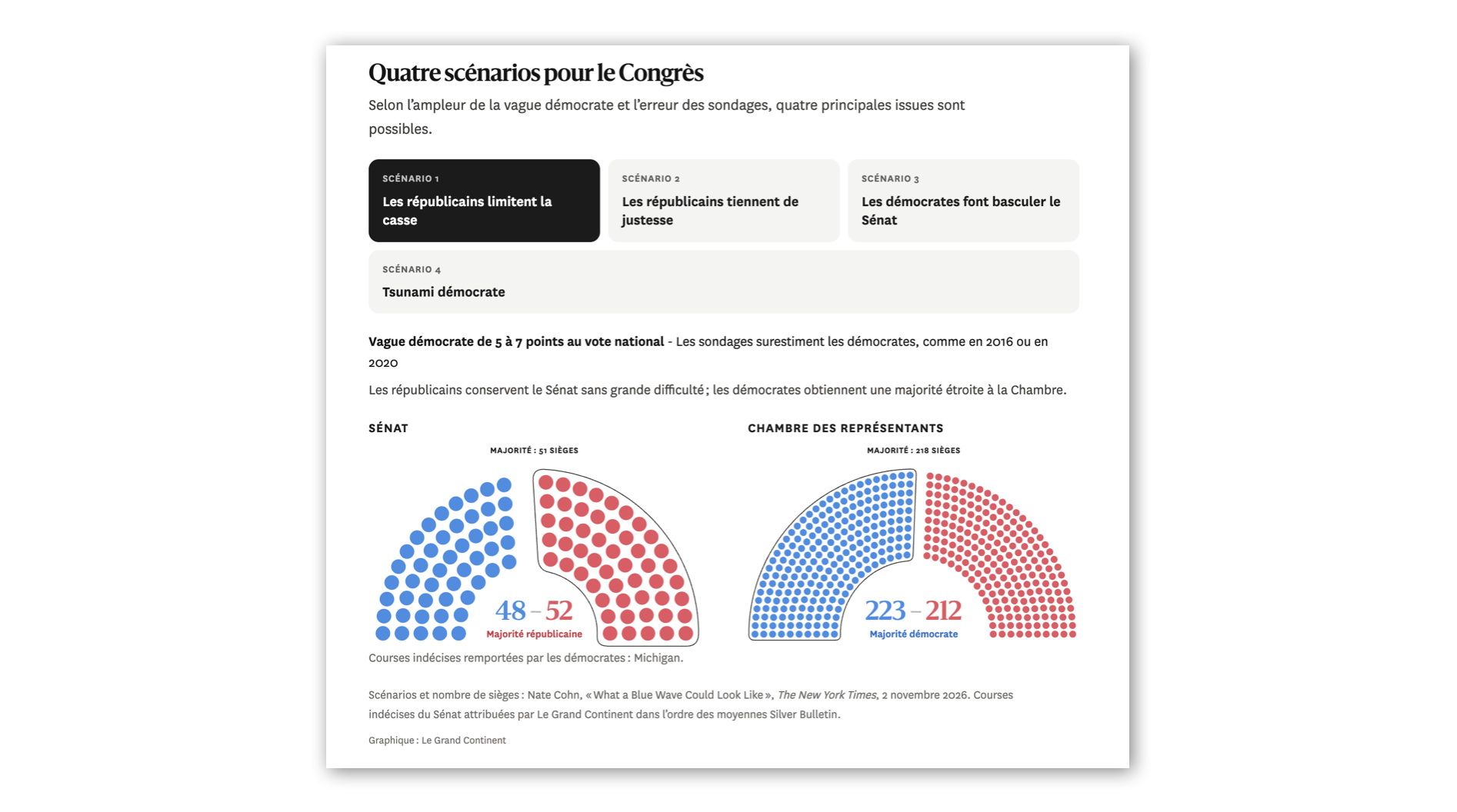
- According to analyst Nate Cohn, four main scenarios are plausible, depending on the strength of the wave and the margin of error in the polls.
- The first scenario would, compared with the latest polls, amount to a modest Democratic victory, who would take control of the House but with a narrow majority, placing them in the same kinds of cohesion challenges the Republicans have faced since the 2022 elections. The Senate would remain under Republican control.
- The second scenario could be viewed as a Pyrrhic victory for the Republicans, who, after spending hundreds of millions of dollars on advertising in key races, would keep Senate control thanks to the support of J. D. Vance. The House would be solidly Democratic.
- In the third scenario, the Democrats would flip enough seats to win a Senate majority. The party would then be able to render Donald Trump a true “lame duck”, a president whose room for maneuver would be markedly reduced.
- The fourth scenario, which Nate Cohn calls a “tsunami,” would see the Democrats prevail decisively even in states that have not elected a Democratic senator in decades: 1932 in Kansas, 1988 in Texas and in Maine, and 2008 in Alaska and in Iowa.
The third and fourth scenarios would expose the Republicans to three main risks.
The first concerns the Republicans’ ability to enshrine their priorities in the budgets to be voted on in 2027 and then in 2028.
- With a majority in both chambers, the Democrats would be well placed to press the White House to secure concessions on Medicaid cuts and food assistance, as well as on the substantial increase in the budget for the Department of Homeland Security, notably for ICE, the immigration and customs enforcement agency.
- They could also oppose the significant rise requested for the Pentagon budget by Trump.
The second risk relates to the continuity of major supporters of Republican candidates.
- The crypto, technology, defense, and fossil-fuel sectors, among others, have spent hundreds of millions of dollars to back Republican candidates in order to push their interests in Congress.
- These companies benefited from tax breaks, government contracts, mergers, deregulation, and presidential clemency granted by Trump.
- In anticipation of a Democratic victory, several large firms began hiring former Democratic aides to reconnect with the party: Paramount Skydance recruited a former member of the Biden administration; Palantir and the two giants of predictive markets, Polymarket and Kalshi, recruited former party advisers.
The third risk concerns the legacy of the Trump administration’s second term.
- A majority in both chambers would allow the Democrats to launch investigations into Trump, members of his administration, and his “representatives,” such as Jared Kushner and Steve Witkoff, who influence U.S. policy and negotiate deals without Senate confirmation.
- One of the early targets would be the Secretary of Defense, Pete Hegseth, heavily criticized—not only by Democrats but also by a portion of Republican lawmakers—for ordering the war against Iran without congressional authorization, for restricting journalists’ access to the Pentagon, and for failing to provide a full accounting of the cost of the war. The Republican Thomas Massie has pledged to force a vote on his impeachment as early as November.
- Among other potential targets would be the Attorney General, Todd Blanche, and the Secretary of Health, Robert F. Kennedy Jr. Trump himself could face a fresh impeachment proceeding before the end of his term 3.
The White House has been preparing at least since April for a possible defeat.
- Stephen Miller, Trump’s deputy White House chief of staff, and Russell Vought, the budget director, are said to have identified several executive measures Trump could implement without Congress on immigration, tariffs, housing, and federal spending 4.
- The White House lawyers would also have issued guidance to those named to political posts and to agency heads on how to respond to potential subpoenas and requests for documents.
- Trump himself could invoke executive privilege to shield from Congress his communications with private advisers: the White House had reportedly asked the Department of Justice for a legal opinion on this point.
Sources
- Shane Goldmacher and Ruth Igielnik, “Democrats Show Strength in Final Days of Race for the Senate, New Polls Find”, The New York Times, November 1, 2026.
- “American bosses are desperately trying to de-MAGAfy”, The Economist, October 27, 2026.
- Annie Grayer and Haley Britzky, “Pete Hegseth’s political future could be on the line if Democrats win the House”, CNN, October 30, 2026.
- Nandita Bose and Tim Reid, “Trump White House maps path to govern without Congress if Democrats win”, Reuters, November 1, 2026.