
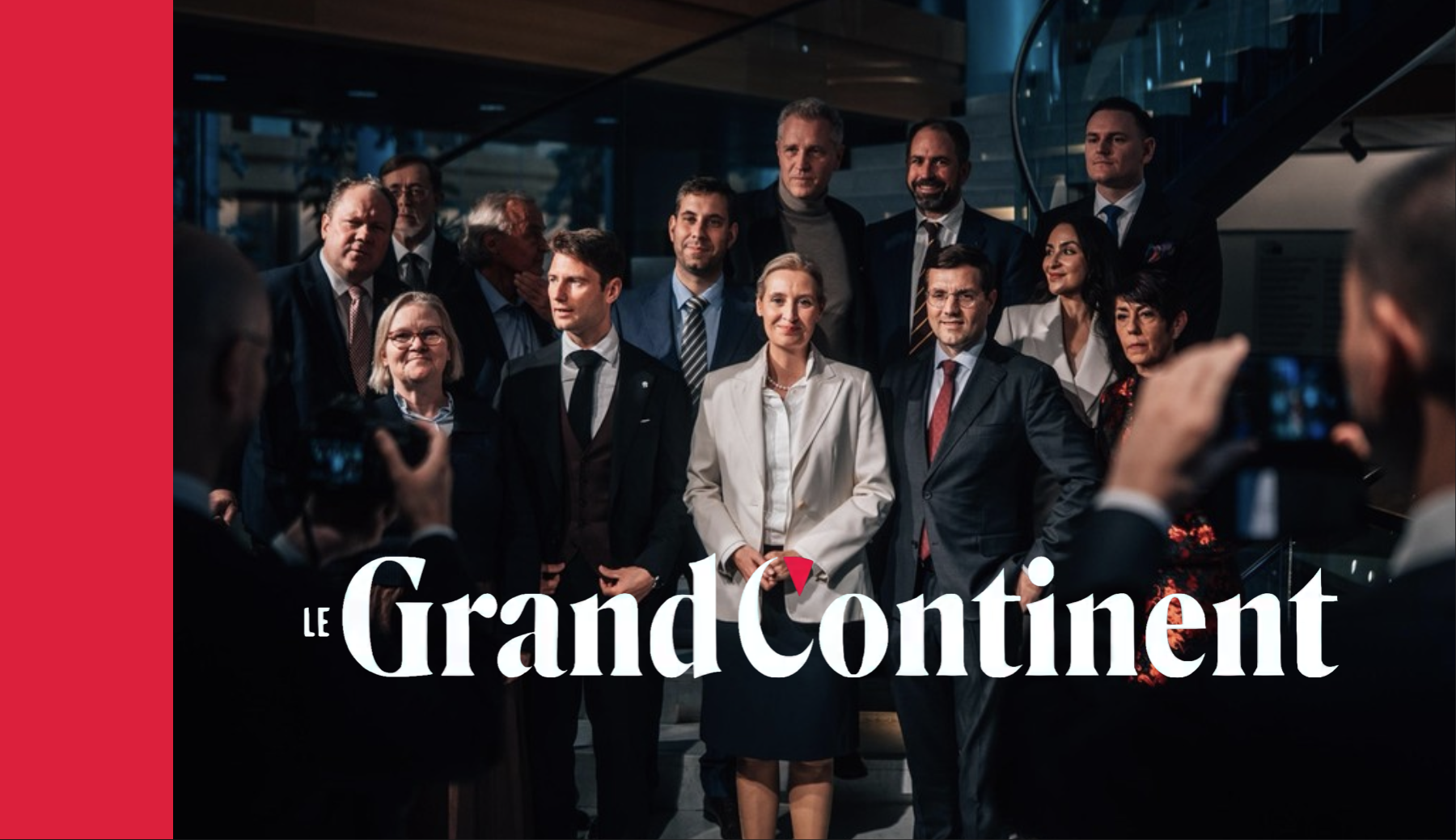
On Wednesday, October 21, the AfD unveiled a program to dismantle the European Union in the event of a “patriotic and right-wing” majority in the European Parliament in 2029. Spanning 14 pages, the text was drafted by the AfD’s parliamentary delegation, which sits in the ESN group whose 27 MEPs form the smallest group in the European Parliament. The far-right party views its strategy as contingent on two electoral conditions: winning power in Germany and forging an alliance of populist and nationalist right-wing forces in the Parliament. The AfD envisions fortress Europe but an Union emptied of its substance, which would dissolve in the face of the repeatedly stated principle of popular sovereignty, which is expressed only within the national framework.
While the plan draws on some measures shared by far-right groups, it also includes concerns more specifically German, ranging from defending financial interests to insisting on the right to use cash.
The concept of the “Dexit” sometimes used by AfD leader Alice Weidel on the domestic political stage does not immediately appear in this program, but rather as a possible last resort. If negotiations fail, the AfD states that it would leave the choice to the people in a referendum on the European Union if it were to lose the standoff with its partners. During the press conference, the party leader did not confirm the strategy regarding the common currency as expressed in the program.
The plan envisions an institutional, financial, and ideological reorientation of Europe: the end of the direct election of the European Parliament by universal suffrage, the centrality of the European Council, and a reduction of the Commission’s role to that of an administrative executor of its decisions. The party also envisions abolishing or “streamlining” a large portion of the directorates.
The text uses the term “European Union” only in negative terms, and generally in the past tense, and mentions only “Europe,” the “European level” (European level) when it concerns the form to be given to it.
The program also reads as a series of refusals directed at the European Union against an alleged unlimited expansion of its competences, and proposes a radical restriction of shared competences: the single market, outer borders, armaments, research and technology, and the defense of the common cultural heritage. Outside of these domains, the AfD envisions narrowly defined shared-competence areas, and rejects everything else. However, the program rests on largely unrealistic assumptions that would render European cooperation completely ineffective, including in the areas the AfD intends to preserve.
The plan envisions a Europe of nations with no normative ambitions in cultural, social, or ecological matters. The threat of withdrawal rights, called in the text “Opt-Out,” serves as a permanent leverage tactic.
The Reorganization of European Cooperation: Sovereign Nations, Common Europe
Foreword: A Europe of Nations as the Aim of German Policy
In 2029, what we have barely dared to imagine until now could become a reality: a patriotic, right-wing majority in the European Parliament is within reach. This makes possible a fundamental shift in the direction of Europe. We must seize this historic window. Not just for cosmetic corrections, but for a fundamental reorganization of European cooperation. The mistakes in the development of the European Union and the common currency are so profound that a few reforms would not suffice. A patriotic right-wing majority must therefore implement substantive changes. We want to renegotiate the European treaties!
The European competencies must be limited to areas where concrete advantages are evident. Their mission is primarily the effective protection of Europe’s external borders, the single market, cross-border crime fighting, and the cooperation and coordination of security policy.
This reorganization must necessarily entail financial and institutional consequences. The European budget will be seriously reduced and the European administrative apparatus radically slimmed. Germany must stop playing the same role for decades, that of treasurer forced to excessive contributions!
The architecture of the common currency must also be fundamentally transformed. The initial Maastricht Treaty stability criteria should be reactivated as the foundation of the euro, and a country’s vote in the ECB Council should be tied to its size. Germany must receive a voting weight corresponding to its financial and economic weight. The TARGET balances negotiated within the euro area are to be scrapped and replaced by regular asset values. A bankruptcy regime is introduced in the monetary union, and the ECB returns to neutrality in monetary policy.
Tant que ce processus de négociation est en cours, les possibilités d’Opt-Out – comme le Danemark, la Suède, la Pologne et d’autres États-membres les utilisent – sont le moyen de choix, pour protéger l’Allemagne des dommages (souveraineté coopérative). Ces règlements d’Opt-Out peuvent être utilisés pour que l’Allemagne ne soit pas forcée de participer à des politiques conséquentes et particulièrement dommageables pour notre pays, comme les attributions d’immigrants n’ayant pas de droit de séjour en Allemagne conformément aux accords de Dublin, ou les emprunts de l’Union européenne garantis en commun.
The year 2029 could thus be a historic milestone. If it turns out that, despite a German government in which the AfD participates and favorable majorities, substantial transformation of the European Union is impossible, the decision must return to the sovereign—the people—in a democracy. Then the German people themselves will decide the European path Germany will take. The year 2029 is historic; it enables us to turn Europe from a centralized entity into a Europe of sovereign nations.
Chapter II: Organization of Competences, European and National Responsibilities
The insidious expansion of European competences into areas of national self-determination and the guarantee of their existence is the root of the loss of trust in the European Union. A Europe fit for the future needs two things: a real boundary between true common missions and national competences, and an effective instrument to enforce this boundary in debate. The instrument is “non-participation,” the sovereign “Opt-Out.”
1. The Right of Withdrawal (“Opt-Out,” NDT) as a Correction of the Organization of Competences
When the European Union oversteps its central missions, and intervenes in national competences without justification, without producing a clear common added value, member states have the right to non-participation. Denmark, Ireland, Poland, and up to 2020 the United Kingdom have shown that separate developments (Sonderwege) guaranteed by the treaties do not weaken European cooperation, but rather strengthen it. They force the Union to self-limit on what truly requires a common rule. Germany will use this instrument decisively in the future—not as a retreat or a flight, but as a correction in the service of a common Europe that acts only when it directly benefits its peoples.
2. The Central Missions of a True European Cooperation
In the following areas, joint action is the expression of subsidiarity and not a violation—they represent the domains in which European cooperation provides a proven added value:
- The Internal Market as a Space of Economic Freedom
We support free trade of goods, services, capital and people to the extent that they benefit our peoples. The internal market must be freed from the shackles that hinder the economy. Rather than regulatory excesses like the Green Deal, REACH, or ESG directives, we rely on unleashing the economic force of our entrepreneurs and workers and preserving our industrial fabric.
- The Continent’s Shield – Effective Protection of Our External Borders
Sovereignty is unthinkable without the physical integrity of the borders. The flawless protection of the European Union’s external borders is not optional but an existential duty. Only a fortified border defense can guarantee internal security, the rule of law, and the continent’s cultural identity. It is the foundation on which trust and order rest across our continent.
- Defense of Europe’s Natural Heritage
The protection of air, waterways, and biodiversity is the protection of our homeland (Heimat) natural. Where natural spaces do not stop at natural borders—such as keeping our great rivers clean or protecting fish stocks in our seas—we coordinate our actions with resolve. We safeguard Europe’s natural heritage for future generations.
- Arms and Defense Technology
A genuine strategic autonomy requires foregoing energy dependencies, particularly on non-European powers. We rely on cooperative defense industries among sovereign states: through joint development in key areas such as drone systems or security-oriented artificial intelligence, and through mutually prioritized purchases, we pool our forces for a common national arsenal. Cooperation here serves technological assertion and industrial strengthening, while command of the soldiers remains, necessarily, in the hands of the states.
- Research and Technology
To shape its own future, Europe must break its technological dependence on non-European powers. We pool our strengths in cutting-edge research—from space exploration to revolutionary medical innovations and the development of homegrown AI models, up to the energy sources of the future. Europe must be a center of excellence, asserting its freedom through technological breakthroughs.
- Protection of Our Western-Christian Heritage
The identity of our continent is expressed in the unique material and spiritual diversity: it thrives on the diverse languages, the depth of its philosophy and its legal culture, in the grandeur of its music as well as in its cathedrals and in the places where our history was carved in stone. Protecting our heritage as a whole is a duty to our history and to future generations.
3. National Non-Participation: Where Germany Exercises Its Right to Withdraw (“Opt-Out,” NDT)
In the following areas, the European Union lacks legitimacy by treaty and democracy to take centralized action: Germany thus commits to a fundamental renegotiation of the European treaties to permanently and officially bring these competences back to the national level, in accordance with the principle in EU law of case-by-case authorization (Einzelermächtigung), whereby any competence not explicitly delegated is retained by the member states. Until this reorganization is completed by treaty, in the areas where Europe tries to intrude at the heart of national sovereignty, Germany will resolutely exercise its right to non-participation, the Opt-Out rights:
- Fiscal and Social Policy
The organization of the welfare state and tax collection belong to the non-negotiable core of democratic self-determination. We reject any form of European social harmonization. With us there will be neither a European minimum wage, nor European unemployment insurance, nor supranational social funds. Guaranteeing the autonomy of social partners at the national level and protecting our economic structure take absolute priority over egalitarianism and a welfare state imposed by the European Union.
- Migration and Asylum
Deciding who enters our territory and who remains is the most elemental characteristic of state sovereignty. We explicitly support cooperation for steadfast protection of outer borders, as well as European solutions for relocating asylum procedures to third-country states. But what we strictly reject is intra-European administration of migration at the expense of the nations’ ability to act. Germany will no longer participate in any mechanism of distribution or quotas for asylum seekers. Following Denmark’s model, we demand an “Opt-Out” that guarantees unlimited border rejection capacities. European cooperation is necessary at the borders, but the final decision at the German border must remain sovereign.
- Security and Defense Policy
The decision on war and peace is the decisive sovereign responsibility of the state and can never be delegated to supranational institutions; we strictly reject a European Army with centralized leadership, or the pooling of defense policy. The constitutional parliamentary reserve and the national command exercised by Parliament over our armed forces (Parlamentsheer, NDT) are sacrosanct. Germany will not participate in any supranational military structure that erodes national chains of command and subordinates German soldiers to foreign engagement doctrines.
- Intervention in Societal Matters
The European level has no mandate to alter the social orders inherited from the history and culture of its member states. We reject participation in programs that, under the guise of “values” or “civil society,” install ideological control in gender policy, climate policy, or family policy. Financing networks of political actors and NGOs with European funds is a misuse of public funds and will not be supported or tolerated by Germany.
- Distribution and Permanent Subsidies
True solidarity requires individual responsibility. We reject the insidious establishment of a European transfers union. There can be no cohesion logic that camouflages a lack of competitiveness with permanent subsidies. Financial transfers without firm and measurable countervalue and without structural reforms cement dependencies and will thus be blocked by a German veto. These reservations are not a ragbag of individual demands, but the coherent application of a political principle: every competence not at the heart of Europe’s true missions must return to the nation. To permanently enshrine this restitution principle in primary law, renegotiation of the European treaties under Article 48 TEU is the essential goal— to be pursued if necessary in the transitional period through an German Opt-Out. The method of anchoring this instrument in law and its application across political domains is developed in the roadmap of Chapter VII.
Chapter III: Institutional Architecture: A Parliament of Nations
An organization of competences that exists only on paper and is not anchored in the institutions and the sovereignty of the people remains ineffective. The current administrative structure of the European Union is characterized by diffuse responsibilities, a delusional Commission, a legislative practice with privileged access for lobbyists, and a Parliament poorly connected to the nations, and it is therefore entirely out of control. An institutional reorganization of the European Union must ensure that the boundaries between national and European competences set out in Chapter II are also democratically enforceable.
1. Democratic legitimacy through national parliaments
We want a Europe of sovereign nations. Thus the European Parliament should no longer be elected by direct universal suffrage but be composed of deputies sent by the nations. Each national representation elects its delegates according to its majorities in each country and thus directly transmits its democratic legitimacy to the committee work (Gremienarbeit) at the European level. Thus the Parliament remains linked to the citizens of the nations rather than developing its own logic.
2. Clear competences: the Council decides, the Commission administers
The European Council becomes the central decision-making body: heads of state and government negotiate and decide directly. The Commission is confined to a coordinating and executing role, and no longer acts as a de facto government. The majority of directorates-general and agencies is leaner, superfluous structures are dissolved, and duplicative competencies are merged. Regular oversight and a systematic elimination of EU legal acts ensure that member states retain their decision-making power.
3. Priority of national law
National constitutions take precedence over secondary European law, as long as the latter does not concern the EU’s true central missions. Within the central missions—especially the internal market—the European law is unique and binding for all member states: this is how a common economic space can function. The primacy of national law applies precisely where the EU oversteps the powers entrusted to it by the treaties, and intrudes at the heart of national sovereignty—not where member states have consciously delegated regulatory competence. The Court of Justice of the European Union will be transformed into a European arbitration court, which will intervene only as an inter-state body in well-defined treaty-law questions within the transferred competences, and not on national competences or constitutions. Articles 4 and 5 TEU will be amended accordingly, to guarantee the scope of competences and the legally safeguarded national interpretive sovereignty.
4. The Legal Framework for the Right of Withdrawal
To ensure that the national reservations mentioned in Chapter II do not remain mere statements of intent, binding protocols must be embedded in the EU treaties, modeled on the derogation regimes enjoyed by Denmark and Ireland. An opt-out right is effective only if guaranteed by the treaties and cannot be revoked at the whim of the Commission. This institutional overhaul thus provides a legal basis for the substantive requirements of the distribution of competences.
Through this architecture, we end the Brussels centralism era and lay the foundations for an Europe that is not sustained by regulations, but by the free will of its peoples. We are building a structure where freedom and sovereignty do not oppose each other, but instead constitute the necessary conditions for its durability.
Chapter IV: Financial Sovereignty: Responsibility Instead of a Union of Transfers
Financial sovereignty is the foundation of any national self-determination. A people that no longer decides how to use the means it has generated loses its capacity to act politically. The current EU financial system has moved away from the principles of individual responsibility and integrity and has been replaced by a system of collective guarantees and redistribution. The new Europe demands a return to fiscal truth: freedom and responsibility must again be inseparable.
1. End the role of treasurer: a limited budget
The end of Germany’s role as the European Union’s treasurer is not merely a fiscal demand but a democratic assertion. We demand structural caps and a reduction of the European Union budget.
- Contributive sovereignty
The logic of automatic redistribution ends. We demand the abolition of VAT and of own resources, as well as a drastic reduction of Germany’s net contribution. In the future, Germany will release funds only for tasks with demonstrable European added value.
- Administrative efficiency
The administration of the European Union must not be an end in itself. We demand a strict freeze on staffing and the coherent dissolution of agencies without fundamental functional benefits.
2. Invest in convergence rather than funding an ideology
Public resources must not be misused for ideological re-education. The European level has no mandate to intervene in the established order of peoples by funding politicized NGOs or socio-political programs.
- The value-added principle
EU programs aimed at promoting “values” or “democracy education,” which actually serve to exert unilateral political influence, must be scrapped without replacement.
The cohesion policy is shifting from a system of permanent transfers to a model of measurable progress. Helping people help themselves instead of cementing their dependency: in the future, funds will be disbursed only according to strict convergence indicators and with higher national contributions.
3. Sovereign investments: private capital and strategic alliances instead of Brussels-funded debt-financed funds
Europe’s dramatic weakness in global industrial and technological competition results from a striking lack of venture capital and private equity. The creation of ever-new European funds, financed by debt, merely obscures the real causes of the flight of European capital. True financial sovereignty requires moving away from debt-financed funds and toward unlocking private creativity.
- The deregulation of the capital market
European capital must be able to flow freely toward industrial and technological innovations, rather than being forced into unproductive green financial products by policy directives.
- The new Europe as coordinator of strategic investments
Instead of ideological redistribution, we call for a framework for intergovernmental investment consortia. The European Union acts as the administrative coordinator of large-scale industrial and technological projects, whose financing is decided sovereignly by the member states. In this way, we pool national resources to achieve continental economies of scale and make the Union the coordinator of our strategic independence.
4. A stable monetary system for free citizens
True financial sovereignty also includes protecting individual assets from government access and from inflationary devaluation. The Euro system needs a fundamental overhaul to restore budgetary robustness.
- Monetary discipline and the neutrality of the ECB
We demand an end to indirect government financing by the ECB and an annual balancing of Target 2 balances with assets of value such as gold or Bitcoin. In the future, ECB Council voting rights should be based on share ownership. The ECB must remain strictly within its original mandate of price stability; we reject integrating climate, social, or economic policy objectives into its monetary policy decisions as a violation of its neutrality and contractually guaranteed independence.
- Freedom of payment operations
The right to cash must be enshrined in European treaties as an expression of individual freedom. We oppose the introduction of central bank digital currencies (CBDCs) because they have the potential to monitor and control private payment flows completely.
We regard decentralized cryptocurrencies like Bitcoin as a step toward a free financial order. Instead of overregulation such as MiCA, we rely on a framework that fosters innovation and safeguards the sovereignty of individual assets in a digital world.
5. A fundamental question of monetary union: a coherent reform rather than a flawed construction
The euro, in its current design, suffers from a fundamental structural flaw: a monetary union of economically heterogeneous economies without fiscal integration has, by back door, led to a debt-and-liability union. The reforms mentioned in this chapter—end of indirect government financing by the ECB, equalization of TARGET balances, capital-weighted voting rights, a credible insolvency regime for member states—are the way we demand to correct this flawed construction and place the euro on a durable base of personal responsibility.
As noted in the Foreword, the decision on Germany’s future European and monetary policy orientation is, if in doubt, reserved to the sovereign itself.
6. The Fiscal Veto as a Protective Instrument
For us, restructuring European finances is non-negotiable. Germany will relinquish its role as financial guarantor for a redistribution policy doomed to failure.
If a deep reform of the EU’s financing system were blocked, Germany will opt for a parliamentary blocking strategy in future decisions on own resources. Whoever respects the freedom of peoples must respect their financial sovereignty.
The reforms presented must be understood in the context of the reform of European monetary policy envisioned in the electoral program for the Bundestag elections in 2025. In this framework, retaining the euro—or a flexible unit of account akin to the ECU—remains a possibility as a parallel element. However, even in this scenario, the euro should be adapted accordingly.
Chapter V: Sovereignty in Production and Supply: Economy, Energy, and Agriculture
The material foundation of our political freedom lies in a performant and autonomous economy. A new Europe should aim to become a leading global hub for industry and innovation, rather than a highly regulated open-air museum or a mere market for goods, lacking any intrinsic creative capacity. True sovereignty requires control over our own energy supply, protection of domestic production, and the guarantee of our food sovereignty.
1. Industrial substance and technological freedom
We advocate for an Europe that frees the creative forces of its entrepreneurs and skilled workers, rather than paralyzing them with dirigistic directives.
We call for a moratorium on any new European regulation. Existing constraints—such as the REACH regulation on chemicals or bureaucratic supply-chain legislations—should be scaled back to a fair level, or even abolished.
- Technological neutrality
Innovation must not be hindered by bans (such as those targeting internal combustion engines). As noted in Chapter II, we will coordinate our research efforts where they strengthen our strategic autonomy—particularly in the areas of artificial intelligence, robotics, aerospace, and modern nuclear research.
2. Energy sovereignty: the national mix as a competitive advantage
Energy supply constitutes the nervous system of any industrial nation and must remain under state responsibility. We therefore demand the end of the European “Green Deal,” whose centralized planning directives compromise supply security and push up prices.
- Freedom of the energy mix
Each nation decides its energy mix sovereignly. Germany must retain the freedom to rely on nuclear energy, coal, gas, and renewable energies, depending on the needs of its economic fabric. Affordable energy is the fundamental production factor on which the survival of our industrial base depends.
- Preserve competitiveness rather than imposing bureaucratic constraints
Low-cost energy and a strong industrial base constitute the foundation of our prosperity.
We reject all bureaucratic devices that undermine these foundations, such as mandatory CO2 quotas or border carbon adjustment mechanisms (MAC). Rather than ideological orientation, we demand an energy policy that respects the freedom of decision of member states, secures industrial production, and enables full deployment of our economic and industrial capacities.
3. Agriculture: stable funding and strategic food sovereignty
Our farmers are the guarantors of our strategic food sovereignty and the stewards of our cultural landscapes. Recognizing that agriculture—essential to the survival of our nation and our continent—cannot be reduced to just another economic sector, we intend to protect our high-quality domestic food production.
- Ensure stable funding for farmers
We demand, in the short term, the abandonment of any plan to reduce funding under the Common Agricultural Policy (CAP). The degressivity and cap on subsidies threaten farms and endanger Germany’s food security. In the long term, we favor renationalizing support for agriculture.
We are in favor of international trade, a motor and vector of our prosperity. Diversifying trade relations creates new markets and strengthens the resilience of supply chains. At the same time, the negotiation of trade agreements should not come at the expense of citizens and their democratic rights. Trade agreements must be concluded only if the quality of imported agricultural products is beyond question. We must be able to feed ourselves by our own means if we want to avoid any form of coercion. In principle, we believe it is democratically necessary that trade agreements be subject to approval by the competent Parliaments.
- Reduction of bureaucracy
The will to develop international trade is hampered by excessive Brussels bureaucracy, which leaves little to no room for German and European agriculture to prepare for the global agricultural market and compete on an equal footing. Therefore, European agricultural bureaucracy must be dismantled and its policy reformed. Only in this way can the European Union create internal conditions for its prosperity. We should simply collect farm data and tailor instructions to farm size and practical reality. Approvals must be given more quickly and excessive regulation must be reduced so that farms can invest more easily and find their footing in the markets. Thus our excellent products gain international competitiveness. Thus European quality standards and the sustainability of local agriculture will be guaranteed.
Chapter VI: Intellectual Life and the Public Sphere: Education, Culture, and Media
Our European identity is not the product of Brussels decrees but a common heritage that lives in the diversity of our peoples, languages, and traditions. As the homeland of freedom of opinion and thought, we see in Europe a special duty to resist paternalism, censorship, and surveillance. The defense of this heritage against technocratic egalitarianism and the repression of opinions is for us more than an educational, media, and cultural theme; it is a central mission of our policy. To protect Europe in its diversity and unity, the prerequisite is that intellectual and identity-related competencies be clearly held by the nations.
This section lies at the heart of AfD programs, both nationally and regionally: the restoration of a supposed freedom of expression and “national values” fits into its metapolitics approach and its aim to align culture and education with the party’s positions. It is notable that it also addresses these questions at the European level, where the European Union has only limited competences.
1. Cultural policy: a space for preservation and creation
The cultural diversity of Europe is nourished not only by preserving its heritage but also by the creative minds that understand yesterday, today, and now and render it visible or audible. This, however, requires a freely developed space, not ideological instructions and regulations. We want to create such a free exchange space that protects artistic creation, and we reject any political conditionality for subsidies.
2. Education: sovereignty over one’s own intellect
The preservation of education, language, and history is the condition of a citizen identity and democratic self-determination. We therefore reject any attempt to level national school curricula or cultural identities through European instructions. Sovereignty over educational institutions is intangible. Each nation decides for itself how to protect and develop its heritage.
3. The Media: Freedom of Debate as the Elixir of Life
A Europe of free nations requires the competition of arguments, not the imposition of centralized narratives. Media diversity and freedom of opinion are the lifeblood of democratic participation. We reject extending European mechanisms of sanctions to journalists and any instrumentalization of the law against divergent political positions. A democratic order is defended by free speech, not by politically correct censorship. The European level must not be used to control public opinion or to ban critical discourse.
4. The Family as the Foundation of Society
The family, consisting of a man, a woman, and children, is the indispensable ferment of every society. In it, responsibility is lived, intergenerational cohesion is fostered—it is the condition of everything that makes education, culture, and community in Europe possible. Protecting marriage and family is therefore not a secondary lever of social policy but a pillar of our conception of society. We support the family as a natural institution protected by the Constitution and reject any attempt to relativize its importance relative to any life choice or to abolish its socially determining function. This includes protection of life from conception to natural end. From this protective function also follows the rejection of any ideological remodeling: we reject the institutionalization of gender mainstreaming and LGBTQ propaganda, and advocate against early sexualization in educational institutions and in public spaces. We must guarantee children a protected space for their natural development, free from ideological influence. Support for families and children is a national responsibility: the European level has no competence or mandate in this area.
Chapter VII: Future and Implementation: The Reorganization of Europe
With a federal government including the AfD, a phase of responsibility opens for Germany, during which the orientation and future of the European Union will be renegotiated in the interest of European nations and their citizens. The central objective of this reform is a global renegotiation of European treaties, aimed at permanently embedding in primary law the model—developed in this document—of a federation of sovereign European nations. This reform will unfold in three successive phases, involving increasing time horizons and progressively deeper legal scope.
1. Measures within the existing legal framework
As soon as the government takes office, all measures permitted by current law will be undertaken:
- Elimination of superfluous agencies and directorates-general; reducing the Commission to its essential portfolios.
- Implementing a spending brake within the multiannual financial framework.
- Introduction of a national veto right in case of violation of the subsidiarity principle.
This will require qualified majorities in the Council as well as simple majorities in Parliament.
Time horizon: two to three years.
2. Measures requiring treaty amendments
The heart of this reform requires a global renegotiation of the European treaties, according to the procedure provided in Article 48 TEU — unanimously by the European Council and ratification by all member states. This renegotiation pursues a double objective: institutional reform (Chapter III) and the durable—and contractually irrevocable—incorporation of the national reservations mentioned in Chapter III in the form of binding protocols, modeled on the derogation regimes enjoyed by Denmark and Ireland. More precisely:
- Transformation of the European Parliament into a chamber composed of delegations sent by the nations.
- Clarification of Articles 4 and 5 TEU aimed at establishing the primacy of national law outside the domains of the EU’s true fundamental missions, while confirming the primacy of EU law within those fundamental missions—most notably with regard to the internal market (Chapter V).
- Inclusion of a mechanism to limit debt and spending in primary law.
- Inclusion of binding Opt-Out protocols for the areas listed in Chapter II.3, which could not be left to the sole discretion of the European Commission.
Time horizon: five to seven years.
3. Budgetary sovereignty as a lever
Given that any modification of the decision on EU own resources requires unanimous ratification—and thus the approval of the Bundestag and Bundesrat—the Germany possesses an effective veto. If Brussels blocks the path to reform, this veto will be used to block future legislative acts relating to the Union’s financing and to drastically reduce German contributions. Germany is no longer willing to fund a system that refuses reform.
4. The Opt-Out mechanism: identifying gaps and demanding a reform
For us, resorting to an “opt-out” is not an end in itself; it is the consequence of a clearly identified gap in current cooperation, as well as a necessary transitional instrument until the treaty revision described in point 2 is completed.
Where we choose to withdraw, we also propose domains where true European cooperation could take over—drawing on Denmark, Ireland, and Poland as examples, showing that specific trajectories and European added value are not mutually exclusive. The following measures illustrate how, through the opt-out strategy, we enable a reform of European cooperation:
- Financial and budgetary policy
Problem: The mutualization of responsibilities and the banking union undermine individual responsibility and distort competition among member states.
Reform: Instead of mutualizing responsibilities, we propose a transparent convergence and early-warning mechanism that highlights divergences without funding them with other taxpayers’ money.
Problem: The digital euro and the transfer union erode citizens’ monetary sovereignty.
Reform: We demand, instead, the inclusion in European law of the right to use cash (Chapter IV.4) as a fundamental right for all Europeans; this is genuine cooperation aimed at protecting individual freedom, rather than centralized control.
- Migration, asylum, and border protection
Problem: The common distribution of asylum seekers has collided with the diversity of national realities and eroded trust in the Schengen area.
Reorganization: Where distribution fails, external-border cooperation must be strengthened: we rely on expanding Frontex, on common return agreements, and on relocating asylum procedures to third countries—true European cooperation where it is effective.
- Climate and agricultural policy
Problem: The Green Deal and centralized regulations undermine Europe’s industrial and agricultural foundations. They must be scrapped.
Reorganization: Instead of dirigiste governance, we favor a cooperation that protects Europe’s productive forces: we rely on common protection of the internal market against substandard imports (food sovereignty) as well as cooperation in technological areas in nuclear and energy research (Chapter V). True European cooperation protects production rather than stifling it with bureaucracy.
- Industrial policy and infrastructure
Observation: The EU’s current support gets lost in micro-management and a patchwork logic, where funds are disbursed according to proportionality criteria rather than strategic effectiveness; this results in increasing technological dependence on non-European powers.
Reorganization: Germany uses the Opt-Out to enable the allocation of national funds to the model of “investment consortia” defined in Chapter IV. We envisage a reformed European Union acting as a central platform and project master: coordinating, across national borders, the large-scale deployment of major projects—from autonomous energy infrastructures and satellite navigation systems to semiconductor production capabilities. We thus unite our national economic and industrial strengths in a continental effort, in the service of a “Plan for European Power.”
- Supply chains and securing raw materials
Observation: EU legislation on supply chains weakens our competitiveness by imposing excessive control bureaucracy and liability risks based on moral considerations.
Reorganization: Germany ends this regulatory burden by asserting its Opt-Out. We advocate the creation of an “European Alliance for Securing Supplies”: rather than constraining its own companies, the European Union must mobilize its diplomatic and economic weight to guarantee access to critical raw materials directly from partner countries. True European cooperation means geopolitical security of raw material supply, rather than bureaucratic oversight of our own value chains.
These exemption clauses must be implemented in concert with partners who wish to pursue the same path—one of self-assertion and constructive reform. Thus, isolated disengagements become a common European project.

Chapter VIII: The Model: An Association of European Nations
Our Europe of the future is not a centralized federal state but an association of sovereign nations. In this model, each nation bears and guarantees its own sovereignty. Common policy takes place exclusively where it creates added value that the national state alone cannot create. Immutable principles form the basis of this cooperation:
1. Subsidiarity and responsibility instead of centralism
Subsidiarity is not merely an administrative slogan, but a fundamental principle of the state in Europe, whereby power is always considered from the smallest to the largest level. Decisions must be taken where they have effects: in families, in municipalities, regions, Länder or nations. By returning decision-making power to the citizens, we defend Europe’s ideal of freedom and responsibility against the current development of a total administration. Subsidiarity is the courage to decide for oneself: where EU institutions seek to standardize every aspect of life, we rely on organic growth and the judgment of our peoples. We do not want a return to national narrow-mindedness, but the recognition that Europe is strong only when it respects the freedom of its parts.
2. Responsibility as the rule of sovereignty
The principle of responsibility for us is inseparable from the concept of state sovereignty; a community of sovereign states rests on the principle that freedom and responsibility are two sides of the same coin. Each state is responsible for its actions, its economic decisions, and its finances. The end of guaranteed joint debt and forced redistribution is therefore not only an economic necessity but a matter of political honesty. Acting without bearing responsibility corrupts the character of the political community. True European solidarity is expressed not in revenues from anonymous transfers but in mutual respect for financial sovereignty and each nation’s economic contribution. Responsibility means getting one’s house in order to be a reliable partner in the common European village.
3. The Community of Destiny of European Nations
A new Europe will rise not through a mandate to unify, but through a common community of destiny. We reject all national chauvinism that places itself above others, as well as universalism without roots that declares peoples nonexistent or seeks to dissolve them.
Our path is to recognize the dignity of every people: only those firmly rooted in their own identity possess the inner grandeur necessary to respect, in return, the uniqueness of their neighbor. True European solidarity does not draw its source from abstract regulations, but from the pride of sovereign nations, united in their diversity.
Where Brussels centralism views the uniqueness of European peoples as an obstacle and seeks to erase it through homogenizing “harmonization,” we see, for our part, the source of Europe’s cultural and spiritual strength. European unity does not rest on regulations, but on the shared conviction that our ethno-cultural identity and our Western culture are the most precious goods to be preserved in an increasingly anarchic international world. Only a union that defends national specificities as essential elements of Europe’s common heritage will find the strength to assert itself.
The target model is that of an association of European states preserving their independence and freedom of decision. Each nation retains full sovereignty over its internal affairs and participates in common policies only on the basis of a clearly defined convergence of its national interests. Cooperation operates where it is necessary and mutually advantageous: for example in security, trade, research, and the protection of common living conditions.
4. Core Principles of the New Europe
The subsidiarity principle implies that political decisions are taken as close as possible to citizens, at the local or national level. It is only when a problem clearly exceeds the competences of a nation that it is addressed at the community level. Take migration as an example: immigration control remains a national prerogative; it is only in the presence of cross-border challenges or threats that coordinated European measures can be considered. However, such common measures must never infringe the sovereign competence of nation-states, nor serve as a pretext for transferring financial burdens. The subsidiarity principle ensures that the real needs of citizens are taken into account and prevents the excesses that could result from the actions of supranational institutions.
The principle of responsibility requires that each state fully assumes its own actions and economic decisions. There can be no joint responsibility for debts, nor forced redistribution of risks: mismanagement or political errors made by some nations must not weigh on the taxpayers of other countries. Indeed, acting without bearing responsibility inevitably leads to irresponsible behavior. In financial policy, for example, deficits of nations cannot be covered by common resources.
- Europe as a Union of Sovereign Nations
The current machinery of the European Union is characterized by excessive regulation, a lack of transparency, and pronounced centralism. Bureaucratic constraints and pressure toward ever-closer integration have aroused a sense of alienation and loss of control among many citizens. This model must evolve toward a flexible and cooperative association that respects Europe’s historical diversity, strengthens the specificities of each nation, and confines cooperation to the essential: collaboration where it is relevant, rather than subordination to a centralizing instrument.
- Organic Diversity as Europe’s Strength
In this new Europe, cultural richness is not a weakness but a source of dynamism, innovation, and stability. Different political systems, rooted cultures, and distinct national interests coexist, enriching the entire union. A Europe of nations is built on respect, subsidiarity, and individual responsibility. It is the only path to endure together and meet present and future challenges. Cultural autonomy and the freedom to decide at the national level are the foundations of a vibrant Europe.
The New Europe: Our Political Mission
The European project, in its current form, has failed. Instead of allowing our continent to freely and proudly choose its future, centralism, bureaucracy, technocracy, and distrust of its own citizens choke our national economies, our cultures, and our political autonomy. We know that Germany is at the heart of Europe, and that is why we no longer want to stand by as Brussels bureaucracy steals every mind, every will, and every future from our continent. Our Europe is that of nations and peoples, of history and the past, which seeks to assert its own place in the world.
The following five pillars form the foundation of our European policy:
1. Identity as the Basis of Existence
The preservation of the cultural identity of European peoples is our principal objective and forms the foundation of our region. Europe is not merely a site of production, a hub of communication, or a market, but a community of cultures of peoples historically related to one another. Protecting our heritage is our highest European mission.
2. Non-Cooperation for the Good of All
Sovereign nations are prepared to set aside their private interests where the good of the whole continent requires joint action. Where the European Union places ideological goals above real common needs, the German Opt-Out becomes a necessary correction. We exercise our sovereignty through a series of global Opt-Out rights not out of selfishness but as an emergency brake against development errors that threaten the continent’s stability, prosperity, and diversity.
3. Subsidiarity Over Centralism
European nations form the backbone of Europe and must continue to exist. The European level should intervene where the peoples must combine their strengths to continue existing in an age of global politics, particularly for maintaining the internal market and the external borders.
4. Financial Discipline and Sovereignty
Germany can no longer be the treasurer of Europe. We end automatic redistribution and contribute only when a clear, common interest justifies the use of German public funds.
5. Democratic Legitimacy
Europe does not exist for itself but is grounded in its nations. The European Union must become closer to citizens and controllable. We demand the return of the European Parliament to a chamber of delegations appointed by the nations and strict respect for the primacy of national constitutions over the EU’s secondary law. This is our guide for a resolute transformation of Europe—for the good of our peoples and the preservation of our freedom.