
The historian Romain Bertrand and the designer Jean Dytar retrace the first years of the colonization of Mexico, drawing inspiration from wood engravings of colonial art and Mesoamerican codices.
After more than a decade of reflection and numerous proposals, historical comics are on the rise, with a constant concern to involve academics. While theCartoon history of France directed by Sylvain Venayre (La Découverte, 16 volumes published) enters its home stretch by tackling the XXe century, several albums have met with critical and public success in recent years. So Revolution (Actes Sud, 2 volumes published), whose authors, Grouazel and Locard, sought the advice of numerous recognized specialists of the period, or even of theHistory of Jerusalem (Les Arènes, 2022) directed by Christophe Gaultier on a screenplay by Vincent Lemire. We can also cite adaptations in comics works of historians, such as the essay Free to obey by Johann Chapoutot with Philippe Giard on the drawing (Casterman, 2025), or the sum by Gérard Noiriel, A popular history of Francepublished in two volumes by Delcourt (2021-2022).
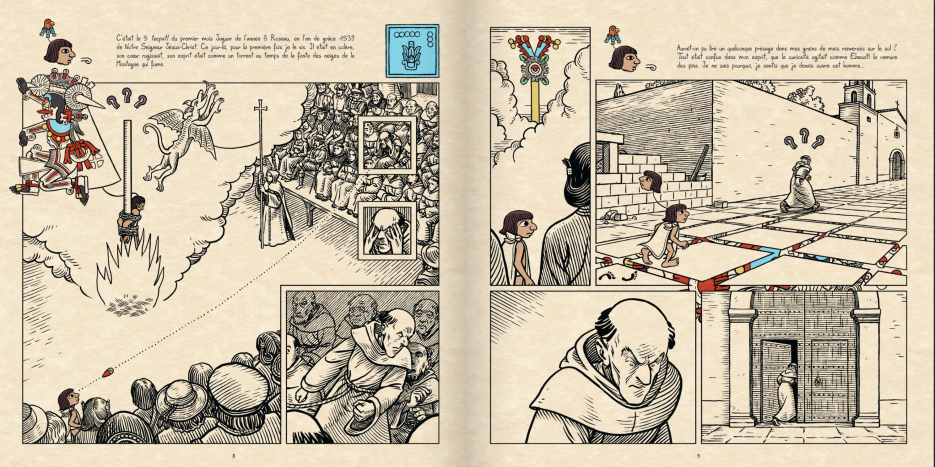
Hailed by the monthly Historythis album entitled Anahuac Trails part of a genre now established and which, far from a simple concern for popularization, explores history differently through new narrative and visual proposals. It is no less triply original: firstly by its subject, which concerns the first years of the colonization of Mexico, then by its ambition, which consists of making the history of a historiographical rereading, and finally by its technical mastery and graphic virtuosity. And for good reason, three distinct styles are combined depending on the content of the story or the interactions between the protagonists: hatching reproducing the wood engraving typical of colonial art, clear black and white line for the memories recounted and, above all, colors and glyphic patterns inspired by Mesoamerican codices.
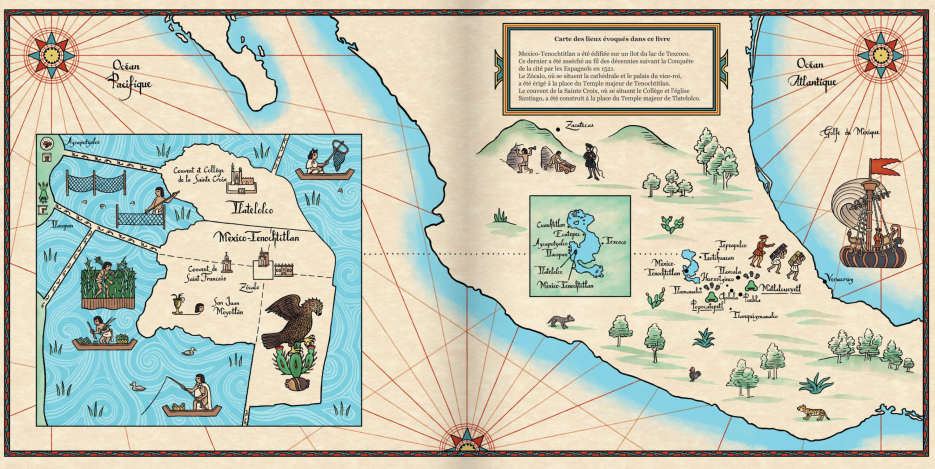
Showcasing the encounter of the Spanish colonizer with the populations of the ancient Aztec (or Mexica) space, this album is as solid and informative in substance as it is readable and educational in form, like the very beautiful illustrated glossary which accompanies the reading in the form of a separate print and resembles an exlibris for collectors. As for its physical characteristics (large square format, ocher and thick paper), they make it a very beautiful work for young and old.
The genesis of a manuscript
Based on real events, the plot places at its heart a book and the story of its genesis: theGeneral history of things in New Spaina colossal manuscript of 2,446 pages, the production of which began in 1558 under the aegis of the Franciscan brother Bernardino de Sahagún. He, surrounded by his numerous students from the college of the Holy Cross in Tlatelolco, founded to train indigenous clergy, undertook in-depth research into the history of Mexico by recording the stories collected in the Nahuatl language from indigenous communities. The investigation included the establishment of questionnaires in Aztec script and the compilation of testimonies from old caciques, the responses then being noted in a transcription from Nahuatl into Latin. The role of Sahagún’s indigenous collaborators is therefore essential: among them, Antonio Valeriano is the main protagonist of the story. The reader follows his journey, from his apprenticeship among the catechumens of the Tlatelolco college, to the peak of his career within the colonial administration.
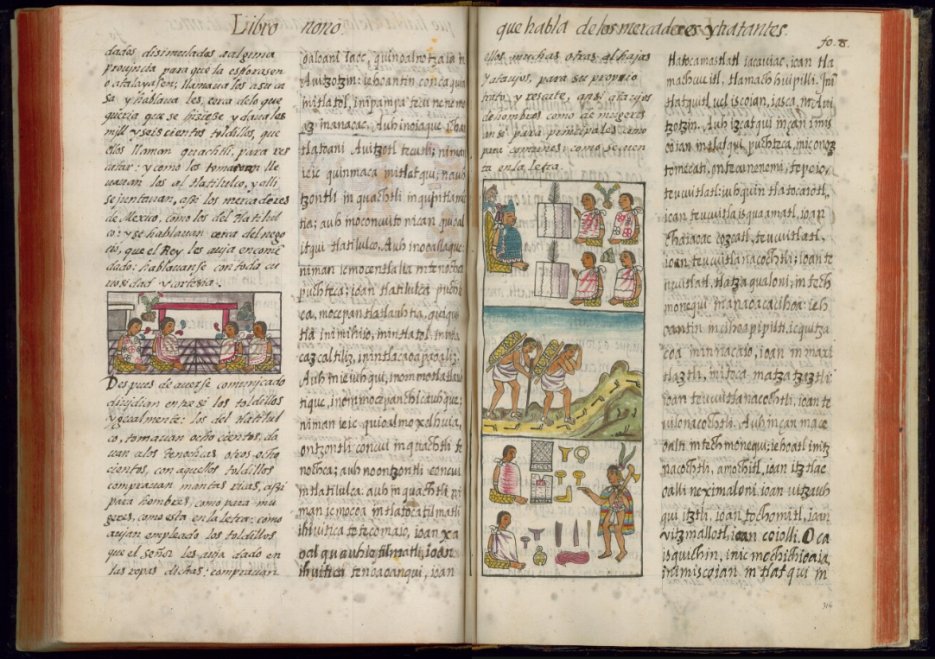
The fruit of twenty years of tireless work, targeted for a time by the internal censorship of the order, then by a royal decision of confiscation, theGeneral history was removed from the Spanish authorities and brought back clandestinely to Europe in 1580, before resurfacing some time later in the Laurentian Library in Florence. Perhaps given as a diplomatic gift by Philippe II to the Grand Duke of Tuscany, Ferdinand Ierafter its accession in 1587, the book is however not listed there until the end of the XVIIIe century, hence its common title of Codex fiorentinus. A true encyclopedia of indigenous knowledge, the Florence Codex remains one of the most precious sources on Aztec civilization and the times before and during the Spanish conquest, the full digitization of which is also freely accessible.
Written by Nahua scribes called tlaquiloqueL’General history includes two columns: a text in Nahuatl, and a summarized translation produced in Spanish under the supervision of the Castilian missionary. Added to this are numerous vignettes created by Nahua artists and testifying to the syncretism between Aztec aesthetics and European techniques. Divided into three volumes, theGeneral history includes twelve books, dealing with Mexica religion and cosmogony, astronomy and divination, but also commercial practices, reigns and other political events, without forgetting indigenous knowledge about nature. As for the last book, it concerns the Spanish conquest seen by the Nahuas.
Colonial conquest, local elites and crossbreeding
Himself a specialist in colonial contacts and the circulation of knowledge between European powers and colonized populations from the XVIe century, particularly in Indonesia (in History in equal partsor even The Great Disappointments), Romain Bertrand here becomes a comic strip writer, in order to extend the questions on the meeting between Europeans and “ indigenous » from other continents. The setting this time is Mexico between 1539 and 1590, that is to say a generation after the shock of the Spanish conquest under the orders of Hernán Cortés.
As he was able to do about the first circumnavigation in Who covered what ?Romain Bertrand explores in Anahuac Trails the ambiguous relationships between globalization of trade, imperialist domination and dynamics of cross-breeding – continuing the work of Serge Gruzinski. The decades following the Spanish conquest were in fact those of the hybridization of all aspects of culture and local knowledge, religious beliefs, artistic forms and imagination.
In a rich appendix revealing the sources and “ trails » of the historical investigation, a real historiographical update is proposed, which also makes it possible to fully explain the social and political issues present at the heart of the story and explaining the alliance of the Spaniards with certain local elites, “ whether it concerns the chiefs and main (the notables of the villages) or members of the fallen nobility, the pipiltin » (p. 157). The character of Antonio is thus the “ quintessential incarnation of this educated Indian elite “, finding himself suspended “ between the world of his ancestors and that of his masters », between the protection of a threatened tradition and the duty of loyalty towards the Church and Spain (p. 158). Having become the first indigenous governor of the city of Mexico-Tenochtitlan, and probably of aristocratic ancestry, Antonio Valeriano remains little known, which allows the authors of the Anahuac Trails to take advantage of the silences of the sources to make it play a decisive role in saving the Florence Codex.
A clash of aesthetics
The success of Anahuac Trails would not be as brilliant without the talent of Jean Dytar. The designer is used to depicting historical stories located both in the Isfahan of Omar Khayyâm and on the French poetic scene of XIXe century. This new album with Romain Bertrand is for him the opportunity to return to the Renaissance, after two previous works on the painting of Giorgione and (already) on Atlantic colonization. This time, the designer mixes his usual line with pages inspired by the woodcuts of European prints from XVIe century, treated in monochromy, with a line of regular thickness and hatched shading.
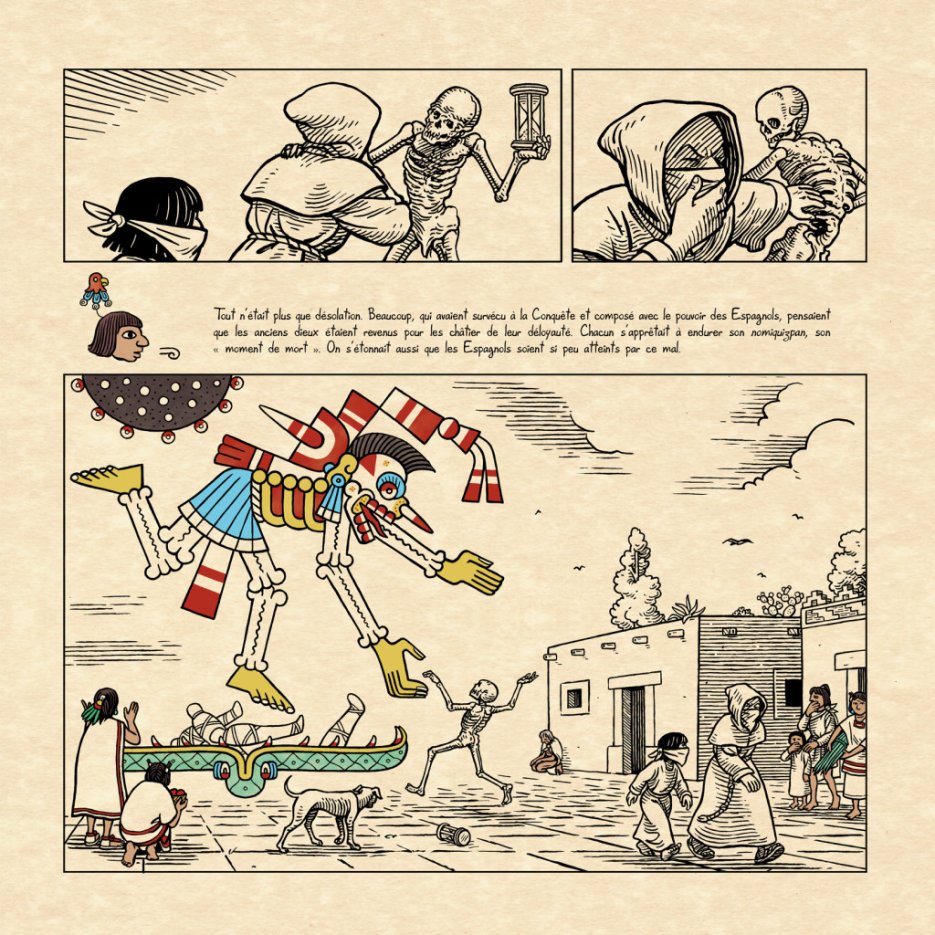
Added to this is the inspiration of “ scribes-painters » of Anahuac, whose particular aesthetic was transmitted, not only by the Florence Codexbut also by other pictographic manuscripts of XVIe And XVIIe centuries. This homage finds full expression in striking full-page or double-page illustrations, throughout the story, in particular to illustrate Cortés’ entry into Tenochtitlan in November 1519 (p. 64-77), to depict the famous episode of the Sad Night of June 30, 1520 during which the Spanish troops were massacred in their flight (p. 74-76), or to represent ancient times in Texcoco, under the sovereign Nezahualcoyotl described by the Nahua students, nourished with Latin culture, as resembling “ to the philosopher-king of whom Plato speaks » (pp. 85-89).
Finally, Jean Dytar also uses some striking quotations, both European (Holbein) and from Mexican codices, starting with the representation of the god Xipe Totec on the cover, inspired by Codex Borbonicustoday kept in the library of the National Assembly. Through these inspirations and the way in which he juxtaposes them before making them hybridize, Jean Dytar thus fully extends the desire perceptible in the story to give shape to a clash between worlds, and to the new horizon that results from it.
Remarkable in many ways, this comic book album shines with the finesse of its historical analysis. With subtlety, the authors thus allow a glimpse of the ambivalence of Bernardino de Sahagún, whose enterprise of saving Nahua memory responds as much to an ethnographic curiosity before its time as to the intention of evangelizing minds through a more empathetic approach. Like the work of Camilla Townsend (2023) and the exhibition at the Musée du Quai Branly devoted to the deities of Templo Mayor (2024), this book is part of this new historiography of the conquest of “ New World » which, based on vernacular sources, intends to demonstrate the unsuspected persistence of the Mexica people, beyond political enslavement, frenzied acculturation and epidemiological ravages.