
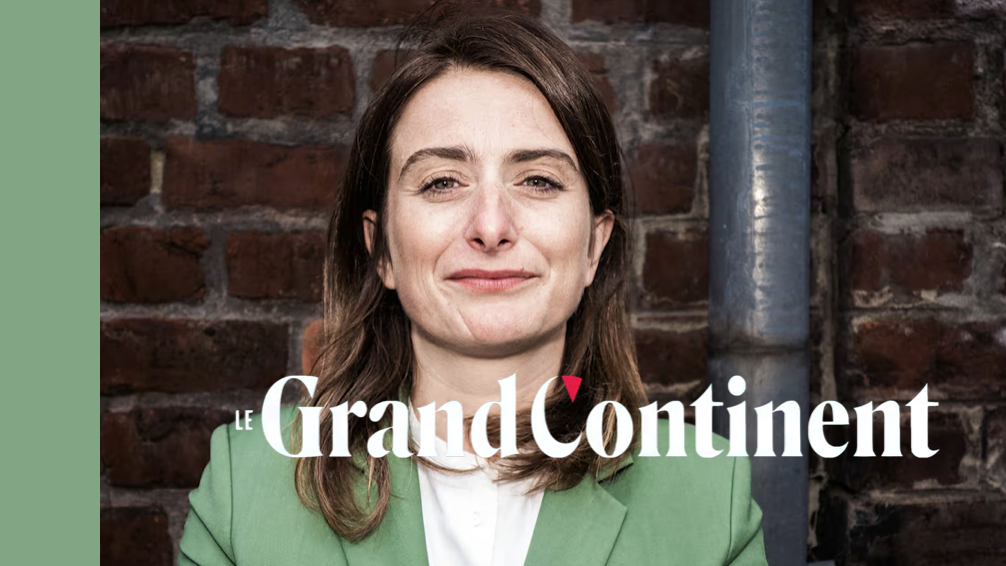
With the Doctrines Françaises series, we open the pages of the magazine to the pivotal figures shaping the presidential election. Their positions do not bind the independent editorial staff of the magazine.
For too long, our continent had been nothing more than a vast field of battles. Whether feudal, religious, revolutionary, imperial, national or civil wars, they soaked soils and hearts in a bloody bath for centuries. I, who come from Hénin-Beaumont, know the depth of the traces left by war. In this northern land, the Great War still marks the landscapes, memories and bodies.
In my town, in 1918, only seven inhabitants remained. A century later, our running water is still polluted by bombs that continue to rot in our fields. The “gueules cassées” have ultimately left us, but in family memories, and all across France, stand monuments to the dead for the homeland.
Because Europe, it was war.
In it first, and elsewhere too. By military force, commercial greed and technological know-how, European nations carried their appetites of conquest beyond the continent’s shores. Europe colonized the world, organized its looting, enslaved its peoples and fed its economic development on the planet’s riches.
At a moment when the hideous specter of war haunts our continent again, devouring men and women on the Donbass front, in the streets of Kharkiv, Bucha or Kyiv; while the Putinist imperialism unfurls its criminal procession of massacres, destructions, pillages and rapes… It is good to recall why we had wanted, eighty years ago, to end, once and for all, with war.
Because in 1945, for the second time in less than a human lifetime, the bloody quarrels of European nations had led humanity to the worst. And even beyond, with the Shoah, this genocide planned to annihilate an entire people. Six million Jews exterminated because they were Jews, and with them Roma, homosexuals, disabled people, resistants, and millions of lives crushed by Nazi power. The moral collapse and the material destruction demanded a leap. This “Never again” cried in silence by more than 60 million victims was at the core of a new political community: Europe.
The European nations chose to recognize in each other the values that united them: humanism, tolerance, democracy and cooperation. They asserted the urgency of building an “ever-closer union between the peoples.” And they signed international treaties to forge by the force of law the unity of a continent that had until then known only the rule of force.
The struggles for independence later returned liberty to peoples enslaved by European colonial powers. Forced to renounce the era of empires, these powers claimed to make Europe the new champion of democracy, of freedom and of international justice. They sought to make interdependencies—commercial, energy and industrial—into a pacifying force for the world. They positioned themselves as beacons of the defense of human rights and pioneers in the fight against climate change.
Emerged reunified from the Cold War that had torn its heart for half a century, Europe thus became the enthusiastic engine of a “happy globalization.” Even if it was happy only for a minority of privileged people and blind to the persistence of a relationship of domination over the world’s poorer countries.
The Return of Empires
From Moscow to Tel Aviv, from Washington to Beijing, the return of Empires sounded the end of shared rules. Predators threaten Europe with a new form of feudal subjugation. The acceleration of climate imbalances, the gradual exhaustion of resources and the crossing of planetary boundaries condemn its model of economy.
In this final phase of capitalism’s finitude — which hurries the great powers toward one another to grab the means of power — we cannot and must not hesitate. Torn between the temptation to join the giants’ battle and the fear of becoming nothing more than a marginal territory in the new world order, European nations struggle to rise to the challenges.
Since 2008, a sequence of crises has produced a polycrisis whose scale and reach have become existential for the Union and its member states. They have the merit of crystallizing the advent of a more political Union, more responsive, less locked in technocratic management of continental affairs. But it remains largely insufficient.
Forge by the force of law the unity of a continent that had hitherto known only the law of force.
Marine Tondelier
Financial, budgetary, economic, social, migratory, identitarian, security, health, and environmental shocks that upheave European societies are too recurrent and cumulative to be mere temporary accidents on the road of “business as usual.” They signal rather that we must adapt our political regime to the “new climate regime” that characterizes this new world. For if we continue to conceive of it with the institutions and reflexes of the old one, the prevailing feeling is one of general impotence, and a disturbing disorientation for the peoples. It is on such resignation that the far-right thrives.
Today, it is urgent to prepare the conditions for a new surge. There will be no national answer to the century’s challenges. Even Germany or France are too small. They need, we need, a strong and united Europe. A Europe secure in its choices, whose unity will no longer depend on the context and the goodwill of governments in power at critical moments.
Overcoming Our Divisions
Alas, sovereignist and nationalist obsession persists and keeps us in the illusion of control. There is no doubt, however, that Europe is powerful, influential and attractive. Its researchers win Nobel prizes. Its cumulative military capacities are remarkable. Its climate ambition has made it a leader in the field before it has faced retreats and abandonments. It is toward its shores and its society of plenty that those seeking a better future press, at the cost of terrible human dramas.
Ultimately, Europe must face an existential fragility: its divisions. Too often, it remains imprisoned in narrow national perspectives. The retreats of some, the calculations of others, the numerous blind spots translate into critical delays: on the obvious Russian threat since 2014, on the Atlantic alliance’s realignment since 2016, on the association with Israel, now indefensible, on China’s aggressive trade practices…
Europeans allow themselves to be locked into a form of selfish and naive denial of their common interests. Despite a few isolated voices, they struggle to take the measure of a world where they are now “alone.”
Its institutions limit its ability to act against hostile powers, especially when those powers have long been allies. The offensive of fossil and reactionary empires is, however, the clear sign of fear among our adversaries. If Russia, the United States, China, Turkey, Israel, and so many others seek our lasting weakening, and ultimately the disintegration of the European Union, it is because a strong and united Europe represents a real force, a pillar of stability, a power contrary to their interests.
That is why they inflame our differences. China buys support through industrial investments. Russia and the United States instrumentalize our energy needs. Russia, again, wages a merciless political war against our democratic model. Russia, still again, as Belarus, Serbia or Turkey, weaponizes migratory pressures in contempt of human rights and human dignity. Moscow, Beijing, Ankara, Washington, Tel Aviv, Baku, and many others organize destabilization operations, fuel citizen distrust through propaganda and online manipulation and weaken our social cohesion. Trump threatens, insults, betrays, bullies, subjugates European states, and politically supports destabilizing far-right forces, also financed by Russia.
Yet this external subversion is only possible and workable because of our internal fragmentation. In this hostile storm, each European state seems tempted to save itself alone, at the expense of any coherence and solidarity with the others, by attracting foreign investments through social or fiscal dumping (as shown by the Choose France operations), by negotiating exemptions from common rules, or by trying to reduce its contribution to the common budget.
The memory of the austere and brutal handling of the sovereign debt crisis deeply undermined mutual trust among member states. The feeling of being scorned by Paris or Berlin when they voiced concerns about Russia fed distrust in Central and Eastern Europe. The disarray of countries on the outer European border, abandoned by their partners in welcoming and managing refugees, favored national solutions. The aggravation of inequalities within member states also provided fertile ground for all populist challenges. Across Europe, the hydra of the far-right has raised its hideous heads again, fed by social fears, popular resentments, citizen anger and elite contempt.
The Imperative of a Just Ecological Transition
Facing the obsolescence of its economic model and its geopolitical model tailored for a bygone era, Europe must rediscover the path of shared prosperity without contributing to the destruction of the world. The immense existential challenge of our era is ecological. The planetary boundaries that determine Earth’s habitability are being crossed one after another. Europe’s vital dependence on global flows of fossil energy or derivative products such as fertilizers and pesticides worsens its economic, energy and strategic vulnerabilities. It is literally under siege. Yesterday ecological transition was first a moral question. Today it has become a question of power. Our competitors and adversaries have not missed this: decarbonizing the European economy, moving toward agroecology and ecological transformation represents a real threat to their own interests.
But our adversaries can take comfort. Under pressure from industrial lobbies, myopic governments, and radical-right factions, the European Commission decided to challenge the main lever of Europe’s competitiveness: its Green Deal. From half-measures to retreats, in the name of a “simplification” that rhymes with “deregulation,” Europeans are abandoning the ecological ambitions that had made them exemplary in the eyes of the world. We are heading toward the abyss with our noses pointed at obsolete indicators of immediate profitability.
So What to Do?
First, change our perception of the stakes. silo-thinking pits economic policies against environmental policies, always giving priority to the former. Why? Because capitalism destroys the planet but the growth it has generated has financed social peace and reduced inequalities. Today, the challenge is to make the transformation of our economy the core of our new European project.
This external subversion is only possible and effective because of our internal fragmentation.
Marine Tondelier
A new economic and social model, a new energy model, a new agricultural model: the rupture must be triple to aim for ecological prosperity.
The Green Deal of Ursula von der Leyen’s first term was not truly ours. It favored technological mirages, paid little heed to social justice and never gave itself the means to transform our agriculture. It is precisely this contradiction that caused its failure. Yet it did show a path: decarbonize value chains, European and global, subject the single market to the logic of Paris agreements and reconcile our agriculture with biodiversity preservation.
The project remains vast, and many ideas are ready to be implemented: reform competition law to strengthen national or European public services and the state aid regime to prioritize socially and environmentally virtuous activities. Transform public procurement so it can become a lever of ecological redirection. Augment “Made in Europe” with a “Buy Green and European Act” that would prioritize 50 to 80% of products manufactured in Europe for public markets, depending on sectors. Amend the European Central Bank’s mandate to systematically incorporate environmental considerations into its analytical models and in implementing monetary policy, excluding fossil-fuel projects from loan guarantees.
This also requires redoubling efforts in the political fight against those who defend fossil energies that cost us dearly and subject us to the powers of foreign carbon-heavy and authoritarian regimes. Moving from Russian gas to American LNG did not solve our addictions; we simply swapped dealers.
Phasing out fossil fuels is not only a climate imperative; it is a liberation from imperial pressure, rents, and the cost of living. The European energy imperative rests on three pillars: a more ambitious policy of restraint, accelerated development of renewable energies, and substantial investment in distribution and storage infrastructures. For this, Europe needs means that only the Union can provide: eurobonds to finance the ecological transition.
In agriculture, food sovereignty means transitioning to an agroecological model by 2050. The obstacle is political and financial. The entrenched interests of large producers and agribusiness remain powerful and saturated with public subsidies. That would be the first step: wean the intensive model off this magic money. It must find an economic model without European subsidies. The Common Agricultural Policy would then focus on financing and developing a peasant farming model that respects women and men farmers, enabling them to live decently from their work. A pesticide-free agriculture, which minimizes the use of freshwater and fertilizers (nitrogen, phosphorus). The soil quality and biodiversity are major determinants to feed the European population in the long term. The Common Fisheries Policy, meanwhile, should ban destructive industrial practices, favor small-scale coastal fishing and more strongly protect ecosystems. Studies, from Shift to IDDRI, show: it is both necessary and possible to decarbonize our agriculture, rid it of petrochemical dependencies, and of global markets. For the benefit of farmers, soils, animals and consumers.
Next, we must adapt our physical, social, economic infrastructures and our lifestyles to the new climate regime. Fires, floods, heat waves, poor harvests challenge our insurance schemes and health systems. Again, no country can respond alone. The civil protection mechanism must be multiplied to develop a European fleet of Canadairs and helicopters commensurate with the stakes. The insurance sector must be reformed – and sometimes nationalized – so that risk is shared by all, particularly for small landowners and for farmers. Labor law must adapt to protect workers during extreme heat but also in cases where employment itself could be destroyed – especially in fossil sectors.
Moving from Russian gas to American LNG, Europe has not solved its addictions; it has simply changed dealers.
Marine Tondelier
To meet these challenges, one of the too-neglected levers of transformation lies in science. Under pressure from reactionary ideologies seeking to impose their denials, conservative economic interests, and transhumanist misleaders of Big Tech, European science is primarily threatened by a lack of budgetary investment. Public research is drained, and academic freedoms in universities are threatened. This public investment in service of the common good must be doubled by a sustained effort in research and development. To assert our sovereignty, we must build a European scientific power. For the liberal right, competitiveness is viewed only through the lens of costs (labor, energy, production) whereas our competitiveness and our ability to prepare the future come mainly from scientific innovation, the skill of workers and the quality of our infrastructure. Financial investment in public and private research should be comparable to the United States and China. Yet we are far from it and do not even reach the 3% of GDP target set for 2020. In 2025, Alphabet, the giant behind Google, invested more in research and development than the entire set of French companies. I call for a more ambitious European research policy that would double programs like Horizon Europe and quintuple Erasmus so that half of the students can study or work in another European country.
Another lever, it seems to me, is a European industrial policy. The challenges of transforming our industry go beyond mere decarbonization. It is also a question of sovereignty and employment. That is why it is essential to develop across the European territory a decentralized, open and sober model of digital infrastructures, to free ourselves from dependence on the tech barons’ major platforms. While the United States and China have turned AI into a new weapon in their struggle for global dominance, European digital sovereignty is the guarantee of a robust democracy and strategic autonomy. Beyond applying regulations (DSA, DMA, AI Act) without political hesitation, European digital policy should favor frugal hardware and digital models, particularly in artificial intelligence, strengthen algorithm transparency, guarantee researchers access to data, support free software and effectively protect personal data.
Whether it concerns agriculture or digital, energy or transport, the choices have become binary: do we align with the great powers, or are we ready to secure our own conditions of prosperity and share its fruits? It is time to stop opposing ecology to security. Ecological transformation is not a luxury for quiet times; it is our political guarantee of security in the face of big winds. The more we electrify, the more we invest in sovereign renewables, the more we renovate and develop public transport, the less we finance authoritarian regimes and the less we are exposed to geopolitical blackmail. Of course, provided that this policy is socially and fiscally just. Asking families to bear the burden while we continue to protect rents fuels the resentment on which the far-right and all populists feed. The transition must improve the quality of life of the working and middle classes. That is a condition of its success.
The Democratic Conditions of Power
To remain free and democratic, Europe must therefore become a power. A green power. There are many misunderstandings about the notion of European power. It is not the power of its leaders. I am not talking about adding floors to the buildings of the European Commission.
Those who criticize Europe as too technocratic are not entirely wrong. Europe has always needed its supranational administration, ultra-competent, capable of synthesizing the countless conflicting interests of its diverse stakeholders, public entities, companies or citizens… But in Brussels, we are far from the ground. And above all, collective choices must first come from democracy and citizens’ preferences. That is also the role of the two co-legislators, the Council and the Parliament, representing governments and citizens at the continental level. Even united and federalized, Europe would not be meant to substitute other levels of power such as states, regions, or municipalities. It is the principle of subsidiarity that must prevail.
So when I speak of Europe-power, I am really talking about the power of the peoples. Our capacity to unite in the face of world adversity and in the diversity of the continent. In Brussels, no more than in Paris, I will never defend any form of jacobinism, national or European. Centralization and uniformization are mutilations, and what we think we gain in efficiency and cohesion is lost in diversity and alienation. Europe is not a bigger France; it is meant to become a federation of decentralized and ecological states.
But that still implies stepping outside the narrow framework of national democracy. I dream of a popular European sovereignty. With European elections combining regional representation and transnational lists covering a single continental constituency, representing the shared aspirations of citizens from Dublin to Athens, from Porto to Helsinki… We would then have a European Parliament expressing both the diversity of local interests, from Calabria to Silesia, from Aquitaine to Transylvania, and the unity of the European peoples. Moreover, this Parliament would finally be endowed with a budgetary power and the right of initiative.
Moreover, European or not, democracy is not limited to institutions. It is lived and contested at every level of public life. The media, of course. But also associations and representatives of civil society, whose funding is currently threatened by the right-wing alliance. Finally, as a form of a European regime of business with the “EU Inc.,” it seems essential to include unions, and to give social partners the ability to negotiate collective agreements at the European level. In my view, Europe must be built as much through social dialogue as through political deliberation.
For a Federal Leap
We need to federalize our European Union.
This is not a leap for the sake of spectacle. It is a qualitative leap. A manifestation of the European spirit. Our divisions remain dependent on governments and policies educated, molded within the national framework. Often shortsighted on global issues, or for some entirely in the pocket of national economic interests, or even personal when the closeness between public and private becomes incestuous, they strive to defend the present while forgetting the future.
The choice is simple: if Europe wants to be a power capable of protecting without brutalizing, of investing without destroying, of defending without corrupting, it must accept to put its values above private interests—and above the mercantile interests of a few companies or states. It can no longer behave as a common market of 27 small open economies competing with one another. For it is in reality a global power of half a billion citizens, a hub of scientific excellence and a leader in steering change toward a planetary ecology. This unquestionably requires institutions designed to face the tests of the era, in the absence of leaders able to think of the future and act in the face of the unknown. If a single state can block decisions for all, we end up taking incomprehensible decisions and legitimizing double standards that discredit us in the eyes of the world, as in the Middle East and especially with the destruction of Gaza.
It is therefore time to finish integrating our institutions. This necessarily implies reform of unanimity in favor of a qualified majority in matters of fundamental rights protection, social protection and European tax integration as well as for the common security policy—whatever the cost to supposed French exceptionalism. We want a France free in a federal Europe because now, the two go hand in hand.
I can already hear the indignant cries of the far-right, these so-called “patriots” who swoon at Trump, or are ready to sell their country to Putin. These cardboard patriots, brutal with the weak and servile with the powerful, refuse to see the simple reality: isolated, France does not have the means to respond to the technological, climatic, geopolitical and military challenges of our world.
While the French far-right has again illustrated its contempt for our partners, particularly those who rely on European funds, by proposing to reduce our participation in the Union’s budget, the question of resources arises with urgency. Obsessed with budgetary discipline and tax constraints, the member states are preparing to negotiate the next budget, the Multiannual Financial Framework, in the worst possible way: missions ever more ambitious in defense, industry, digital, cohesion, research, and a touch of climate, but with ever more limited resources. Without any consideration for coherence, they claim to want a strong Europe without own resources. When Mario Draghi published his report on competitiveness, they lean toward simplification and regulatory relief, but suddenly become deaf to the mention of the 800 billion euros of investment necessary…
This hypocrisy is no longer acceptable. We need a budget commensurate with the challenges and ambitions. I support a reinforced European budget at 2% of European GDP in 2035 and 5% in 2050, with greater contribution from the member states but especially broadened own resources. These resources, I think, should come from strengthening the Border Carbon Adjustment mechanism, which is nothing other than the return of what was once the “Common External Tariff.” I would also add a common tax on corporations. But our needs are immense—so this budget should be complemented by a common borrowing to finance long-term investments, these “Great European Ecological Works” such as rail, energy and digital integration, the adaptation of the most exposed regions to warming, or the doubling of the means for scientific research and innovation.
The other element of Europe’s federalization lies in redistribution. It is not only about proving that democracy can be lived beyond national borders; it is about showing that solidarity and social justice can have a transnational dimension. The first urgency is to end the austere constraints of the Stability and Growth Pact and the fiscal dumping that benefits some countries at the expense of others. Until there is a pan-European tax system integrating economic and ecological sustainable practices, but only negotiations between states, we will not achieve this and we will undermine European solidarity.
The second urgency is to build a European welfare state. The legitimacy of a federal Europe rests on its ability to produce “public goods,” such as health or solidarity. Since the Delors Single Act in 1986, Europe has gradually equipped itself with tools to guarantee or defend rights—but the core of its redistributive action remains concentrated on regional cohesion. I think it is time to establish a real European social protection that is not limited to the poorest or to posted workers but encompasses all members of the European political community.
The federal Europe is the sole horizon of our sovereignty, of our ability to choose our way of life, to protect our population from crises, to choose our allies autonomously, to take back control of the economy, to defend a multilateralism based on international law.
In short, to be a power without becoming an empire.
Europe as a Power of Peace
From a power “in peace,” Europe must now become a “power of peace,” carrying a vision for the world. This requires rethinking its place in this post-Western world, marked by international disorder. Its traditional model, based solely on trade and law, is obsolete.
Strategic autonomy cannot simply be a means to maintain an illusory hegemony. Unlike variable-geometry anti-imperialists who delight in a passive neutrality toward non-American empires, or in diplomatic opportunism, Europe must be able to choose its positions, its partners and its modes of action.
This foreign policy would rest on three aspects of the European construction experience: its ability to live with contradictions, reconciling values and interests, unity and diversity, universality and historical self-critique; its emphasis on long-term thinking, illustrated by European reconciliation and the transformation of former enemies into partners; and a non-imperial conception of power, rooted in integration, law, transnational democracy, civil society and decentralized authorities.
But any coherent foreign policy also rests on credible defense.
That is why I want to carry, against all fifth columns, all defeatists pro-Putinists and pseudo-pacifists, the necessity of a European defense. Non-violent, ecologists have never been wrong: they have never waved a complacent pacifism calling for a ceasefire in whatever context. Clarity about responsibilities and commitment to the rights of peoples has been our compass all along. Whether it is Chechnya, raids on Aleppo or Georgia, we know that we must contain and push back Vladimir Putin’s imperialism. That is why we supported military aid to Ukraine and will support it to the end, despite Trump’s betrayals.
The time has come for Europe to assume rising power. In my view, we should first develop the European pillar of NATO so that we can operate without American involvement, by integrating existing multinational military capabilities. The treaties, particularly Article 42(7), already guarantee a principle of European solidarity in case of an attack on a member state — let us give it real teeth by creating an integrated European military command under the supervision of the Council of the European Union, going beyond the current embryonic chain of command. Then, let us plan greater integration of defense capabilities and the creation of a true European Coordination in Defense Industry and Technology, drawing inspiration from successful cooperations like the long-range ground-launched missile program Thundart.
The European Federal Europe is the only horizon of our sovereignty.
Marine Tondelier
I dream of a Europe that also recognizes the real danger, and does not yield to the fantasies of migratory submersion. Europe must not become a fortress bristling with barbed wire and algorithmic barriers. Contrary to right-wing fantasies, the Union can create legal and secure channels of immigration to facilitate return and circular migration. It can demilitarize its border management and refuse outsourcing of its migratory policies, especially expulsions to third countries that do not respect human rights like Libya. It could dismantle Frontex and replace it with an agency responsible for protecting the fundamental rights of migrants, especially sea rescue. It could finally open international negotiations on a legal framework for climate-displaced people, drawing on the Protection Agenda for Displacements Related to Disasters. European power would be strengthened by all this.
All this will not happen by itself: I think we must respond seriously to the alliance offer from middle powers made by Mark Carney, Canada’s Prime Minister, in early 2026 and repeated before the European Parliament in September. A security architecture of collective defense in which the United Kingdom is included, but also Norway, as well as Japan, South Korea, Australia or Brazil. The US-China rivalry should not extinguish multilateralism on which global stability rests. International law must be our compass.
On this basis, it seems to me that we could then evolve this collective security to respond to climate change and biodiversity loss. I dream of an Europe that would lead a global alliance for the planet, an international “green coalition,” with the aim of developing green infrastructures, technology transfers and diversifying our energy and goods sources, so that no power could impose its fossil choices or its technology blackmail on others. This alliance would also secure mechanisms for compensating losses and damages, and drive agreements to preserve common spaces from pollution and militarization, including the oceans, space, the Arctic and the Antarctic.
The power of Europe must be at the service of the spirit of universal peace on which it was founded.
European Pride
To the specters of collapse and decline, I want to oppose prosperity and ecological security. Europe has this incredible chance to be able to answer the challenges of the world. The legacies of the Enlightenment, the rule of law, feminism, counter-powers, and political ecology must be transmitted to future generations.
I know that a portion of the left will not agree with my vision of a federal Europe, endowed with autonomous defense in the service of peace. Yet it is up to the left to remind us who can carry European ambition into public debate, because it is the wish of a large majority of our fellow citizens. We cannot leave Europe to the stubborn Macronists or to violent nationalists: the peoples have shown a desire for a more sovereign, more social, more secure Europe. I want to carry this European ambition with pride and determination.
Building tomorrow’s Europe with our partners means asserting European interest, avoiding any national retreat, and keeping the sense of community alive. Nations and peoples of our continent have decided to live together in the diversity of their cultures and histories to accomplish the unthinkable: banish war from our horizon. I propose that we write the next chapter of the European project by making Europe a green and peaceful power.