
Ingredients (serves 4)
- 4 slices of veal shanks
- Flour
- 200 g carrots
- 3 cloves of garlic
- 200 ml white wine
- 1 bouquet garni
- 2 tomatoes
- 2 onions
- 1 lemon
- Butter
- Parsley
- Salt
- Pepper
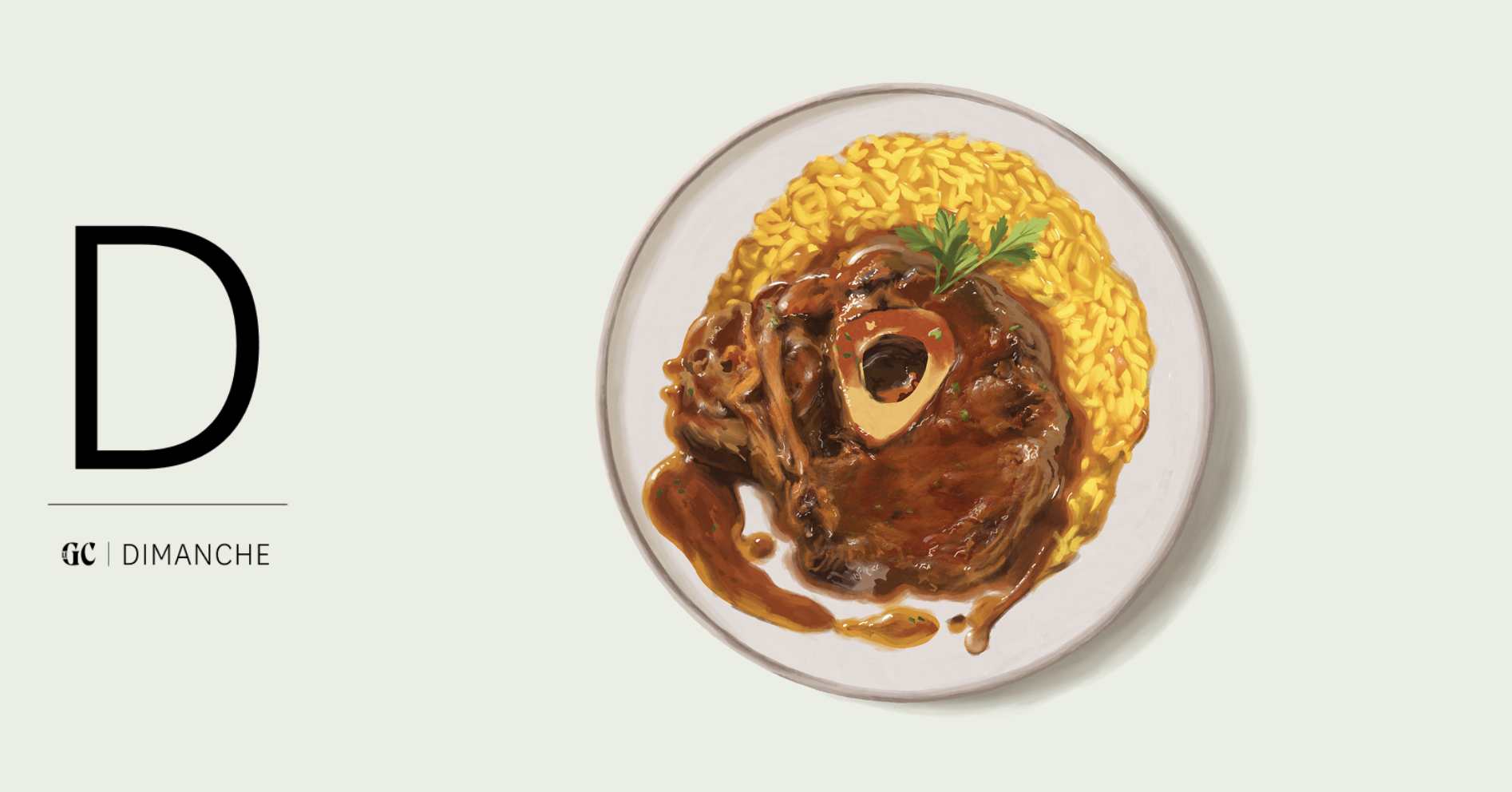
As a Milanese, I could not choose any other dish than osso buco. It is one of the emblematic dishes of Milan, the city where I was born and grew up. It mirrors the spirit of the place: a simple dish, yet very rich. Milan is a city that is not immediately sophisticated or warmly welcoming, but it is, in fact, quite opulent. Milan tends to hide behind its own beauty. One must know how to discover all that is beautiful and good there. In that sense, Milan is not a city that reveals itself with beauty like other Italian cities such as Rome, Venice, or Florence.
This seasonal dish, autumnal and even wintery, is typical of trattorie, those small taverns with a comforting atmosphere where one is served food for foggy autumn or winter evenings.
We can also prepare osso buco at home. My mother and grandmother used to make it; I still do today. But it isn’t a dish you cook every day, as it is fairly heavy. It’s a Sunday dish. It isn’t difficult to prepare, but you can’t improvise it. It requires time and attention, watching over it and following several mandatory steps. Usually, osso buco is served with saffron risotto, a great Milanese specialty. It’s long, but not very hard to miss.
These comforting flavors can also be found in France, though they are less typical there. I recall dinners in Paris where people were a bit surprised to be served osso buco, particularly because the meat looked very well done. That’s what I love most. I am completely against this raw-food culture. For me, the meat must simmer for a long time to express all its subtleties and flavor. It’s a bit of an old-fashioned way of cooking.
The Recipe
When you buy your veal shank, make sure your butcher leaves a piece of bone with marrow inside. “Osso buco” simply means “bone with a hole.” Dredge your pieces in flour, then prepare a pan or a pot large enough to brown them. Put some butter in. In Northern Italy, one cooks with butter, not oil. Add one finely chopped onion, carrot, and celery: this little preparation is typical of Italian cooking; it is called soffritto. It serves as the base for a number of dishes.
Immediately add the floured pieces of meat. Sear them on one side, then on the other. Then pour in a little white wine. Let it evaporate, then add a bit of broth and cover. From this moment, simmer for at least 1 hour 30 minutes, or up to 3 hours. The meat should be very tender and able to be cut with a fork.
Now for a typically Italian question: the use of tomatoes. You will find different schools of thought. You may add a sliced fresh tomato or a bit of tomato sauce. Tomato sauce in Italy is a bit like crème fraîche in France: it is added almost everywhere. But Northern purists (including me) don’t always agree. I don’t add it, because it tends to mask the flavors of the ingredients. I stick to just a few small tomato pieces.
Keep cooking while stirring regularly. Above all, be careful not to burn the fond at the bottom of the pot. In the meantime, prepare your saffron risotto: it’s very easy, you simply add the saffron at the end of cooking. But it takes time, since it must be cooked slowly as well. You start with onion, then rice, and you cook everything with broth. As soon as the meat is very tender, make sure it doesn’t dry out. If it does, don’t hesitate to add more broth.
If you find the risotto too heavy, you can also pair it with mashed potatoes or plain white basmati rice.

If you choose the Milanese version, place a little risotto in each plate, then add the osso buco on top. At the last moment, finish with the secret but essential touch: the gremolata. It isn’t exactly a sauce, but rather a blend of ingredients: parsley, garlic, and very finely grated lemon zest. This is how the real osso buco is served in Milan. It brings a refreshing note to this long-cooked dish.
All that remains is to recommend a very good red wine. With a dish this robust, one tends to drink fine wines from Northern Italy, such as those from Piedmont: nebbiolo or barolo.