
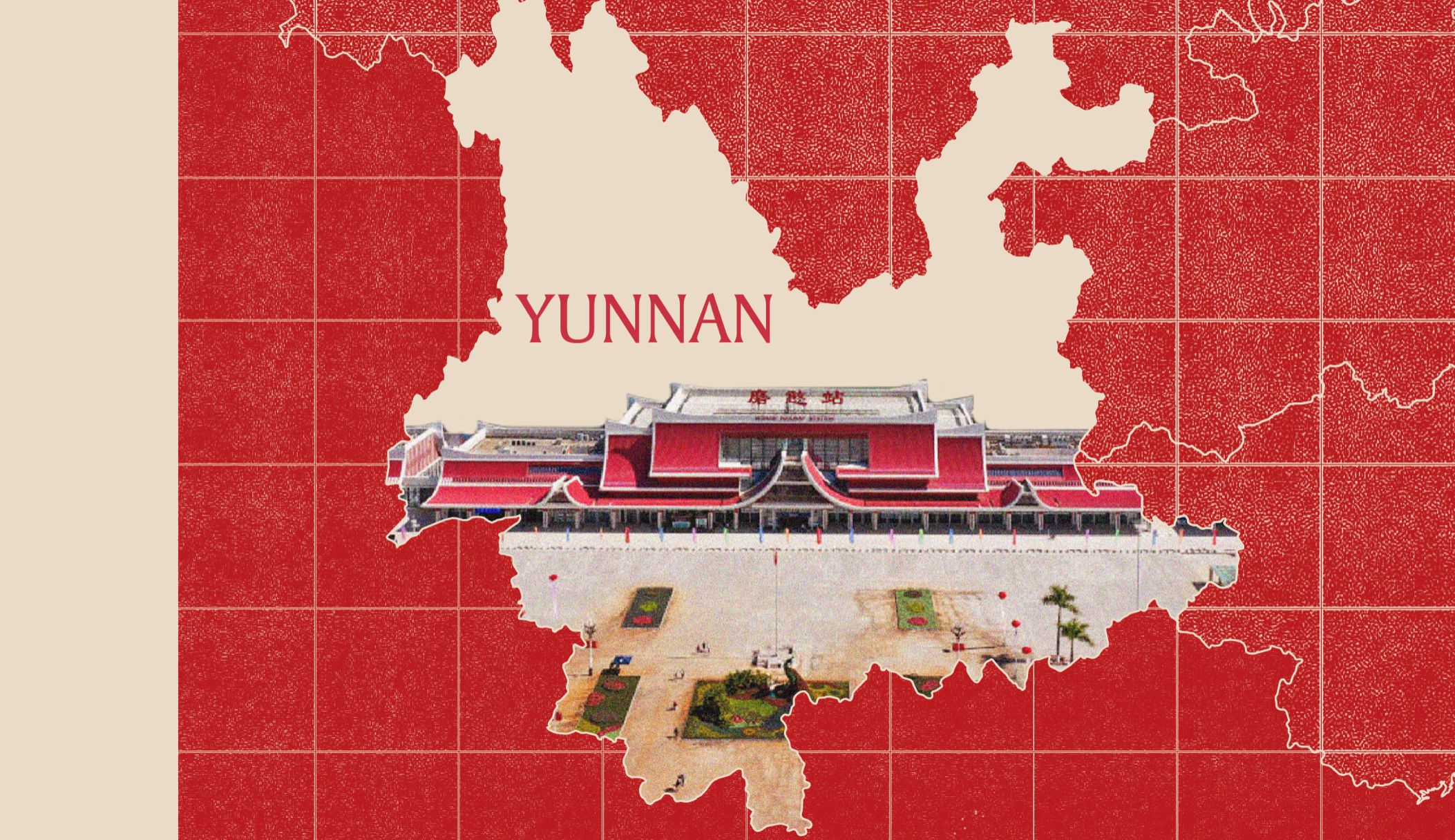
Do you know three Chinese provinces? To understand Xi’s China, you must leave Beijing and Shanghai. Our new series goes to meet the spaces where another figure of the future is being built. To receive this series which has already taken us to Sichuan, Zhejiang, Guangxi, Hunan, or Shanghai, subscribe to Grand Continent. In your inbox from 8 euros per month
On December 28 and 29, 2025, the shores of Fuxian Lake in Yunnan province hosted a trilateral meeting between China, Cambodia and Thailand. This took place the day after the conclusion of a ceasefire, ending a cross-border conflict between the two countries. Fuxian Lake — in the depths of which legend locates a sunken city — offered this southern diplomacy with power a setting of the tranquil landscapes typical of Yunnan. The choice of this place was no accident.
Just like the shores of that lake, a stage for international mediation; Yunnan is caught between two regimes of discourse. On one hand, there is an effort to make this Chinese province the gateway to Southeast Asia through major infrastructure projects. On the other hand, there is a drive to cultivate the imaginary of a preserved and contemplative province, embodied by places like Dali, Lijiang, or Shangri-La. These two horizons—apparently contradictory—are in fact characteristic of the political, economic, and cultural dynamics imposed by the central state. How does this temporal tension, between myth-making and acceleration, fit into the national unity logic and the government’s international projection? To answer it, one must try to describe these horizons that are both external and internal traversing Yunnan, drawing on the province’s economic, historical, and sociological trajectories.
Governing the Margin
Yunnan forms part of the many margins that China encompasses. The country indeed shares land borders with 14 countries across nine provincial-level units. Among these, there are four autonomous regions: Inner Mongolia, Xinjiang, Tibet, and Guangxi. Yunnan is more precisely its southern margin. It is one of the provinces most distant from the capital: roughly 2,500 km separate Beijing from Kunming, the provincial capital. Kunming is thus closer to Southeast Asian capitals. Economically, Yunnan presents an average profile: in 2024 it ranked 18th in provincial GDP in China; about half that of its Sichuan neighbor. The same holds true demographically. With 46.5 million inhabitants, the province has one of the lowest urbanization rates in China — about 54% at the end of 2024, well below the national average of 67%.
Its history likewise bears witness to complex relations with the central power. The most remarkable event occurs at the start of the 20th century. On December 25, 1915, Yunnan’s military authorities broke with Yuan Shikai and proclaimed political independence. This rupture triggered the National Protection War against the monarchist restoration attempt. From 1928, Long Yun becomes the main political and military figure of Yunnan. The power of this military elite rests notably on the province’s own resources and on its integration into cross-border trade networks. The exploitation of Gejiu tin, one of Yunnan’s principal mineral resources, along with the opium trade, then fuels the finances of regional authorities. The export of these resources is facilitated by the gradual opening of Yunnan toward French Indochina. This occurs notably thanks to the Kunming–Haiphong railway, built under French concession between 1904 and 1910 and linking Kunming to the Indochina port network.
This autonomy took on a strategic dimension during the Sino-Japanese War: Yunnan then became one of the main entry points for China’s wartime supply, notably thanks to its connection with Burma and the routes linking Kunming to Allied networks in Southeast Asia. But, very quickly, this regional autonomy clashed with Chiang Kai-shek’s desire to strengthen the nationalist government’s control over peripheral provinces. In October 1945, Long Yun was thus removed from power in a move to regain direct control of the province. Four years later, the provincial government, led by Lu Han, sided with the Communist camp. In December 1949, Kunming fell under the control of the People’s Liberation Army. The last military operations in the province continued until 1950.
Today, the province is led by two officials from other regions of China: the Party secretary Mo Gaoyi from Hubei, and the governor Wang Yubo, who took office in 2020 and hails from Henan. This circulation of cadres is accompanied by a particularly marked renewal of the provincial leadership. The Party Standing Committee elected in November 2021 included three cadres from ethnic minority backgrounds: Shi Yugang, of the Miao ethnicity, Qiu Jiang, of the Gelao ethnicity, and Li Shisong, of the Bai ethnicity. Since then, all three have left this body: Shi Yugang and Qiu Jiang have left the Committee, while Li Shisong was placed under disciplinary investigation in June 2024, and was arrested in January 2025 for alleged corruption. The profile of leaders from other provinces is however not unique to Yunnan: Guangxi, another southwestern border region, has notably been led by Liu Ning, a hydraulic engineer by training and former vice-minister of Resources.
Yunnan, an External Horizon
The central Chinese government makes Yunnan an outward horizon toward South Asia and Southeast Asia, projecting the province internationally. This projection unfolds in several steps. First, in July 2009, while visiting the province, Hu Jintao coined the notion of a “bridgehead.” This concept rose to the rank of national strategy, with the views of the State Council on May 6, 2011. These set the objective of building a “major bridgehead for opening toward the Southwest.” But the decisive shift occurs in January 2015, when Xi Jinping speaks of Yunnan as a “center radiating toward South and Southeast Asia.” The document Vision and Actions for the Silk Roads published in March 2015 formalizes this formula at the national level. It was then necessary to wait until November 2022 for the State Council to dedicate a strategic document to Yunnan — the “Opinion on Supporting Yunnan to Accelerate the Construction of a Center Radiating toward South and Southeast Asia.”
Through margins like Yunnan, Beijing seeks to redefine the role of border zones and its neighborly relations. Within the research project “Mapping China’s Strategic Space: Borderlands” conducted by the National Bureau of Asian Research, sinologist Nadège Rolland notes that since November 2021, the Chinese government has framed this perimeter within “its national security strategy under the label sanbian, or ‘the three borders,’ an abbreviation designating China’s border zones (or border margins, bianjiang), frontiers (or border regions, bianjing), and the periphery (or surrounding spaces, zhoubian).” The April 2025 conference on “Working with the Neighborhood” stressed the need to create a “community of destiny” with China’s peripheries. According to Nadège Rolland, this development marks a shift from a logic of coexistence to a desire for regional organization.
The Yunnan province thus develops external action framed by Beijing that naturally proceeds through decentralized cooperation agreements, and the organization of forums and twinning arrangements between cities or between provinces. Yunnan’s most active partners are Laos, Myanmar, Thailand, Vietnam, and Cambodia. Kunming maintains cooperative or twin-city relations with Vientiane, Chiang Mai, Hanoi, but also with Zurich and Denver. Yunnan also turns toward South Asia via the Bangladesh-China-India-Myanmar (BCIM) corridor.
Born from the Kunming Initiative of the 1990s and formalized in the BCIM Forum as of 1999, this corridor was meant to connect Kunming to Calcutta via Mandalay and Dhaka. Moreover, the official Chinese narrative lends it a historical depth by placing it on the Southwest Silk Road. The Tea Horse Road (茶马古道) imagination also overlays it. However, the project stalled due to Sino-Indian rivalry and the priority given to other corridors, notably the China-Pakistan Economic Corridor (CPEC). The actual economic returns of these large infrastructure projects for the province are thus called into question.
A Tunnel Effect?
Since the Western Development strategy launched in the late 1990s, then with openness policies toward South and Southeast Asia and the Silk Road initiative, Beijing has sought to transform Yunnan’s peripheral position into a geographic advantage. This includes strengthening its ties with major Chinese hubs and neighboring economies. However, economically, Yunnan remains less developed than the coastal poles. In 2025, its GDP stood at 3,276.6 billion yuan, and its GDP per capita at 70,472 yuan. Yunnan’s growth has lagged behind the national average since 2023, and the gap widened again in early 2026. How does the province actually fit into these large projects?
The China–Laos Railway, inaugurated in December 2021, is one of the emblematic infrastructures of Beijing’s strategy. About 1,035 km long, the line connects Kunming to Vientiane. It sits within a regional corridor expected to extend to the rail networks of Thailand and beyond—toward ASEAN’s major logistics hubs, notably Bangkok and the Laem Chabang port. Between Kunming and the Laos border, the train passes through Pu’er city prefecture, then the Dai autonomous prefecture of Xishuangbanna, before reaching Jinghong and Mohan‑Boten in the cross-border economic zone. Toward Laos, the line carries electronics, communications equipment, automotive parts, and photovoltaic products. Toward China, rubber, ore, tropical fruits, coffee, and fertilizers are exported. China Railway operates the Chinese side of the network, while Yunnan Investment Holdings participated in financing and building the Lao section of the railway, within the Sino‑Lao joint venture that operates it.
Despite these large projects, Yunnan bears heavy geographic constraints and maintains a productive structure in which agriculture occupies a larger share than in China’s major industrial poles. In 2025, the primary sector still accounted for 13.2% of the provincial GDP, while services represented 54.8%. This structure comes with significant income disparities between urban and rural areas, despite steady growth in agricultural incomes: annual disposable income per rural capita reached 18,514 yuan in 2025, up 6.1%. The province is also characterized by strong labor mobility: of 10.1 million migrant workers recorded in 2025, 6.4 million worked outside their home commune.
The province’s limited production diversification intensifies what geographers call the “tunnel effect,” i.e., the erasure of intermediate relays through the deployment of a fast circulation along a single axis, and the absence or insufficiency of entry points into the network. Even if the Silk Road of the South infrastructures connect Kunming to the broader network, the production hubs remain in the Eastern coastal zone. In other words, at the provincial level, the dramatic improvement in connectivity can indeed turn Kunming and Mohan into entry points and logistical hubs, but the movement of goods and capital through these nodes does not guarantee proportional benefits to the intensification of these flows.
This tunnel effect is reinforced by the change in status of the border town Mohan. A border town of Mengla District in Xishuangbanna’s Dai Autonomous Prefecture, facing Boten in Laos, Mohan was placed under the direct authority of Kunming’s municipality in April 2022, for 50 years. This policy of “provincial capital and border port” (省会城市+边境口岸) frames a cooperation between the central government and local authorities, a “central-local cooperation” (央地合作). The railway passes through Pu’er and the rest of Xishuangbanna without these territories benefiting economically from this connectivity. These sector-specific positive externalities of infrastructure projects nevertheless have an advantage: they help preserve the tranquility of these regions—the second horizon, more interior, of Yunnan.
Yunnan, or the Inner Horizon of China
In contemporary Chinese representations (and tourism), Yunnan is frequently presented as a space of disorientation, where landscapes, minority cultures, and alternative ways of life constitute central resources for the province’s tourist promotion. These representations fix Yunnan within the traditions of its ethnic minorities. On this front, the central government places value on this diversity as much as it governs it. The province counts 25 historically established ethnic minority groups (世居少数民族), or 15.636 million people (33.12% of Yunnan’s population, according to the 2020 census). The six largest groups are the Yi, Hani, Bai, Dai, Miao, and Zhuang. The contemporary category of the 56 minzu recognized by the Chinese state largely stems from the process of “ethnic recognition/classification” (民族识别) carried out since the 1950s. Some groups were touched by the policy known as “direct transition” (直接过渡), and thus became the subject of targeted development and poverty-reduction policies.
The interior horizon of diversity today tends to be integrated into a tighter national community. In August 2021, the Central Conference on Ethnic Work made the “consolidation of the Chinese national community’s consciousness” (铸牢中华民族共同体意识) the guiding line of the Party’s ethnic work. This orientation culminates in the “Law on Promoting Ethnic Unity and Progress,” adopted on March 12 and entering into force on July 1. It is the first law in more than 30 years to include a preamble (aside from the Constitution), and the first bill studied by the Politburo since the 1990s — a sign of its political weight.
Despite this central political will, the Yunnan province remains trapped in this assigned representation of a “province of minorities,” which can lead to what Louisa Schein has named an “inner Orientalism.” Working on the Miao, Schein defines this Orientalism as the adoption of Western Orientalist logics and premises for self-representation. A similar mechanism is found in the province. For example, the Yunnan Ethnic Village (云南民族村) is a space in Kunming that stages the folklore, culture, and architecture of the province’s ethnic groups. It adjoins the Yunnan Ethnic Museum (云南民族博物馆). Another example: the film The Five Golden Flowers (Les Cinq Fleurs d’or) marks a major turning point in the folklorization and representation of the Bai. Produced in 1959 for the 10th anniversary of the People’s Republic of China, this romantic musical is one of 18 Celebration Films (献礼片), in addition to 18 homage films presented at the film exhibition. The then-Prime Minister Zhou Enlai had asked the Vice-Minister of Culture, Xia Yan, for a light comedy shot in Dali, showing the minorities “singing and dancing.” It thus told the story of young Bai A Peng, who goes in search of his beloved Jinhua across the Cangshan and Erhai. He confuses her successively with four other “Jinhua”: the Jinhua used as a model for composting, the one from the farming, the one from the steel plant, and the one from the tractor. The names here reflect the different sectors of production of the Great Leap Forward. One of the film’s emblematic songs, today a classic of Chinese music, is “Beside the Butterfly Spring” (蝴蝶泉边).
The cities of Dali, Lijiang, and Shangri-La have become symbols of this Orientalism, reinforced by local representation regimes. Lijiang’s inscription on the UNESCO World Heritage List in 1997 changed the local economy, increasing tourism and a certain museification of the city. Similarly, in Zhongdian, in the Tibetan Autonomous Prefecture of Diqing, the county was renamed Shangri-La by the State Council in 2001. That name is that of an utopia forged by a British novelist, James Hilton, in his 1933 novel Lost Horizon. Yunnan also develops the image of a slow China, where the open spirit of the mountains and the inspiration offered by nature meet. Eastern Chinese tourists thus come there to recharge. This representation also sits within the Colorful Yunnan brand (七彩云南), and within the slogan “Kunming, the City of Eternal Spring” (春城昆明). This latter is used in national television campaigns, airport billboards, and brochures featuring the province’s tempting specialties — such as “crossing-the-bridge noodles” (过桥米线), Xuanwei ham, or Pu’er tea.
Traditionally marketed, especially in compressed cake form, Pu’er tea is known for some vintages that age well. This property fuels its image as an “antique you can drink” (能喝的古董), or even as a “living antique” (活古董). Pu’er, emblematic of Yunnan, is produced in several parts of the province, notably in the eponymous city and in Xishuangbanna; its geographic indication covers parts of 11 administrative divisions of Yunnan. Since 2008, Pu’er has enjoyed a protected geographic indication, covering parts of 11 prefectures and prefecture-level cities of the province, while its contemporary valorization relies on its terroir and on the history of the Tea Horse Road networks connecting Yunnan to Tibet and to Southeast Asia. Unlike many teas valued mainly for their freshness, some Pu’er have become collectibles and targets of speculation, notably on Fangcun Market in Guangzhou, nicknamed the “Wall Street of Tea.”
But perhaps the most telling manifestation of this inner horizon represented by Yunnan remains religion. Shared with neighboring southern countries (Thailand, Laos, Myanmar, Cambodia), Theravada Buddhism exists in China only in Yunnan. In Jinghong, the capital of Xishuangbanna’s Dai Autonomous Prefecture, the Institute of Advanced Buddhist Studies (中国巴利语系高级佛学院) is a national institution devoted to higher education in Chinese Theravada Buddhism. The institute held its first intake ceremony on September 7, 2024, with a class of 20 students. Its official missions include training future religious leaders of Chinese Theravada Buddhism, research and doctrinal interpretation, ongoing training of religious leaders, and exchanges with foreign institutions.
Within this institute, the two horizons are thus condensed. The outward-looking one seeks to make Southern Buddhism a vector of radiance toward Southeast Asia, sharing its tradition. Inward toward China, the institute trains a Dai clergy — once dependent on foreign influence —, in Sinicization of its practice, in order to strengthen the national community.