
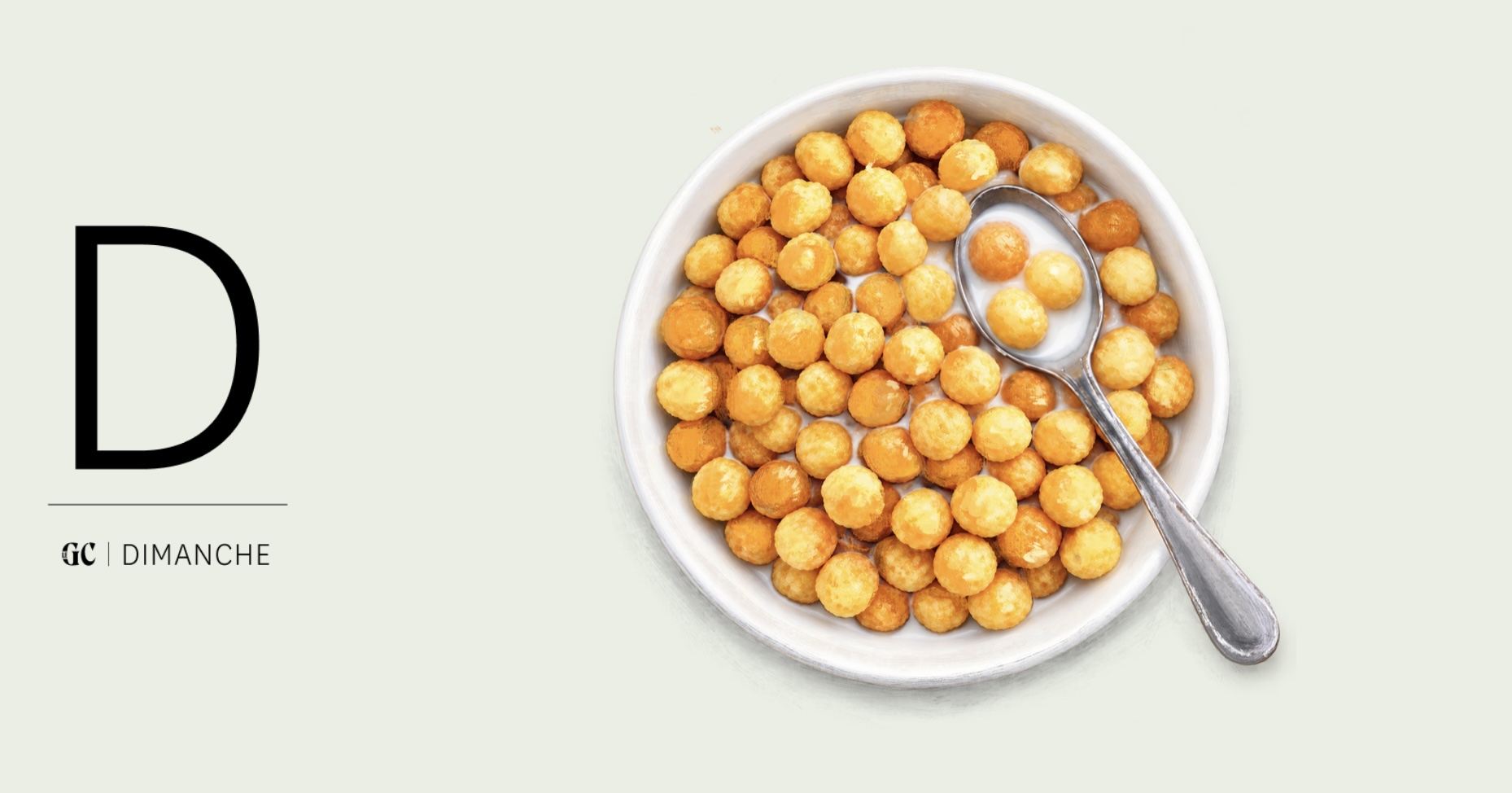
There are two schools of thought. Some pour the milk first, then the cereal. I do the opposite: cereal goes to the bottom of the bowl, then I pour on the milk.
There are also two ways to eat. Some swallow all the cereal, then drink the milk. Not me. Each spoonful must contain three lumps of Honey Pops and milk, and this rule is scrupulously observed to the last bite. The aim is to reach a bottom of the bowl where there is neither milk at the bottom nor a solitary Honey Pop. On the last spoonful: three Honey Pops, milk, and nothing after. The bowl must be clean.
This rigor applies only to junk food. For example at McDonald’s, I eat the burger first, then the fries. Never the other way around.
Why this dish
The bowl of cereal represents a certain relationship to repetition. In essence, every dish is a matter of repetition, but a good cook is creative; the obsessive, himself, is not at all, since his principle is to redo the same thing again and again. This falls under mania, even monomania, and mania in Greek means madness. Should we conclude that these rituals have something insane about them? That is the central question of my book (The Obsession. An Inner Regime, L’Observatoire): obsession is not madness, it is a way of existing.
First, the bowl of cereal speaks to the obsessional relation to action. One readily imagines it as a pressure cooker, haunted by intrusive thoughts until everything bursts and he acts. That is not true. The obsessive, Freud tells us, remains at the pre-active stage. He does not move to action; he relishes thinking, he relishes rehashing. For him, thought does not precede action, because there will be neither action nor realization. The bowl of cereal is perfect for this: nothing is produced there, one stays in the ritual, and the mere act of chewing the cereal in the same way takes the very form of rumination.
Next, it says something about our relationship to time. In The Irreversible and Nostalgia, Jankélévitch regards those who dream of turning back time as fools or idiots; he does not much fancy Nietzsche’s eternal return. Time moves in a straight line. And yet it makes space for nostalgia, and for a particular nostalgia: not the weekend in Capri that everyone remembers, but a dull, unglamorous landscape that is ours. The bowl of cereal is exactly that meal: the one we forget, the one we will not speak of the next day, which we even feel a bit ashamed of. And Jankélévitch writes of mechanical gestures that they “call the elementary confirmation that only the second time would bring us.”
Obsession is what finally makes us open one eye to what we were paying no attention to. What it refuses is not that time passes, but that it passes without us noticing. When we ruminate, at night in bed, it isn’t the important appointment that returns; it is the banal remark of a stranger, the line we failed to say. We relive it not to act better next time, but to understand what was at stake. It is a digging of time within time, as Kafka’s Terrier puts it: we refuse to move forward in order to dig deeper. Chewing and re-chewing one’s cereals is precisely that.
Finally, I did not want to write a laudation of obsession; there are already too many, and some obsessions are honestly painful. What interests me is that it gives us access to a part of ourselves we do not know. We do not particularly enjoy ourselves while eating our bowl of cereal; there is a slightly guilty pleasure there. We would like to cook a real meal, and we settle for the bowl, less out of laziness than because a strand of willpower resists. I call this the anti-self: something that comes from us, yet we do not recognize ourselves in it. It is neither the unconscious of psychoanalysis, nor a psychiatric pathology, nor a dark force that would be the evil within us. It is a part of us we do not understand, and yet it makes us act. An existential impulse, in short: with a bowl of cereal, I still feed myself, I do not let myself die, and perhaps it says something about my tastes, or my hunger, that I cannot elucidate.