
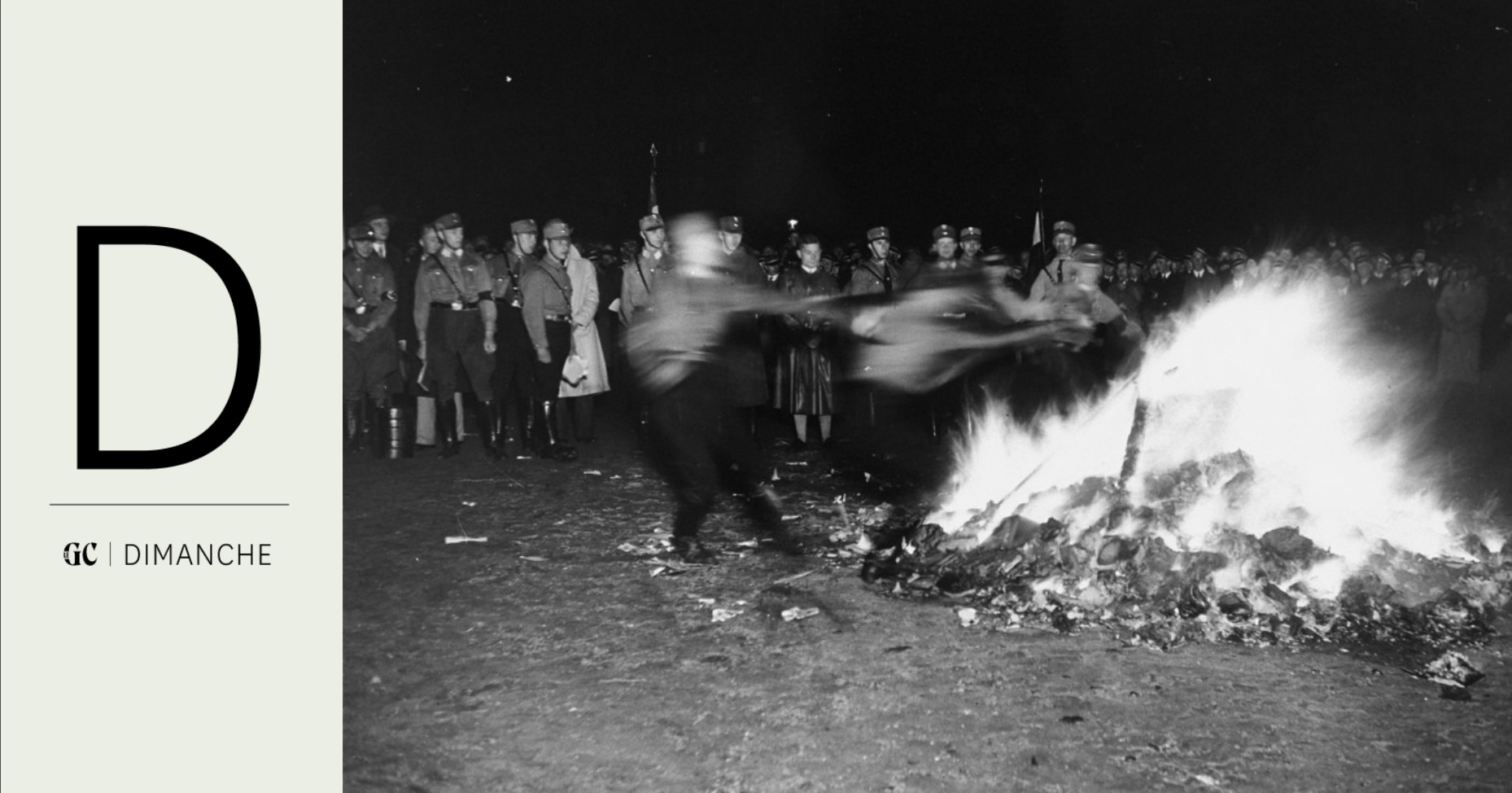
In the AfD, isn’t there AdF, auto-da-fé?
The recent electoral successes of the AfD (Alternative for Germany) in three states of Germany urgently raise the question of the return of the brown shadow in the German and European political landscape: this return is no longer a distant possibility, more or less far off, but a reality. And this reality, which mirrors what has been unfolding in the United States since Donald Trump’s presidency and their highly atypical approach to how democracy should function—a style that Elon Musk is readily trying to export, notably to Germany—also takes the form of memory revisionism, where negotiations with a past that can be summoned at will according to the desires and rhetorical needs of various people gradually undermine historical rigor and its work on the past.
Nearly a hundred years ago, the Nazi regime, newly brought to power by the elections of the Weimar Republic, instituted a memory revision policy that targeted books in particular. We know by the fatal chain of events that the destruction of books was only a prelude to a destruction far more terrible still. For, as the poet Heinrich Heine (1797-1856) so presciently stated, “where books are burned, they will later burn people too.” Fifty years later, for the 1983 commemoration of the 1933 book burnings, the literary sociologist Leo Löwenthal (1900-1993), a founding member of the famous Frankfurt School now unjustly little known in France, was invited in Berlin to offer a meditation on Nazi book burnings.
This text provides us with valuable keys to reading our present moment. Published for the first time in French by Rue d’Ulm Editions, it allows us to think of book destruction as an anthropological gesture, beyond the particular historical circumstances that witnessed it. When Löwenthal delivered his discourse on the autodafé—then titled “The Legacy of Caliban,” for he saw in Caliban, the character from Shakespeare’s The Tempest, a prefiguration of all the barbarities that destroy humanist and rationalist thought—, the Cold War was drawing to a close and one would soon, with Fukuyama but also with many European progressive thinkers, declare history finished, with clashes between ideologies past and liberal democracy definitively established.
Löwenthal, for his part, was not mistaken. An anecdote from his old age—he was then 89—related by his friend and editor Helmut Dubiel shows how the Fall of the Berlin Wall did not, for him, signify the end of ideologies:
Regarding the events of 1989, [Löwenthal] possessed a clarity that one hardly acquires except after a long life lived in full awareness. I will never forget the argument we had on the day the Wall fell. At that moment, the events in Berlin, Prague, and Budapest did not leave me without enthusiasm. He could not understand this at all. In front of his hotel on Mecklenburgische Landstraße, he lost his temper. “The old ghosts will return,” he told me. “In Eastern Europe, the nationalist and ethnocentric spirit of the interwar period will rise again. There, foreigners will be persecuted, Jewish tombs will be desecrated, and politicians will be corrupt enough to strip the right of asylum from the Basic Law under pressure from the right.” I strongly opposed his remarks at the time.
Löwenthal was prophetic. Die alten Geister—the expression Löwenthal used, common in Goethe’s language—the brilliant poet of “The Sorcerer’s Apprentice,” can be translated as either “the old spirits” or “the old ghosts” or “the old specters.” We are living in a time of resurgent specters—whether they ever truly left.
The facts soon vindicated Löwenthal. Between May and August 1992, as war engulfed a Yugoslavia disintegrating, libraries and archives in Sarajevo and across Bosnia were destroyed by the deliberate bombardments of ultranationalist Serbs. In the same year, the Taliban seized Kabul and would subsequently extend their control over the rest of the country. In August 1998, they destroyed more than 50,000 volumes of the Nasser Khosrow Library in Pol-e Khomri: this was only the prelude to the axe destruction of works in the Kabul Museum and the demolition of the giant Buddhas of Bamiyan. From the Balkans to Central Asia, a new geography of intolerances emerged, with its long procession of book burnings on both sides, and it remains ours today. A long list of destructions—of books, works of art, and productions of the human mind—has since relentlessly unfolded, in this East where Löwenthal foresaw the resurgence of the spirits of past ideologies, but also, and more and more, in the “West” that believed itself safe from such collective deliriums. And the East, after arriving in Russia, then Hungary, has reached the heart of Europe: Germany.
When will France join? The question of historical revisionism, and the desire to destroy books that accompanies it, is resurfacing today with even greater urgency. That is why we present, as a preview, three excerpts from the Autodafés. The Books That Are Burned: an excerpt from Joseph Goebbels’s speech on May 10, 1933 at midnight; an excerpt from Leo Löwenthal’s speech in May 1983; an excerpt from our afterword to Löwenthal’s text, published almost fifty years later.
For the question remains: where will we be, fifty years after 1983, a hundred years after 1933? Will we content ourselves with burning books? Or will we go further? To where books are burned…
The autodafé: the making of a new race of men?
Joseph Goebbels, speech delivered on Opernplatz, Berlin, May 10, 1933
Make no mistake: no obstacle stops revolutions when they are authentic! No revolution reforms or overturns only the economy, or politics, or cultural life. Revolutions bring forth new visions of the world. And when a vision of the world truly deserves that name, it cannot content itself with overturning a single domain of public life: it must pierce public life in its entirety, and no domain must remain untouched. Just as it transforms people, it also transforms things! And in the end, mass, people, state, and nation will become one.
But we, people of wit, know this: political revolutions must be prepared spiritually. At their origin lies the idea, and it is only when the idea marries itself to power that the historical miracle of upheaval appears. You, young students, you have been the bearers, the fighters, and the defenders of the young and revolutionary idea of this state. And just as you once had the right to attack the false state, the non-state, and to refuse your respect to its false authorities, you now have the duty to enter the state, to bear it, and to give its authorities a new shine, a new dignity, and a new legitimacy. A revolutionary must know how to do everything: he must be as great in the destruction of non-values as in the construction of values. If you, students, claim the right to fling intellectual rubbish into the flames, you must also undertake the duty of opening the way to a true German spirit. The spirit is formed in life and in the lecture halls, and the coming German will be not only a man of books but also a man of character.
The book as an infected body
Leo Löwenthal. Hygienic Purification
I will be brief on this point. Hand in hand with erasing what relates to history, with the darkening of its horizon, goes the elimination, in the present, of what is deemed unhealthy. The book is already destroyed or relegated to the “hell” of a forbidden reserve. (That so-called “hell” is in fact a separate chapter. All arsonists have resorted to it—from ancient China to Stalin and the Nazis. One may wonder if it is not a magical or perverse act of reassurance, a esoteric mania, a collector’s impulse, or a theft. Be that as it may, the profane hell distorts the idea of a sacred erasure of history.) The writer who is proscribed is already in the concentration camp, dead or in exile, his name forgotten, erased. What remains is the possibility of infection. Then begins a true orgy of analycity. The idea of racial purity, religious purity, cultural purity is realized through the symbolism of the purification operation, for which the book is both bearer and symbol of the infection.
In the discourse where Goebbels speaks of erasing history, he mentions the filth and dirt of the “asphalt” Jewish writers whose works fill the libraries. The waste and dirt imply disease. In the Middle Ages, during the Inquisition and the Wars of Religion, the comparison with plague is never far.
Leo Löwenthal, at once our contemporary and Goebbels’s
How could Leo Löwenthal, when invited to open the conference commemorating fifty years of the 1933 autodafés, perceive his task, given that he had fled Germany in 1933 to settle, for the rest of his days, in the United States? It is probably useful to give a brief account of how this thinker, intellectual companion of Horkheimer, Adorno, and Marcuse, is tied to the famous Frankfurt School. Since the late 1920s, the School’s works, whose members gathered at the Institute for Social Research, had laid the foundations for a structural understanding of fascism and its extreme version, German National Socialism.
The Frankfurt School was then not known by the name it bears today, and even its method, commonly called “critical theory,” was not yet designated as such: one had to wait for an article by Max Horkheimer published in 1937 to see this notion appear, which Horkheimer used to distance himself from Marxist critique of capitalism. In truth, the paths of “critical theory” were diverse, and one should not simplify and retrospectively reduce the Institute’s work and its organ, the Zeitschrift für Sozialforschung, a journal of which Leo Löwenthal was precisely the secretary, from its founding in 1932 to its end in 1942. This journal stood at the center of a web of ideas in which many thinkers moved, nurturing a dissident Marxism, of which Walter Benjamin is perhaps the best known today—his essay on The Work of Art in the Age of Its Technological Reproducibility, an antifascist reflection on the modern uses of art, was published as an article in this journal in 1935.
The exile, from Germany and then from Europe, irreversibly altered the history of the Institute for Social Research: a French exile had at one time been contemplated, perhaps at the instigation of Raymond Aron, to the École normale supérieure, but this did not come to pass. After World War II, as Horkheimer and Adorno, as well as Herbert Marcuse, came into the limelight, Löwenthal drifted away from the core of the Institute’s research, where a new generation of thinkers rose. Jürgen Habermas, certainly its most famous figure, paid tribute to Löwenthal in 1980 on the occasion of his 80th birthday and the publication of the first volume of his complete works by Suhrkamp.
In 1983, for the commemoration of the fifty years since the 1933 autodafé, it was therefore to a renowned thinker, the last survivor of the “first generation” of the School, that one asked for his view of the event: Löwenthal was seen as a sage who had known Weimar Germany and the mad rise of Nazism. How did he approach it? His critical analysis had to keep its distance from the description of the event. Neither the anger of Joseph Roth, nor the utmost restraint of Raymond Aron, nor the provocative exaggeration of Oskar Maria Graf, nor the shame of Golo Mann had a place. It became essential not to condemn, but to understand—a concern that ran through Löwenthal’s entire life.
The thought of Löwenthal sits, in this regard, in the wake of the Institute for Social Research’s work on antisemitism, while reminding of the importance of those on fascist mentality. Indeed, the autodafé is not merely the act of a single individual; it is collective, it calls for unity around a sacred fire and implies the collusion of all forces, from the bearer of authority to the least of the community’s agents. Löwenthal asks to what extent the autodafé would be a genuinely antisemitic gesture, an operation aimed specifically at Jews, regarded as the people of the book. […]
Leo Löwenthal did not attend the 1933 “ritual,” for he was already organizing the transfer of the Institute for Social Research’s work to a more welcoming destination. His work destined him to study what had happened: to explain, in short, the inexplicable, while all his prior intellectual life had aimed at achieving a reconciliation between Jewish thought and German rationalism.
Born in 1900, Leo Löwenthal belonged to Frankfurt’s bourgeois Jewish milieu, with an atheistic father whose model of integration was clearly undermined by the rise of National Socialism. As a student, he identified as a supporter of both Orthodox Judaism and socialist utopianism, in a current to which Michael Löwy’s work offers fine analyses, classing the young Löwenthal among the “religiously anarchist Jews,” with Martin Buber, Franz Rosenzweig, Ernst Bloch, and Gershom Scholem. The thought Löwenthal develops during his studies is contained in a seminal text: “The Demon. Sketch of a Negative Philosophy of Religion” (“Das Dämonische. Entwurf einer negativen Religionsphilosophie” [1921]). This philosophy can be defined, according to Löwy, as follows:
« […] a negative theology that draws on Marx, Lukács, and Bloch to assert that we live in a world without God and without Redemption, a cold world given over to despair, a space between Paradise and the Messiah that seeks God without finding Him. The key formula of this religious philosophy is given by a quotation from The Theory of the Novel [by Lukács]: “The writer’s irony is the negative mystique of the times without God.” However, Löwenthal cannot be content with this assessment: he passionately aims at abolishing this condition of the world and at the advent of the “radiant messianic light” (strahlende messianische Licht) that will end all twilight and demonic things. »
One can easily see what might have connected Löwenthal with Siegfried Kracauer or Walter Benjamin—for evoking a thinker close to Löwenthal, far better known in France today—whose intellectual evolution from 1924 onward led him to a form of religious messianism, which he shared with Gershom Scholem, and a communist utopianism inspired by Lukács and Bloch, but also Bertolt Brecht.
Löwenthal was well aware of the difficulty of reconciling sociology with religion. After a doctoral thesis defended at the University of Frankfurt in the summer of 1923, on the thought of the social philosopher and mystical theologian Franz von Baader, Löwenthal, moving from messianism to the Enlightenment rationalism, prepared a habilitation project on a very different subject, Helvétius’s philosophy of history. The tension between these two poles of interest ran through his thought all his life. It was spiritually important for Löwenthal, moreover, to turn away from messianism, since, in the ideological convulsions of the interwar period, it was invoked just as much by rising Nazi theorists as by socialist utopians—their aspirations resembling each other in certain respects.
In his 1983 lecture, Löwenthal recalls what the autodafés of 1933 owe to the Wartburg festival of 1817. Löwenthal could just as well have traced back even further, to Luther and Johannes Pfefferkorn, the refuser of Johannes Reuchlin’s writings; or, considering a French tradition, to the martyrs Étienne Dolet or Miguel Servet, burned for the theses defended in their writings, the first in Catholic Paris, the second in Calvinist Geneva. The fact that, for Germany, it remained only post-revolutionary ideological convulsions can be partly explained by the fact that he was above all a specialist in the history of the Anti-Enlightenment and the Enlightenment.
Löwenthal was not unaware that Goebbels himself had, in 1921 at the University of Heidelberg, defended a German studies thesis on the Romantic dramatist Wilhelm von Schütz, which he obtained with the lowest possible grade, rite superato. Schütz had been Baader’s friend: Löwenthal thus must know his thought. Goebbels, for his part, whose direct inspiration for his thesis came from a course by Friedrich Gundolf at Heidelberg on “The Founders of the Romantic School,” started from the idea that there existed a deep resemblance between the Romantic era and the 1920s (“the decade we are traversing”). He wrote about this in terms heavy with meaning:
“Here and there, a form of superficial Enlightenment rationalism Aufklärung is spreading, which finds its culmination and raison d’être in a flat, spiritless atheism. But against this fights the young generation of seekers of God, mystics, and romantics. All these little and smaller ones are calling for Führer-guides, but there will be no great man to take them all into his arms.”
At the head of his work, Goebbels had placed a quote from Dostoevsky taken from Chapter V of The Demons; dialoguing with Stavroguine, Chatov conveys the essence of his thought: the life of nations, until the end of time, will never be governed by reason, but by forces coming from beyond:
“In the life of peoples, reason and knowledge have always played only a secondary, subordinate, instrumental role—and it will always be so! Peoples are shaped and driven forward on their path by a force of a completely different nature, a force that commands and compels, whose origin may be unknown and inexplicable, but whose existence is no less real.”
Goebbels thus expressed his admiration for the Russian thinker, or at least for the anti-rationalism of a major figure in his novel. And Dostoevskian demonic appears at the head of his thesis, which indeed calls to mind Löwenthal’s own fascination with what Georg Lukács called, regarding Dostoevsky, a “religious atheism” and which another contemporary thinker of Löwenthal, Leo Strauss, with more conservative political leanings, would characterize as “nihilism.” It is also worth noting that among Nazi intellectuals, Goebbels remained part of the left wing, less racist and more inclined toward a messianic urge for radical renewal of society, and that in the 1920s he nourished a strong admiration for communism and Russian literature.
It is no coincidence that Löwenthal is precisely the one to whom a study is owed, in 1934, on how pre-World War I Germany had appropriated Dostoevsky as a myth legitimating various ideological aspirations. Löwenthal’s project was meant to shed light on the spirit of his time—even as book burnings were being organized across Germany:
“The project for this study was conceived during the last year of the Weimar Republic, and it is at that time as well that the data for the survey were collected. The study itself was written ‘in exile,’ after Hitler came to power. I am making this plain intentionally to warn the reader that the motivation for this work did not stem so much from scientific interest per se as from political or, if you will, moral concern. As a sociologist working within the German university context, I was deeply struck by the growing political and moral apathy of the German middle and lower-middle classes from the 1920s onward—apathy, if not insensitivity, hidden behind a veneer of supposed ‘cultural’ pretensions. I wanted to know whether it would be possible to develop a systematic method of scientific investigation capable of studying this configuration in which political and moral decline converged with cultural grandiloquence.”
Dès cette époque, Löwenthal était parfaitement armé pour déceler dans les discours d’un Goebbels les manipulations imposées à la littérature. Sa propre méthode critique a été dérivée de ces observations ; elle doit être comprise comme une constante analyse de ce que les œuvres littéraires permettaient de connaître de l’histoire intellectuelle et sociale du passé et du présent. C’est à cette méthode, éprouvée au cours des années 1950 et 1960, que Löwenthal allait recourir pour éclairer ce qui semblait, même cinquante ans après 1933, le mystère de l’autodafé : il tenta de saisir la pulsion profonde qui motive l’autodafé, par-delà les motivations immédiates de l’idéologie national-socialiste.