
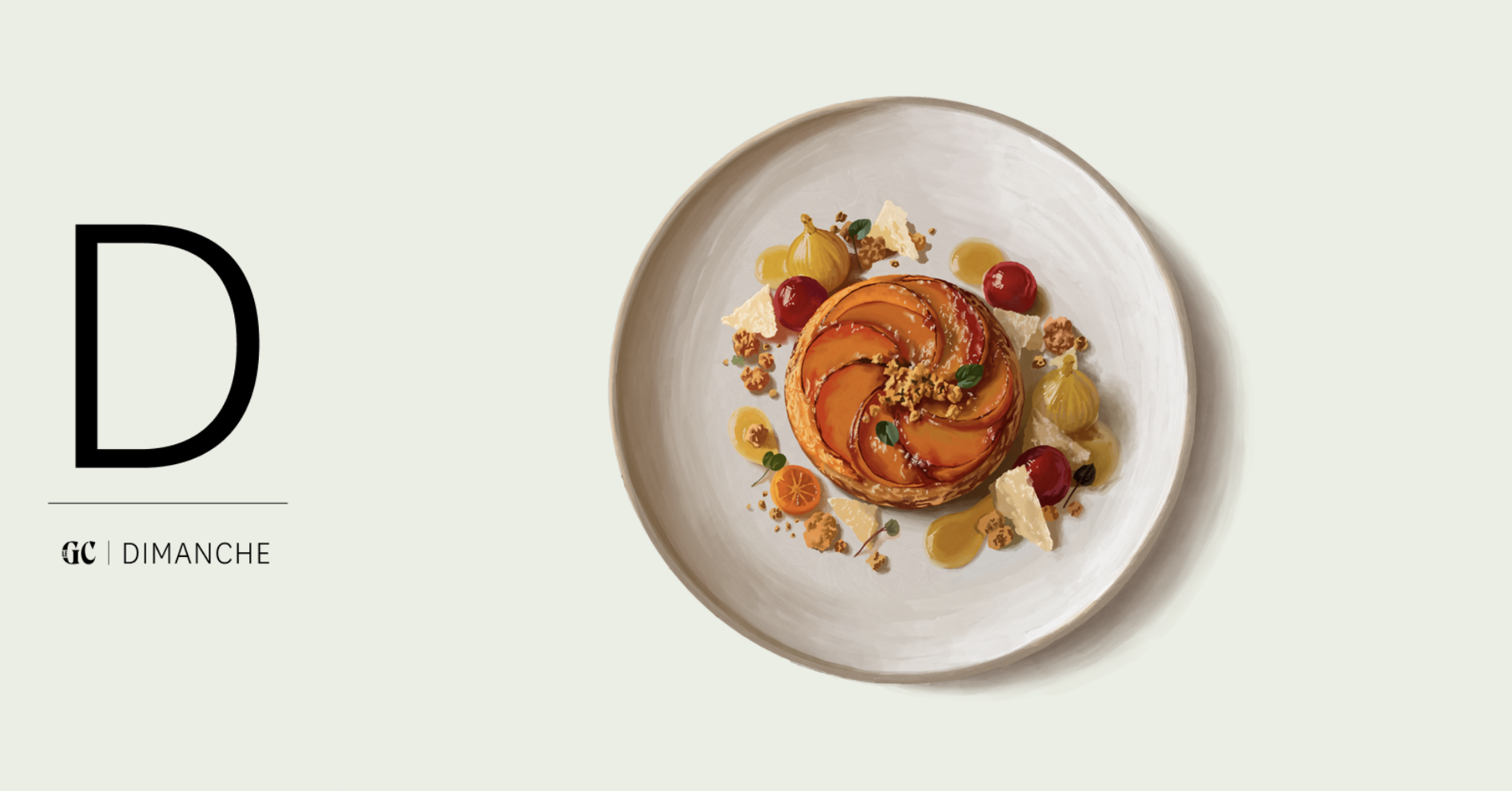
- 1 pumpkin
- 1 shortcrust pastry
- Parmesan
- Cream
- Amaretti
- 200 g sugar
I have always found it fascinating that theory can be practiced in dishes and applied to taste. This tart is a blend of several stories. It stems from a deliberate stance.
When I returned to Italy seven years ago, I realized that the idea of traditional Italian cuisine was becoming a political and identity tool exploited by the right and the far right. It has only worsened since. As a chef in Milan, I notice that everyone proudly clings to traditional Italian food. There is a sectarian side that narrows possibilities and confines us a lot. We end up eating the same things all the time and lose a great deal of curiosity. I strive to work against that logic.
I too carry childhood taste memories, such as Mantuan pumpkin ravioli, deeply rooted in my memory. From there, it seems interesting to shift this memory to show that flavors, techniques, and associations can travel elsewhere. In this case, the ravioli’s taste can tilt toward a tarte tatin. I spent ten years in Paris, and inevitably, at the start of autumn, the tarte tatin is a necessity. It’s one of the things that brings me joy. So three years ago, I decided to blend these two worlds. The ravioli transforms and assumes the shape of the tatin.
It will be a pumpkin tarte tatin, because the raviolo filling in question includes pumpkin, a product very typical of the countryside of the Po Valley plain, Parmesan as the region’s flagship product, and amaretti and mustarda, a product quite fascinating that comes from where I grew up, between Cremona and Mantua. These are candied fruits in a syrup flavored with essential oil of mustard. This product, in my view, will likely never reach France because of its etymology and its strong resemblance to the word mustard. It is impossible to sell, to tell, to market: it is very sharp, it is an adult flavor. When you are a child, you hate it. You usually eat it with cheese, in ravioli, and with meats, in the equivalent of pot-au-feu.
Its etymology, the same as that of the word mustard, is charming: mustum ardens. Musus like the must of burning grapes, the must that burns. It makes perfect sense to eat it in autumn, the time when the warmth of summer has transformed into fermentations, into confit, into jam, into canning—one of the countless techniques humanity devised to embalm time and flavors for later.
This recipe is also a nod to a medieval culinary tradition. Until the end of the 15th century, Europe, especially Italy, ate foods very spicy. There were many spices; foods filled halls with scents and contrasts that were sweet and savory. Through its striking and explosive combination, this dish is a reminder that Italy is also capable of that. The question is why spices were excluded from European gastronomy in the 17th century, particularly Italian and French gastronomy. Spices were rare and expensive. At some point, the lands where they were cultivated were colonized; the product became more abundant, cheaper, thus less prestigious and less coveted. The ruling classes and intellectuals deemed it no longer fashionable. Moreover, we had met the peoples who harvested them; colonial history suggests they were considered inferior. The taste for spices, within a few decades, became a source of contempt. I therefore want to bring them back to the table.
Regarding this, here is the recipe, which is fairly technical. Take Japanese Hokkaido pumpkin or a squash; rinse it and remove the interior completely. Ideally it should be quite firm. Cut it into quarters, then slice the quarters into diamonds; the skin should have a triangular cut so that the pieces fill the pan without leaving gaps. Roast the pumpkin in the oven at 200°C for about fifteen minutes, with neutral oil and without salt, because salt would release water. Salt will be added after cooking.
Meanwhile, we will have prepared a shortcrust pastry (which can be bought). In a shallow, two-handled pan that goes to the oven, make a caramel with 200 g of sugar, color it with butter and a touch of vinegar to balance the sweetness of the pumpkin. Once the caramel is done, move on to the assembly.
Spread the pumpkin chunks well, optionally dusting them with potato starch before laying them directly onto the caramel as is. Once the pastry is well filled, cover with a lid or another dish and press firmly so that all pieces are as compact as possible. Then place the disk of shortcrust pastry on top. You can bake it immediately at 160°C for 35-45 minutes, depending on the oven.
When it’s cooked, you can let it cool and unmold later if you want to serve slices individually, because it’s very hard to cut the tart cleanly while hot. If you choose to cool it, allow a night of resting in the fridge. As soon as the tart is well cold, flip it over, cut slices just before serving the slices one by one. I’ll share a trick for the delicate unmolding part. Like a classic tarte tatin, return the very cold pan to the heat for about a minute and a half. Place your hand on the shortcrust pastry and try to rotate the tart inside the pan. As it heats, the caramel melts, causing the tart to begin loosening and turning inside the mold. Once it turns inside the mold, you can be fairly sure that when you invert it, it will detach perfectly.
At home, you can approach it differently. You can indeed let it rest a little and then flip it as is to slice it right in front of everyone. I strongly recommend serving it with a parmesan cream prepared as simply as possible. Use equal parts grated parmesan and cream. Warm the cream in a blender or food processor with the parmesan, blend, and you’ll have your parmesan cream. It works with any cheeses that are a bit firm and can be grated.
Finally, the rest is straightforward because it’s store-bought: candied fruits in a mustard syrup and amarettos that can be crushed on top. When you’re at home in a convivial setting, I suggest placing on the table the pumpkin slices, the whole tart, and bowls containing the amarettis, the candied fruits, and the parmesan cream with spoons. That way everyone can compose their plate according to their preferences, re-creating the shape of the service table à la française. It’s a fall dish for a home dinner with friends. As soon as the ingredients are mixed on the plate and served hot, a fragrance nearly becomes liturgical. It’s an ancient but very present scent, rooted in the distance, and it consoles you.