
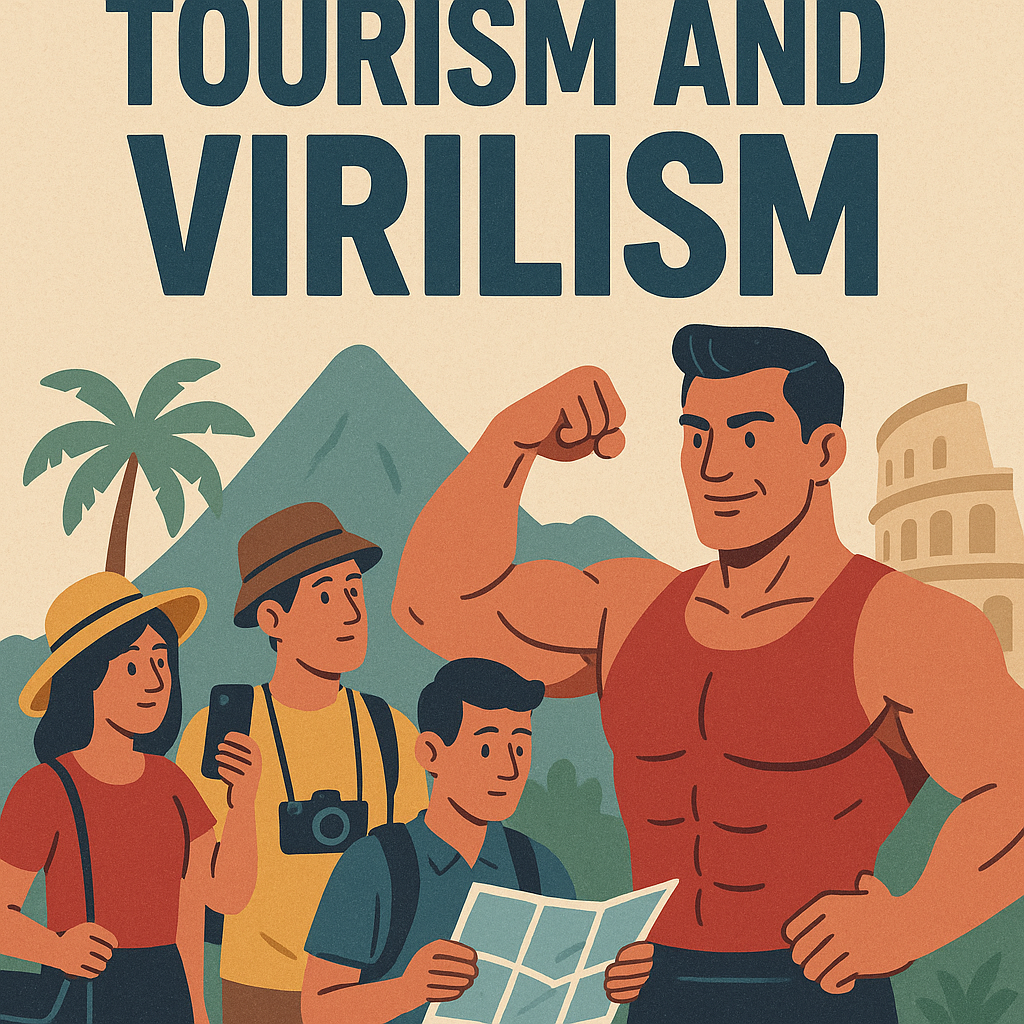
Focusing on the seaside resort of Lloret de Mar in Spain, an anthropologist studies male sociability in a context where alcohol, partying and sex structure imaginations. When “ tourism » rhymes with “ virilism »…
Thanks to Alix Boirot’s investigation, what happens in Lloret no longer stays in Lloret. For his thesis, the anthropologist spent several summers in the seaside resort of Lloret de Mar on the Costa Brava (Spain), in order to study the festive practices of young European tourists. Employed as a tout for a famous nightclub in the city, whose name she changed, she chose a prolonged immersion in the heart of Lloretian nights, which allowed her to closely observe male sociability in a tourist context.
Party, alcohol and fantasies
Lloret de Mar has established itself as one of the main destinations for festive tourism – or of borrachera (drinking), depending on the angle from which you are located. “ Festive “, if you are a young man aged 17 to 23 who has come to experience the promises of the Mediterranean night ; “ of borrachera », if you are a resident of Lloret, in the front row to suffer the harmful consequences, regularly relayed by the Spanish media.
A modest-sized town during the winter, Lloret de Mar transforms in fine weather into a space polarized by nocturnal activities. Bars, discos and fast food restaurants open all night occupy a central place in the urban landscape, mainly on Avinguda Just Marlès Vilarrodona and surroundings. Groups of French, Italians, British or Dutch, but few Spaniards, rub shoulders in this environment where alcohol, partying and sexuality structure imaginations and practices.
Lloret resembles other party tourism destinations, such as Albufeira in the Algarve, Magaluf in the Balearic Islands or the Leisure Island, near Cap d’Agde. However, it stands out for its ability to attract young people from several European countries, where the others are associated with more clearly identifiable clienteles. The seaside resort has also established itself due to the existence of turnkey stays inspired by Spring Break American. Every spring, the travel agency Studiomove offers a stay in Lloret by putting up a poster in universities selling the ingredients for the party (minus alcohol and sex): “ Spain Break – Lloret de Mar. Transport + accommodation + fiesta pack + photos and videos + entertainment and activities “.

Lloret’s reputation is closely associated with partying, cheap alcohol, fantasy figures of sexually available women and puticlubsestablishments linked to a tolerated, but legally ambiguous, prostitution market. This reputation also finds an echo in a long-standing personal knowledge of the place: I myself knew Lloret de Mar in the early 2000s. It was an accessible destination for a group of friends from the suburbs of Grenoble, attracted by the idea of a festive and inexpensive vacation in Spain. This situated memory allows us to further measure the analytical scope of Alix Boirot’s investigation, which gives names, social forms and anthropological depth to practices perceived in a diffuse manner at the time.
Manly performances
The work includes a prologue and three parts which present the different temporalities of the trip: before departure, the experience on site and afterwards. Alix Boirot begins by explaining her investigative approach and her situated positioning as a young woman researcher. These pages reveal the practical conditions of its particularly demanding terrain. Her reflection on methodology is one of the important contributions of the book.
The first part places the city of Lloret de Mar in the history of Spanish tourism. Although relatively brief, this review of the historical construction of the seaside resort is essential. Drawing on the pioneering work of Sasha D. Pack, Boirot recalls that the first nightclubs opened in Lloret in the 1960s, when Franco’s Spain was in the midst of a tourist boom. Nocturnal leisure activities then give an image of normality and modernity, even if they are only islands of tolerance for foreigners.
Greater attention is given to the recent period, marked by conflicts of use between residents, tourism professionals and visitors. They arrive on vacation with a pre-established image of their destination, an image of transgression, linked to alcohol and sex. This male gauzebetween eroticization and cheap exoticism, is at the heart of the marketing practiced by party venues.
The second part constitutes the heart of the work and takes us into the Lloretian nights, for a “ choral vision of festive tourism » (p. 12), from the professional practices of touts to the trajectories of tourists. The author describes the working conditions (illegal and precarious), the economic logics and the mechanisms which structure the party industry.
Concerning tourists, if Alix Boirot chose to focus on groups of boys, it is because they are in the majority, oriented towards excess at all stages of the trip, and because they constitute a privileged field for analyzing contemporary forms of masculine socialization, the rites of passage associated with vacations and the injunctions to virile performance.
But girls are not absent from the nightclubs of Lloret, nor from the pages of Alix Boirot’s book. They occupy a central place in the staging and validation of virilist masculinities. However, the practices of young women are often understood through the male gaze which dominates and structures the space of the party. ; and if we sometimes regret that more voice is not given to female tourists, this asymmetry is precisely one of the elements of the investigation.
Intersectional analysis
Behind practices that may seem immutable, Alix Boirot reveals the social norms, the hierarchies of gender, class, race, as well as the forms of sociability that structure the contemporary tourist experience. In fact, the price offered at the entrance to nightclubs depends on the nationality of the group of tourists (tourists from “ Northern Europe » have a better reputation than those of “ South “).
The pages devoted to discrimination at the entrance to clubs are very enlightening, because they highlight its intersectional nature. This passes through the price, which can play the role of a foil, without the racial criterion being explicitly mentioned. For racialized young people, other elements are highlighted, such as clothing style. associated with the suburbs and rap » (p. 101). It is the doorman who will determine the entry price, without this practice seeming to be debated.
Once there, what seems most important for these boys is, as in any tourist trip, to match expectations and reality. They came for “ party and girls », and the festive, advertising and commercial system designed for this male and heteronormative audience promises them this. The paradox raised by Alix Boirot is that boys come for girls – hypersexualized in advertisements – but that their practice is homosocial, whether in discotheques or in clubs. puticlubs.
In these brothels, the experience is not only homosocial, but its story also remains in a masculine framework: they also have some difficulty recounting their experience to the anthropologist, because she is a woman. The survey also shows that the virile performance observed in Lloret is part of ambivalent social trajectories, where certain young men possess attributes associated with domination, “ whiteness, masculinity, youth ”, without being “ truly in a dominant social position » (pp. 200-201). Intersectional analysis allows us to grasp this tension.
The third part focuses on post-Lloret and the stories produced and disseminated. Memories, mainly nightclub merchandising, photographs, discussions between friends and publications on social networks, construct a selective memory of vacations, with, logically, lived experiences embellished and reorganized around a few motifs which will fuel the imagination of the destination.
Virilist norms and tourist spaces
Alix Boirot’s work is remarkable for several reasons. It makes an original contribution to the study of contemporary masculinities, by giving voice to ordinary actors from a perspective bottom-upwhile proposing conclusions that go beyond the framework of Lloret de Mar, to provide a more general reflection on youth, gender and contemporary forms of male sociability.
It is not only an account of experience, because the author summons the bibliography of gender And masculinity studies and dialogue with Judith Butler, Raewyn Connell, James W. Messerschmidt, Isabelle Clair, Elsa Dorlin and Vulca Fidolini. The book shows that tourist masculinities are part of a situated play of positions, where marginalized forms of virility – those of boys who scream, vomit, practice predatory flirting – can become, during the holidays, a local norm and part of the social order.
The case of Lloret opens onto a broader contradiction. Since the La Manada affair and the feminist mobilizations that followed it, Spain has established itself as one of the European countries where feminist demands have most clearly invested the public space, legal debate and institutional action, particularly around sexual violence, consent and women’s rights.
However, Lloret appears to be a tourist enclave where young men can reenact, under the guise of a vacation, heightened forms of virilist sociability in front of groups of girls who are often embarrassed or led to develop avoidance strategies. The strength of the investigation is to show that virilist norms can be redeployed in tourist spaces where the party economy makes them visible and sometimes profitable.
The work constitutes a particularly stimulating reflection on anthropological inquiry. By following the author on the noisy sidewalks of Lloret, from where she invites tourists to spend part of their evening at the “ Moonlight “, the reader concretely grasps what field work entails, with its hesitations and the possibility of evolution. Indeed, one of the most interesting aspects of the book lies in the progressive transformation of the researcher’s perspective.
Young tourists, initially perceived through the negative stereotypes associated with mass tourism, gradually appear in all their complexity. The approach adopted, attentive to ordinary actors and their own stories, allows us to go beyond moral judgments, to reveal socially constructed expectations, vulnerabilities and constraints produced by a social order strongly marked by virilist norms.
Reading this investigation after my own Lloretin experience stirs something very concrete – besides the photographs with 20 years younger, a tank top emblazoned with the logo of a nightclub and a henna tattoo. For anyone working on the history of tourism today, it gives social intelligibility to memories which, at the time, were mainly carefree, and reminds us that vacation spots are never simple parentheses.