

By following the journey of ḥusayn Ibn ʿAbdallāh, Mamlouk in Tunis having experienced a good social ascent XIXe A century, M. Oualdi guides us between the Ottoman Empire, Tunisia and Europe, and took the opportunity to shake up the partitions between Ottoman, colonial and Maghreb historiography.
Here is an atypical book in its way of grasping colonization, through the examination of a biographical trajectory. And this in a vast but nevertheless specific space, North Africa and the Mediterranean in the second half of XIXe century.
If writing a life is a bet, to paraphrase François Dosse, it is not the bet that M’hamed Oualdi, professor at Sciences Po in Paris, is trying to “rather offer” Decompose the colonial, national and ottoman history of the Maghreb to rethink the ability to act of local actors ».
Tunis-Florence-isanbul: a life at the crossroads of powers
Even if the book may seem, at first glance, a kind of partial biography because it examines certain episodes of the life of an Ottoman slave freed in Tunisia, ḥusayn ibn ʿAbdallāh (circa 1820-1887), it is actually a connected story that combines several micro-history from the colonial fact. The numerous wanderings of the protagonist, the Circassie, his native country, in Istanbul, imperial capital ; From Tunis, his true adoptive homeland, in Florence where he lives his last years, offer the author the opportunity to build a meandric story covering a considerable part of the old world between the years 1820 and 1890.
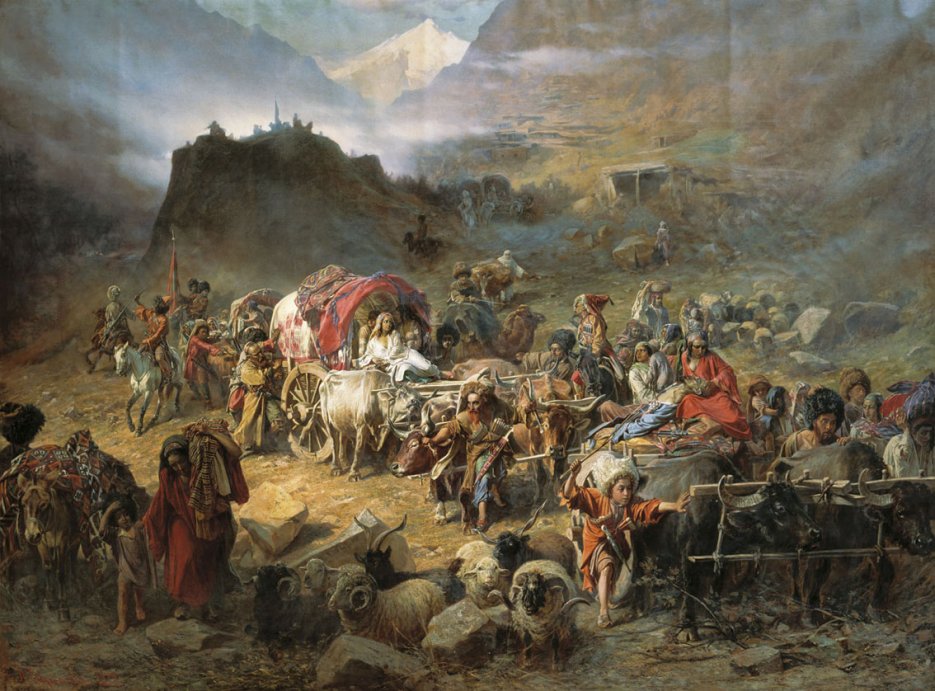
Born in Circassie, in the Caucasus, ḥusayn Ibn ʿAbdallāh is sold as a slave in the Ottoman Empire and arrived in the late 1820s in Tunis. He enters the limited circle-and which tends to decrease-mamlouks, that is to say soldiers devoted to governors. After studying at the Bardo military school, he began a bureaucratic career that led him, after about twenty years, to public positions of primary importance. Tunisian political upheavals lead him to leave the country well before the start of French colonization. He travels and made long stays in Europe, visiting Italy, Spain, France, Belgium, Germany, Denmark, Sweden, England, passed through the United States and, naturally by Istanbul. He even returned to his native country, the Circassie, before settling in Florence where he saw his last years.
The life of this Ottoman slave does not really end, moreover, with death, because for certain former slaves with trans Inspensions, there is indeed a life after death. This is how his heritage as his body continue, after his death, to oppose various powers: France, colonizing power having got their hands on Tunisia, Italy, country of its last home, having disappointed imperialist ambitions on Tunisia and the Ottoman Empire, its country “ original ».
In a short book – a text of barely 184 pages -, articulated around five chapters, an introduction, an epilogue and a conclusion, M’hamed Oualdi aims to shake the received ideas and the tropisms of colonial, national and ottomanists of the Maghreb. To do this, he especially criticizes colonial historiography and to a certain extent ottomanist, which, although competing at first, meet in their approaches centered respectively on the metropolis, or on Istanbul, by relying almost exclusively on French or Ottoman sources to write the history of the colonial and precolonial Maghreb. However, as the author, of rich local, private and public sources, who have existed.
Maghreb companies procedural and Paperassières
This is one of the main contributions ofA slave between two empires : Demonstrate through multiple examples that, unlike the common places of colonial historiography, the Maghreb societies have been proceeded and Paperassières. Another point constantly underlined by M’hamed Oualdi is that colonization also had the consequence of bringing together the Tunisian elites of Istanbul, the imperial capital. The colonial presence has had contradictory effects by strengthening “ French control over justice and archives, while revealing what remained of an Ottoman political and legal culture in the old province of Tunis (P. 160).
The author’s reflection is complex here because it shows throughout the book that it is not a shock but rather a legal and cultural context of the colonial, imperial (ottoman) and local elements. Thus, for local elites, colonial jurisdiction also constitutes a lever likely to increase their capacity for action against the sovereign of Tunis, and the Ottoman imperial heritage is mobilized in turn to contain colonial power. Colonization is therefore an element that widens the repertoire of action of the local elites.
The Imperial Ottoman element is distinguished from colonial domination in that it consists of a multisecular culture of political domination of the imperial capital over the provinces, which is incomparably more inclusive than colonial configuration. Concretely speaking, the protagonist ofA slave between two empiresalthough a bit of the origin, certainly nourishes a feeling of undeniable belonging to the Ottoman Empire while he cannot imagine the other empire, the French colonial empire, that as a foreign power which must be wary, that one must try to use, if necessary, to achieve individual or collective goals.
In short, while restoring the Ottoman part of Maghreb history in the face of dominant colonial historiography, the author scrupulously weaves a penetrating story that highlights the ability to act of these elites, including ḥusayn Ibn ʿAbdallāh is the paragon.
To do this, learning is combined with a concise narrative economy. Skillfully avoiding giving an excess of meaning and coherence to the protagonist trajectory, the author exposes the historiographical nodes successfully and precision, manages to question the colonial (French), national (Tunisian) and imperial (French, Italian and Ottoman metarians). These metarécits have the common point of favoring the weight of a single omniputing power center compared to the space concerned, often going so far as to completely ignore the ability to act of others, as well as their interference. In addition, the French colonial metarécit – as well as the imperial metarécits – organize the history of Tunisia and its population according to clear and definitive chronological divisions which follow one another (the time or the Ottoman, French, Italian influence …), by removing, in this way, Tunisia, of its “ own History, or by obscuring the continuities of this story.
In contrast, the search for a story that would be “ own From any foreign element, the Tunisian national metarécit, proposes a suffering national history, like all nationalist historiography, an excess of sense of history which reduces the Ottoman, French and Italian elements in Tunis to foreign, necessarily ephemeral, in some way unnatural. However, the history of human societies is incessantly made up of countless mixtures. This book therefore gives history all its complexity both by decomposing monolithic stories and scrupulously connecting the scattered elements which do not fit into their milestones.
Thus, by reading M’hamed Oualdi, we learn a lot, among other things, on the role of Muslim exiles and the factory of new conceptions of Islam and panislamism (p. 52-53) ; On the spread of European anti -Semitic ideas in Muslim societies (p. 54) ; on the interlocking of the statutes between the public and the private (p. 73-74) ; On the demands of sovereignty of the Ottoman power vis-à-vis the body of its ex-projects (p. 109) ; On the lasting importance of the central institution of the Ottoman socio -political structure, the household (p. 160) ; and on the centrality of Istanbul of the young Turkish period in the emergence of Maghreb nationalisms (p. 171-174).
These are only the remarks of an Ottomanist here, probably sharing a good part of the tropisms pointed, rightly, by M’hamed Oualdi. Some could certainly draw other lessons fromA slave between two empires. By the multiple avenues of reflection he offers, this book which breaks down the certainties and the common historiographical places should be part of the obligatory readings of any historian who works on colonial, Maghreb and Ottoman history.