
According to Nicholas Klingaman, former head of weather at Citadel, the winter of 2026-2027 could see a record-strong El Niño interact with Madden-Julian Oscillation (MJO) episodes that are more numerous and intense than usual. Such a configuration is rare: only three “super El Niño” have been measured since 1950, including those of 1997-1998 and 2015-2016, which coincided with strong MJO activity.
- The MJO is a pulse of rain, wind, and clouds that travels eastward, from the Indian Ocean toward the Pacific, roughly every one to two months.
- It recurs continually, with phases more or less active, but only its strongest episodes reach the Pacific.
Its atmospheric undulations can span thousands of kilometers, altering atmospheric circulation down to mid-latitudes.
- In winter, it influences the North Atlantic Oscillation (NAO), which largely conditions weather in Europe.
According to Klingaman, the MJO could complicate forecasts based on El Niño, because its effects become visible only a few weeks in advance. Its interaction with El Niño could thus shift temperatures in Europe away from what is expected, with the coldest deviations occurring between late January and March.
- According to a study published in late 2023 in Nature Climate Change, the predictability of the MJO has increased over the 20th century.
- In winter, weather models can theoretically anticipate it about six days earlier than 100 years ago, with an average lead time of around forty days.
- Climate warming would explain part of this increase, and it is expected to continue through the 21st century, making the MJO stronger and more regular.
The relationship between temperature and gas consumption in Europe is nearly linear. In France, Germany, and Italy, cold alone explains about 90% of the monthly variations in consumption from 2015 to 2025, according to an analysis published in the journal.
- In September, Goldman Sachs highlighted in an analysis the weight of deviations from seasonal norms on Europe’s gas prices this winter.
- According to the American bank, in winter, temperature can cause gas demand to vary by roughly 12% of storage capacity.
- The price impact is asymmetric: a winter colder than the average by one standard deviation would lift the forecasted winter price by about 75%, while a milder winter by one standard deviation would push it down by roughly 30%.
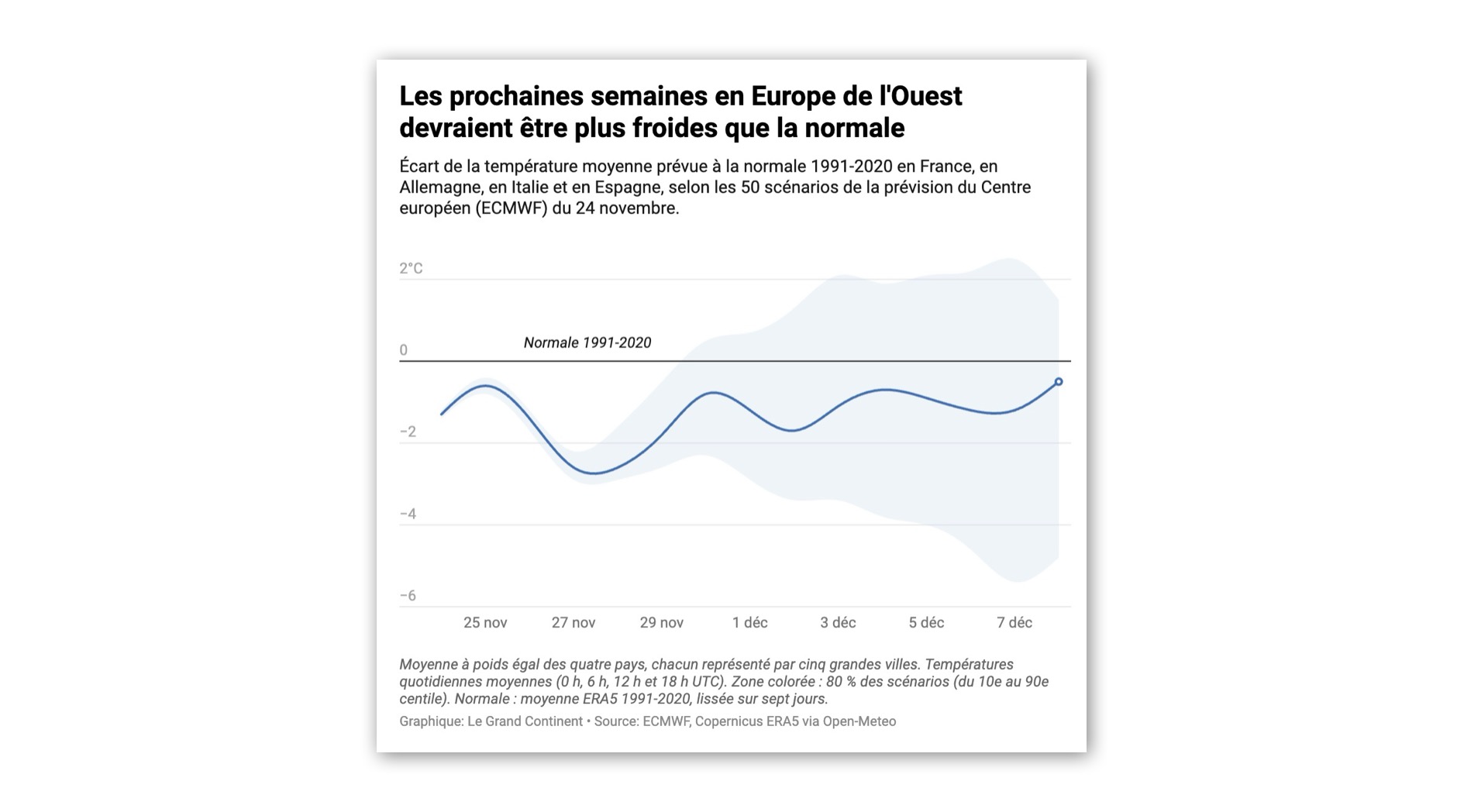
Gas prices surged in Europe at the start of the week due to new weather forecasts predicting a cold spell, this time tied to the early collapse of the polar vortex. On Monday the 23rd, the benchmark contract climbed as much as 8.6% in trading, to 96 euros per megawatt-hour (MWh).