
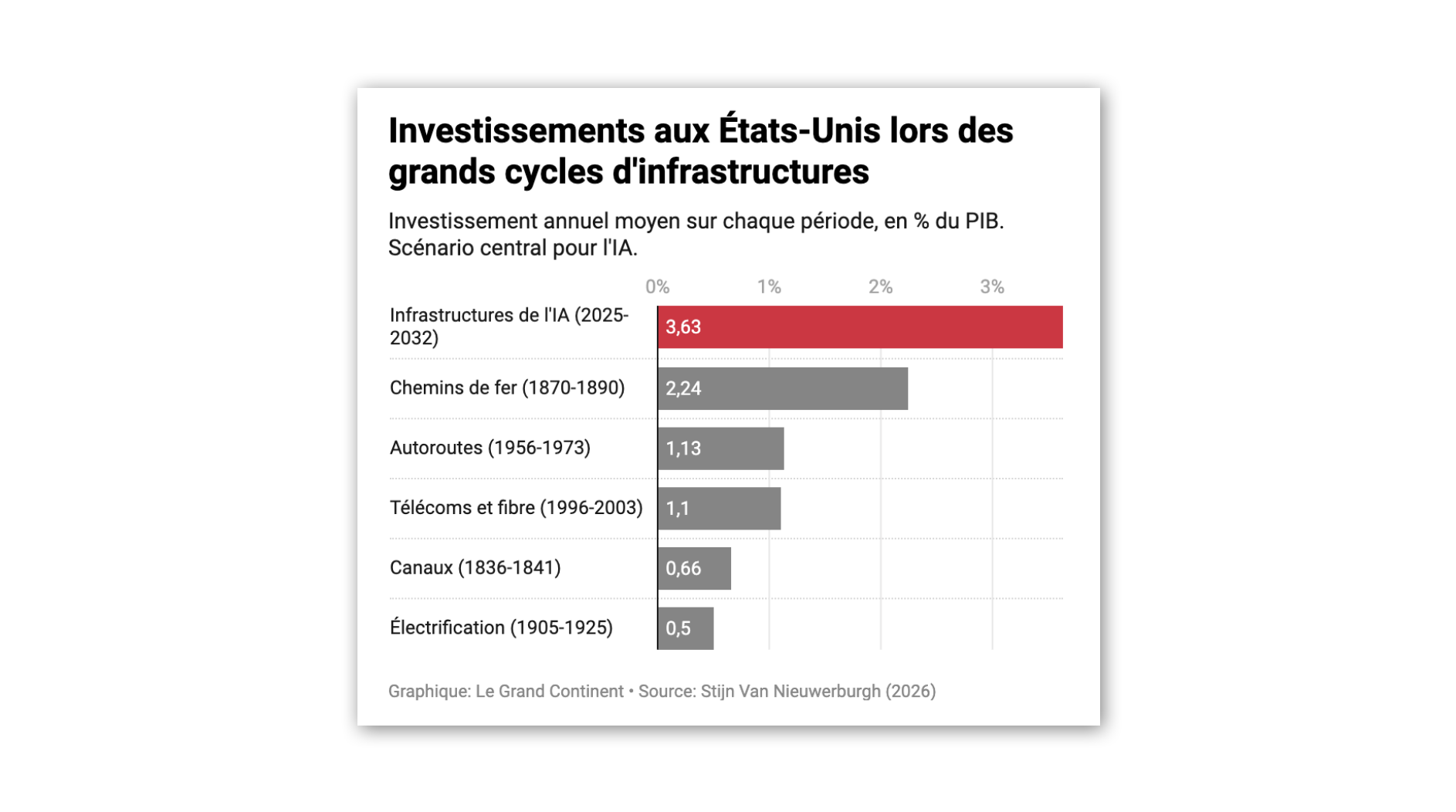
According to a study presented on September 25, cumulative investment in the United States’ AI infrastructure could reach $10.3 trillion over the 2025-2032 period, averaging 3.6% of GDP per year. By the end of this period, in 2032, these investments would represent 5.1% of GDP.
That is almost 2 percentage points higher than defense spending, estimated at 3.2% of GDP in 2026.
- The AI boom is unlike any investment undertaken during previous major infrastructure cycles in the United States.
- Railways had accounted for an average of 2.2% of GDP per year between 1870 and 1890, electrification 0.5% between 1905 and 1925, highways 1.1% between 1956 and 1973, and fiber and telecommunications 1.1% over the 1996-2003 period.
These investments will be used to construct the physical infrastructure necessary for the development of the technology: data centers (buildings, cooling systems), electrical interconnection infrastructure, and, for about two-thirds, computer hardware. Hyperscalers are indeed devoting substantial sums to purchasing chips, whose economic lifespan is estimated at five or six years.
- American tech giants cannot shoulder these financings on their own.
- More than half will thus come from external capital (equity investors, bond markets, banks and private credit), which disperses potential risks across the financial system, all the way to pension funds.
According to an analysis by two Stanford economists, Jared Bernstein and Ryan Cummings, to profit from the AI investments undertaken since 2024 by Google, Amazon, Microsoft, Meta, Oracle and SpaceX, these companies would need to generate between $2.4 trillion and $3.8 trillion in AI-derived revenues over the next six years, effectively multiplying their current AI-related revenues by 13 to 45.
Nevertheless, returns on investments could materialize later than anticipated.
- Berstein and Cummings write: “The diffusion of a new technology requires not only that companies adopt it, but also that they determine how best to integrate it into their existing workflows, a process that can take considerable time. For example, in 1900, only 5% of mechanical power was electrified. It took another 30 years to reach an 80% adoption rate.”
Donald Trump views American dominance in AI as potentially one of the main legacies of his second term.
- On Tuesday, September 29, at the White House, he had OpenAI, Anthropic, Google, Meta, xAI and Nvidia sign an agreement by which these companies voluntarily commit to self-regulation.
- The document simply mentions the possibility, “in the long term,” of enshrining these commitments into law or regulation.