
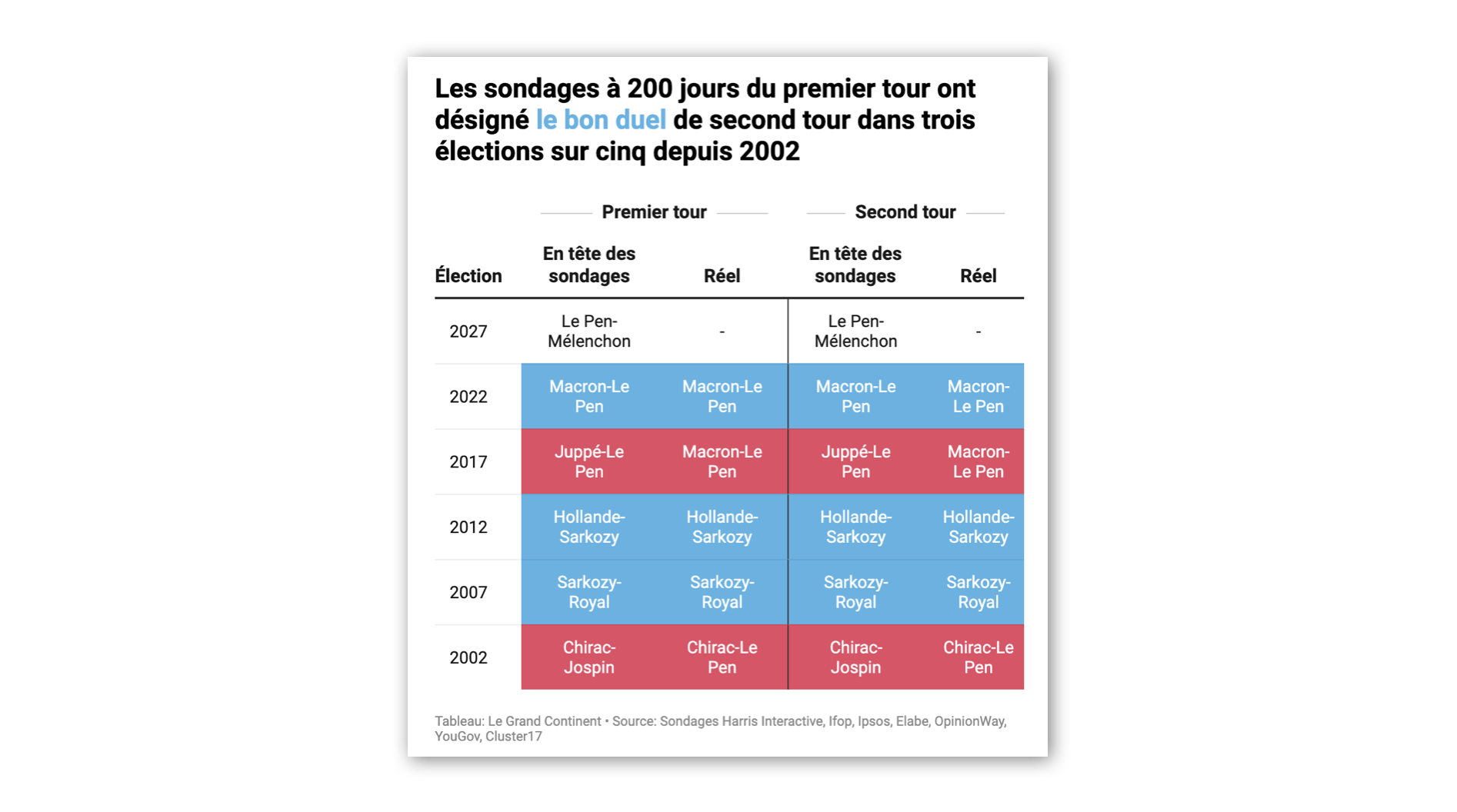
The first round of the French presidential election will take place in exactly 200 days, on April 18, 2027. While around thirty candidates have already declared their candidacies and must secure 500 endorsements from elected officials across at least 30 different departments or overseas territories by March 12, the polls already converge on the frontrunner for the first round.
- Marine Le Pen, the candidate of the National Rally, is projected to win in all polls published in September, for both the first and the second rounds, no matter which opponent is tested.
- The candidate of La France insoumise, Jean-Luc Mélenchon, and Édouard Philippe (Horizons) are neck-and-neck for the first round, around 16–17%.
- Gabriel Attal (Renaissance) and Raphaël Glucksmann (Place publique, a contender in the Socialist primary) are credited with roughly 10–11% of voting intentions on average, ahead of Bruno Retailleau (Les Républicains, around 8%).
- The score for Attal depends heavily on the presence of Édouard Philippe: from 12 to 15.5% without him, and from 5 to 9% with him.
Past presidential campaigns, however, suggest that the balance could still shift by the month of April.
- In the five most recent presidential elections (from 2002 to 2022), the candidate leading the polls 200 days before the first round finished first in four cases (Chirac in 2002, then neck-and-neck with Jospin; Sarkozy in 2007; Hollande in 2012; and Macron in 2022).
- The anticipated second-round duel 200 days out only materialized in three elections: Sarkozy–Royal in 2007, Hollande–Sarkozy in 2012, and Macron–Le Pen in 2022.
- In the other two elections, at least one of the two finalists was not the expected one: Jean-Marie Le Pen instead of Jospin in 2002, and Macron instead of Juppé in 2017.
If polls conducted 200 days before the first round did not consistently forecast the final configuration, they nonetheless offer several lessons.
- In three of the five most recent elections, polls at this stage of the campaign yielded figures close to the eventual first-round score of the FN/RN candidate.
- Jean-Marie Le Pen was, on average, about 12% in 2007, and he ended with 10.4% of the vote; Marine Le Pen was forecast at around 19% at this stage in 2012 and finished with 17.9%, then she reached 23.15% in the first round in 2022, while poll averages had estimated around 21%.
- In 2002, Jean-Marie Le Pen was notably underestimated (6 to 11% in the J-200 polls, for 16.9% of the vote), and Marine Le Pen was overestimated in 2017 (predicted 24 to 33%, while she ultimately obtained 21.3%).
For Jean-Luc Mélenchon, however, polls at J-200 consistently underestimated the final first-round result in each of his three candidacies.
- He was projected to finish between 3 and 7% in 2011 and ended with 11.1% in 2012. In 2016, polls placed him between 10 and 15.5%, and he attained 19.6% in 2017.
- Similarly, during the 2022 election, he hovered between 7 and 13% at this stage in 2021, and ultimately collected 22% of the votes.
As explained by Jean-Yves Dormagen, Bruno Retailleau and Dominique de Villepin, who has not yet officially declared, possess a broad but “soft” electoral potential: if their candidacy is conceivable for a sizeable portion of the electorate, it is nonetheless less often a priority.