
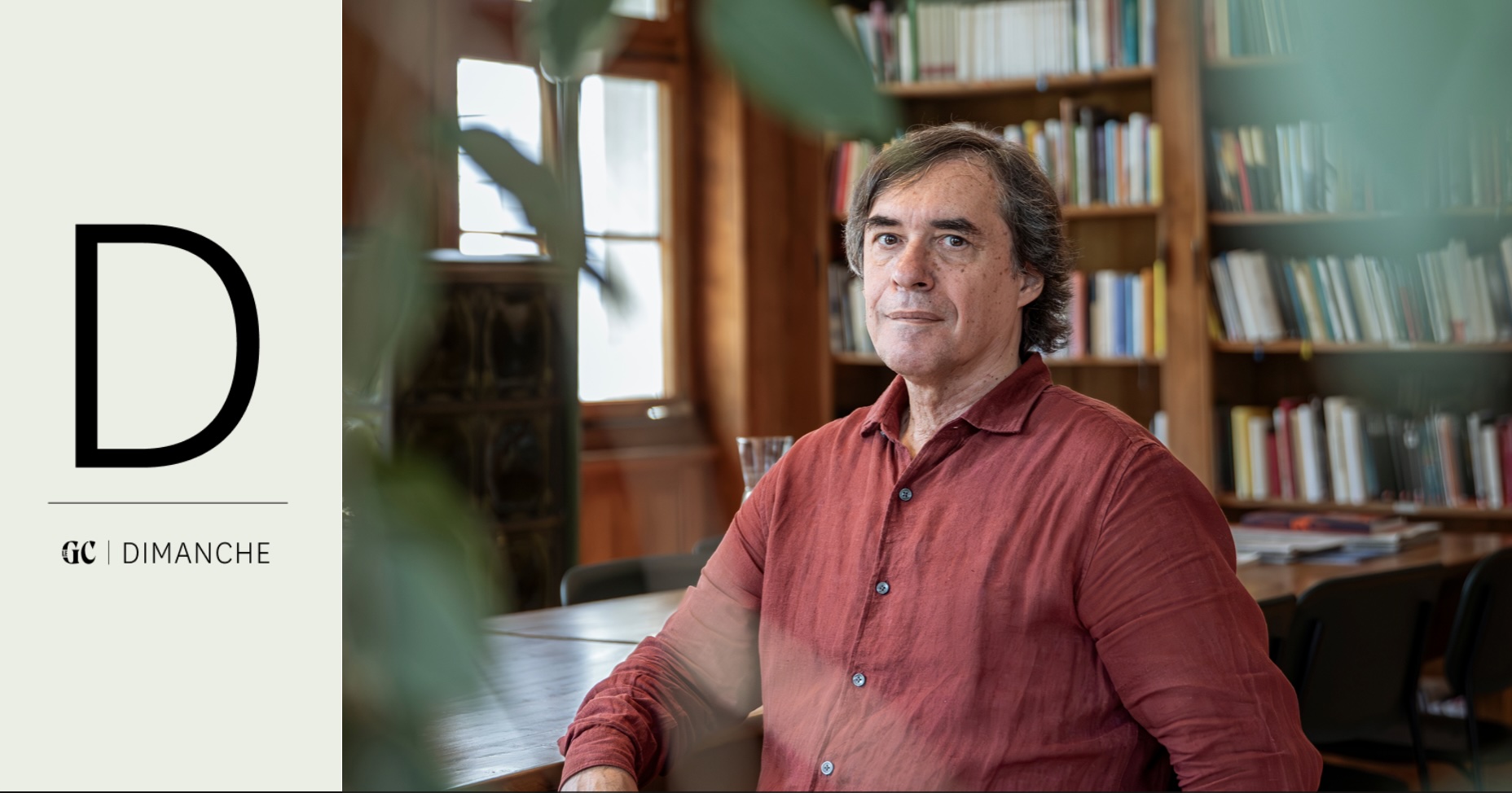
From Zurich, Zug is reached in only half an hour. It’s barely enough time to realize that one has left one lake for another. The weather is gray on this morning when I have an appointment with the author of Nostalgia and Melancholia. There are perhaps five or six of us getting off the train. How long has Mircea Cărtărescu been waiting in this deserted railway station hall?
Almost as soon as the introductions are done, I receive a compliment on my Romanian, which I practice only exceptionally. My interlocutor is affable and his wit always sharp. Twenty minutes on foot separate us from the place — still kept secret — where we will speak, he warns. Nothing in his simplicity betrays the writer translated into about twenty languages, a laureate of the Formentor Prize, whose name has been circling for years, with growing insistence, in Nobel rumors.
Guide to a Short Stay in Zug
I have time to learn about Zug, a place that is both a city and a canton, having become a tax haven for tech-finance companies. Mircea Cărtărescu has been living there for two months, thanks to a six-month residency grant from the Landis & Gyr Foundation. It’s the second time he has received support from this Foundation; he fondly recalls a Berlin residency, a quarter of a century ago, during which he could mingle with the writer Péter Esterházy. As we walk along the lake, Cărtărescu tells me that he feels privileged to stay in such an environment with excellent material conditions.
The gray sky and clouds keep Mount Rigi from looking like a postcard. To reach our objective, we must thread through the streets of Old Zug and its imposing 15th-century buildings that appear untouched. The stairs and shortcuts known to the writer-in-residence help us ascend to the Maria Opferung cloister. It is there that Mircea Cărtărescu and Ioana Nicolaie — his partner, herself a writer — reside, in a place that houses other authors and translators, mostly from Eastern European countries.
Before stepping through the door, Cărtărescu tells me that the last sister who lived there died in June, ending the Capuchins’ presence, who had inhabited the place since the 17th century. Beside the entrance, there is a small yellow panel of wall where a Christ with his stigmata is nestled, picturesque encircled by the branches of a pear tree.
A Monastic Routine
The walls of the room where I am received are fully paneled. There is also a library containing the works of former residents. Before we begin the interview, Ioana Nicolaie joins us for coffee and a few cookies, which we hardly touch. Mircea Cărtărescu, for his part, checks the milk’s expiration date before pouring it into his cup. The table at which we sit is precisely the one where the nuns used to eat. I begin by asking him what a day here looks like. Like the nuns, Cărtărescu follows a strict schedule: “I rise around eight in the morning, work until about three in the afternoon. Then comes a time devoted to reading and a walk. On Sundays, we go out to discover nearby towns like Zurich, Lugano, Bern, or Lucerne. It is an extremely beneficial place for work.”
From Bucharest to Zug
The lake and mountain landscapes found in Switzerland bear little resemblance to the urban atmosphere of Bucharest — “this museum of melancholy and the ruin of all things” — to which the author of Solenoid and the Orbitor trilogy has accustomed us. In fact, for several years now Cărtărescu has not lived in the heart of the Romanian capital, but to its north, in the residential district of Pipera, greener and less concrete than Bucharest, he notes.
So, when I ask him what Zug and Switzerland more generally inspire in him, he looks me in the eye and replies: “My world is an inner world that has no direct connection with the places where I write. It is made up of a mixture of places and diverse temporalities, like in our dreams. All my experiences are indirect, filtered through my inner sensors.” Geography, for him, is only an inward motion. In his books, this ornateness is not that of a Romantic or surreal dream; he draws on the natural sciences — biology, physics, entomology — to transform Bucharest, scarred by Ceaușescu’s regime, into a palimpsest city whose buried layers resurface.
The conversation returns to Zug. He then mentions that political figures like Lenin, but also several characters from Dostoevsky — Prince Myshkin in The Idiot, or Stavrogin in The Demons — lived in Switzerland. He does not forget his fellow Romanians Tristan Tzara and Marcel Janco, among the founders of Cabaret Voltaire, or Tudor Arghezi, a Romanian poet dear to him who stayed in Switzerland in his youth. “Switzerland too is a zone of my mental space, which I will certainly enjoy one day,” he concludes.
Living “Inside Literature”
It is hard to talk about anything other than literature with Mircea Cărtărescu, whose surname also echoes the Romanian term cărturar, meaning the thinker, the man of books. His work unfolds narrative architectures where the various strata of lived experience blend with a personal literary memory. “I live inside literature,” he explains; “I would have trouble separating minor from major influences in my writing. I could almost say that every book I have read has influenced me.” In his pantheon stand the great novelists of English and Viennese modernism, but especially American postmodern authors such as William H. Gass and Thomas Pynchon. On the Romanian side, he cites the poet Nichita Stănescu.
Originally, I had asked him about the insistent comparison critics draw between his work and that of the author of The Metamorphosis. His answer softens the analogy: “Kafka influenced everyone. You cannot read him without it changing your life. But you must remember that he was a great writer precisely because he did not want to be one.” On the other hand, there is the parallel with Proust, by virtue of a stream-of-consciousness writing “which, superficially, I would be inclined to say, resembles the Proustian method; it is difficult to conceive of such a combination, which is why I remain skeptical of these references.” The pace of my interlocutor’s speech is steady; he seems never to hesitate in the direction his answers take. He continues: “The fundamental difference is that I do not want to tell stories. I do not seek to describe characters, to deal with divorces or love triangles, political or social events. These dimensions exist in my work but never frontally. At the forefront, there is the life of literature, which blends with my personal life.” This is partly the subject of Texistența (2026), a book of aphorisms in which this “symbiotic process” is discussed, just published by his longtime Bucharest publisher, Humanitas.
Janus bifrons
Between sips of coffee that grows tepid, the discussion leads us to Théodoros, his latest book translated into French by Laure Hinckel for the Noir sur Blanc editions. This novel takes the reader to the 19th century, tracing the steps of a hero who left Walachia to become emperor of Ethiopia. It is a book that moves away from the contemporary era and from the biographical material that characterizes the author’s other works.

Yet he is nonetheless tied to an older book, titled The Levant. Published in 1990, this epic poem recounts the adventures of Manoil, a young Vlach who sets out to free his homeland from Ottoman rule. Behind this adventure lay a parody of Romanian literature, each chant borrowing the style of a different era. A similar reflexive impulse motivated the writing of this new novel that illuminates “the values and virtues of the Romanian language,” by mobilizing archaic or biblical registers in particular. This tribute to the Romanian language is also a nod to the East: “Like a two-faced Janus, Romanians have the privilege of belonging to a European ideal, but also to Balkan, Oriental, or even Byzantine heritages that exist in us and demand to express themselves. These external, linguistic and historical pressures pushed me to undertake a psychoanalytic descent into my past and into the collective unconscious.”
Avoiding contradictions about his reluctance to tell stories, Cărtărescu states that Théodoros is a “pseudo-historical” novel, whose subject would be precisely the historical novel. “I did not write about Emperor Tewodros; I wrote about literature,” he insists. He then recalls almost childlike pleasure he had in weaving together several worlds, “a mix between One Thousand and One Nights and postmodern fiction.” The result, he says, is built like “a clockwork mechanism, with its many cogs, which can only function together.” The metaphor lands well, all the more happily for having seemed accidental.
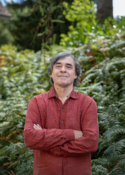
He is nevertheless still seeking the final word on this book and, as is his habit, does not keep us waiting: “Of course, Théodoros is a very ambitious novel. I wanted to represent a certain archetype of the tyrant, in which all tyrants—from antiquity to the monsters that now appear everywhere, the ‘bad boys’ of the geopolitical world—should recognize themselves.” The Romanian author places himself in the tradition of novelists who have captured the essence of tyranny, led by several South American writers. Cărtărescu specifically invokes Alejo Carpentier and his Recours de la méthode, García Márquez’s The Autumn of the Patriarch, or Vargas Llosa’s The Feast of the Goat.
The Romanian Geopolitical Laboratory
One might mistake these tyrants for distant. I ask him whether he is concerned about his country’s geographic proximity to Ukraine and the Russian threat that hovers over this part of Europe. Some even think that Russia’s invasion of Romania has already begun. He takes a sip of water, then launches into an answer that quickly goes beyond the Romanian frame: Russia is, in his view, “a great danger to Europe.” A danger that does not date from Putin, but is part of an imperial history rooted in aggression. The current Russia, heir to Tsarist Russia, continues this logic both through open warfare in Ukraine and through hybrid means: destabilizing neighboring countries, electoral interferences. He mentions in this regard the suspicions surrounding Romania’s last elections with the rise of Calin Georgescu, the far-right candidate supported by Moscow and Washington, but also Brexit.

To stop this momentum, Russia must, he says, “undergo a different political experience,” fundamentally distinct from what it has practiced for centuries and which has proven deleterious for Russians themselves. But this threat is compounded by another, coming this time from across the Atlantic: Donald Trump’s America would now be “neither a friend nor an ally” of Europe. Cărtărescu denounces in particular the closening between Washington and Moscow, whose visit by Volodymyr Zelensky to the Oval Office he sees as a symptom. Europe, left alone in the face of this new configuration, must now find ways to navigate this moment.
And as if these worries were not enough, Cărtărescu broadens the scene to other crises sweeping the world: climate change, but also the rise of artificial intelligence. “It’s as if everything converges to make us uneasy and anxious,” he notes with resignation, before concluding: “All we can do is live day by day, with the ever-present threat of a nightmare.”
An Unattainable Ideal
What remains is literature and the desire to experiment with new forms. On the occasion of the Texistența launch, Cărtărescu affirmed that this book was a “tentative to become a niche author again.” In this light, I ask whether he sometimes dreams of being more radical in literary experimentation, at the expense of his ever-growing readership. Indeed, for Cărtărescu, being a “pure” author, not concerned with the game, has always been an ideal. This is the subject of Solenoid, in which the protagonist is a writer who refuses to compromise at all, including refusing to publish his own writings. He would rather live alone a fantastical life, which turns out to be far more real and interesting than that of an established writer. For Cărtărescu himself, this ideal has proven unattainable: “I have always had a complex: that of playing the game. I have involved myself a lot. I have participated in this literary life. The ideal writer should not think of that: he should devote himself only to writing.”
Such a stance does not suit the temperament of a writer now translated around the world. He takes some pleasure from it: the pleasure of being read and understood by readers from diverse cultural backgrounds. Among them, some are particularly receptive to his writings. Starting with the Spanish-speaking world. “Perhaps because these nations are, in a sense, Don Quixote-like. They share this manic and fantastical attitude that characterizes Cervantes’ character and that they recognize in my writings.”
Portrait of the Writer as a Rock Star
In Latin America — where he will tour again this winter — he has lived through surprising experiences. In Mexico and Colombia, he was welcomed as a rock star, seized by crowds of admirers who see in his books something like a Gospel. Cărtărescu is eager to tell me an anecdote. At a meeting in Mexico, a reader steps forward, embraces him and begins to cry, then explains that reading Solenoid helped him emerge from a deep depression. He comments: “It is very striking to confront such readers. It somehow demystifies the myth of the writer who refuses to produce work. When I meet people who tell me that reading my books stimulates their imagination and opens up inner perspectives, I realize that writing participates in the progress of the world.”
Poet and Diarist
Although he is best known for his novels, Cărtărescu is essentially a polymath. A novelist, essayist, but also a short-story writer, he entered literature in the early 1980s with the poetry collection Phares, vitrines, photographies (Faruri, vitrine, fotografii). I recall this couplet, where his dreamlike imagination is already entirely present: “In the hotel room oval as the glassy bulb of Cinzano glasses / wandering like a billiard ball through beds with ivory sheets.”
Cărtărescu has since continued to write and publish poetry at varying intervals, the most recent appearing in 2020. At a time when the novel seems to reign supreme, I ask him whether poetry still has a role to play. His answer comes with no hesitation. For Cărtărescu — who has always seen himself as a poet rather than a prose writer — poetry remains the dominant genre, even when it takes the form of a novel: “The essential is the vision; it’s another way of speaking about style. As soon as a novel deploys a vision, it becomes a poem.” So poetry is not only the art of composing verses, but a way of expressing reality. For once, he searches for his words. “A singular way of relating to the world, I would say, one that characterizes neurodivergent artists and poets.” Today, his poetry is being rediscovered; his volumes are translated into Spanish, German, and French.
While he rejoices in this attention, he cannot help but find it strange. Because the cornerstone of his work is neither poetry nor the novel, but his practice of the diary. “I have kept a diary for fifty-two years, since I was seventeen.” He continues along this numerological thread, explaining that he publishes fragments every seven years, and that the sixth volume is due to appear. “From my diary come my other works. It is there that I developed and thought them: they are the branches of the same tree.”
Cărtărescu views his diary as a second skin, a practice necessary to his lifestyle. He writes by hand in journals because he does not trust technology with something so intimate. “I have even written some novels entirely by hand, others on the computer,” he adds. Another peculiarity: he never goes through a draft: “Everything I have written has been in a single go. I have always handed my publisher a complete manuscript, with not a single leaf torn out.” From his diary practice he has preserved its impulsive character. From poetry, the luxury of being able to skip edits.
Read/Write
Cărtărescu did not come here to read, but to work on his next book, he assures me. Yet he finds comfort in reading, and especially in rereading certain “classics,” such as Borges. Philosophy also helps him deepen his thought. He is glad to see so many people reading in public spaces in Switzerland: books seem to occupy an important place there, as in Germany, where he experiences something of a revival. This emphasis on the book makes him reflect on the situation in his own country: “I cannot help but draw a parallel with Romania, where libraries and bookstores are closing, and where people are gradually losing the habit of reading, in favor of social networks.”
I have exhausted my questions, but we will not end there. We walk down to the garden with Ioana Nicolaie, who insists on showing me the extent of the place: an orchard, a vegetable garden, then paths lined with old stone walls, where a few Swiss flags flutter here and there. Cărtărescu walks there with the same calm that has accompanied him throughout our interview, but with a sly smile that seems to say these sanctified spaces suit him. As we part, he thanks me and says: “We’ve had a good discussion. Now I can get back to work!”