
I had just discovered that a famous Borges line — « Many times in my life I have set myself to the study of metaphysics, but happiness has always interrupted me » — wasn’t his, but another Argentine, Guillermo Enrique Hudson. I had plunged, in a rather somber mood, into the biography of this author (whom Roberto Bolaño admired so much, in fact) when suddenly, in the middle of reading, happiness interrupted me as well. How could that have happened? It’s very simple: I received an email, on the eve of the World Cup’s start in Mexico, the United States, and Canada, inviting me to write something about the Football World Cups in general. The proposal pleased me, partly because I realized it would neatly free me from my biographical research on Guillermo Enrique Hudson. I was delighted and I marked the moment by seeking the refrain of Shakira’s song for the tournament that began at the Azteca Stadium on June 11.
« Dai, dai, we go, dale, ale, let’s go » (to be repeated four times).
After the joy comes calm, that is, reflection. I slipped into a state of floating bliss, a pleasant and simple peace, as if I had returned to the life I led before the world (“the horror, the horror” as Conrad wrote) pushed me toward metaphysics. I came to discover unexpected connections. Hudson, for instance, was Argentine and wrote in English. And one could say the same about Borges. And another link: Argentina won the most recent World Cup, the Qatar one, while the first, in 1930 in Uruguay, had been won by Uruguay, at the Nacional stadium in Montevideo. As a child, I was a Barça supporter (I always say I was born a Barça fan) and also (from afar) a Nacional supporter.
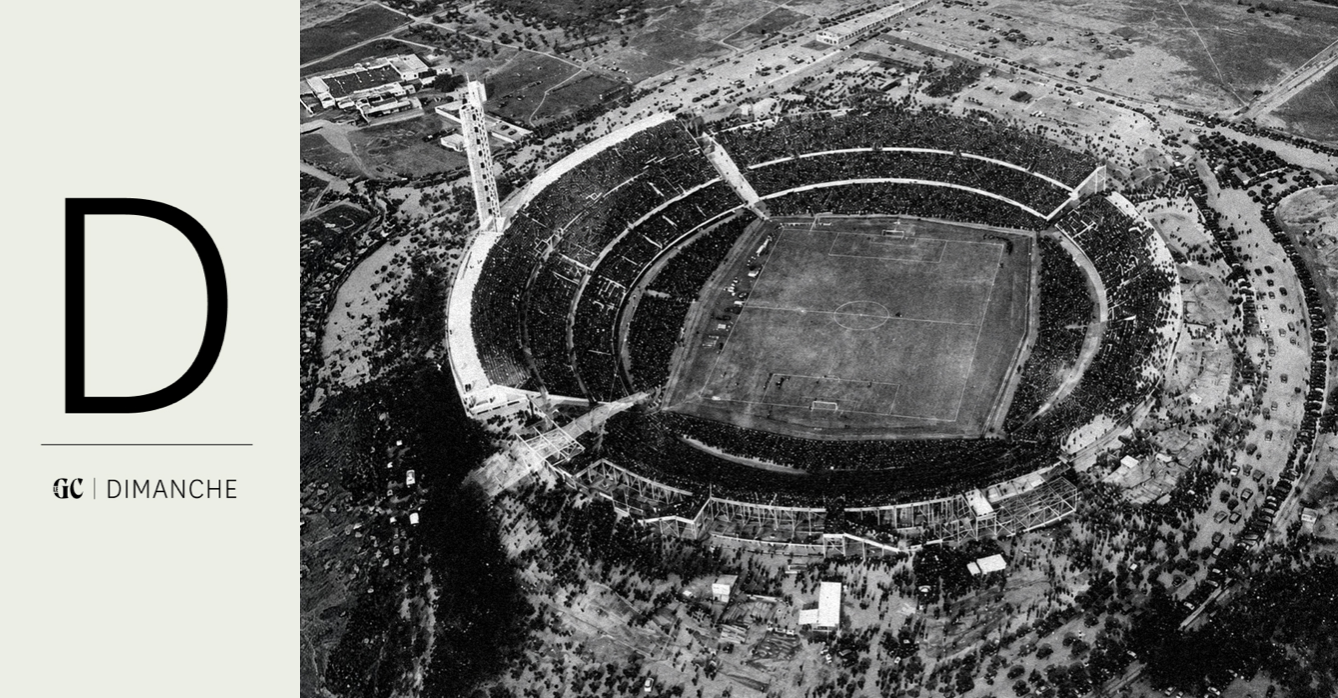
Could this early life affinity for a football club located in the vast overseas, beyond the visible ocean and the colossal borders of the horizon, have played a crucial role in my literature? I wouldn’t dare go that far. Yet it is certain that it had some influence. A few years ago, just before the pandemic, when I arrived in Montevideo for the first and last time, I asked to visit Nacional’s stadium, the Centenario, where, in the center circle of the pitch, the ball for the first match of the world’s first World Cup had been put in play for the very first time.
My hosts asked me, somewhat surprised, whether that was the sole reason I wished to see this “historic center circle of the field.” And I replied that yes, choosing not to reveal the “true reason,” obscure, that had led me there. They were already sufficiently astonished by my two other requests upon arrival in the city: a tour of the old Cervantes hotel, then dilapidated, and the poetic and mythical, yet forgotten, Tour des Panoramas, along the banks of the Río de la Plata.
To all of this was added another element — I believe it was precisely metaphysical — that reinforced my desire not to voice aloud the true reason I wished to glance at this “historic center circle of the Nacional de Montevideo football field.” It rested on my fear that my revelation, as Maurice Blanchot suggested regarding what can happen to us when we write, would make me readable to everyone’s eyes, yet indecipherable to myself.
Of course, I hesitated twice and told myself that I should have no trouble becoming indecipherable as long as it was only to temporarily practice the craft of sports journalism. After all, last year, my friend Estela Paskan, a Lacanian psychoanalyst, essentially told me that she had come to the conclusion that I had the soul of a sports journalist. It wasn’t clear to me at the time, but, with time, I came to realize that Paskan may not have been wrong at all. And the proof that she was right is probably this unease that gnaws at me and kills me every time I watch a television debate on football broadcast by the Catalan channels. A discomfort more than a worry, because I would like to participate in what is said, especially when sports journalists are asked what will happen in Sunday’s match. How could anyone possibly know that?
Regarding this World Cup, for example, the only thing I dare to imply is that we will continue to witness the predictable footwork of the elephant Trump bursting into his own mental porcelain shop. Moreover, the United States faced Belgium in the opening match of this first World Cup in 1930. This opening game of all World Cups, so closely tied to the tragic history of Abdón Porte, a midfielder for Nacional de Montevideo. A chiselled face, straight hair, very tall, a combative tenacity. We were in March 1918, and it was in Uruguay that the world’s best football was being played at the time. Abdón Porte was 27 years old. He was the idol of Nacional fans, even though they did not know that Abdón knew perfectly well he had just performed the last great gesture of his life. He was entering a slight decline he was aware of, and he saw himself as a substitute for another midfielder for the following season.
All Nacional supporters adored Abdón Porte, and that day, in March, the team had beaten Charley 3–1 at their stadium. After the match, Abdón went to celebrate the victory with his teammates. At one in the morning, he bid farewell to everyone and said he would take the train at the Central Station. But something happened when he found himself alone: he changed his mind and returned to the stadium. In the depths of the night, he went to the center circle of the pitch (the place where, twelve years later, the first ball of the first World Cup would be put into play), in that spot where he used to reign. No one would replace him anymore. There, in the heart of the stadium, he shot himself through the heart.
The next morning, the team’s goalkeeper, who was the first to enter the stadium, discovered the midfielder’s body in the center of the pitch.
Next to the revolver, a straw hat, with two moving farewell letters.
Even today, at Nacional’s every match, one can see in the stands a banner bearing the inscription Pour le sang d’Abdón. “An idiotic allegory,” someone wrote. “Where he stood, as the master of the midfield, he wanted time to become eternal.”
Whether the image is idiotic or not, two weeks after that suicide, Horacio Quiroga, a masterful storyteller and one of literary history’s most tragic figures, drew on Abdón’s story to write Juan Polti, half-back, a short story published in the magazine Atlántida in May 1918. “When a young man, for one reason or another, and without any prior training, comes to savor the strong liquor of men that is glory, he irretrievably loses his mind.” It is from this liquor of men and this mythic suicide that, years later, the story Muerte en la cancha by Eduardo Galeano would also speak of.
Independent of Abdón’s death, Idea Vilariño would write long afterwards: “It was a moment / a moment / at the center of the world.”