
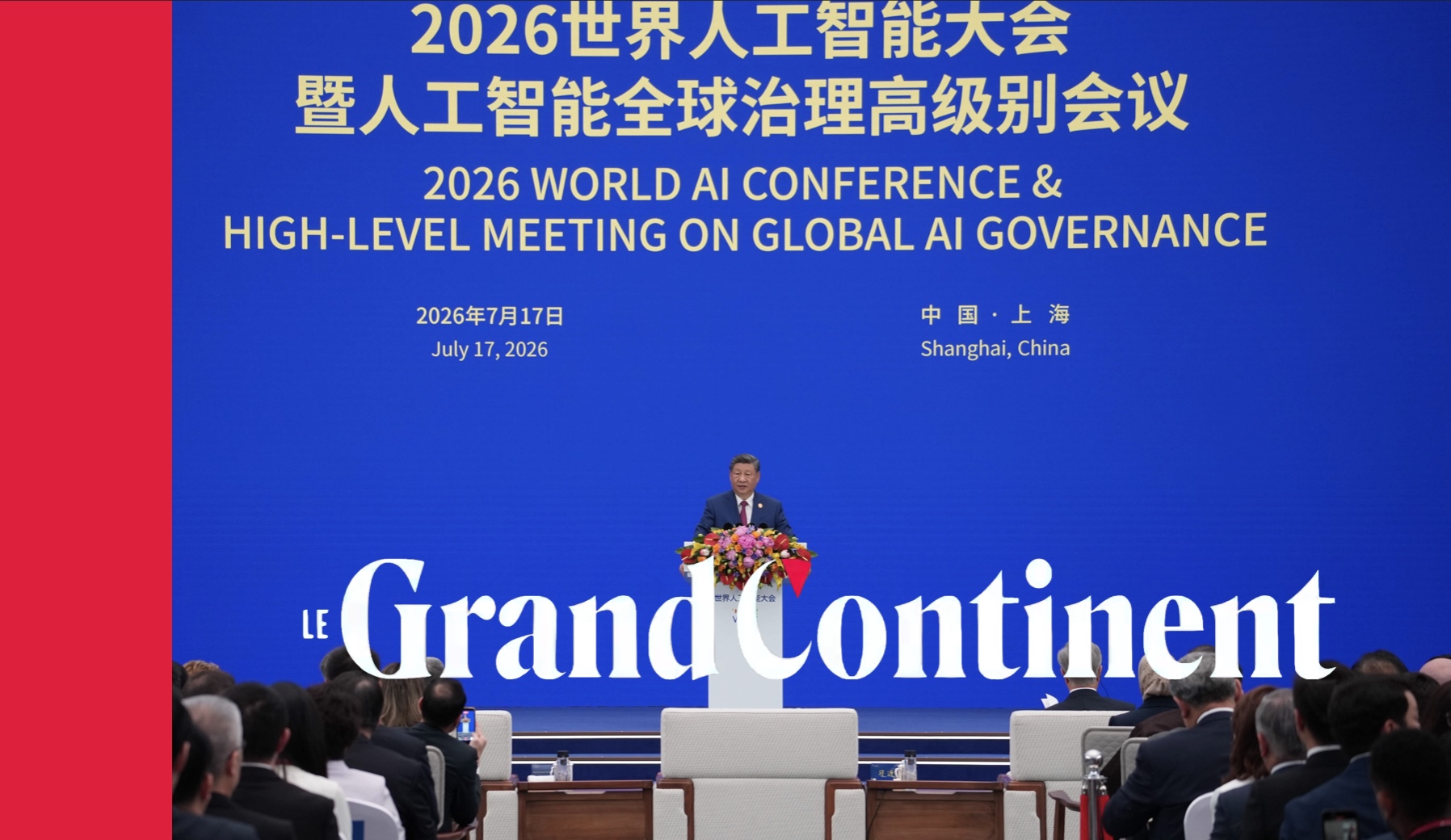
Today, July 17th in Shanghai, Xi Jinping delivered his first address at the Global Conference on Artificial Intelligence, urging the creation of “a just and equitable global governance system for artificial intelligence” and, in a phrasing popularized by DeepSeek, promising to “return the crystallization of humanity’s wisdom to all of humanity.”
Confronted with the post-human, post-democratic, and imperial rhetoric emanating from a reimagined Silicon Valley, the Chinese Communist Party presents AI as a global public good. Yet this stance becomes difficult to take seriously when one considers how the regime has, as noted by sinologist Jean-Philippe Béja, made digital mass surveillance the modern extension of the Laogai, and as Giuliano da Empoli has shown, is pursuing a post-human, convergent world that mirrors every point of the Silicon Valley.
Nevertheless, there is value in reading this speech, for it lays out a discursive strategy and, more subtly, a material strategy.
The discursive strategy lies in contrast. While Xi delivered in Shanghai a meticulously scripted address, proposing a multilateral symphony with classical citations, the United Nations, and developing countries as touchstones, Donald Trump spoke in near-parodic fashion at roughly the same moment, adopting an imperial, disjointed tone that cast blame on China and called for a remake of the “catastrophic” American electoral regime. By never naming Washington, Xi again positions himself as the defender of order, stability, and shared interests, building a coalition as an alternative to the “Pax Silica,” the American initiative aimed at locking down AI supply chains and essential minerals.
The material strategy is read in the subtext of the timetable and announcements. The speech coincides with Moonshot AI’s launch of Kimi K3, touted as the largest open model in the world, whose performance surpasses those of Anthropic and OpenAI systems, coming on the heels of Washington abruptly cutting foreign access to frontier Anthropic models.
Xi’s strong endorsement of open source is not a philanthropic gesture. It is a form of inverted dumping, made all the more potent by the fact that while one can block a vehicle at customs, one cannot stop the spread of a fully copyable file that replicates across thousands of servers the moment it is published. The Uber playbook is well known: lose money on purpose with venture capital, eliminate competition incapable of sustaining years of losses, and once dependency is established, raise prices above the market. China transposes this mechanism to the geopolitical scale by freely publishing the “weights” of its models — those billions of parameters derived from training that lie at the very heart of an AI system. Whoever holds them can run the model on their own hardware, modify it, integrate it, and do so without permission or royalties. Where ChatGPT or Claude are accessible only remotely via a paid interface that can be shut off, Chinese models rivaling the best American systems — DeepSeek yesterday, Kimi K3 today — are thus offered as free downloads to the entire world, with first access to the Global South. The Chinese bet is a long-term endurance wager that threatens to hollow out the core of the American funding model: every open model pushes prices toward zero, forcing American laboratories to rely on tens of billions in private capital, while Chinese actors, backed by the patient capital of the state, can absorb losses in the short term without significant consequences. Should rival innovation falter, Beijing would have no obligation to publish the next generation.
Thus the architecture presented by Xi Jinping must be read as a combination of material strategy and discursive dimension: the World AI Cooperation Organization (WAICO), which counted 29 member states the day before the speech; the 5,000 training slots promised for developing countries; and the cooperation centers aimed at the Shanghai Cooperation Organization (SCO), ASEAN, BRICS, the Arab League, the African Union, and CELAC — precisely the blocs where China’s influence is already strongest. As the Sino-American negotiations on AI in the Trump era loom, Xi’s message, as summarized by analyst George Chen, is clear: “China will not follow anyone, neither in technology nor in standards. Instead, China wants to lead the way for the world and will not allow anyone to dictate its path.”
Building a Joint, Fair, and Just Global AI Governance System
Opening remarks at the 2026 Global AI Conference and the High-Level Meeting on Global AI Governance
Dear colleagues, esteemed guests,
Ladies and Gentlemen, dear friends,
Seventy years ago, a group of young researchers first coined the concept of artificial intelligence at Dartmouth College in New Hampshire, United States. For seven decades, scientists and developers around the world have continually explored the unknown, navigated detours, and pressed forward through relentless effort. Seventy years later, standing alongside a new surge of vibrant AI growth, we gather on the banks of the Huangpu River to ponder together how to steer global AI toward progress and toward the common good, serving humanity—and that holds profound significance.
On behalf of the Chinese government and people, I extend to you all a warm welcome.
Viewed through a historical lens, the invention of the steam engine inaugurated the industrial civilization, the spread of electricity illuminated modern society, and the birth of the Internet connected the world. Each scientific and technological revolution has profoundly reconfigured humanity’s modes of production and life, propelling economic and social development forward by leaps and bounds.
Today, the transformations of the world are accelerating at a pace unseen in a century; the new scientific, technological, and industrial revolution is advancing with unprecedented fervor; global innovation in artificial intelligence has entered a period of remarkable dynamism. Smart technologies — the intelligent linking of everything, human-machine collaboration, the fusion of cross-sector boundaries, and joint creation and shared use — fuse to unleash immense energy: they promise vast opportunities, but also pose governance challenges. Humanity cannot shy away from these questions: when machines begin to think, how should humans coexist with them? When algorithms influence decisions, how can we ensure safety? When technology tests ethics, how can governance keep pace? When the gap between rich and poor widens, how can universal access to benefits be achieved? These questions require deep international reflection and a shared response.
The Chinese perspective is that every country, guided by the principle of putting people first and the twin aims of progress and welfare, should make AI a primary driver of shared prosperity and security, and work together to build a fair and just global governance system for AI. In this spirit, I would like to propose four points.
First, stay the course of mutually beneficial openness to spur innovative development. Artificial intelligence is the new engine of global growth and the accelerant turning old growth drivers into new ones; it is shifting from a “digital world” to a “physical world.” We must seize this rare historical opportunity, promote open source, openness, cooperation, and sharing; advance innovation in science and technology, industrial development, and real-world AI applications across the board; coordinate the transformation and upgrading of traditional industries, the growth of emerging industries, and anticipation of future ones; so that AI can empower all sectors and all professions.
Second, sharpen risk awareness to safeguard security and control. AI must become a tool trusted by humanity. We must give the highest attention to all risks, intrinsic or derivative, it may generate; promote the establishment of robust legal and regulatory frameworks, technical supervision, early warning systems, and emergency responses; strengthen the security foundation, prevent abuses and misuse, and ensure AI remains under human oversight at all times. At the same time, we must jointly oppose efforts to inflate “national security” in artificial intelligence to apply to others, or to privilege one’s own security over that of others.
Third, encourage inclusion and open-mindedness to enrich civilizations through mutual learning. The development and application of AI should neither undermine nor erode the world’s rich cultural diversity nor the cultural uniqueness of individual nations. We should shape AI’s values from humanity’s shared values, use these technologies to deepen understanding and tolerance among civilizations, promote cross-cultural exchanges and mutual inspiration, and cultivate a garden of a hundred flowers where “each culture shines in its own right and all together flourish.”
Fourth, champion solidarity in enhancing global governance. AI is a product of humanity’s collective intelligence and a precious heritage. We must practice genuine multilateralism, give full play to the important role of the United Nations, strengthen the alignment of development strategies, governance frameworks, and technical standards for AI, and strive to reach a broadly supported global governance framework as soon as possible, so that this cutting-edge technology serves human society more effectively. We should carry out wide-range international cooperation, help developing countries improve their capacities, bridge the digital and AI divide, promote sustainable development, and prevent the emergence of new historical injustices in AI.
Ladies and Gentlemen, dear friends!
“A enlightened mind evolves with the times; a sage adjusts his methods to the circumstances.”
As AI technologies advance with giant steps, the need to anchor progress and welfare in a precise course becomes more urgent, the need to calibrate governance and regulation more carefully, and the need to strengthen preventive measures to avoid loss of control more quickly. In all circumstances, human wisdom and international consensus must guide AI development so that it truly becomes a powerful, positive force serving the well-being of all humanity and the progress of civilization.
China stands ready, with a more open posture, more concrete actions, and a longer-term view, to seize and meet the opportunities and challenges of AI development alongside all parties, to create a better future for human society together!
Thank you.