
A Work with an Illuminating Title
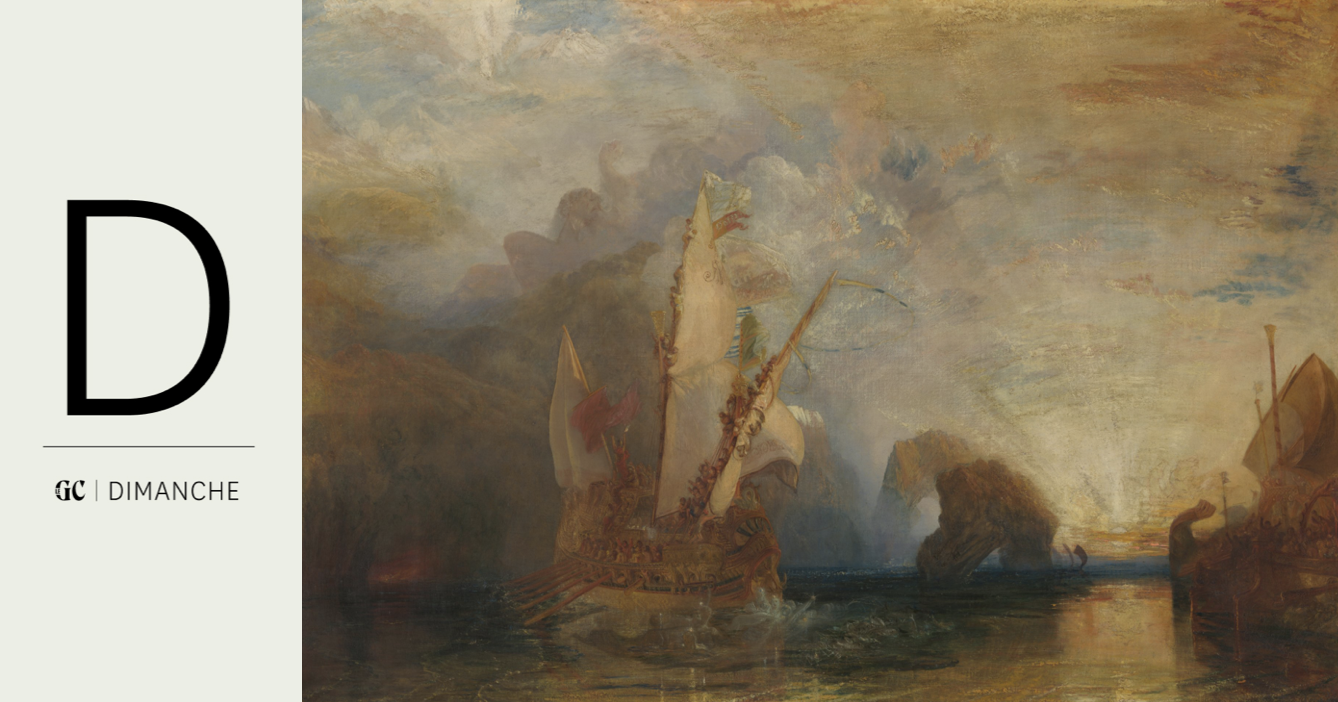
Presented at the Royal Academy in 1829, at a moment when the British painter Joseph Mallord William Turner (1775-1851) is fifty-five years old, this medium-sized work (132.5 × 203 cm) unfolds a horizontal and open composition. At first glance, only two boats stand out with relative clarity; the eye is more drawn to the rising sun, on the right of the composition, whose light irradiates a large part of the canvas. The painting appears to lack a true center, while the rays radiating from the star structure the space and disperse the viewer’s attention.
It is truly the painting’s title kept at the National Gallery in London, Ulysses deriding Polyphemus – Homer’s Odyssey, that points us toward its interpretation. Indeed, this designation refers to a specific episode from Book IX of the mythic epic. After escaping the Cyclops’ cave, which he blinded during the night, Ulysses looks back from his ship to taunt Polyphemus and reveal his true name. This provocative gesture, born of hubris, provokes the Cyclops to curse him and call upon his father, Poseidon, “that Ulysses never reaches his homeland; or, if he must return, that he comes back late, alone, after having lost all his companions.” This malediction constitutes the true starting point of the trials that will mark the long return of the Greek hero to Ithaca.
The Artist’s Choices
As in many of Turner’s other works, the effects of light, intensified by their reflections on the water, take precedence over the precise definition of forms, whether natural or connected with human constructions that sometimes seem to dissolve into an allusive brushstroke, or be relegated to the shadows. Thus, for instance, one can only guess at the silhouettes of women, half-submerged, near-phantasmal, sketched in a few light touches below the vessel or at the dolphins in the foreground.

This uneven handling, bearing the sun’s incidence, lies at the heart of a personal reading of the myth in which the characters are secondary to the grandeur of nature. Through the interplay of powerful contrasts, one clearly recognizes the transition from the dark world of the Cyclops’ cave to the realm of light, guiding the voyage and the hero’s future, in a nearly cosmic vision, whose order is greater than that of humans, as well as of human constructions or monsters.
Rather than depicting the most spectacular episodes of the tale—the assault on the Cyclops or its blinding, as a history painter in the classical tradition might have done—Turner chooses the moment that follows. Polyphemus, far from occupying the center of the composition, is barely discernible, relegated to darkness on the left of the painting, on a rocky promontory whose outlines are uncertain, turned toward the sea where Ulysses’ ship withdraws; after escaping him, the hero turns back toward him, arms raised in a gesture of defiance. The decisive event is thus no longer the physical clash, but hubris. The drama is no longer physical, but moral.
If, in the instant, Ulysses believes he has triumphed, his feat will lead him to a tragic destiny.
A Contrasting Reception
When the work was exhibited, the lack of legibility of the drawing, as well as the flamboyance of its colors, elicited a divided reception: “a specimen of colouring run mad” noted by a Morning Herald critic, who spoke of vermilion, vivid indigo, and all the boldest shades of green, yellow, and violet contending for supremacy on the canvas, with the vehement contrasts of a kaleidoscope or a Persian carpet… For the Literary Gazette, “Even if the Greek hero has just torn out the single eye of the furious Cyclops, that is no reason for Turner to gouge out both our eyes, harmless critics. Rarely has a mass so incandescent been projected onto our visual organs.”
Nearly thirty years later, the famed critic John Ruskin, who had made the artist the herald of his Modern Painters, described the work as “the central picture of Turner’s career” (1856), a claim that has persisted in contemporary historiography, underscoring its pivotal place in the artist’s career.
Indeed, Turner shifts the question of narrative. More than the clash between Ulysses and the Cyclops, he concentrates on his true subject: the moment when the hero’s achievement, through a gesture of pride, mutates into a tragic fate.
This mature painting offers a particularly innovative reading of a theme with a long iconographic history. While Ulysses’ ship remains faithful to the antique imagination of its era and recalls Claude Lorrain’s idealized vessels, the artist prioritizes effects of light and atmosphere over precise description: his choices serve the poetic evocation of a human destiny confronted by the forces of nature, a vision that surely contributes to his being today widely regarded as one of Turner’s masterpieces from his mature period and as a milestone of British Romanticism.