
There are two Daniel Mendelsohns, and France hardly knows the other one well. Ours is the author of The Disappeared, winner of the Prix Médicis foreign-language prize, the man who journeyed across twelve countries to recover six submerged names, the author of Three Rings, winner of the Best Foreign Book prize, a meditation on exile where Auerbach in Istanbul, Fenelon in disgrace, and Sebald in England cross paths. A writer of memory and mourning, indeed, whom one invites to colloquia on the Shoah.
The other, the American, is a critic. For twenty-five years, he has maintained in the New York Review of Books and in the New Yorker a column that moves, without changing its tone or lowering its demands, from Sappho to Mad Men, from Rimbaud to Avatar, from the Aeneid to Game of Thrones. His collections announce themselves from their titles: Waiting for the Barbarians. Essays from the Classics to Pop Culture; then Ecstasy and Terror. From the Greeks to Game of Thrones. The French reader has only a glimpse, So Beautiful, So Fragile, where we traverse Sofia Coppola’s Marie Antoinette to the 300 of Sparta, Tarantino to Philip Roth, Thucydides to The Kindly Ones. He demolished Mad Men in a famous article whose courtesy was as sharp as its argument, and he took seriously Julie Taymor’s musical Spider-Man as a classicist would take a fragment in earnest.
This double belonging is not a decorative biographical feature: it is the method. Mendelsohn does not descend from the Greeks toward pop culture as a condescension. He holds that the critic’s role is to act as intermediary, intelligently and with style, between a work and its audience, and that this task does not change in nature whether the subject is Cavafy or a blockbuster. Hence the obvious reason to talk about him this week. A man who has spent his life reading the Odyssey in Greek and who has also written about James Cameron is about the closest thing to the right reader for a two-hundred-and-fifty-million-dollar IMAX film drawn from Homer.
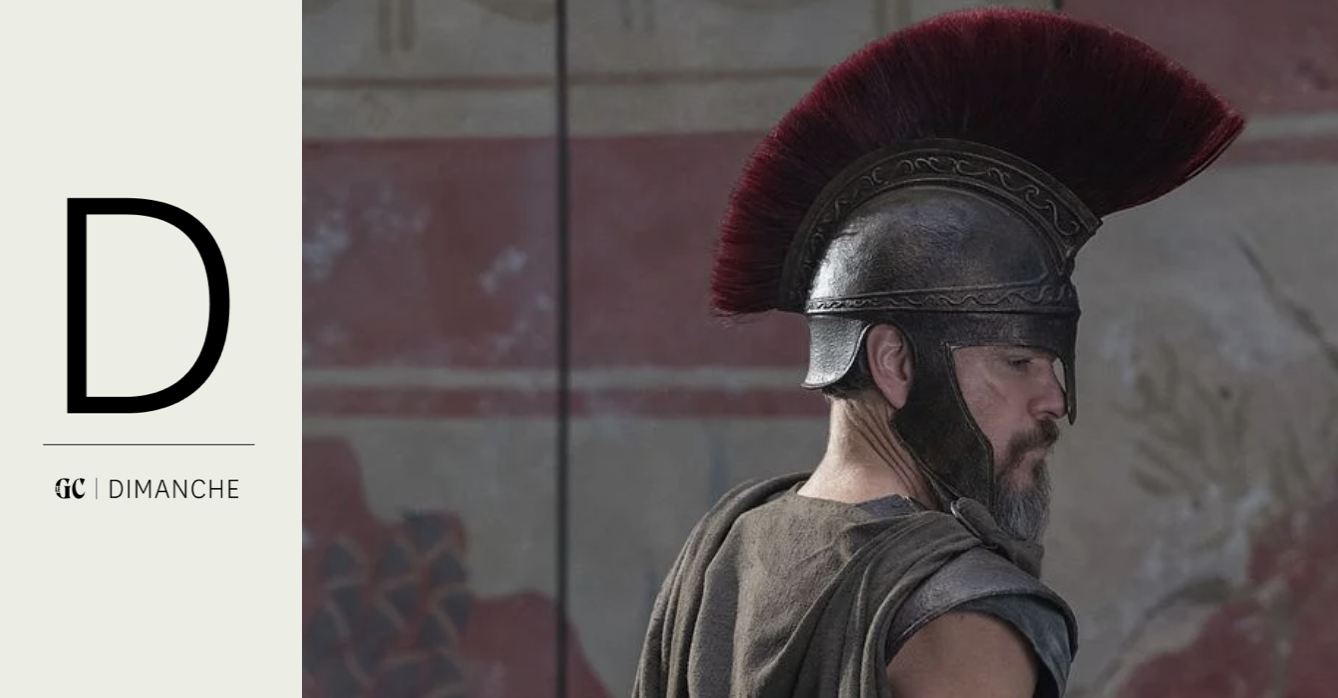
For here is the event: Christopher Nolan releases his Odyssey, shot entirely in IMAX 70 mm, with Matt Damon as Ulysses, Anne Hathaway as Penelope, Tom Holland as Telemachus, Zendaya as Athena. Mendelsohn saw it a week ago. He, for the occasion, re-watched all of Nolan’s films. His verdict is not the one expected of a professor facing a blockbuster, and that is precisely what makes it interesting.
Admiration First
He begins by warning: “I am really a great admirer of Christopher Nolan, I liked his films a lot.” This is not merely a politeness before a verdict. The praise is specific, technical, the product of a man who has watched. Visually, he says, it is quite impressive. Some scenes are truly successful: Circe and the swine, the Cyclopes, the magnificent storms.
On IMAX, he offers no irony, even as the medium could invite all manner of Greek-mythic snobbery. “In IMAX, you have this colossal amount of sensory information,” he says, and it works very well for the storms. The sound design is excellent. His recommendation is that of a spectator, not a mandarinate: “If you see it, see it in IMAX, that’s kind of the whole point.” And about the audience: “People will like it; they’ll think it’s a beautiful adventure story, and they’ll be pleased.” No contempt in the sentence. It is a statement, and perhaps a regret.
The Depressed Veteran
The trouble comes next, and it rests in a single sentence: “He turns Ulysses into a Nolan-esque character.”
Damon’s Ulysses is haunted by guilt for the Trojan War. A figure of post-traumatic stress. The film is about what he feels before the sack of the city. And the Odyssey, Mendelsohn reminds us, rests entirely on the complexity of a man whom the Greek designates as polytropos and polymèchanos: cunning, inventive, witty, sly. “None of that is in the film. It’s a kind of depressed, traumatized veteran. That quality is missing to a great extent.”
One could object that this is a modern reading, and one has a right to it. Mendelsohn does not contest the right: he contests the loss. “One can have a modern reading of the Odyssey, but there, the protagonist’s defining trait has disappeared.” And he offers what is perhaps the year’s loveliest definition of the poem he has heard: “The entire point of the Odyssey is that Ulysses is a hero of the mind, rather than a hero of the body. If you strip him of his intelligence, there isn’t much left.”
The symptom is not isolated. Two and a half years ago, Uberto Pasolini’s Homer’s Return, with Ralph Fiennes and Juliette Binoche, already pursued the same operation: a psychologically damaged Ulysses, tormented by guilt. Two films, one operation. “I don’t simply think it is very epic,” he says, with the understatement that is his signature.
The explanation he gives should be contemplated by anyone adapting the Ancients. We feel a deep unease about warfare, “which was not the case for the Greeks.” For them, war was part of life; they did not overreact to it. “The heroes of the Iliad, and certainly the audience of the Iliad, are not haunted by guilt for having slain their enemies.” Nolan lends them our bad conscience and calls it fidelity. “Listen, I have nothing against the American; it’s not the problem.” The concession is crueller than the reproach. But it is a way of looking at a sensibility that would have been very foreign to Homer.
A Non-Heroic Age
Should we conclude that we have grown depressed, guilty, and have lost metis, that art of finding new solutions? Mendelsohn goes higher. “I believe modernity has a problem with the very idea of hero. We no longer tell heroic stories.” Not that the Homeric hero is simple; he has dark sides, and Mendelsohn is far from denying that. But “we are in an anti-heroic era.” Perhaps we still have a form of intellectual hero, he concedes, “but it is more complicated.”
That is why the Odyssey presents a particular difficulty: “the character himself is the challenge.” What follows is a portrait as a kind of specification, one we would like to have read by producers: he must be clever, sly, seductive (“you have to understand why all these women throw themselves at him”), unscrupulous, violent. “And intelligent, that is the most important trait.” The model Mendelsohn conjures is not antiquity: “It’s a bit of a James Bond-like character.”

We must pause on this comparison, because it is the method itself. Mendelsohn does not pair Ulysses with Bond to modernize him. He does it because the juxtaposition illuminates and leads elsewhere. The next Bond is a matter of debate, he notes: “James Bond is a hero very difficult to treat today, because all the qualities that made him a fun hero in the 1960s…” The sentence is left hanging; each will finish it. With Daniel Craig, “they made him a psychologically tortured character, with a terrible past and all that.” The same operation, then, on Ulysses and Bond, forty centuries apart: “We have a problem with this kind of glamorous hero, and we will find ways to transform them into models of masculinity we deem appropriate.”
What disappears in the operation is not only the cunning: it’s the laughter. Mendelsohn emphasizes “all the craft and deceit that also make the wonderful relationship between Ulysses and Athena, which is one of the great comic relationships in Western literature.” The barbs, the jokes. The goddess and the liar who recognize one another as professionals. “It is very important to convey that.” And the payoff of the operation, starkly: “If you remove all these qualities, there remains only the dark side: the killer, that sort of thing. That is half of the character.”
The Gods, or what Is Lacking
What remains are the gods, who are for us the greatest mystery of ancient culture, and on whom I wanted to hear him. His answer is clear: “That’s the other big problem with the film.”
Circe is not a goddess there. Calypso isn’t a goddess. “They are ordinary women.” As for Athena, there has been much commentary on Zendaya’s casting: “Honestly, she’s on screen perhaps three minutes.” It’s not about timing. It reflects, he says, a contemporary discomfort with the gods’ role in the epic, a discomfort he notes every year in his Bard College classes, where his students “have enormous trouble understanding how they are supposed to think about the gods.”
Then comes the detail that, in itself, is worth the critique. The film’s climactic scene: Ulysses tells in a flashback the fall of Troy, the thing about which he feels so guilty. And Athena? “She sits beside him, weeping, holding his hand.” Mendelsohn announces the scene in advance: “you will find this funny.” It is indeed comic, but darkly so: the goddess of cunning reduced to the role of a compassionate girlfriend. “What made Athena so fascinating in Homer has been erased.”
The inconsistency lies elsewhere, and Mendelsohn reads it immediately, because he is used to works that want the butter and the butter’s money. The film keeps Circe’s pigs, keeps Scylla and Charybdis. “He is willing to have these fantastical elements when it suits him, but he does not care for the divine.” The marvelous as spectacle, yes; the sacred as structure, no.

Or this structure is the poem. “The Odyssey actually opens with Zeus and Athena; the action begins with a gods’ decision.” Mendelsohn here summons what he calls his mistress, the classicist Jenny Strauss Clay: if she is right, all of Ulysses’ return participates in “a divine cleansing operation designed to permanently separate the world of the gods from the world of humans.” There is a divine plan: “the last of Troy’s heroes must return, so that we can finally cleanse the world and forever separate the gods from men,” as they evidently are not in the Iliad. Ulysses’ return is not a sailor’s tale. It is the closing of an age. Remove the gods, and there remains only a man who returns home.
What Nolan Has Understood
It would be too easy to stay at the level of an indictment, and Mendelsohn does not. On one point, he concedes the director’s view, and this point is not minor.
In the Odyssey, the symptom of social collapse is the continued violation of xenia by the suitors, that rule of hospitality which is “the closest thing to a universal law,” and “certainly the most important thing in the Odyssey.” Nolan attends to it. References race throughout the film; he makes it a law. “I think Nolan understands its importance and sought a way to inscribe it within the film.” Even a spectator who knows nothing of Homer will come away “understanding that what happens isn’t a gang of guys picking on others, but something that puts a whole system of social, even divine, norms at stake.” Mendelsohn adds, and one hears the professor’s satisfaction: “I grant him that. It’s pleasant to see these references.”
Better still: Nolan saw the central irony, one that students take weeks to glimpse. When Ulysses enters the Cyclops’ cave and serves himself, “it is he who breaks the law.” The suffering he endures afterward is “ironically the mirrored image of what he intends for the suitors.” The hero chastised for the fault he will punish. “He found a way to integrate that.”
One measures here the difference between a critic and a prosecutor. Mendelsohn holds two opposing judgments about the same film without forcing a reconciliation, because the work itself is contradictory. This is what he calls elsewhere the work: to mediate between a work and its audience.
Women, the Lotus, Oblivion
On Circe, he notes the inversion the film performs: these men have killed, raped, and plundered all over the world, “they are therefore really pigs, and they should be pigs.” The metamorphosis no longer transforms; it reveals. “It’s another form of modernization.”
He does not frown at it. The Odyssey “is indeed full of powerful women,” and feminist discourse there finds a legitimate entry point. What he regrets is more technical, and more grave. Calypso’s speech in Book V is famous: the nymph reproaches the gods for tolerating their own loves and forbidding hers. On screen, “that yields a very pale, not very interesting character,” whereas “in Homer, she is very alive.” Charlize Theron, he adds, “certainly has the presence that is needed.”
Then comes the major betrayal, the one that sums up everything. In the film, during the years spent with Calypso, Ulysses suffers from amnesia: she has fed him lotus. “That entirely reverses the book’s meaning: in the Odyssey, he wants to return home.”
Everything is there. Homer’s poem is that of a man who, able to become immortal with a goddess, chooses to grow old and die beside a woman, and who grieves daily on the shore as he gazes at the sea. The film makes him a man who has forgotten. The first desires; the second endures. We have not modernized the Odyssey: we have removed the desire, which was its engine, and replaced it with amnesia, that is, with the exact opposite of nostos. The lotus, in Homer, is what Ulysses refuses: he forcibly tears his men away from the land of the Lotus-Eaters, because one who tastes it will no longer want to return. Nolan makes him swallow it.
The Father in the Hall
What gives this judgment its weight is that it comes from a man for whom the Odyssey is not merely an object of study. In 2011, his father Jay Mendelsohn, a retired engineer, enrolled in his Bard College seminar. A gray-haired man in the back row of a classroom full of eighteen-year-olds. From that semester emerged An Odyssey.
Jay Mendelsohn disliked Ulysses. “People are either from the Iliad or from the Odyssey,” his son says, and the father belonged to the Iliad. A generation from World War II: “there is a war, there are two camps, there are these hard cases who must make hard decisions. He understood that. The Odyssey, not so much.” Why? “My father liked things to be in order, and Ulysses is a disruptive character. That is what he does. That is what his name means.”
The writers, themselves, adore Ulysses “because he is a kind of professional: a teller, a fabulist.” He improvises, he invents, he plays with language as one does with the Cyclops. “So people like me, like us, find that wonderful.” The we is nice: it includes his interlocutor, it designates a fellowship, that of those who live by telling stories.
But the best is elsewhere. What scandalized the father was the tears. Ulysses weeps constantly, which seemed “very strange” to him. One day, in the middle of a class, before the students, he blurts out: “I was in the army; no one cried.” Mendelsohn draws from this: it is “one aspect of heroes that we have a hard time accepting, that these hard men cry so much.”
Here is the paradox that illuminates the Nolan affair. We have made Ulysses a traumatized figure, and we cannot bear that he cries. We attribute to him our guilt and we take away his tears. I mentioned this to Mendelsohn while thinking of Dunkirk: no one there cries. He revisited the film, as he did with the others, in preparing his critique, and he offered one remark that goes beyond the specific case. In Dunkirk, “we have no idea what the real situation was.” Nolan never names “the Germans,” never “the Nazis”: he says simply “the enemy.” “The film therefore has been stripped of any particular historicity.” If you knew nothing of the war, you would learn nothing. Mendelsohn sees in this a deliberate bias (“he wants you to focus in a very specific way”) and draws no condemnation from it: “Dunkirk is a film I found very good. It is visually stunning, but it’s a bit like a video game, in broad terms. A question of texture.”
“Question of texture”: that phrase is perfect, and it applies to the Odyssey as well. Nolan consistently subtracts something. At Dunkirk, he subtracts the Germans. From Ulysses, he subtracts intelligence, the gods, and the desire to return home. What remains is vast and hollow, and perhaps that is what we now call an epic.
As for Telemachus, played by Tom Holland, “a big Spider-Man star,” notes the man who wrote about Julie Taymor’s musical, Mendelsohn regrets a missed opportunity. The most beautiful arc of the poem is his: “he moves from a forsaken adolescent to a fully realized warrior.” But “Nolan is so focused on Ulysses that Telemachus’ part in the film isn’t very interesting.” The son sacrificed to the father, in a film drawn from the poem whose author wrote a book about his own father: the irony did not escape him, and he did not highlight it.
Who Is That Old Woman?
The remaining question—the one that, for him, governs everything and the film never asks—is: how do we know who someone is? The Odyssey “examines identity questions with extraordinary sophistication,” and this question runs through the poem from start to finish “precisely because the hero is a liar.” Mendelsohn formulates it with the clarity of a logician: “When your hero is an expert in lying, you have a problem.”
There is the word, polytropos, by which the poem designates Ulysses from the very first line, the man of a thousand devices. Mendelsohn reads it as a decidedly banal phenomenon: “we are constantly different people, depending on whom we are with.” Not the same with his lover as with his office colleague, not the same with his children as with his school friends. “We are polytropoi.”
From there his fascination with recognition, whose French rendering he gives better than we: “to recognize, to re-recognize, to know again, it’s brilliant.” And he draws a lesson his students do not anticipate: recognition with Telemachus, which comes first, is “emotionally the least interesting part of the whole epic.” Why? “They never knew each other at the outset. There is nothing to recognize. They are strangers.” The true scene is Penelope: “that is where there is so much to recognize.”
This question of identity is also the one behind The Disappeared, but turned outward toward others: “a kind of rescue mission, a mission of identitary rescue. It is about restoring to these people an identity that had been ripped away.” He explains this through the American experience: apart from Indians, “every American is an American with a hyphen”—Irish-, Italian-, Polish-, Judeo-American. “You are American, but you are always haunted by that other identity.” For Jews of his generation, there is the vertigo: if your grandparents had decided differently, “you wouldn’t even exist.” And as he was also a gay child, “there was an excess of identity.” The phrase is wonderfully casual in speaking of a childhood.
He finally recalls the etymology he was commenting on in The Fugitive Embrace: identity comes from idem, “the same thing all the time.” “But what is vertiginous is that we are not the same, and yet we go on.” And the Odyssey knows this: “it also understands that time is a factor of identity.” No one is the same after twenty years. “You no longer have the same appearance. You hope you no longer act the same way.” Everything hinges on this paradox: “something in us remains identical and recognizable, even as we are no longer the same.” You must return and say, “I am the same as the one who left,” even as no one is the same after twenty years.
That is where he tells the story, and one understands, while listening, why no film will ever film it. On the day his father attended the last class of the term on the Odyssey, Jay, already seated in the back, Mendelsohn calls his mother in a rush for her birthday. She says to him: “That is funny. I woke up this morning, it was my birthday, I went to the bathroom to brush my teeth, I looked in the mirror and I asked myself: who is this old woman? Because I feel exactly as I have always felt.”
“And I thought: that is what the Odyssey is about.”
A mother before a mirror, a father at the back of a classroom, and three thousand years of poetry distilled into one question: who is that old woman? “We are the same all the time, and we change with time. Recognizable and unknowable at the same time.”
Nolan has two hundred and fifty million dollars, seven countries of shooting, IMAX 70 mm, and Matt Damon. In his bathroom, he does not own an old woman. And there is, somewhere in his mind, a old man who could have said, from the back of the room, that in the army, no one cried.