
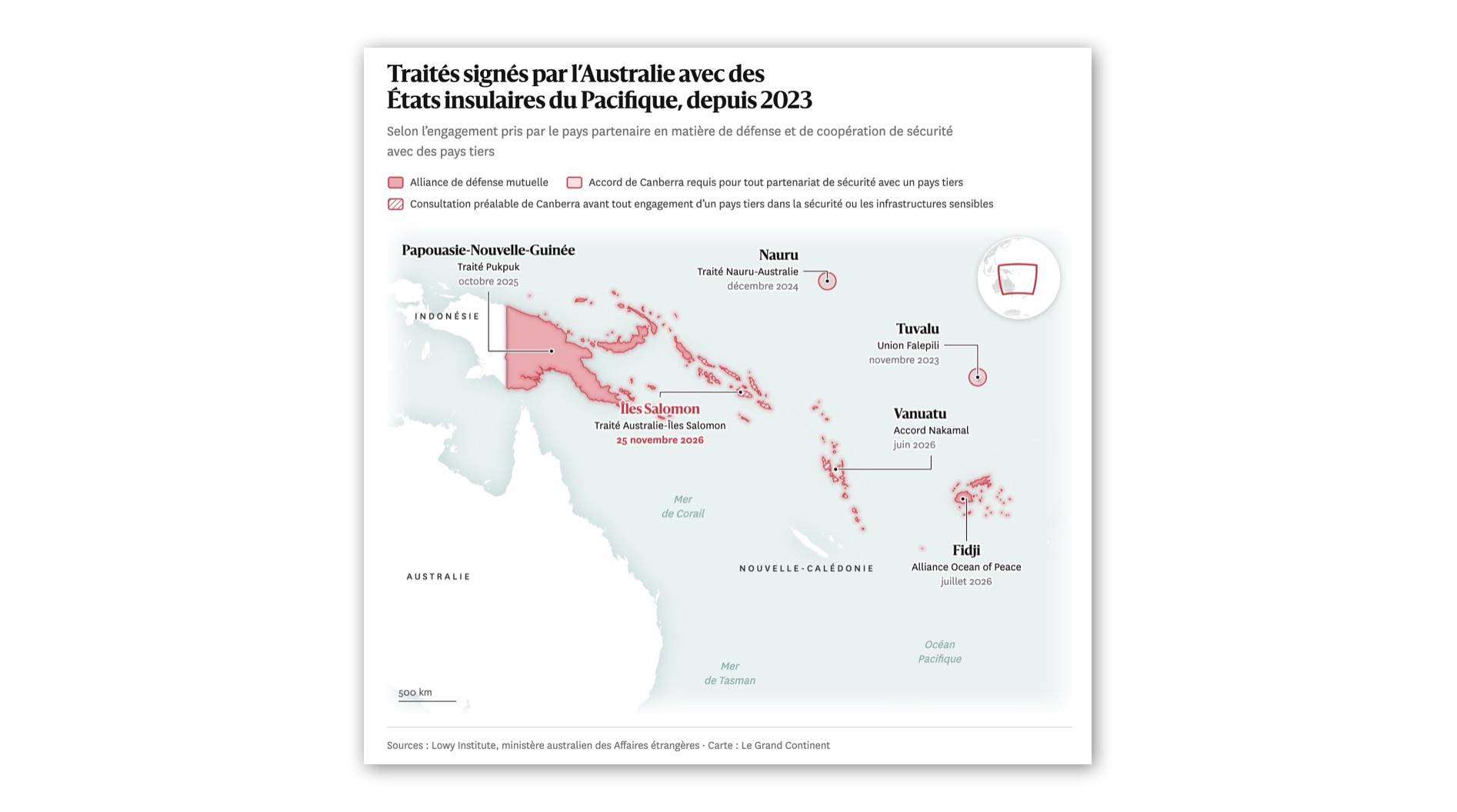
Australia signed on Wednesday, November 25, a new treaty with the Solomon Islands that notably provides for the island nation’s commitment not to authorize the construction of military bases or foreign security installations on its territory, and to safeguard its sensitive infrastructures from any militarization.
The agreement marks a major setback for China, which had strengthened its ties with Honiara in recent years, notably in the area of security.
- In exchange for this commitment, the Solomon Islands will receive, according to Canberra, 740 million Australian dollars (about 450 million euros) over the next ten years to fund education, renewable energy, infrastructure and a sovereign wealth fund.
- It is the sixth bilateral security agreement Australia has signed with Pacific island countries since 2023, following Tuvalu (2023), Nauru (2024), Papua New Guinea (2025), Vanuatu and Fiji (2026).
Since taking office in May, the Solomon Islands Prime Minister, Matthew Wale, has reversed the rapprochement with China pursued by his predecessor, Jeremiah Manele, whose election in May 2024 had formalized a pro-Beijing shift. Wale has drawn closer to Australia, but also to the United States, and has condemned the security agreement signed with China in 2022 by Manele, then foreign minister.
- Since taking office in 2022, Australian Prime Minister Anthony Albanese has sought to rival China’s Belt and Road by expanding security and defense agreements in the region.
- The Nakamal agreement, signed with Vanuatu this summer, had nevertheless led to a compromise that reflected a downward revision of Australian ambitions.
- Port-Vila had notably not ruled out cooperating with the Chinese police, and Canberra had to give up the veto right it wished over critical infrastructure projects, in favor of a pre-consultation mechanism, which does not legally prohibit any unilateral decision by Port-Vila.
The treaty signed on Wednesday, November 25 with the Solomon Islands marks a diplomatic victory for Canberra and, more broadly, for its allies, and notably the United States, which seek to contain China’s influence in the Pacific.
- According to the Sydney Morning Herald, Honiara has recently informed Beijing that it would not renew the 2022 security agreement, which expires in April 2027. Wale refused to confirm the information, citing a confidentiality clause .
Beijing has in the past expressed its displeasure with these agreements by organizing military exercises or missile tests.
- On July 6, the day of the signing of the defense alliance between Australia and Fiji, a Chinese submarine had thus conducted a test-fired ballistic missile in the South Pacific.
- Beijing has so far been content with a laconic comment, the spokesperson for the Chinese Ministry of Foreign Affairs, Guo Jiakun, having stated on Tuesday the 24th that China’s cooperation with the Solomon Islands “does not target any third party and is not subject to external influence.” .