
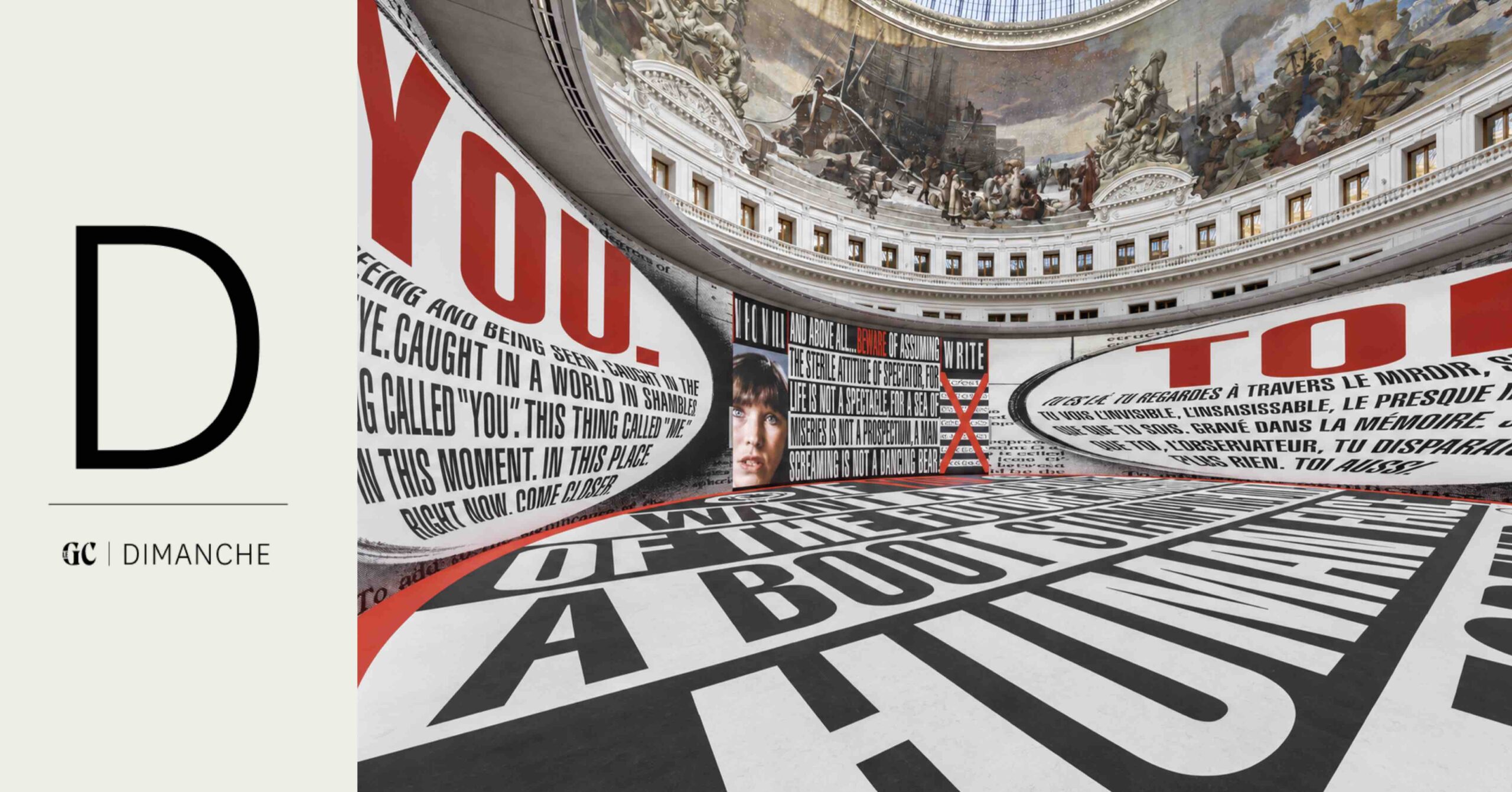
Autumn brings together two major figures of American art in Paris: Barbara Kruger with The History of Tears at the Bourse de Commerce (on view until January 18, 2027), and Jenny Holzer at the Musée d’Orsay with I Saw (from October 20, 2026 to February 21, 2027). Since the late 1970s, the two artists have treated text as a material, and they deploy it across a multitude of supports (monumental installations, sculptures, videos, projections, paintings…) delivering sharp, sometimes funny or moving, deeply political messages. They borrow the codes of advertising and billboards to derail them in devices relentlessly revisited and refined over the course of their careers.
The coincidence of these two exhibitions offers an opportunity to revisit works of rare intensity and to measure their relevance today, even as they bring to light, through intertextuality and mediation, voices from other eras: Barbara Kruger invites visitors to the Bourse de Commerce – Pinault Collection to read texts by Aimé Césaire and George Orwell, while Jenny Holzer traverses the Musée d’Orsay archives and enriches her finds with documents collected in the Epstein Files as well as from late-century literature, such as The Sexual Emancipation of Women, written in 1911 by the writer, physician, and anarchist Madeleine Pelletier.
The Words at Work: Subversion
In 2009, the exhibition “elles@CentrePompidou,” curated by Camille Morineau, gathered in its section The Word at Work artists who, since the late 1970s, have explored narrative forms to denounce the mechanisms of advertising, now omnipresent, and also to question the different viewpoints circulating in the media and political spheres. This moment is also that of the Pictures Generation: a cohort of artists, including Cindy Sherman and Richard Prince, who appropriated images and turned photography from a documentary tool into an instrument for critiquing representation. Barbara Kruger is a major figure in this, and Jenny Holzer is often associated with her. Both seize not only language but also the spaces they critique to address their works to the general public, beyond the art world alone.
Both began by occupying streets, producing works that resembled cheap posters, printed in large quantities on sheets of paper pasted to walls without signatures. Trained in late-1970s New York, they were noted for their visual power and the radicality of their voices. Jenny Holzer’s earliest works publicly shown are the Truisms (1977-79), a series of countless phrases in uppercase, written as a list, where the artist expresses viewpoints now famous such as Abuse of power comes as no surprise ; Money creates taste ; or Raise boys and girls the same way. She would be awarded the Golden Lion at the 1990 Venice Biennale for her exhibition revisiting these same texts. She continues to conceive textual series using different narrative devices: her Inflammatory Essays (1979-82) collect statements ranging from conservative to progressive, printed on sheets of various colors, also pasted anonymously in the streets. It was by invading Times Square in 1982 that Holzer’s work truly took a turn: her words began to appear on illuminated signs, starting with the Spectacolor, which typically broadcasts advertisements.
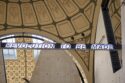
She has since continually reinvested in this medium, designing monumental installations where her texts scroll by, like information banners displaying the latest news, or in the form of large-scale laser or Xenon projections. Unsigning her intervention, the artist relies on the element of surprise: passersby are disoriented by what they read, even though the language is visually familiar. For this new Paris show, Jenny Holzer’s works inhabit historic spaces such as the façade of the old Orsay train station and its nave, or the moldings designed by Gae Aulenti for the museum’s layout in 1982, which the artist traverses with a luminous circular band; similar to the one created for her first show at the Guggenheim in New York in 1989. Her contemporary intervention in a 19th‑century museum is a true caméléon game, not unlike the narrative device of her early exhibitions. She now takes to marble columns and benches, engraving on them phrases as disorienting as ever, which could nonetheless go unnoticed. The artist relentlessly seeks to enable a surge to occur.
Kruger’s circulation also accelerated in the early 1980s, with major exhibitions, such as Monika Sprüth in Cologne where the artist appeared among Jenny Holzer, Cindy Sherman, Louise Lawler, and Rosemarie Trockel, and her participation in Documenta 7 in Kassel in 1982. It was in 1989 that her work left the art world to become broadly known to the public, amid protests against Republican offensive efforts seeking to overturn Roe v. Wade. The poster Untitled (Your Body Is a Battleground) shows a black-and-white portrait of a woman, split into two halves, with the text placed in a red banner. Kruger’s style is thus close to Dadaist collage in its geometric construction, and the artist uses typography common in brand communication, Futura Bold. The poster even found international resonance: a Polish version was distributed in Warsaw in 1991, where feminist militants proposed producing a number of them in defense of abortion rights, and Kruger adapted this poster for Knowledge Is Power, her French version commissioned by the Ministry of Culture for the bicentennial of the French Revolution. Trained in the logic of visual communication, Barbara Kruger cut her teeth in magazine publishing and studied at Parsons School of Design, where Diane Arbus was her photography teacher.
Like Jenny Holzer, Barbara Kruger grew up in a society where image occupies an ever-expanding place: the golden age of advertising, and a generation of thinkers such as Roland Barthes began to theorize the dialectic between text and image. One can view these artists as contemporaries of a broad movement of appropriation: that of images, but also of language. “I write because I do not want the words I find,” Roland Barthes wrote in 1973 in The Pleasure of the Text: writing allows him to free himself from ready-made language, by removing stereotypes rather than reproducing them. Rejecting doxa, Barthes makes writing the place to interrogate the very nature of words. At the same time, writers such as Monique Wittig invented new textual forms, and Hélène Cixous published in 1975 The Laugh of the Medusa, a manifesto of feminine writing: “It is necessary for women to write themselves … It is necessary for women to put themselves into text — into the world, and into history — by their own movement.” Where Barthes removes clichés, Kruger and Holzer choose to repurpose this language to turn it around.
Response to Roland Barthes
Today, it is not a poster that is exhibited at the Bourse de Commerce, but an installation titled after Roland Barthes, The History of Tears, and a large in situ ensemble reviving one of his emblematic works from recent decades: Untitled (Remember Me), 1988, which gives its title to the exhibition. Like Holzer, Barbara Kruger continually reworks her early works, with the aim of reinventing their circulation across different media. Her early paper posters, almost punk, become prints on vinyl canvases, then LED and video installations that she reimagines today. A tearful, fixed, close-up eye surmounts the title of the work Untitled (Remember Me). Set to industrial music, while several interpellations scroll across the screen, one can read: “Remember me; Dismember me; Delete me”, or “Unravel us; Embrace us; Replace us; Release us.” The installation is a 23‑minute video loop, punctuated by moments of diffraction where the eye image pixellates, until it disappears.
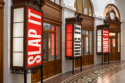
The result is disarming, both for the movement of the text and for the shift from I to we; as much for the narratorial versatility that compels our identification. The sonic atmosphere reinforces the intrusive character of the work, whose forcefully repeated headline is deliberately amplified. In a nearly kitschy fashion, it is the shift to a cellular scale, what is shared by us, that becomes explicit, a purpose also conveyed by the microscopic image of the dermis surrounding the work. Shock phrases and powerful visual vocabulary contribute to our disorientation, and we have not yet even walked through the Rotunda. On the Bourse’s historic vitrines, written in red, black, and white are: “Steal it; Lend it; Kiss it; Hurt it; Break it; Weaponize; Theorize; Marginalize…” A cacophony of contradictory injunctions questions the mechanisms of influence and the circulation of ideas, as well as the reproduction of power relations.
Entering the Rotunda by Tadao Ando, which Kruger has entirely occupied with walls and floor, the confusion grows still greater. This installation presents a set of texts chosen by the artist: an excerpt from Aimé Césaire’s Cahier d’un retour au pays natal, another from George Orwell’s 1984, but also her own words, where the recurrence of the pronouns “You” and “Me” extends the artist’s address to the viewer. The line You, I mean me, I mean you is a recurrent Kruger phrase, which became the title of her large touring exhibition: Thinking of You. I Mean Me. I Mean You, shown at the Art Institute of Chicago, LACMA, then the MoMA, the three largest American contemporary art museums, between 2021 and 2023. The texts are cracked across the concave walls of the rotunda, stretched and gigantic, and vertigo is inevitable as the installation videos resonate. In this supernatural reading experience, one feels drawn into the excerpts chosen by the artist:
“And above all, (…) beware of crossing your arms in the sterile spectator’s stance, for life is not a performance, for a sea of pain is not a proscenium, for a man who screams is not a dancing bear…” – Aimé Césaire, Cahier d’un retour au pays natal, first published in 1939 in Volontés, then in volume by Présence Africaine (1956 definitive edition, regularly reissued in paperback).
“If you want an image of the future, imagine a boot stamping on a human face, forever.” – George Orwell, 1984, translated from English by Romain Vigier, p. 273.
“You. You are there. You look through the mirror, somberly. You see the invisible, the elusive, the almost nonexistent. You. Whoever you are. Engraved in memory. Until you, the observer, disappear. Nothing more. You too.”
Dans cet espace verbo-visuel de forte intensité, qui commence à s’apparenter à un piège, Kruger prend aussi le soin de dissimuler une question: Who will write the history of tears? These words are Roland Barthes’s in Fragments d’un discours amoureux (Fragments of a Love Letter): “Who will write the history of tears?” (Seuil, 1977). The question runs along the top of the Rotonde like a skylight, and brings with it a breath. Beyond the darkness of ominous signs, it must be said, carefully chosen by the artist, one must imagine what the malaise we know will become. To imagine a continuation to the story; a desirable future where we will have at least learned to listen to the tears of the past, and where sensitivity could exist shamelessly, becoming the instrument of our political jolting, not turned into “sensiblerie,” as Barthes laments recalling the warm tears shed by the Greeks in their theaters.
There is sublimity in this Barbara Kruger installation, in that it places the viewer in a cruel vulnerability, while inviting them to cling to it, through the profusion of images and sounds of this captivating environment. Kruger, as a photographer, has reflected on the mediation of images and the transformations triggered by digital technology throughout her career; on the increasing immediacy we know; and on the instinct to keep a record of things, which stands as the central challenge of photographic practice. Who will write the history of tears?, she asks us as we leave the exhibition.
The Emergence of Jenny Holzer
Like Barbara Kruger, Jenny Holzer uses a borrowed “I” to speak of war, of what becomes of humanity; of the power “that kills us” – to borrow again the words she addressed to me, as she slipped me into her exhibition a few days before its opening. Holzer does not fade behind the texts she gleaned from the Orsay archives for I Saw. I meet her as she walks on the elevated walkway, capturing the reflections of light emitted by her works in the old Orsay station. The light floods her reflections; she cares about colors, the day’s modulations, and what that does to her work. Marble is chosen for its softness, canvases are covered with sheets of gold and reflective materials. She also draws inspiration from Rothko’s canvases, whose color diffusion at the edges fascinates her, and which she seeks to reproduce in her luminous panels.
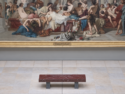
But back to the emergence. The artist appears on the walkway, imposing in her stride, slow and audaciously confident in her black, loose clothing; she is terribly elegant and her presence, punk. In a room devoted to war (Jenny Holzer was born in 1950 and her father was an aviator during World War II), she toys with a painting “too large to be moved” from the initial gallery where the show unfolds, one she immediately adored. A vast painting indeed depicts a desert crossing by a troupe of emaciated men, carrying a young captive woman, and a fortress of hunted game. It is a work by Fernand Cormon (Caïn, 1880), which is none other than Cain and his kin fleeing across the desert, condemned to wander forever. Hung on either side of it are large-format canvases by Jenny Holzer reproducing, among others, a document entitled “Emerging threats in the AI era,” an artificial intelligence diagram published in The Express Tribune in 2021, based on the work of political scientists, analysts, and military historians, listing the social-conflict risks that AI development could trigger. Facing her, Holzer expresses the immense joy she feels to have installed a Rousseau painting titled The War (1894), which allegorically features a furious woman flying over a mass grave, but also a war scene depicting Joan of Arc (Frank Craig, La Pucelle, 1907), which the artist greatly admires.
Jenny Holzer’s words traverse and illuminate the old Orsay station in the same way, threading through vitrines and rooms, reflecting in the immense bay windows. A set of canvas works presents “forbidden” documents: redacted documents dealing with 9/11, “alternative interrogation techniques” – permitted torture –, chemical and biological weapons, excerpts from the Epstein Files. Jenny Holzer compares the redaction performed by secret services to a work of art, almost to a Black Square by Malevich, notes co‑curator Nicolas Gausserand. The artist nevertheless questions what is shown or not, as she continues her meditation on memorial and anti‑memorial through an exploration of the museum’s archives opened to her. The exhibition features 19 marble pieces, with a display arrangement chosen by the artist, who, aided by the house’s archivists, cataloged more than 700 quotes that punctuate the show.
Jenny Holzer chose to install alongside certain museum works a multitude of texts written by artists, some of whom are young women, others authors close to great painters; psychiatrists, poets, or anarchists, she notes. Preferring to borrow Zola’s words rather than writing words that would anyway be less good, Holzer considers herself lucky to give form to a multitude of flashes of insight that she hopes, she tells me, to prophesy.
In a previous exhibition at the Kunstmuseum Basel, Holzer had traversed Louise Bourgeois’s archives; a monumental volume survives. It houses an assemblage of texts and images chosen by the artist, where medieval engravings sit alongside Bourgeois’s sometimes bawdy yet always meaningful works. She speaks of the artist, also American, with great admiration. She recounts the end of Bourgeois’s life, when, seated, she wrote from her bed while an assistant carefully moved the sheet of paper under her hand to allow her to continue writing. Another prolific artist who caught the text bug before her, and whose legacy is undeniable: all share the same audacity, the intact subversion, throughout a career spanning decades. Regarding the coincidence that brings her exhibition to coexist in Paris with Barbara Kruger, Jenny Holzer is delighted: it is time for the old ladies to be seen. “I Saw,” in this exhibition, Jenny Holzer seizes the “I” of illustrious voices and renders it more embodied than ever.
The Infinity of Language
The dissemination of her works throughout the museum is dense, like an archipelago where, as one wanders, one discovers text-image pairs, following the trace of benches (stoneworks) she created and placed opposite works from the Orsay collection. The artist is interested in the Nabi painter Pierre Bonnard: before Femme assoupie sur un lit (1899), Holzer quips: “Bizarre is maybe too strong, but perhaps pertinent,” at the sight of the big toe of the woman depicted — a Bataillean symbol if there is one. The artist also notes that she chose the marble for the bench so that its veining echoes the folds of Bonnard’s wrinkled drapery. A sense of strangeness fascinates the artist, and a certain erotic and bloody tension (Lustmord) runs through her selection. This is the case with Paul Cézanne’s La Femme étranglée (between 1875 and 1876), which Holzer chooses to show opposite a sentence by Madeleine Pelletier engraved on one of the exhibition benches: “Women must get used to carrying a revolver for evenings out and country walks.”
The artist’s keen gaze thus creates unsettling associations, among which one finds an excerpt from Camille Claudel’s correspondence before Rodin’s The Gates of Hell, a text by Van Gogh facing Gustave Courbet’s Self-Portrait, and writings by Claude Monet: Holzer says she was struck, upon discovering them, by the way they address “the fundamental questions.” I finally find what is perhaps the exhibition’s most personal association: Pierre Bonnard’s fascinating painting The Boxer (Portrait of the Artist), in which the man with a crimson face clenches his fists against an unseen foe (one I have long enjoyed imagining), and which now faces the sibylline words of Van Gogh: “One must make desperate attempts.”
Through her gaze on these paintings and texts, Jenny Holzer opens meaning to infinity. The evocative power of the associations she desires grants the spectator extraordinary freedom, who unexpectedly encounters snippets of text of great beauty, or rediscovers works in light of the text attached to them. It is surely the freedom and generosity of the artist that make this exhibition so beautiful, so expansive, and poetic. Here, the aim is to favor a poetic approach to reality, to acknowledge a plurality of meanings as Barthes wrote; and to emancipate the viewer from any imposed reading. From there, the reception of the work becomes an intimate matter; a silent conviction, a secret one clings to. It is this same freedom that guided Holzer in choosing the authors presented to read in the exhibition, but also during screenings outside the museum, organized from October 18 to 22.
Sylvain Amic, the exhibition’s co-curator who passed away last year, had initiated a project with Jenny Holzer on secularism, twenty years ago, at Montpellier’s Fabre Museum. It could not come to fruition then. Today Jenny Holzer titles her exhibition “I Saw”: she came, she saw. By twisting the Latin phrase as Victor Hugo did before her, Holzer places emphasis on the critique of power, which could be the heart of her work. She wished to show us the fruits of her research, to convey her fears as well as her astonishments.
Who will write the history of tears? Surely the artists, but also scientists, historians, archivists, whom Jenny Holzer surrounds herself with to present us with a sprawling, open, and sincerely world-facing exhibition. Among the more than 700 quotes chosen to evoke violence, war, passionate loves, as well as the disarray of artists who persist in depicting the nature of the soul, humanity in its oldest sense, and hoping for a jolt, you will certainly find the answer to this question.
The mediation theme deeply informs the respective works of Barbara Kruger and Jenny Holzer: their explorations of language present themselves as attempts to make discourses heard. Borrowing the words of others probably helps to achieve this, and it allows us to question, by moving from one medium to another, the very possibility of speaking about war.