
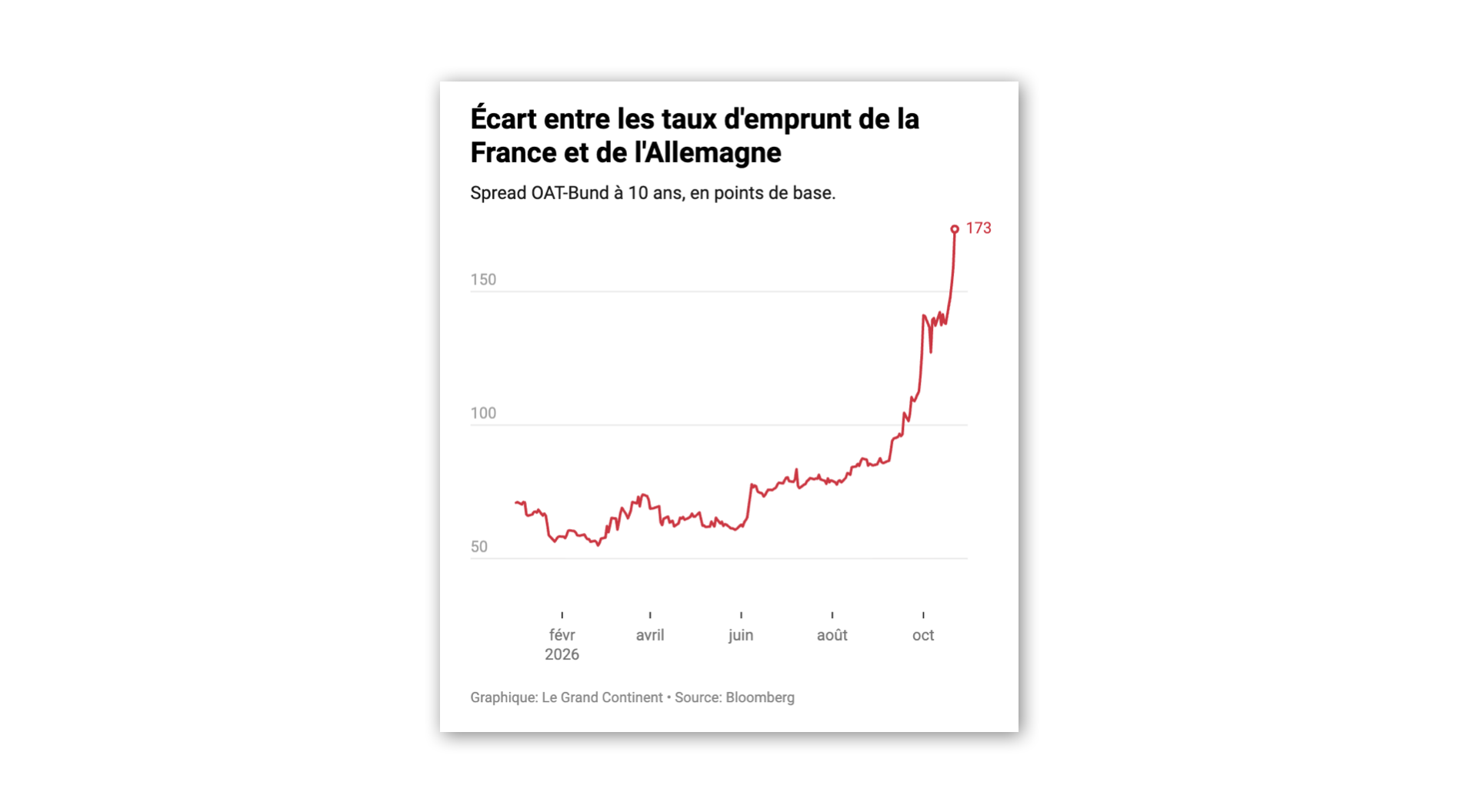
Yesterday, Wednesday, October 21, the yield demanded by financial market participants on French 10-year government bonds rose above 5% per year for the first time since July 2002, a few months after the euro entered circulation.
Today, at around 5.1%, this yield exceeds the rate required to finance American debt—a first since 2013.
- At the same time, the spread, i.e., the gap in 10-year yields between French and German debt, climbs beyond 170 basis points, i.e., 1.7 percentage points.
- This marks an unprecedented level since November 2011, at the height of the euro zone crisis.
France is now borrowing at a rate roughly one percentage point higher than Spain’s and about 0.5 point higher than Italy’s, even though Italy’s debt is larger as a share of GDP. At the current pace, and according to the review’s calculations, France could overtake Greece in debt-to-GDP terms as early as 2028 or 2029, with Italy following between 2033 and 2040, thereby becoming the EU’s most indebted country within seven years.
- The spread measures the risk premium that financial actors attach to French debt relative to German debt. It mainly reflects the risk they perceive of not being repaid at the maturity of the bonds they hold.
- Because of the severe social and political crisis the country is experiencing and the lack of a credible short-term solution, these players believe this risk is rising, and distrust of French government debt is growing rapidly.
- Consequently, the prospect of a major financial crisis before the presidential election, whose first round will take place on April 18, 2027, is looming large.
Distrust begets distrust, and the deterioration of credit conditions faced by French debt mechanically increases the debt load, which in turn raises the risk of a default. A self-perpetuating spiral that could only be halted by a substantial intervention from the ECB, or even the IMF, risks taking hold.
- France, the EU’s second-largest economy and population, is nonetheless not Greece.
- A financial rescue of France would pose a political and economic challenge of a completely different magnitude for the euro area and the Union.