
Last weekend, a Russian satellite came very close to ICEYE-X36, a radar satellite built by the Finnish company ICEYE, registered as American. The Russian satellite, Kosmos 2612, launched in April alongside five other craft, had raised suspicions after a series of maneuvers began on September 30, which by October 12 placed it on the same orbit as ICEYE-X36.
By the end of the week, it stood at roughly two hundred meters from the American craft, before moving to a higher orbit on Sunday the 18th in the evening.
- ICEYE-X36 is among the satellites that provide images to the Ukrainian army. In August 2022, the company transferred one of its crafts to the Ukrainian government and granted it access to its constellation.
- Then, in January 2026, it announced a contract that broadened Kyiv’s access to its satellite data.
The intentions of Russia remain unknown. According to Adam Marsh, of the company LeoLabs, Kosmos 2612 could have collected images or other data on ICEYE-X36, or carried a weapon. Clayton Swope, a researcher at CSIS, does not exclude the possibility that Russia had contemplated destroying the satellite before backing off.
- In April, the commander of the U.S. Space Command, Stephen Whiting, stated that Russia had deployed operational anti-satellite weapons aimed at American satellites.
- The American intelligence services consider that Moscow “is conducting activities of research, development, testing and deployment of anti-space systems in order to exploit the vulnerability perceived in the American military’s dependence on space.”
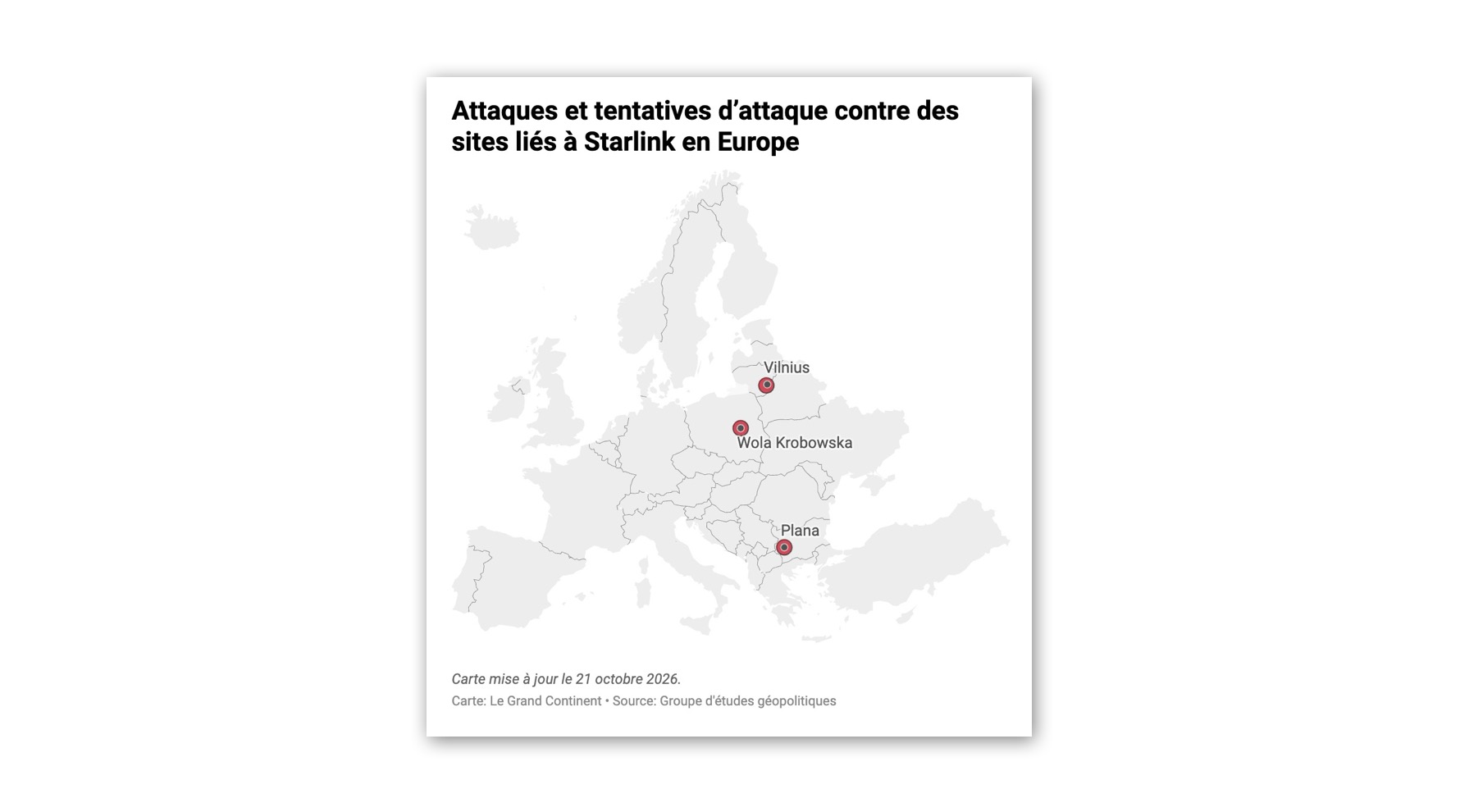
Satellite infrastructures are also targeted on Earth. In recent weeks, three sites related to Starlink, SpaceX’s satellite Internet service, have faced attacks or attempted attacks in Europe.
- On September 23, a Starlink station located in Wola Krobowska, south of Warsaw, was hit by a fire. According to Der Spiegel, members of a Turkish criminal gang nicknamed the “Daltons” could be the perpetrators. They may have acted on behalf of Russian intelligence services, which Warsaw says are “without any doubt” behind the attack.
- On October 9, in the evening, two masked individuals allegedly set fire to eight antennas at a site near Plana, 20 kilometers from Sofia. The Sofia court approved a European arrest warrant for two 19-year-old German nationals. Bulgarian authorities have not named a mastermind to date.
- Finally, in the night from October 17 to 18, antennas and a control unit of a Lithuanian company storing Starlink equipment in Vilnius were subjected to an arson attempt that failed. Prime Minister Mindaugas Sinkevičius attributed the attack to Russia, and said authorities were taking measures to protect the population and its property.
A portion of the Starlink sites in Europe contributes to Ukraine’s connectivity. This includes the Wola Krobowska station, which belongs to the Polish public telecommunications operator Exatel and ensures Internet transmission to Ukraine. Since 2022, Warsaw has spent more than 480 million zlotys (about 110 million euros) to finance Starlink terminals and subscriptions for Ukraine.
- Starlink has become a vital service for Ukraine’s defense against Russian drones. The service also enables units deployed on the front to communicate with each other and coordinate their actions.
- Kyiv also benefits from American satellite intelligence, notably the SBIRS system, which provides early warning, and allows the detection of ballistic missile launches and real-time tracking of cruise missiles, whose low altitude helps them evade ground-based radar detection.
Europe possesses several high-performance observation satellites, whose imagery can locate troops, artillery, ammunition depots, and missile launch sites. No European country, however, has an equivalent to the American SBIRS, and satellite Internet services lag behind in constellation size.
- The closest European counterpart to Starlink, OneWeb, counts around 600 satellites, compared with roughly 10,000 for Starlink.
- Consequently, it cannot carry as much data, and therefore cannot serve as many users concentrated in a single area.
- Last year, Europe accounted for only 0.3% of satellites launched: 13, versus more than 4,000 for the United States, 387 for China and 99 for Russia.