
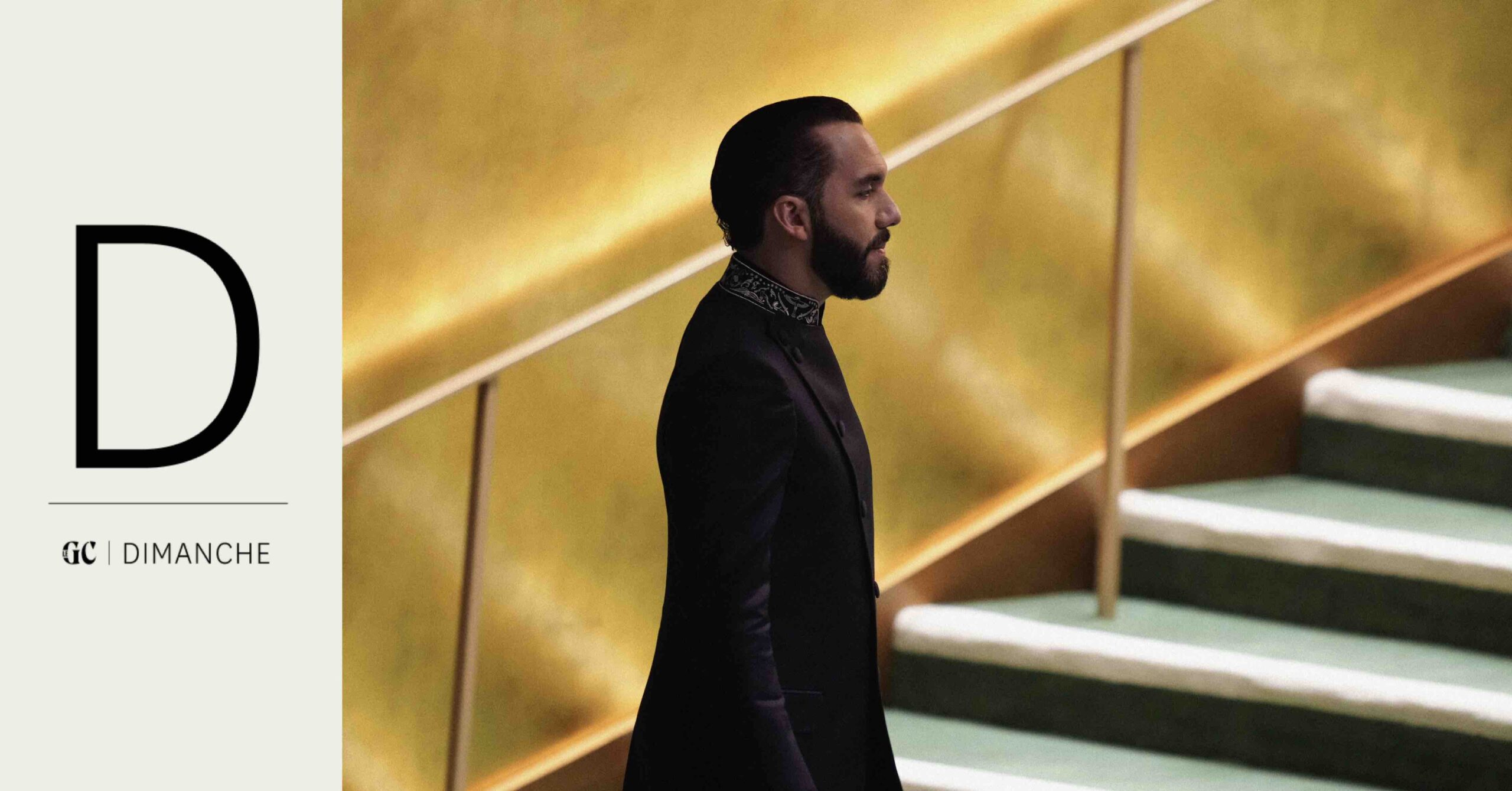
About a year ago, I mentioned Nayib Bukele, the president of El Salvador, in a few pieces of writing — here is a quotation that neatly sums up my reflection.
“Bukele easily won a second term on February 4, 2024. How did he manage it? By arbitrating between security and democracy: he mobilized the army and had thousands of presumed gang members arrested, imprisoned in jails where the conditions of confinement are horrific. What is new and truly surprising about this scandalous procedure is that the brutal and illegal treatment of prisoners is not hidden from the public, but openly displayed — the message is clear: ‘If you are arrested, you will have no fundamental rights, you will suffer far beyond what the law allows!’
My point was not merely critical. I wanted to compare Bukele’s effectiveness with that of liberal democrats, and more broadly with all people on the left, who sacrifice any chance of solving an urgent problem in the name of absolute respect for rules and the system.
My conclusion was this: the left needs its own Bukele.
Imagine my surprise when I learned, on November 22, 2026, that Bukele had answered me personally, with a brief remark that a part of the right quickly hailed as a model of the species: the art of erasing a leftist in a single sentence.
Here is the response he posted on X from his account (where the official presidential seal appears):
“Where Žižek really goes wrong is that I am neither left nor right. I am above these labels that stem from the seating arrangement in the French National Assembly during the Revolution. I am a man of God. Your little political labels cannot bind me.”
My initial reaction, of course, was to think that Bukele was joking, or at least using irony, by describing himself as an “man of God,” as when he proclaims himself “the coolest dictator in the world” or “philosopher-king.” But I immediately understood that the precise meaning of the phrase is irrelevant. What matters is how it operates within our sociopolitical space.
On this point, the answer is clear: if I act as a man of God, I place myself above every law and every legal constraint. I can therefore do whatever I want, using all the means at my disposal, because God himself acts through me.
Indeed, why should the law restrict me if the Supreme Cause – God – supports me?
The Hidden Source of an American Convergence
This absence of constraints not only legitimizes acts of spectacular brutality. It also enables illegal and pragmatic arrangements made behind closed doors. Three months after his return to the White House in 2025, after launching a broad assault on immigration, Donald Trump hosted the president of El Salvador there. The two men struck a deal. Bukele threw open the doors of CECOT, the enormous Salvadoran prison now infamously famous, to entire planes of expelled people, mostly Venezuelans. The American administration had arrested them and charged them with belonging to gangs.
Subsequent journalistic investigations revealed that most of these men had not faced any criminal conviction in the United States and that no link to a gang could be established.
In exchange, the United States pledged not to scrutinize too closely anything that would contradict the image of Bukele as an ironclad anti-gang figure. Yet there was indeed a pact between Bukele and the gangs, and it is this pact that largely accounts for the dramatic drop in El Salvador’s homicide rate. Of course, the pact also had an electoral dimension: the gangs were to ensure that residents of the neighborhoods they controlled voted for Bukele.
Depoliticize to Rule
Being a man of God (and acting as such) also means positioning oneself, by definition, outside the political space with its “little political labels.” It means placing oneself at a more fundamental level: that of religion and patriotism, which require no debate, but a military discipline.
Bukele is not original in this respect: he is merely adopting the classic right-wing strategy of depoliticizing the debate. To name just one of his many predecessors, recall this famous ironic remark attributed to Francisco Franco: “Follow my advice: never meddle in politics” (often quoted in Spanish as “Haga usted como yo, no se meta en política”).
Although Franco ruled Spain with an iron fist from 1939 until his death in 1975, he would have given this counsel to ministers, to editors of newspapers, and to army officers who complained about internal struggles, factional pressures, or criticisms from public opinion.
Franco indeed viewed party politics, typical of democracies, as a source of chaos, division, and destruction. He blamed politicians for the instability that led to the Spanish Civil War. By ordering his subordinates not to meddle in politics, he presented his own power not as a political enterprise, but as a patriotic and military duty: to maintain order and national unity.
The Impasse of the Apolitical Right
A fundamental theoretical remark is in order. The essential feature of the left/right cleavage that escapes Bukele is that there is no neutral space from which to define these two terms. That also means there is no exterior to this cleavage; in other words, any definition you give is itself left or right.
Formally, to declare oneself apolitical is a right-wing gesture: the left is dismissed as an external force disturbing social harmony by injecting “political” quarrels. The left, on the contrary, is always a partisan stance: for it, the social space is by definition political, composed of antagonisms and struggles.
Do we not here, perhaps unexpectedly, echo the physicist Jonathan Oppenheim’s claim that the viewpoint of the totality is stupid, while all genuine knowledge is attained from a particular position?
The right, which presents itself as the voice of the totality even before political cleavages occur, knows less than nothing. The left, on its side, adopts a particular and committed perspective; that is why it knows too much. Totality is stupid; to know, one must be partial.
To mask this fact, the apolitical right disqualifies its opponents with brutally harsh terms. In the eyes of Javier Milei, a more liberal version of Bukele, “leftists” are not merely idiots who understand nothing about real life. He even went so far as to call Pope Francis a “dirty leftist.”
(By the way, I myself constantly face the same rejection in Slovenia, my country, where I was labeled together with a former prime minister as a “school psychiatric case” …)
It is in this sense that I noticed — not without irony — that Bukele’s politics work in practice but not in theory. I am not advocating a delirious ignorance of reality regarding Bukele; I simply observe that if his brutal acts yield immediate results, a deeper theoretical analysis clearly shows that their long-term consequences will be much more ambiguous and likely lead to catastrophe.
One inevitable question remains, and I do not want to dodge it.
Which God does Bukele serve when he calls himself a “man of God”? It is certainly not the God of Christians. Bukele is an obscene pagan for whom Christianity serves only as a mask: a figure of the Antichrist, just as Peter Thiel, who claims to fight it, is himself a somewhat subtler incarnation.