
Yesterday, Wednesday, November 25, SpaceX received from the Federal Communications Commission (FCC) authorization to deploy up to one million satellites into space to build solar-powered data centers intended for artificial intelligence. The decision requires the company to commission a first satellite by 2033, 10% of the constellation by 2035, half by 2038, and the entire system by 2040.
In a statement, the FCC said this authorization “promises to bring humanity closer to a Kardashev II-type civilization, capable of harnessing all the power of the Sun.”
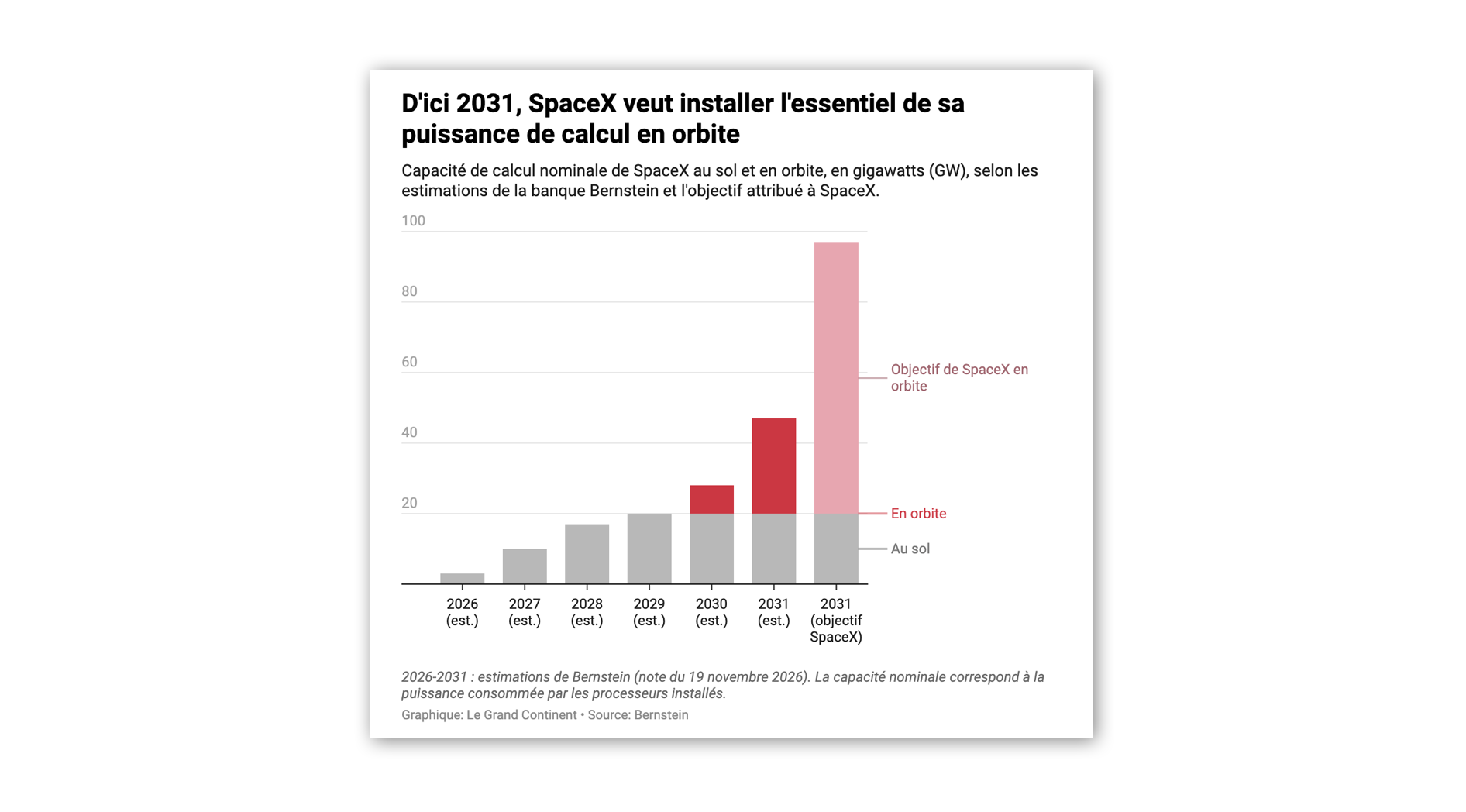
- According to a note from the American financial group Evercore, SpaceX could have an orbital computing capacity—i.e., the power of data centers in orbit—of 8 GW by 2029, which would be multiplied by nearly 10 by 2031.
- The company would then target nearly four times as much orbital compute capacity (77 GW) as on the ground (20 GW), according to Bernstein.
To achieve this, Evercore estimates that Musk’s company would need to conduct about 909 Starship launches in 2029, 2,121 in 2030, and 5,657 in 2031.
- The company conducted 165 orbital launches last year, but Musk aims for 10,000 launches per year by 2030.
- To reach this objective, SpaceX announced at the end of August a plan for a mega spaceport in Louisiana that would comprise 10 launch pads.
Many doubts remain about the feasibility of the operation.
- Amazon, a SpaceX competitor in the space sector, stated in March, in its request for rejection to the FCC, that it would take “centuries” for SpaceX to build this constellation. The company added that very few details had been provided by SpaceX on how it planned to “keep these grand promises.”
- American astrophysicist Adam Becker himself said on Wednesday the 25th that the prospect of launching one million satellites into space to create data centers was a “chimera,” adding: “This will not happen.”
- Becker specifically notes the increased light pollution of the night sky, as well as a serious risk of a chain reaction of collisions among space debris, “which would be a catastrophe for humanity as a whole.”
The deployment of orbital data centers aims to address two problems facing the AI industry: the massive electricity needs to power data centers, and public opposition to their construction. Promoters also highlight the cold of space for cooling the components.
- Financiers remain cautious about SpaceX’s projects. In a recent $43 billion loan guaranteed by Nvidia chips, lenders tried to impose a clause prohibiting the company from sending these chips into orbit, which would prevent them from seizing and reselling them in case of default.
- It is not known whether this clause appears in the final version of the contract.