
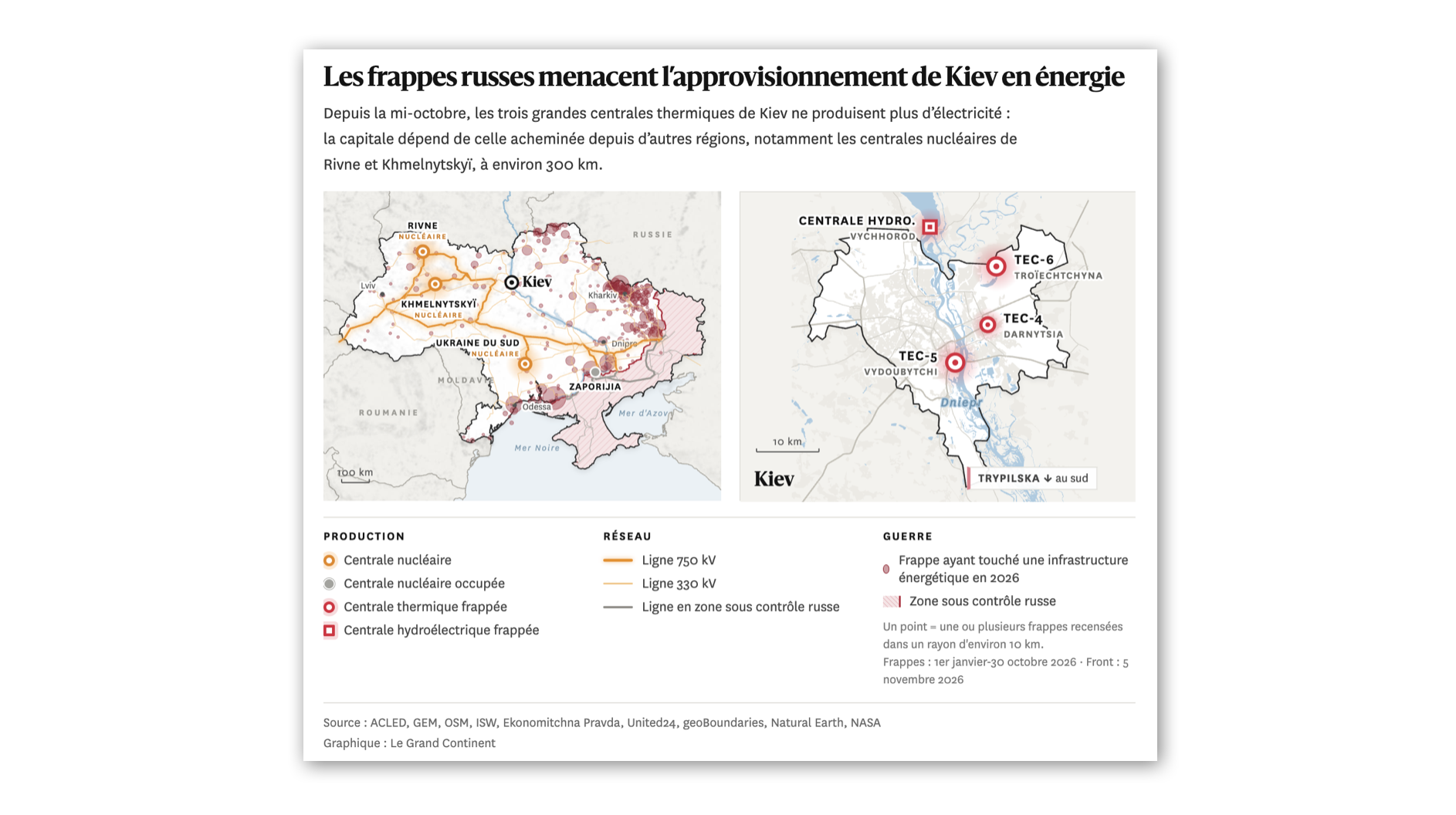
The situation in Ukraine’s major cities has deteriorated significantly in recent weeks, especially in Kyiv, as the Russian army accelerates its campaign of strikes against electricity production and distribution networks. Power plants, high-voltage lines, and substations are being systematically targeted: 238 strikes affecting energy infrastructure were recorded in October, according to ACLED.
This marks a record since the large-scale invasion began in February 2022.
- Kyiv’s thermal power plants are no longer generating electricity, and the capital relies mainly on three nuclear power plants located about 300 kilometers away.
- The long distances traveled by high-voltage lines to transport power from the west and south of the country to the capital make the city highly vulnerable to attacks, especially since the range of Russian drones now exceeds 1,000 kilometers.
Kyiv authorities have developed a network of small gas-fired plants that help sustain essential services—hospitals, some water pumping stations, etc.—but these cover only a fraction of the city’s needs.
Volodymyr Zelensky described on Friday, November 6, the energy situation in Kyiv as “the worst” in the country, citing “very serious” challenges. In addition to electricity outages, Russian strikes deprived the entire capital of water for more than 24 hours on Tuesday, November 3, according to city authorities.
The situation could deteriorate further given the asymmetry between Russian offensive capabilities and Ukrainian defensive capacities.
- Russia would be able to fire between 130 and 190 ballistic projectiles per month this winter. These vectors are too fast to be intercepted by drones or other low-cost means, and require interceptors.
- However, Ukraine receives on average only 12 Patriot interceptor missiles delivered by the United States each month, i.e., less than 5% of the amount needed. European interceptors, such as the Aster missiles of the SAMP/T system, only partially compensate.
- In October, Ukraine shot down only 11 of the 150 ballistic missiles launched by Russia—about 7%.
The winter of 2026-2027 will likely be the toughest for Ukrainians since the start of the large-scale war. The Russian strategy aims to render the country’s capital uninhabitable by targeting infrastructure that provides heating, lighting, or water supply, in order to pressure the population and wear down morale.
- The National Bank of Ukraine estimates that the intensification of Russian bombardments on the country’s infrastructure will shave nearly 2 percentage points off Ukraine’s growth in 2026.
- Real GDP is expected to contract by 0.4% this year, the first decline since 2022. It had risen by 1.8% in 2025, 3.2% in 2024 and 5.5% in 2023.