
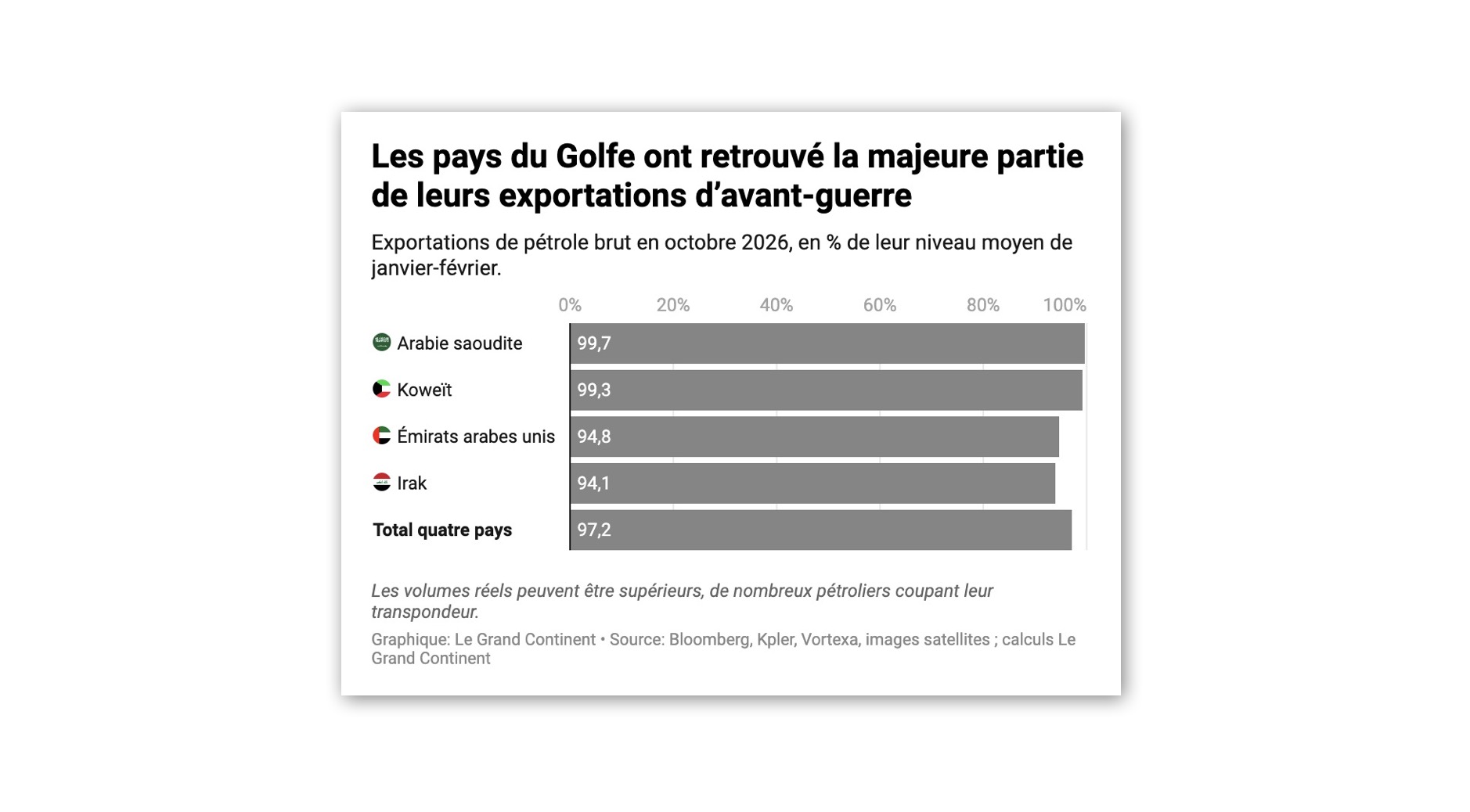
Despite the pressure exerted by the Islamic Revolutionary Guard Corps, oil flows from the main Gulf Arab producers rebounded in October to a level close to pre-war levels. Saudi Arabia and Kuwait thus exported more than 99% of the crude volumes they dispatched before the conflict, despite Tehran’s attacks.
- Indeed, Iran has stepped up strikes in recent weeks: in October, 35 ships were attacked according to UKMTO, more than in any month since the war began.
- Yesterday, Wednesday 4 November, the Islamic Revolutionary Guard Corps stated that four tankers had been destroyed south of the Strait of Hormuz after hitting sea mines, as they attempted to take a route that the Guards describe as forbidden.
According to CENTCOM, the U.S. military command that patrols the region and supports ship transit, the American armed forces have helped export more than 1.5 billion barrels of oil since this summer.
- In tandem with the American presence, exporters have resorted to shuttle tankers, which pass through the strait before transferring their cargoes to other vessels in the Gulf of Oman.
The inability of Tehran to maintain control over flows transiting through Hormuz also stems from a significant degradation of its capabilities. In recent weeks, Iran has used explosive-laden underwater drones, fired anti-tank rockets (RPGs), and deployed teams to affix limpet mines to ships.
- These means, described by the Institute for the Study of War as “suboptimal,” are less effective than the ballistic missiles and anti-ship cruise missiles and the drones used at the start of the war.
- Tehran has also lost a portion of its ability to monitor the traffic in the strait, notably because its coastal radars have been targeted several times by American strikes.
- The Guards today rely on small boats that observe and relay the positions of ships, while the American military continues to carry out undisclosed strikes, notably on Qeshm Island, located at the entrance to the strait, Monday 2 November.
Nevertheless, Tehran continues to benefit from Russian military aid: according to Western intelligence officials, the two countries have further strengthened their partnership since the start of the war. More than twenty Russian ships have in particular transported to Iran, via the Caspian Sea, cargoes including munitions, drone components, and TNT.