
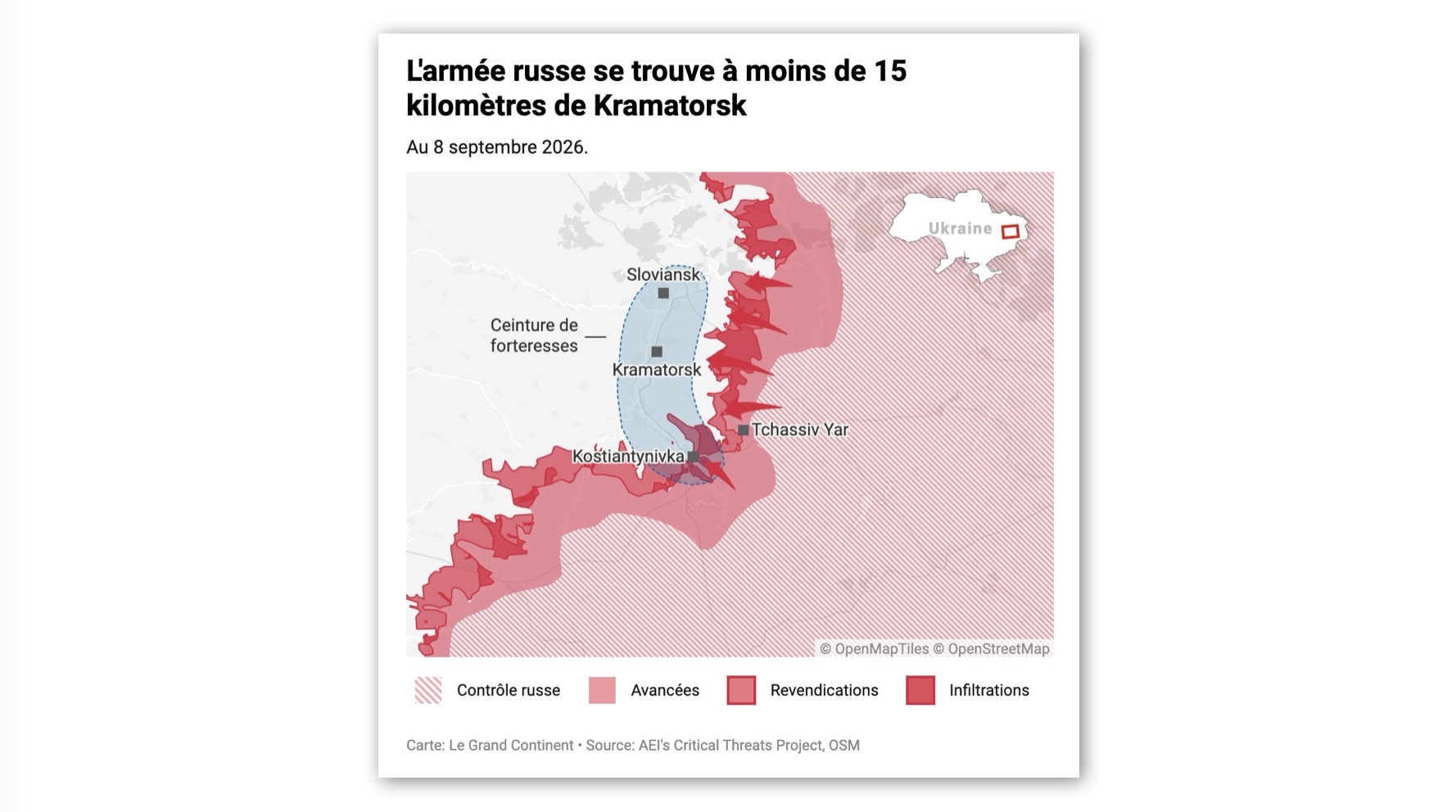
Several sources report, in recent days, the infiltration of a Russian reconnaissance-sabotage group (DRG) within less than two kilometers of the first houses in Kramatorsk, in the Donetsk region. The city sits, alongside Sloviansk and Kostiantynivka, in the so-called “fortress belt” that has allowed Kyiv to limit Russian advances in this area up to now.
- The nearly real-time maps that track front-line movements place the fighters at about 14 kilometers from the city, versus about 17 kilometers at the start of the year.
- If this slow pace of progress reflects Moscow’s difficulties in gaining ground in this sector of the front, the city is now within reach of Russian artillery and drones.
- In recent weeks, civilian casualties have multiplied. According to a resident, the ubiquity of drones forces Ukrainian soldiers, for whom the city had served as a rear base between deployments, to carry a weapon at all times.
The Kramatorsk sector is considered by many analysts to be the most important on the front for Kyiv. Unlike the south of the country, where the army managed to regain more than 700 square kilometers of territory from Russian forces in the first half of the year, the dynamic in this part of Donbas benefits Russia.
- The recent deterioration of the situation around Kramatorsk and Sloviansk led the Ukrainian command to quietly reinforce its positions there by sending, in early July, the 46th Airmobile Brigade.
- This unit, which spent several years fighting in southeastern Ukraine, took part in the counteroffensive launched in February – contributing, according to analyst David Axe, to stabilizing the front in a sector that had previously been highly sensitive for Kyiv.
Its deployment around Kramatorsk apparently does not portend a counteroffensive.
- Its role would rather be to safeguard the withdrawal of other units from the outskirts of Chasiv Yar, a town located about 20 kilometers southeast of Kramatorsk that is now almost entirely occupied by the Russian army.
The prospect of a slow but steady advance toward Kramatorsk could influence Putin’s refusal to enter peace negotiations with Ukraine. During Witkoff and Kushner’s visit to Moscow on Sunday, September 6, Putin reportedly argued to American emissaries that his army was making “tangible progress” on the front and that it would soon reach its “objectives,” according to his adviser Iouri Ouchakov.
Thus, two main factors seem to push Putin to refuse any agreement:
- The belief that a peace deemed unfavorable could threaten his grip on power – he is said to have told a close associate: “They will hang me,” referring to the Russian elites;
- And the belief in his army’s ability to gradually increase control over the Donbas, so that recognizing Russian control over the region would no longer, in the long run, be a bargaining point with Kyiv.
Cartographic data from Deep State, a group of Ukrainian analysts, suggests that it would take Moscow four to five years to capture all of Donetsk and Luhansk. For Kyiv, the risk is that a fall of Kramatorsk and Sloviansk, however slow – it took Moscow two years to seize Pokrovsk – could lead to an acceleration of the Russian advance northward.