
Throughout August, Grand Continent is publishing free access The Vocabulary of the Extreme Right , the product of the collective work of researchers — sociologists, historians, political scientists, sociolinguists — from across Europe under the direction of Steven Forti. To receive each lemma in your inbox and support the work of an independent editorial team, subscribe
On January 20, 2025, on his first day back at the White House, President Donald Trump signs a decree titled “Defend Women Against Gender Ideology Extremism and Restore Biological Truth within the Federal Government” .
The decree orders all federal agencies to remove any statement, policy, regulation, or communication deemed “promoting or inculcating gender ideology”, to replace every reference to gender identity with a strict binary classification based on biological sex, and to end any federal funding associated with what it defines as “the gender ideology”, defined as a movement that “replaces the biological category of sex with a fluid concept of self-identified gender” .
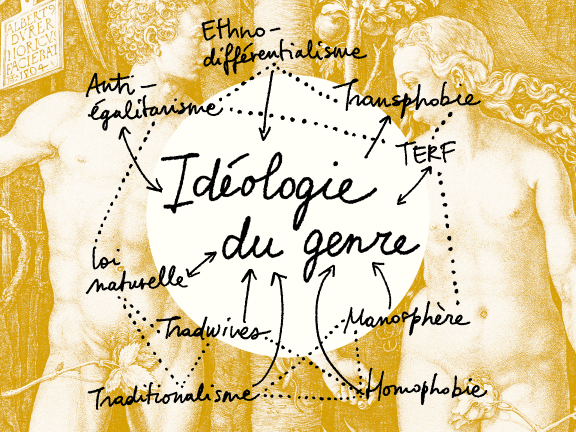
The expression “gender ideology” has etched itself into contemporary political vocabulary while maintaining a striking vagueness. It does not point to a precise field of study nor a clearly defined doctrine, but rests on the perception of threats to traditional models of masculinity and femininity. In other words, “gender ideology” functions less as an ideology and more as a flexible political label that can group a broad range of issues under a single banner: gender equality policies, feminist movements, LGBTQI+ rights, sex education, or gender studies. The definition of an antagonistic space without precision has today become one of the main levers of anti-gender discourses and mobilizations.
What Beijing Changed
At the end of the 20th century, especially in the 1980s and 1990s, feminist theory gained visibility in academic spaces as well as in public debate. Recognizing gender as an analytical category broadened the understanding of social dynamics beyond approaches that focused solely on women, long reduced to questions of biology or reproduction. The International Conference on Population and Development (ICPD) in Cairo (1994), which emphasized gender equality and reproductive rights, and the Fourth World Conference on Women in Beijing (1995), which outlined measures for women’s empowerment, mark decisive moments in this recognition.
As the United Nations notes, “the fundamental transformation that took place at Beijing was the adoption of a gender approach,” whereby it was acknowledged that “the entire structure of society, and all relations between men and women within that structure, needed to be reevaluated.”
From that moment, the concept of gender became institutionalized in international policy, linked to issues of rights and development. The term, initially academic, gradually penetrated political debates, legislation, advocacy policies, and more broadly public discourse.
As the concept of gender gained importance, opposition strengthened, notably among conservative and religious circles. It is clear that not all critique of gender studies or gender equality policies originates solely from the far right. Legitimate philosophical, religious, and scientific debates accompany them. It is precisely because the label “gender ideology” lacks rigor that very different discursive frames tend to be conflated and ultimately reduced to a common enemy.
In the wake of United Nations conferences, several groups mobilized against what they perceived as a challenge to traditional family structures and social norms.
The Catholic Church, particularly concerned by debates on gender and sexuality, became one of the main voices denouncing what it calls “gender ideology,” especially during the papacies of John Paul II (1978–2005) and Benedict XVI (2005–2013), which nonetheless saw advances in the Church’s stance on women’s rights. It presents gender equality policies and LGBTQI+ rights as an intrusion into the “natural order” God willed, and it actively seeks to delegitimize gender as a political and social category. It is no accident that these mobilizations have been strongest in countries where the Catholic Church retains significant social and political influence, such as Italy, Poland, Spain, or Croatia.
From Roman Anathema to the Secular Lexicon
At the end of the 1990s and the beginning of the 2000s, the phrase “gender ideology” becomes the central term of this conservative counter-offensive. In his testamentary book Memory and Identity, John Paul II explicitly positioned himself by labeling the pressures from the European Parliament in favor of recognizing same-sex unions, as well as adoption rights, among the new “illnesses of evil.” He suggested these ideologies, born after communism and Nazism, might be “perhaps more insidious and more hidden” because they seek to “exploit human rights against humanity and against the family itself.”
The genealogy of this notion thus runs through the orbit of the Holy See. As early as 1997, American Catholic essayist Dale O’Leary denounces an “agenda of gender” born, she says, from UN conferences. The Pontifical Council for the Family then dedicates, in 2003, a Lexicon on the “ambiguous and controversial” terms surrounding family and life, before a letter from the Congregation for the Doctrine of the Faith, signed in 2004 by Cardinal Joseph Ratzinger, reproaches the new approaches for minimizing “the bodily difference, called sex” in favor of the “purely cultural dimension, called gender.” This letter condenses the criticisms aimed at feminist theory, sexual and reproductive rights, and the early frameworks for recognizing LGBTQI+ rights. Far from remaining confined to theological registers, this critique was progressively translated into the language of public policy, mobilizing science, psychology, and child development as registers of legitimacy.
It was subsequently taken up by conservative movements, political parties, and think tanks in numerous countries, particularly in Europe and the Americas. In this usage, the term “gender ideology” functions as a euphemism naming opposition to progressive policies on equality and human rights.
The theological framing developed by the Catholic Church does not, however, by itself translate into political action, nor is it monolithic in itself. It is primarily through a network of American conservative organizations — such as the Alliance Defending Freedom (ADF), the Family Research Council, and the Heritage Foundation — that the critique of “gender ideology” is translated into legal and political language, reformulating a primarily theological objection into secular discourse invoking science, child protection, and parental rights.
The plasticity of the term is central to its diffusion. Depending on the context, it refers to sex education reforms, abortion policies, LGBTQI+ rights, or increasingly, the rights of transgender people. This elasticity makes it a reusable interpretive frame in varied institutional settings. More than a stabilized concept, it functions as a framing device that aggregates distinct domains — law, health, education, research — into a single explanatory category. Another essential feature is the construction of an epistemic opposition. Knowledge drawn from gender studies, sociology, or public health is set against “biology,” the “natural order,” or “common sense,” presented as neutral and self-evident forms of knowledge. It is less a scientific debate than a fight over the legitimacy of knowledge.
A Global Slogan
In the United States, this dynamic sits within the cultural and legal transformations of recent decades. Supreme Court rulings, notably Roe v. Wade (1973) on abortion, and later the legalization of same-sex marriage in Obergefell v. Hodges (2015), were seen by conservative circles as a threat to family order. From the 1990s onward, questions of gender entered the public debate, often denounced as forms of moral subversion. By the mid-2010s, numerous laws restricting transgender rights or limiting sex education proliferated, pushed by actors denouncing “gender ideology.” As a candidate seeking re-election, Donald Trump promised in October 2024 “historic action to defeat the toxic poison of gender ideology.” Returning to power, he made it a core axis of federal policy. The pledge to “defeat the toxic poison of gender ideology” was voiced at a campaign rally in October 2024. The United States thus functions as a space of translation and diffusion: a bridge between a religious matrix and political tools exportable to Europe and Latin America.
In Europe, the term gained visibility in debates on marriage and equal adoption rights and school curricula in the early 2000s. Education became a central flashpoint, with equality policies denounced as forms of indoctrination. In France, mobilizations against the 2013 law allowing same-sex marriage — notably La Manif pour tous — helped disseminate the idea of a “theory of gender” imposed on children. This led to the 2014 abandonment of the ABCD of Equality program, intended to combat gender stereotypes in schools, after a campaign of rumors, including the “days of school withdrawal” launched in January 2014, accusing schools of teaching what they called a “theory of gender” to children. These controversies continued, as illustrated by Éric Zemmour’s attacks on the Education Ministry’s circular on welcoming transgender students, deemed “criminal” in October 2021, then presented in January 2022 as “a promotion of transsexuality.”
Indeed, anti-gender mobilizations have frequently leaned on defending children, framed as a moral imperative to protect the most vulnerable from what they describe as ideological indoctrination. The transnational character of this rhetoric became particularly visible on June 12, 2022, when Giorgia Meloni, president of Fratelli d’Italia and future Italian prime minister, spoke at a Vox party rally in Marbella, a few days before the Andalusian regional elections. The event was a deliberate show of solidarity, illustrating the strengthening links between European far-right parties. True to her concise, punchy style that has become emblematic of Italian right-wing rhetoric, her intervention left no room for ambiguity: “Yes to the natural family, no to the LGBT lobby, yes to sexual identity, no to gender ideology.”
Among the most influential figures in defending traditional family values in Europe, Giorgia Meloni presents her opposition to “gender ideology” as a protection of women, children, and the natural order of the family. In this context, many organizations opposed to the “theory of gender” also maintain close ties with anti-abortion or “pro-life” movements. This convergence is notably illustrated by Hazte Oír, a Spanish anti-abortion organization that in 2017 became known for a bus proclaiming that “boys have a penis” and “girls have a vulva,” which launched in September 2019 a widely publicized campaign against indoctrination into the “ideology of gender” in schools under the progressive government of Pedro Sánchez. Its slogan, “Mis hijos, mi decisión” (“My children, my decision”), sums up the parental rights rhetoric that structures these mobilizations.
In Hungary, Viktor Orbán’s government had already signaled a stance in October 2018 by stripping universities of the authority to grant gender studies degrees, arguing that it was “an ideology, not a science.” In July 2021, defending his so-called child-protection law, Orbán asserted that Hungary would not permit LGBT activists in schools . The constitutional reforms pursued by his government then enshrined in law a strictly binary and biological concept of family and gender. The December 2020 constitutional amendment, which states that “the mother is a woman, the father is a man,” shows how political rhetoric can translate into legal norms. Three years later, the tone hardened further. At the Conservative Political Action Conference (CPAC) held in Budapest in May 2023, Orbán drew a direct parallel with Cold War foes, declaring that “the woke movement and gender ideology are exactly what communism and Marxism used to be.” In Poland, controversies surrounding LGBTQI+ rights and sexuality education followed a similar trajectory. They were interpreted through the lens of the fight against “gender ideology,” closely tied to nationalist narratives and the defense of cultural sovereignty. This sequence culminated in February 2019 when Warsaw’s mayor Rafał Trzaskowski signed an “LGBT+ Declaration” supporting LGBTQI+ rights and decided to integrate these issues into sexuality education programs according to the World Health Organization’s recommendations. The ruling conservative party, Law and Justice, denounced it as a threat to Polish children and family values. Following this, hundreds of municipalities and regions proclaimed themselves “LGBT-free zones” (LGBT-free zones). Beyond the Polish case, anti-gender mobilizations typically rely on denouncing “gender ideology” as a foreign, externally imposed ideology, while the European Union and international organizations are accused of meddling in national affairs and undermining state sovereignty.
Donald Trump is not the only head of state to have made the fight against “gender ideology” a central theme of his inaugural address. On January 1, 2019, before Brazil’s National Congress, Jair Bolsonaro began his term by pledging to “valorize the family, respect religions and our Judeo-Christian tradition, fight gender ideology while preserving our values,” adding that “Brazil will become a country free from ideological constraints”. In Latin America, the notion of ideología de género has become a major lever in electoral campaigns and referenda. In Brazil, opposition has largely crystallized around school programs, presented as a threat to children and to family values. Similar dynamics were observed in Colombia during the 2016 peace accords referendum, where misinformation campaigns falsely claimed that certain provisions introduced a “gender ideology” into educational policies. Across the region, religious organizations — Catholic as well as evangelical — played a decisive role in disseminating these narratives, often in alliance with conservative political actors.
The intensification of anti-gender campaigns in the latter half of the 2010s is not a matter of chance. This period coincided with the resurgence of a new wave of feminism, marked by mass mobilizations in Spain and many other European and non-European countries, as well as feminist strikes in Poland or Argentina around abortion rights and the fight against violence toward women, and the global eruption of the #MeToo movement in late 2017. In return, these mobilizations fed a conservative counter-offensive that gradually made “gender ideology” one of its principal revulsives.
Trans Rights, the New Battlefield
Since the mid-2010s, the rights of transgender people have progressively become the main battlefield in discourses on “gender ideology.” Unlike earlier controversies focused on same-sex marriage, transgender identities more directly challenge the biological conception of sex and gender, undermining what anti-gender movements have long claimed as natural truths. The growing visibility of transgender people in the media and public space, notably through figures like Caitlyn Jenner or Laverne Cox, has helped elevate these questions to a major political issue. The controversies surrounding them sometimes touch real questions that spark debate even within medical institutions, while fueling the intensity of the conservative reaction that seeks to subsume them into a single narrative of civilizational subversion.
As transgender rights progressed, the rhetoric of “gender ideology” reorganized around this new target. Conservative organizations now frame the recognition of gender identity as a threat to social order, arguing that it challenges the very foundations of gender difference. Legal recognition of gender transition, access to transition-related care, transgender participation in sports, and their inclusion in public institutions are thus regularly denounced as expressions of “gender ideology.” In the United States, several states have enacted or attempted to enact laws restricting transgender rights, notably in areas of healthcare access or participation in sports. “Bathroom bills,” which tie access to public restrooms to birth sex rather than gender identity, stand as among the most emblematic examples, such as North Carolina’s HB2 enacted in March 2016. At the federal level, Trump had already targeted transgender people during his first term, prohibiting them from serving in the armed forces in July 2017.
This evolution has also sparked tensions within feminist and progressive movements, particularly around questions of sex, gender, and legal classifications. Some feminists — often labeled TERF (Trans-Exclusionary Radical Feminists) by their critics — argue that including transgender women in spaces reserved for women undermines the rights of cisgender women. The controversies surrounding the opening ceremony of the 2024 Summer Olympics, accused by some conservative and religious circles of promoting a progressive view of gender and sexuality, also revived debates on the participation of transgender people in women’s competitions. During the boxing tournament, Algerian boxer Imane Khelif and Taiwanese Lin Yu-ting faced a broad misinformation campaign that wrongly portrayed them as transgender or intersex; neither identifies as transgender, but their cases were nevertheless weaponized to fuel a broader debate about the place of transgender people in women’s sports.
Today, the expression “gender ideology” has become a catch-all formula, mobilized to unite opposition to contemporary evolutions in conceptions of gender and sexuality. It functions as a rallying cry for conservative movements, which present advances in gender equality as threats to traditional values, or even to Western civilization itself. This rhetoric thus reduces complex questions — identities, rights, lived experiences, equality — to a single, homogenized category with a negative connotation. Yet its importance extends beyond discursive space. By designating a common enemy, the notion of “gender ideology” yields tangible political effects. Far from a mere slogan, this rhetoric can reshape public policies and the living conditions of the people it targets.