
Yesterday, Wednesday, August 19, Merck and Moderna (M&M) announced that the phase III results of their new melanoma therapy, the duo intismeran and Keytruda, widely described as having been “designed with AI,” met their primary objectives — the final crucial milestone before market launch.
- Merck and Moderna’s treatment is not, strictly speaking, a drug designated by AI. It is rather a complex therapy that includes, yes, an essential share of artificial intelligence.
- It is first and foremost the combination of two medicines: a “personalized cancer vaccine” developed in part with the help of artificial intelligence, and Keytruda (or pembrolizumab), an immunotherapy stemming from the work of the 2018 Nobel Prize winners James P. Allison and Tasuku Honjo, and marketed since 2014.
- Allison and Honjo conducted their work on how cancer cells inhibit the immune system, at the heart of this treatment, in a context where AI was almost absent. The development of Keytruda likewise proceeded almost without assistance from artificial intelligence.
- The “personalized cancer vaccine” rests on scientific foundations laid in 2012 by Robert Schreiber. It was theorized in 2015, and received a proof of concept in 2017 by Catherine Wu and Ugur Sahin, the founder and CEO of BioNTech, the company behind the first mRNA-based vaccine against SARS-CoV-2.
- While BioNTech did not originate the intismeran + Keytruda combo, Sahin played a pivotal role in the scientific proof of concept for this treatment.
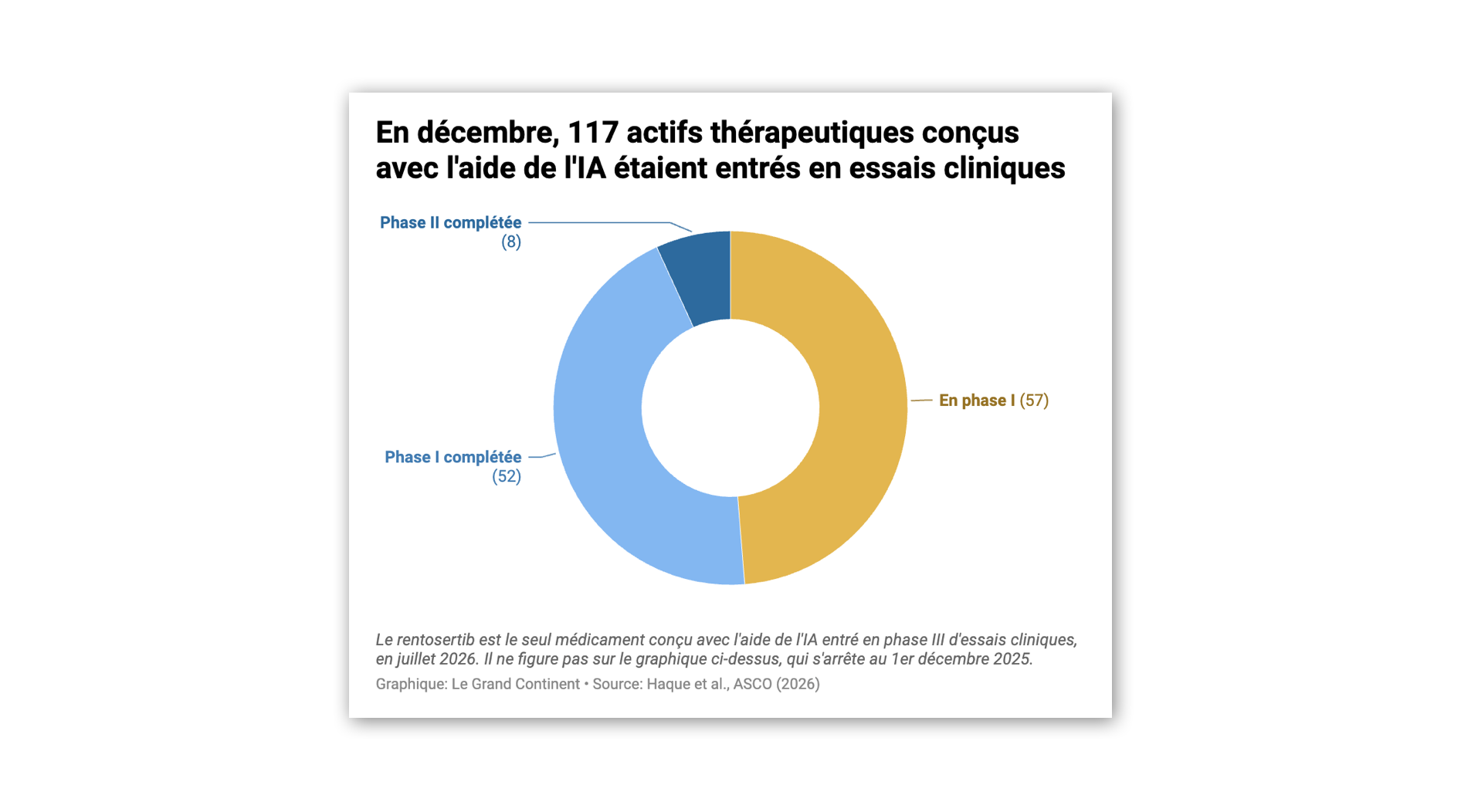
Unlike rentosertib (INS018_055, a TNIK inhibitor) – where AI was asked to name a molecule against idiopathic pulmonary fibrosis, and where it proposed an entirely new one on its own – Merck and Moderna’s treatment combines a drug marketed before the advent of ChatGPT with a therapy whose proof of concept is also older: both have therefore already demonstrated their effectiveness “almost” without AI.
- This “almost”, however, warrants nuance: one could indeed debate what constitutes AI, and many long-used algorithmic computational tools in biomedical research could, in some respects, approach certain definitions of AI.
- The sequencing of the human genome, at the turn of the millennium — the foundation of everything this therapy relies on — was notably made possible by work that pushed the computational power to its limits at the time.
- If Keytruda has been on the market since 2014, and the “personalized cancer vaccine” had a proof of concept in 2017, what then is the role of AI?
The answer lies in three words: “scale up” to make a very heavy, costly, and labor-intensive treatment accessible to the widest possible patient base. To simplify, here is the concept of the treatment:
- First, a biopsy is performed, a sample of biological material taken from the patient’s tumor;
- Next, all genetic mutations present in the tumor are mapped, notably thanks to the work of the Human Genome Project;
- Those mutations are analyzed in detail to select the 34 most likely to provoke an immune response, in the same way as for the SARS-CoV-2 vaccine where the spike (S) protein on the virus surface was targeted;
- An mRNA vaccine is developed that briefly expresses proteins incorporating these mutations, to provoke an immune response against them. This expression is purely transient: these proteins are not expressed after 72 hours, and there is no integration into the genome — since the mRNA sits downstream of the DNA, it cannot physically integrate. Just as a vaccine against a virus introduces the virus’s proteins to elicit an immune response against them, this cancer vaccine introduces proteins carrying the mutations already present in the patient’s tumor;
- The patient is then injected with a combination of this vaccine, and in a second step, with Keytruda. When the immune system has mounted a targeted response against the cancer, this attack is reinforced by Keytruda, which blocks the cancer cells’ ability to dampen the immune system.
Paradoxically, these mutations could theoretically be analyzed without AI, but it would be so lengthy and costly that treating patients this way would not be viable.
- The role of AI is to analyze the astronomical amount of genomic data coming from the patient biopsy, containing all the mutations present in the tumor.
- It analyzes them extremely quickly, through a method that is relatively well understood, controlled, and rational — we seem to be moving away from a black box, the choices made by AI being rationalizable based on well-known and documented bio-immunological phenomena — to determine which mutations will constitute “the best targets” for the immune system.
These are the mutations that will be incorporated into the mRNA vaccine.
- This AI was trained on real biological data from clinical research, the collection of which required substantial resources.
- The AI’s role is precisely to no longer require repeating this tedious collection for every patient, which lowers both the cost and the duration of treatment.
- So, AI was not needed to design and develop this treatment, but it is needed to make it deliverable at scale and economically viable.
Merck and Moderna’s therapy, the intismeran + Keytruda duo, is therefore not “the first AI-designated drug to succeed a phase III clinical trial.” It is, however, a therapy scaled up and made viable and accessible thanks to AI — a proof of concept of AI’s role in medicine, not in the design of molecules or invention of treatments, but in acceleration and automation.
- The press release indicates that at this stage, it seems relatively certain that their treatment will pass phase III clinical trials: it has outperformed the current standard of care, Keytruda alone, with statistical significance.
- We therefore know that the “intismeran + Keytruda” duo is better, but by how much remains to be seen.
- Given the large size of this trial — around 1,000 patients — the treatment could show a statistically significant improvement, without that benefit being large enough to justify the cost.
Even with AI to speed things up and cut costs, intismeran will likely cost several hundred thousand dollars per year, in addition to Keytruda’s $150,000 per year. It remains to be seen whether the U.S. government will determine that this statistically significant benefit justifies the higher price.