
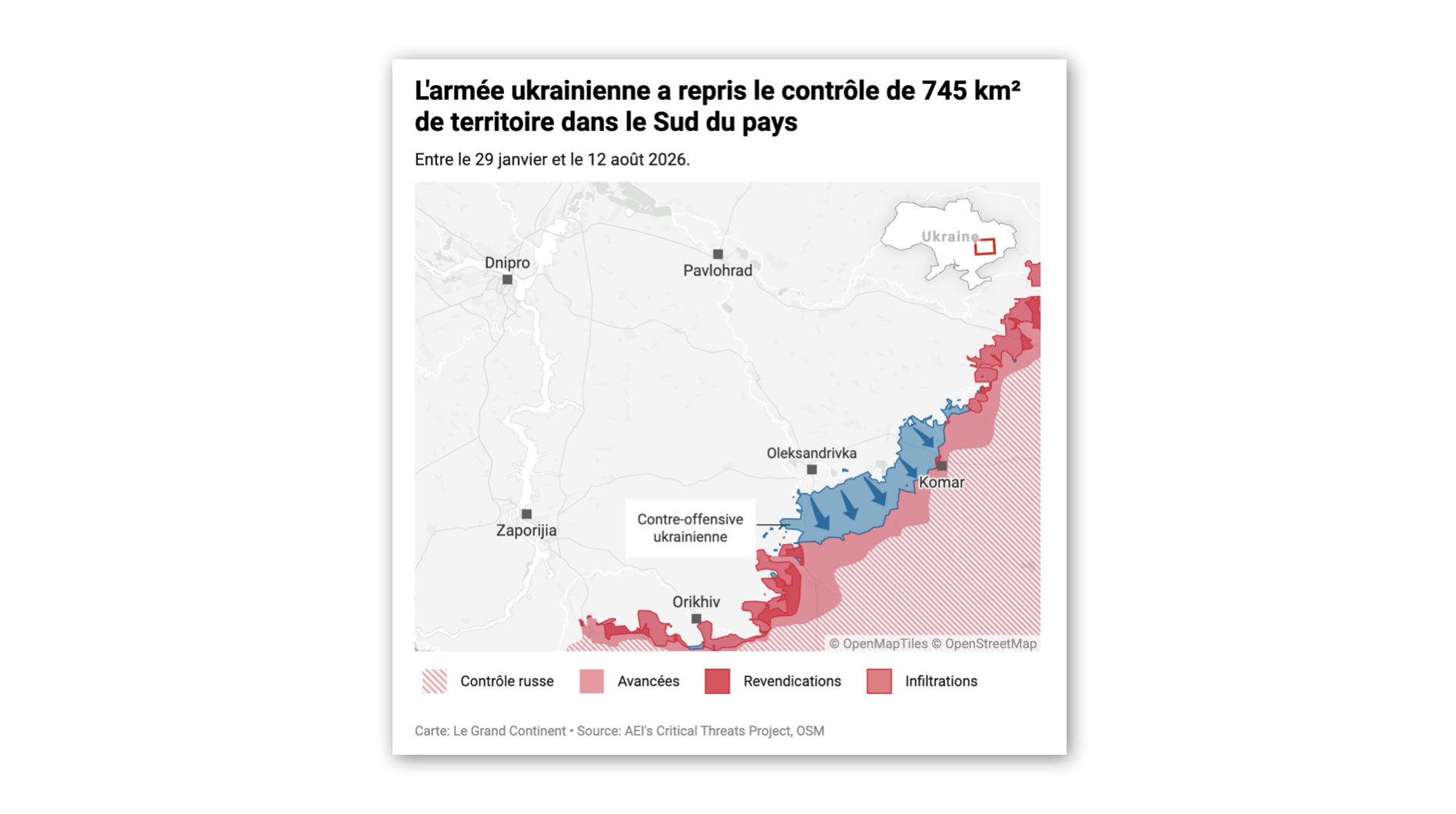
Last week, Ukrainian President Volodymyr Zelensky announced that the army had regained control of 745 square kilometers of territory occupied by Russia and freed 26 villages in the Dnipropetrovsk, Donetsk and Zaporizhzhia regions in the south of the country. The operation had been launched in late January, as the Russian army advanced toward the municipality of Oleksandrivka, and it concluded on August 12.
- The Institute for the Study of War (ISW), while confirming most of Ukraine’s claims on the basis of geolocated images and videos, says the extent of the area is slightly smaller, representing about 627 square kilometers.
- This figure, which corresponds to the largest Ukrainian advance in three years, is equivalent to nearly all territory captured by the Russian army in Ukraine during the first seven months of the year (806 square kilometers).
- On average, the Ukrainian army would thus have retaken around 100 square kilometers per month, a pace that the Russian army has not been able to match since April.
The launch of the operation coincided with the subsequent disconnection, a few days later, of Starlink terminals illegally used by the Russian army, which greatly degraded its communications capabilities. The success of the counteroffensive was also made possible by the deep strikes against logistics networks, the superiority of Ukrainian drones, and better operational planning.
The relative secrecy surrounding the campaign could also have played in Kiev’s favor.
- Since February 2022, social networks and Telegram channels have been saturated with front-line videos documenting almost in real time the fighting, from large mechanized maneuvers to assaults involving a handful of fighters.
- Yet, the counteroffensive that has just ended in the Oleksandrivka sector received only a limited number of leaks, both from Ukraine, which sought to avoid drawing attention, and from Russia, which sought to mask the deterioration of the situation.
- A few hours after Kiev announced the end of the campaign, the Ukrainian analyst group DeepState, close to the Ministry of Defense, confirmed in bloc the recapture by Kiev of 19 villages, rather than reporting, as the operations unfolded, the actual progress of Ukrainian forces.
It is not clear at this stage whether the counteroffensive was planned in advance as a large-scale operation to reclaim a broad area, or whether it gradually evolved by taking advantage of weaknesses in Russian defenses in certain sectors. According to military analyst Mick Ryan: “it is probably a combination of the two.”
- The Oleksandrivka campaign is nonetheless rich in lessons for Kiev: it shows that the army remains capable of conducting mechanized offensive operations by exploiting gaps in the Russian setup and by putting into practice new tactics.
- However, it seems unlikely that the command will be able to repeat in the short or medium term an operation of similar scale. The extent of Ukrainian material and human losses remains to be determined.