
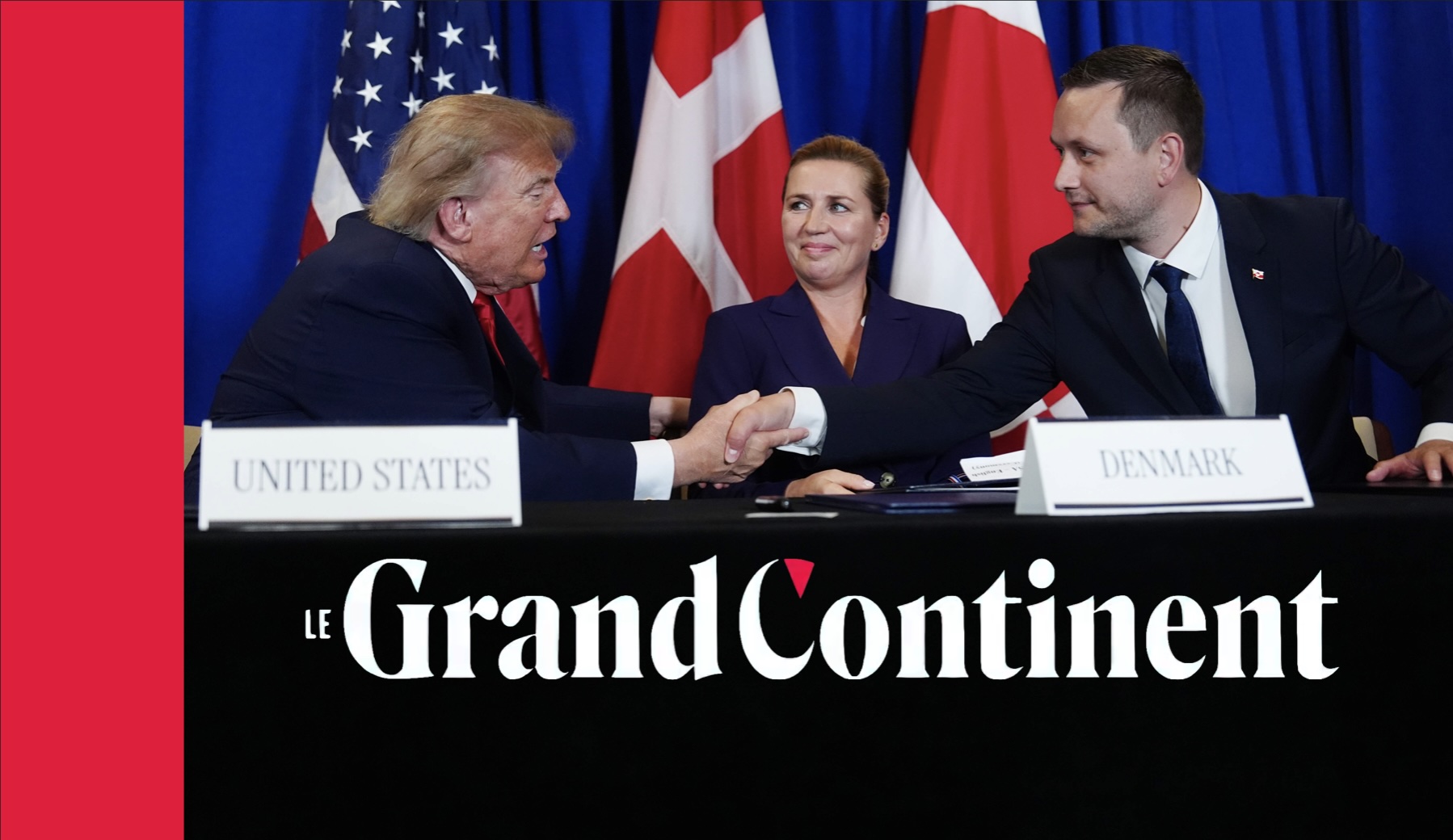
The United States, Denmark, and Greenland today signed, on Tuesday, September 22, on the margins of the United Nations General Assembly, an agreement that is expected to put an end to nearly two years of threats voiced by the American president regarding the Arctic territory.
Published on the White House website with a lengthy title entirely in uppercase, it is likely to feed into Donald Trump’s dramatic diplomatic strategy, yet it marks a substantial victory in the power balance between Denmark and the European Union, with strong backing from France.
Donald Trump had already announced on September 18 the closing of an agreement. This follows several secret trilateral meetings held in Washington since January, during which the Republican administration put forward a number of demands aimed at establishing its sovereignty over the island.
The signed agreement recognizes the sovereignty and territorial integrity of the Kingdom of Denmark and is expected to continue to apply even if Greenland becomes independent.
It affords the United States expanded military access to the island, which was already contemplated under the 1951 agreement. Trump has already announced the construction of two new bases. The agreement also explicitly mentions the “Golden Dome” project, the American anti-missile shield inspired by the Israeli dome, and it acknowledges full freedom for the parties to take any measures deemed necessary for Greenland to defend the North Atlantic Treaty Organization area. The agreement can only be amended by mutual consent of the parties.
In the event of Greenland’s independence, the Greenland government and Denmark must ensure that the new state remains within NATO, including by seeking membership. The agreement furthermore calls for enhanced alliance engagement in the region in the areas of planning, intelligence, and exercises.
The economic component of the agreement is quite limited, even though the White House had since January advocated for strengthening its “cooperation” with Greenland in the realm of natural resources, in order to exploit deposits of oil, uranium, rare earths, and other strategic minerals on the island. The document ultimately mentions only a single reference to “mining cooperation,” with no binding clauses attached.
The most substantive element of the agreement on the economic front concerns foreign investments. It excludes any country that is not a member of NATO or the European Union from exercising control, “significant influence,” or access to non-public information “that could pose a threat to national security or public order in the context of sectors or activities deemed particularly sensitive, described in the agreement as relating notably to critical infrastructure and resource extraction on Greenland’s territory.” This clause is expected to curb Chinese and Russian investments on the island.
Several aides close to the President have already floated ideas of constructing new towns in Greenland or installing data centers.
The agreement will enter into force once the necessary parliamentary procedures are completed in Denmark and in Greenland.
It helps to put an end to a persistent source of tension within NATO and offers Trump, at a moment when the war in Iran continues and the situation around the Strait of Hormuz worsens, a diplomatic victory.
Having claimed American sovereignty over the island and even threatened to deploy military force, the American president is content with an agreement that could have been easily achieved through diplomatic talks. It, however, exists within the framework of a considerably weakened Atlantic alliance.
AGREEMENT BETWEEN THE GOVERNMENT OF THE UNITED STATES OF AMERICA AND THE GOVERNMENT OF THE KINGDOM OF DENMARK, IN COLLABORATION WITH THE GOVERNMENT OF GREENLAND, TO AMEND AND SUPPLEMENT THE APRIL 27, 1951 AGREEMENT CONCLUDED UNDER THE NORTH ATLANTIC TREATY BETWEEN THE GOVERNMENT OF THE UNITED STATES OF AMERICA AND THE GOVERNMENT OF THE KINGDOM OF DENMARK CONCERNING THE DEFENSE OF GREENLAND (1951 DEFENSE AGREEMENT), INCLUDING ALL RELEVANT SUBSEQUENT AGREEMENTS THEREUNDER
Preamble
The Government of the United States of America (hereinafter referred to as “the United States”) and the Government of the Kingdom of Denmark (hereinafter referred to as “the Kingdom of Denmark”), together with the Government of Greenland (hereinafter referred to as “Greenland”), hereinafter collectively referred to as “the Parties” and individually as “a Party”;
Respecting the rights and obligations arising from the North Atlantic Treaty of 1949, and considering that Greenland, through the Kingdom of Denmark, has been a member of NATO for that period;
Recalling the long history of cooperation among the Parties, based on their deep respect for democracy, human rights, and the rule of law, as well as the more than eighty years of close defense cooperation that have contributed to strengthening the security and stability of the United States, Greenland, and the broader area covered by NATO;
Reaffirming the sovereignty and territorial integrity of the Kingdom of Denmark, and recognizing that the people of Greenland constitute a people under international law with the right to self-determination;
Noting that Greenland’s independence process is defined in Article 21 of Law No. 473 of June 12, 2009, on Greenlandic autonomy;
Recognizing the parties’ respective obligations and commitments under international law as well as under domestic legal frameworks, including all existing agreements among the Parties;
Recognizing the need to protect Greenland’s pristine environment and reaffirming Article VI on environmental protection from the 1991 Protocol, as well as the 2004 joint statement;
Recognizing the economic, social and cultural rights of the Greenlandic people, notably with regard to their lands and way of life, including hunting, fishing and other traditional, cultural, historic, and future activities and developments;
Considering that defense arrangements have contributed to stability and welfare in the NATO arena by uniting the Parties’ efforts at collective defense, while preserving peace and security and strengthening their collective capacity to resist armed attack;
Recognizing the indispensable historical and ongoing contributions of the United States to the security and defense of Greenland and the rest of the NATO region, including considerable sacrifices and billions of dollars spent for nearly a century, from before World War II and NATO’s creation, and the irreplaceable role of the American armed forces in the defense of Greenland’s territory, now and in the future;
Taking note of the reopening of the United States Consulate in Nuuk and of the United States’ contributions to cooperation and reciprocal exchanges in scientific and educational spheres, in mining cooperation, in economic development and business promotion, and in cultural and local partnerships with Greenland;
Also recognizing Greenland’s contribution to the Parties’ mutual security interests and the sharing of risks and responsibilities that results therefrom, as well as the Parties’ commitment to continued close NATO cooperation to ensure North Atlantic security, as provided by the Igaliku Agreement of 2004;
Recognizing Arctic security challenges and the High North posed by increasing military activity by adversaries and their growing strategic interest in the region;
Recognizing the Parties’ shared objective of international peace and peaceful coexistence, and acknowledging Greenland’s important contribution to that objective;
Reaffirming the Parties’ common goal of maximizing the real, tangible, and substantial benefits that defenced zones bring to Greenland’s population;
Noting that the security situation in the Arctic is evolving and that further efforts are needed to ensure its safety in the future;
Recognizing the Parties’ shared interest in enabling the United States to have military access to Greenland’s territory to the extent necessary to defend the NATO zone, Greenland, and the American continent, including through the establishment of a “Golden Dome” defense system; and
Desiring to further amend and supplement the defense agreements to strengthen and render permanent their character,
Conclude by the following:
I.
Objectives
The present agreement, which amends and supplements the defense accords, aims to enable the Parties to take all necessary or appropriate measures to promptly fulfill their respective and joint responsibilities in Greenland, including to defend the NATO area, Greenland, and the American continent, while honoring Greenland’s societal interests and bringing tangible benefits to its people.
II.
Engagement of NATO
The Parties support an enhanced NATO involvement in the Arctic, notably in planning, presence, exercises, and the joint collection of intelligence.
III.
Definitions
For the purposes of this Agreement:
“North Atlantic Treaty” refers to the North Atlantic Treaty signed in Washington on April 4, 1949.
“1951 Defense Agreement” refers to the Agreement under the North Atlantic Treaty between the United States and the Kingdom of Denmark concerning the defense of Greenland, signed in Copenhagen on April 27, 1951.
“1991 Memorandum of Understanding” refers to the memorandum between the United States and the Kingdom of Denmark, including the Government of Greenland, concerning the use of the Sondrestrom air base, the Kulusuk airstrip and other matters related to U.S. military activities in Greenland, signed in Copenhagen on March 13, 1991.
“2004 Igaliku Agreement” refers to the agreement between the United States and the Kingdom of Denmark, including the Government of Greenland, to amend and supplement the 1951 defense agreement, as well as relevant subsequent agreements related thereto, signed in Igaliku on August 6, 2004.
The term “2004 Joint Declaration” means the Joint Declaration on environmental cooperation in Greenland among the Parties, published on August 6, 2004 at Igaliku.
The term “2020 Diplomatic Notes” means the exchange of diplomatic notes between the United States and the Kingdom of Denmark concerning procurement, dated October 27, 2020.
The term “defense zone” means a portion of Greenland where the United States establishes and/or operates a military base in accordance with the defense accords.
The term “defense accords” means the 1951 Defense Agreement, as well as the modifying and supplementary agreements and related non-binding arrangements listed in Annex 1.
The term “Greenland Autonomy Act” means Law No. 473 of June 12, 2009 concerning Greenland’s autonomy.
The term “Permanent Committee” means the committee established under the 1991 Memorandum of Understanding to facilitate consultation and information exchange on matters relating to the presence of the United States military in Greenland.
The term “particularly sensitive sectors” means sectors or activities deemed particularly sensitive, including, but not limited to, critical infrastructure and resource extraction.
The term “territorial waters” means Greenland’s territorial waters as defined by Danish national law consistent with international law of the sea as reflected in the United Nations Convention on the Law of the Sea.
IV.
Defense Zones
The Parties shall fully utilize the procedures set out in the defense accords, notably the 1951 Defense Agreement and the 2004 Igaliku Agreement, as amended and supplemented by the present instrument, to enable the following:
i. The United States shall be authorized to modernize and expand its activities at the Pituffik Space Base;
ii. The United States shall be authorized to establish an additional defense zone at Narsarsuaq and at Mestersvig, in accordance with terms and technical details to be mutually agreed by the Parties;
iii. The United States may establish additional defense zones in Greenland and strengthen its operations or facilities. Each Party may identify the need for a new defense zone to defend the NATO area, Greenland, and the American continent. That Party shall submit a proposal describing the location, scope, size, and types of activities of the proposed defense zone, as well as other modalities such as mitigation measures, including those necessary to reflect the 1991 Memorandum of Understanding and the 2004 Joint Declaration. The Parties shall immediately convene consultations within the Permanent Committee to decide on mutually agreed implementation modalities. If no agreement is reached within 90 days in the Permanent Committee, consultations shall move to the deputy ministers’ level, then to ministers;
iv. The United States shall, to the greatest extent possible, award all contracts with private sector firms for goods and services related to the creation, maintenance, and upkeep — including, but not limited to, construction and decommissioning projects — of defense zones in Greenland to Greenlandic contractors, taking into account their capacity and feasibility to perform the contracts. To ensure the awarding of contracts to Greenlandic providers, the Parties agree to update the 2020 diplomatic notes accordingly.
V.
Unstaffed Military Installations
The Kingdom of Denmark, jointly with Greenland, shall consider requests to establish unstaffed military installations in Greenland outside defense zones, under accelerated government approval procedures. The request must include a proposal describing the location, scope, size and type of activities of the envisaged unstaffed installation, as well as other modalities such as mitigation measures, including those necessary to reflect the 1991 Memorandum of Understanding and the 2004 Joint Declaration. Article IV, paragraph iv), of this Agreement applies to the establishment, upkeep and maintenance of such unstaffed military installations.
VI.
Access, Parking, and Overflight by United States Armed Forces
Regarding the access of the United States to the rest of Greenland’s territory (including its territorial waters), the following provisions apply:
- To ensure the safe and efficient operation of defense zones, the United States shall enjoy the right of free passage and free movement for its public ships and aircraft, as well as for its armed forces and vehicles, between defense zones traversing Greenland, including territorial waters, by land, air, and sea. This may also apply to unstaffed military installations, subject to an agreement between the Parties on modalities at the time of their establishment;
- U.S. aircraft may overfly and land on any Greenland territory, including within its territorial waters, and U.S. public ships may access territorial waters by submarine and maneuver within them, without restriction, unless otherwise agreed between the Parties;
- U.S. public ships shall be granted additional access to territorial waters and freedom of navigation within them, to the extent that the Parties agree, at any time, that the military circumstances require such access for the defense of the NATO area, Greenland, and the American continent, or for other purposes agreed by the Parties.
These rights shall be exercised in a manner that, as far as possible, respects Greenlandic society and the Greenlandic way of life, including hunting, fishing, and other traditional, cultural, historic, and future activities.
The implementation of this Article shall be subject to regular review within the Permanent Committee.
VII.
Defense Zone Security and Counter-Espionage
The Parties agree that territory adjacent to a defense zone should not be used in a way that threatens the defense zone’s security. To implement this requirement, the Parties shall cooperate to ensure the security of defense zones. The United States shall have the right to raise concerns about the construction or reallocation of any building, facility, or installation near a defense zone that could threaten the zone. Upon receipt of such notice, the Parties shall determine by mutual agreement what measures may be necessary to address the threat.
The Parties will cooperate to counter espionage in Greenland. Danish authorities shall maintain close contact with competent U.S. authorities and other partners as needed to implement this Article.
VIII.
Denmark’s Defense Posture
Denmark has strengthened and will continue to strengthen its Arctic security posture through a comprehensive, multi-domain approach encompassing land, sea, air, and space capabilities. Through enhanced presence, improved surveillance, and increased cooperation and interoperability with NATO allies, Denmark will continue to confront emerging threats and contribute to regional stability and collective security in the Arctic.
IX.
Establishment of Military Installations by Third States, with or without Personnel
No state that is not a member of NATO shall be permitted to establish its own military installations, with or without personnel, in Greenland, or to maintain a permanent military presence there, except as otherwise agreed by the Parties.
X.
Foreign Direct Investments and Other Activities
Given the national security and public order threats posed by heightened efforts by adversaries to extend their influence and control in Greenland, the Parties agree that States or investors from a state that is neither an NATO member, nor an NATO partner, nor an EU member shall not be allowed to (i) exercise control, (ii) exert significant influence, or (iii) access non-public information that could threaten national security or public order within Greenland’s territory (including its territorial waters) in the context of particularly sensitive sectors or activities, unless the Parties agree that such activities would not pose a threat to national security or public order.
This objective shall be secured by Greenland in close cooperation with Danish authorities under the application of any current or future law relating to investment controls.
The competent Danish authorities shall conduct close consultations with U.S. authorities and other partners. The specific modalities of this close consultation shall be determined by the competent authorities.
XI.
Permanent Nature of this Agreement
This Agreement has no expiration date and may be amended only by mutual consent, in accordance with Article XIII of the 1951 Defense Agreement.
Should Greenland exercise its right to self-determination to become independent, the Government of the Kingdom of Denmark and the Government of Greenland shall ensure that the independent Greenlandic state (i) remains within NATO, including by seeking membership if necessary, and (ii) expressly assumes, as of the date of its independence, all rights and obligations of the Kingdom of Denmark specified in this Agreement, including any implementing agreements among the Parties, as well as the defense accords.
XII.
Entry into Force
The present Agreement shall enter into force on the date of the diplomatic note informing the United States of the completion by the Kingdom of Denmark and Greenland of the necessary parliamentary procedures.
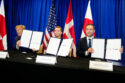
Done in New York, on September 22, 2026, in three originals, in the English, Danish, and Greenlandic languages. In the event of any ambiguity or inconsistency between the versions, the English text shall prevail.
Annex 1
The core defense arrangement documents include, inter alia:
Main Agreement:
- Agreement of April 27, 1951 between the Government of the United States of America and the Government of the Kingdom of Denmark, concluded under the North Atlantic Treaty, concerning the defense of Greenland
Additional and related non-binding arrangements:
- Exchange of Notes of May 31, 1968 between the Government of the United States of America and the Kingdom of Denmark complementing the April 27, 1951 agreement.
- Memorandum of Understanding of March 13, 1991 between the Government of the United States of America and the Government of the Kingdom of Denmark (including the Government of Greenland) concerning the use of the Sondrestrøm air base, the Kulusuk airstrip, and other questions related to U.S. military activities in Greenland
- Memorandum of Understanding of February 20, 2003 between the Government of the United States of America and the Government of the Kingdom of Denmark (including the Government of Greenland) concerning the Dundas area
- Agreement of August 6, 2004 between the Government of the United States of America and the Government of the Kingdom of Denmark, including the Government of Greenland, aimed at modifying and supplementing the 1951 agreement, as well as the relevant subsequent agreements related thereto
- Joint Declaration of August 6, 2004 between the Government of the United States of America and the Government of the Kingdom of Denmark, including the Government of Greenland, on economic and technical cooperation
- Joint Declaration of August 6, 2004 between the United States and the Kingdom of Denmark, including the Government of Greenland, on environmental cooperation in Greenland
- Joint Declaration of October 28, 2020 on strengthening cooperation in Greenland; exchange of notes of October 27, 2020; and the United States–Greenland Joint Cooperation Plan in support of our Pituffik (Thule Air Base) agreement, signed on October 28, 2020
Relevant NATO agreements:
- The North Atlantic Treaty of April 4, 1949
- Agreement of June 19, 1951 between the Parties to the North Atlantic Treaty regarding the status of their forces (the NATO SOFA)