
Based on over 95% of ballots tallied, the Russian Central Election Commission announced on Monday, September 21, preliminary results showing a victory for United Russia in the parliamentary elections held from September 18 to 20. The ruling party would secure 57.8% of the vote, with turnout estimated at 59.3%.
The party of Vladimir Putin would thus claim the largest number of seats in the Federal Assembly’s lower house in its history.
- United Russia is expected to gain 31 seats in the State Duma, the lower chamber, rising from 324 after the 2021 elections to 355 and securing 208 of the 225 seats in single-member districts, each electing one deputy through a plurality vote. The remaining half of the Duma’s seats are allocated through proportional representation.
- 301 seats are needed in the Duma to achieve a constitutional majority.
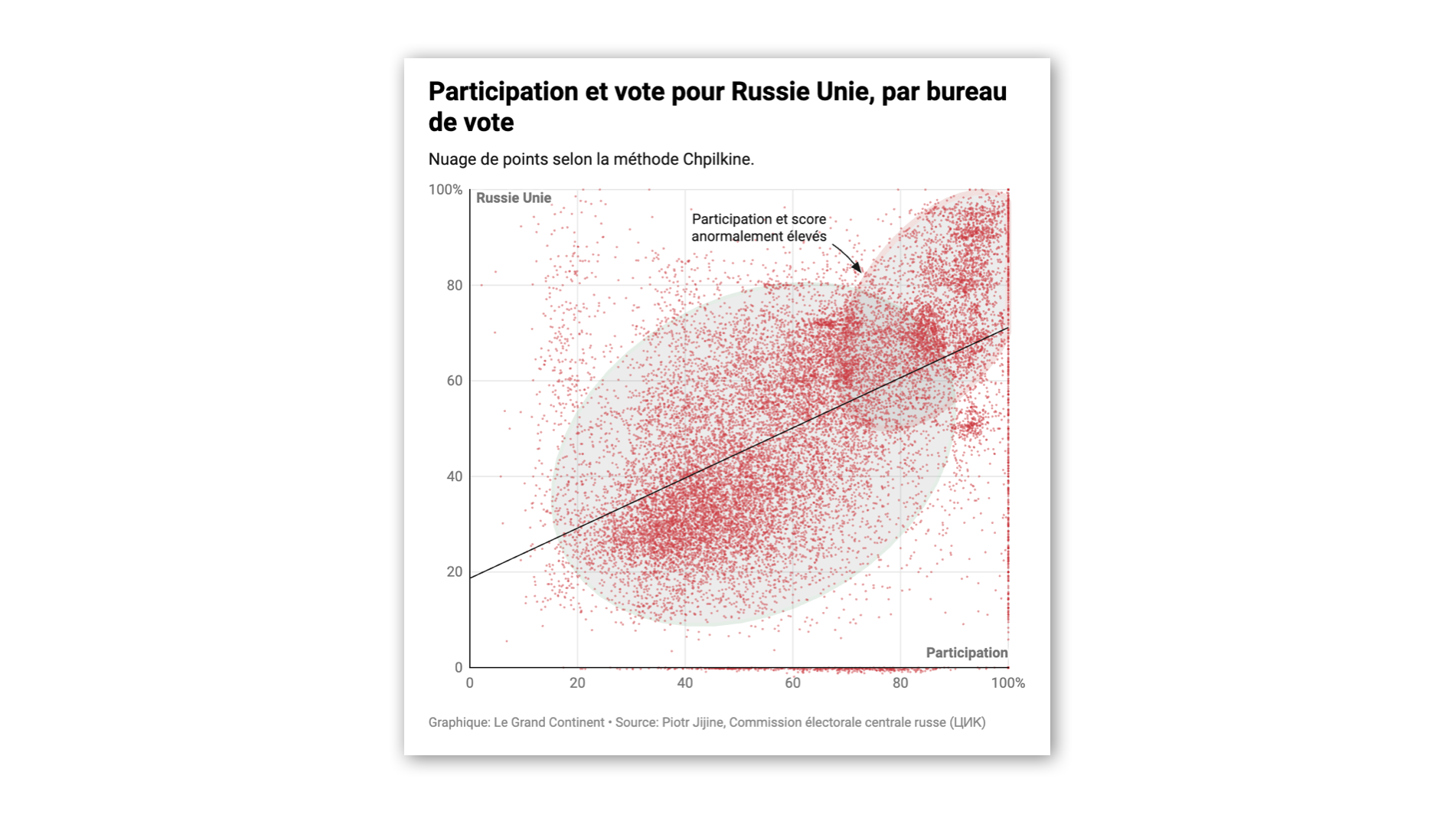
According to an analysis conducted using the Chpilkine method, based on results from more than 20,000 precincts (out of roughly 89,000), the vote would have been inflated by about 16 percentage points in favor of United Russia.
- Russian analyst Piotr Jijine contends that the ruling party would have actually obtained 41.9% of the vote, with the official results having been artificially adjusted.
The graphic below clearly separates two clusters:
- A first cluster representing roughly 73% of polling locations indicates a “normal” voting pattern, with United Russia at 41.9%;
- A second cluster, representing 27% of polling sites, shows a disproportionately high average turnout of about 90%, with a United Russia score of around 70%.
In the absence of independent observers, election result manipulation has become nearly systematic in Russia. In his most recent re-election campaign, in 2024, Putin allegedly attributed more than 20 million votes to himself, rendering the ballot the most rigged in the country’s recent history.
The manipulation of outcomes serves to reaffirm the regime’s legitimacy, reward loyalists, and refresh a portion of the political elites.
- The secretary of the General Council of United Russia, Vladimir Yakushev, stated that 86 veterans of the war in Ukraine had been elected to the Duma, accounting for nearly a quarter (24%) of the party’s deputies and one fifth of the Duma (19%).
- In May, Kremlin sources claimed the new legislature could include nearly 100 deputies who had participated in fighting in Ukraine, including both new entrants and incumbents.
- The final results of the election were expected to be announced by Friday, September 25.