
Since the start of the year, the major AI laboratories have dramatically accelerated the automation of AI research and the model development cycle, committing to delegate an increasing number of tasks to AI at the expense of human developers.
This movement extends a long-running trend observed over the past decade.
- After eliminating the need for humans to manually define input variables (the “features”) with the advent of Deep Learning, AI is now reducing human presence in the loop itself of model improvement.
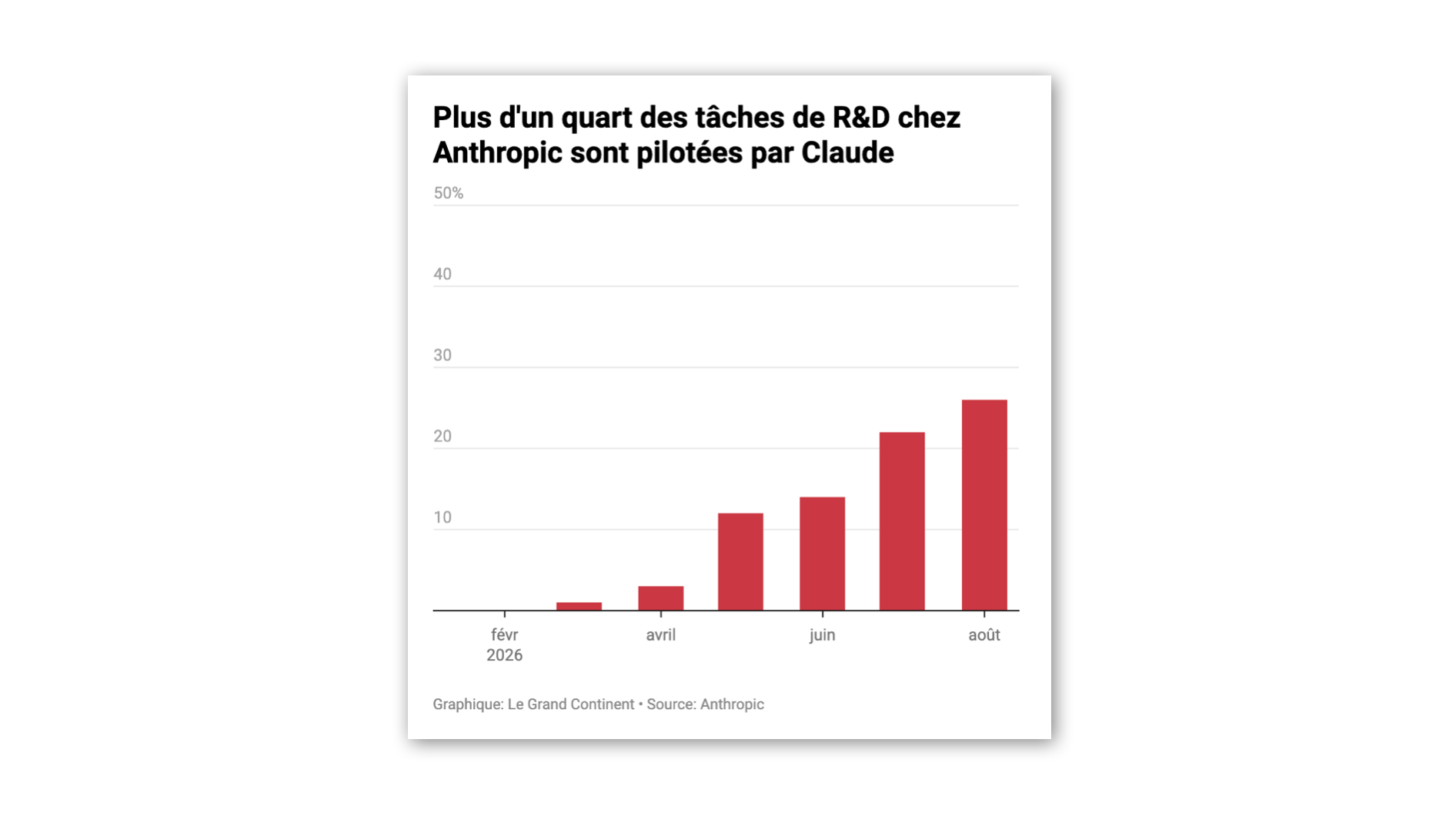
Anthropic notes that more than a quarter (26%) of its AI research and development (R&D) is now at the “AI leads” (AL4) level, compared with less than 1% in February.
- At this level, the human provides a high-level objective, supervises and validates, while Claude carries out the majority of the end-to-end task.
- Anthropic notes that, if the observed trend continues, this share could reach about 80% by the end of the year.
Anthropic proposes three metrics to render RSI (“recursive self-improvement,” i.e., the autonomous ability of an AI model to build its successor) measurable: the rate of R&D automation, the ability to monitor agents, and the allocation of compute.
These indicators could serve as triggers for governance measures or slowdowns.
- Anthropic has not yet reached RSI, but documents a very rapid automation of nearly the entire R&D execution chain.
- More than 90% of AI R&D is already at least at AL3 “AI collaborator”: Claude can therefore perform substantial blocks of work under close human supervision.
- Anthropic indicates that 0% of the measured categories are AL5, the level at which AI identifies the problem itself, defines it, solves it, tests it, and deploys it without any human intervention.
- Around 30,000 AI research agents are working in parallel on Anthropic’s platform at any given moment, capable of communicating with one another and delegating tasks among themselves.
In his essay Pacing the Frontier, Dario Amodei argues that since the summer of 2026, AI has accelerated strongly, mainly because it is increasingly able to contribute itself to the development of the next generation of models.
- He expresses in this text his concern that such an acceleration loop could end up advancing faster than humanity’s ability to understand and control the systems.
- In fact, Anthropic has published figures on its compute allocation: over a week, around 6% of the compute devoted to AI R&D was allocated to safety-related work.
Noam Brown estimates that an acceleration of AI research by a factor of 3 to 10 is plausible in the near term relative to the current trajectory. Experiments are limited by their duration, their sequential nature, and the number of GPUs available; computing power could thus become the main bottleneck for RSI.
- OpenAI asserts that in September it reached the stage of an automated “intern researcher,” capable, under supervision, of carrying out well-defined tasks that would take several days for a qualified researcher. The company aims to reach the stage of an “automated AI researcher” by March 2028.
On another batch of tasks estimated to require 4-8 hours of human work, more than half of those completed in the last six months required at least one human intervention.
- Other laboratories, however, report tangible speed gains by using their own models in their own R&D.
- In June, OpenAI and Broadcom announced Jalapeño, the first inference chip designed by OpenAI.
- OpenAI says it moved from initial design to fabrication in nine months, compared with a typical cycle often around 18-24 months for an advanced chip.
The company attributes, in part, this compression to the use of its own models to accelerate certain stages of design and optimization.
- In March, at post-training, MiniMax’s RL team announced they automated their experimentation process by roughly 30-50% (literature review, experiment definitions, debugging, metric analysis ).
- In September, the Chinese lab Zhipu AI used an agent based on its GLM-5.3 model to optimize how its next model, GLM-5.3-Flash, handles requests once deployed (the “inference stack”). In less than two weeks, engineers and the agent tripled inference throughput on 10,000 Huawei chips.
- Zhipu AI announced it would devote 60% of the money raised in its $5 billion funding round to the development of the next generation of its GLM models and to its “Fully Self Training” system, a mechanism designed to have models participate themselves in training their successors.
Facing this race toward self-improvement, Yoshua Bengio, Turing Award laureate, called in September for banning forms of RSI in which AI systems could autonomously design and train their own successors, without human intervention.