
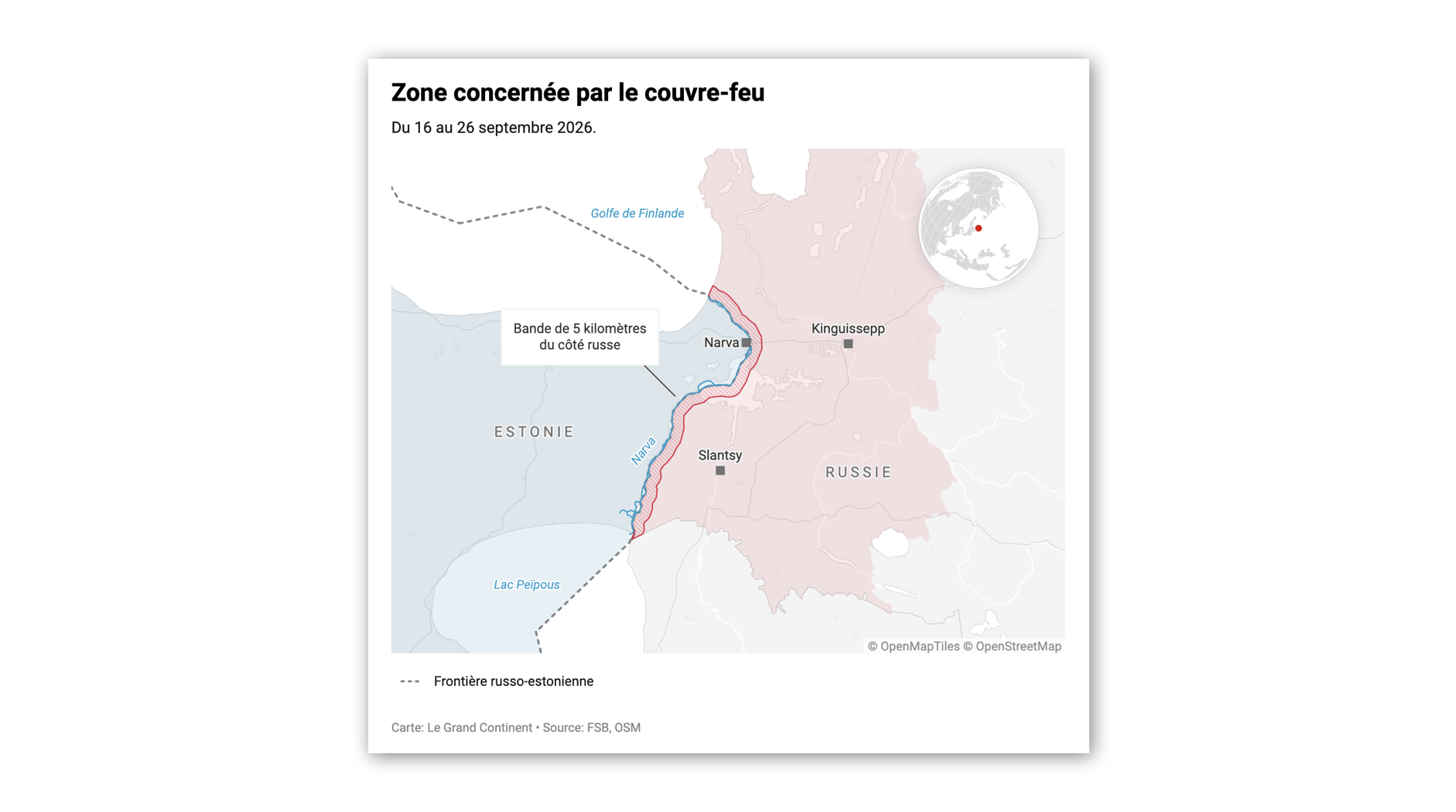
Last week, Russia’s Federal Security Service (FSB) announced the imposition of a nighttime curfew — described in the release as a “preventive measure” — in the Slantsy and Kingissepp districts, which border Estonia, located in the Leningrad Oblast, about a hundred kilometers southwest of Saint Petersburg.
- The curfew came into effect on Wednesday, September 16, and is due to expire on Saturday the 26th.
- In its release, the FSB spoke of measures “aimed at preventing border violations and breaches of migration laws, as well as at protecting aquatic biological resources.”
Three distinct prohibitions are currently in force:
- a ban on presence on the coastal belt and on navigation on the stretch between the Bolshaya Tcheriomoukha River and the Kriusha River;
- a ban on hunting and armed movement across the entire border zone of the Slantsy district and in a 5 km strip along the state border in the Kingissepp district;
- and a ban on nighttime movement within a 5 km strip along the border in both districts.
This is not the first time Russia has restricted movement in the border area with Estonia. According to the Estonian representative at the Russia-Estonia border, Andris Viltsin, access to the Russian town of Ivangorod is already subject to authorization under normal conditions, and Russian authorities impose such restrictions “from time to time, depending on the situation,” for “preventive purposes or as part of exercises” .
Nevertheless, this measure is raising concerns in Tallinn.
- According to the Estonian Interior Minister, Igor Taro, the curfew — which coincides with the parliamentary elections — could signal a new mobilization.
- Rumors have already led several thousand Russians in recent months to leave the country or to seek information about relocating abroad.
- Several voters who cast ballots electronically this weekend said they received, in the hours that followed, a notification of registration in the military register. Two electoral observers working for the Yabloko party, for their part, received a summons to the recruitment office already registered in their name.
The possibility of military action does not appear to be off the table either.
- According to Michal Koudelka, director of the Czech intelligence service, in addition to an uptick in drone activity, Russia could launch “a limited incursion, provocations under a false banner, or a large-scale influence campaign” .
- Estonia, for its part, wishes to remain more cautious. On Saturday the 19th, Jonatan Vseviov, the Secretary-General of the Estonian Ministry of Foreign Affairs, stated: “There has been a lot of panic on social media lately concerning the security of the Baltic states. Take a breath. If there is reason to fear an attack, be reassured: we will make it clear. In the meantime, stay calm, carry on and support Ukraine” .
The Estonian city of Narva is identified by analysts as one of the potential targets that could be subjected to a land-grab attempt. Other scenarios include the Latvian town of Zilupe, the Suwałki Gap between Poland and Lithuania, or the Norwegian archipelago of Svalbard in the Greenland Sea.