
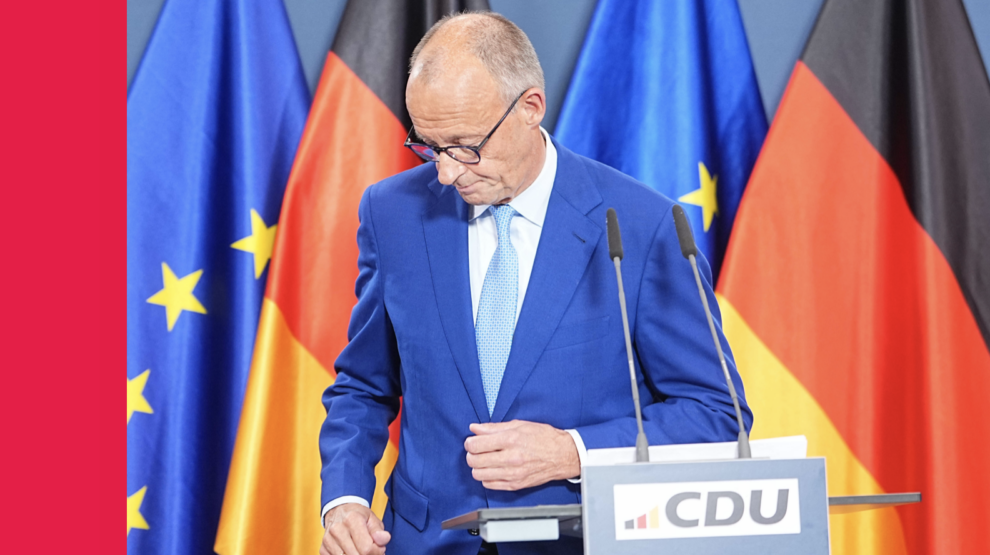
This Sunday, September 20, voters in Mecklenburg-Western Pomerania and Berlin were called to the polls to elect new regional parliaments. According to preliminary results, the AfD and The Left performed well, while Chancellor Merz’s CDU suffered a double defeat.
- In Mecklenburg-Western Pomerania, a rural region in northeastern Germany, the AfD wins the election with 38.2% of the vote, doubling its score from 2021. Its lead over the SPD, led by the popular Minister-President Manuela Schwesig who secures 35.5% of the vote, remains narrow, however.
- The situation is particularly dramatic for the CDU, which, with 4.9% of the vote, falls below the threshold required to win seats, marking the party’s most severe regional defeat in its history.
- The Left (6.5%) and the Greens (5.6%) also manage to enter the Parliament.
- As in Saxony-Anhalt two weeks earlier, turnout is notably high, at 79%.
- An analysis of voting flows indicates that the AfD again attracted a large share of former abstainers and ex-supporters of centrist parties, while the CDU lost votes to the SPD and the AfD.
- In this configuration, the AfD would not have the capacity to form a government.
- The mandate to form a government would naturally fall to the SPD, which would hold a slim majority by partnering with The Left and the Greens. The very low score of the CDU should not allow it to participate in the next administration.
In Berlin, the CDU, which had surprised in 2023 by winning the poll, loses 9.5 percentage points and stands at 18.7%.
- It is overtaken by The Left, which, after a campaign focusing on rent costs and marked by renewed calls for expropriation of large landlords, secures 25.6% of the vote.
- The AfD is in third place, with 16.3% of the vote, ahead of the Greens (14.3%) and the SPD (12.1%).
- Contrary to Mecklenburg, the Social Democrats suffer a heavy defeat in the capital. The FDP fails to enter parliament with 2.2% of the vote, as does the BSW which obtains 4% of the vote.
- Turnout is also high, at 75%.
- Under these conditions, a red-red-green coalition (The Left-Greens-SPD) also appears the most likely in Berlin.
- For the first time, The Left is able to claim the mayoralty; its top candidate, Elif Eralp, could become the chief magistrate of the city-state. A coalition combining the CDU, the SPD and the Greens would also be majority and would allow the CDU to keep the mayoralty. The choice between the two coalitions would depend on the Greens and the SPD. The Greens have already expressed their preference for a coalition with The Left.
The poor results for the CDU fueled speculation about a possible fall of Friedrich Merz.
- Last week, conservative minister-presidents drafted a joint letter to dispel rumors of a topple of the chancellor by the parliamentary group.
- In the 1960s, the CDU/CSU group had already twice replaced the chancellor during a term. In 1961, Konrad Adenauer was re-elected with difficulty, but the CDU/CSU and FDP decided on a mid-term power transfer to the economy minister Ludwig Erhard. In 1966, Erhard himself was replaced by the CDU/CSU group, at the initiative of Rainer Barzel, Franz Josef Strauss, and Kurt-Georg Kiesinger, who followed him as chancellor.
- Unlike the Saxony-Anhalt election two weeks earlier, the chancellor, whose party was the big loser of the evening, spoke almost immediately after the first results were published, at 6:00 PM.
- He tried to differentiate the two elections, acknowledging “a disaster” in Mecklenburg-Western Pomerania.
- According to him, the CDU fought, but fell victim to the escalation of opposition between the SPD and the AfD.
- In Berlin, Friedrich Merz said that Stefan Ewers had “run a campaign under very difficult conditions.” Indeed, the outgoing mayor, Kai Wegener, from the SPD, had to withdraw from the race after a scandal concerning his management of a power outage in western Berlin last winter.
- The chancellor did not mention the possibility of his resignation and stated that his party would carry on with reforms: “The answer cannot be a return to the good old days […] Our answer must be to prepare our country for the future.”
- Returning to Ludwig Erhard’s Wohlstand für Alle, the CDU leader asserted that the promise of prosperity and social ascent for younger generations was the objective of his government, concluding that “Germany is reformable, and these reforms are the antidote to authoritarian poison.”