
All summer, the Grand Continent will stay in motion. Every day, wherever you are, we will bring you ideas you will not find anywhere else (yet which will be everywhere when school starts), texts that are hard to find or refreshing with our Sundays. To receive them directly in your inbox and support this momentum, consider subscribing to the magazine
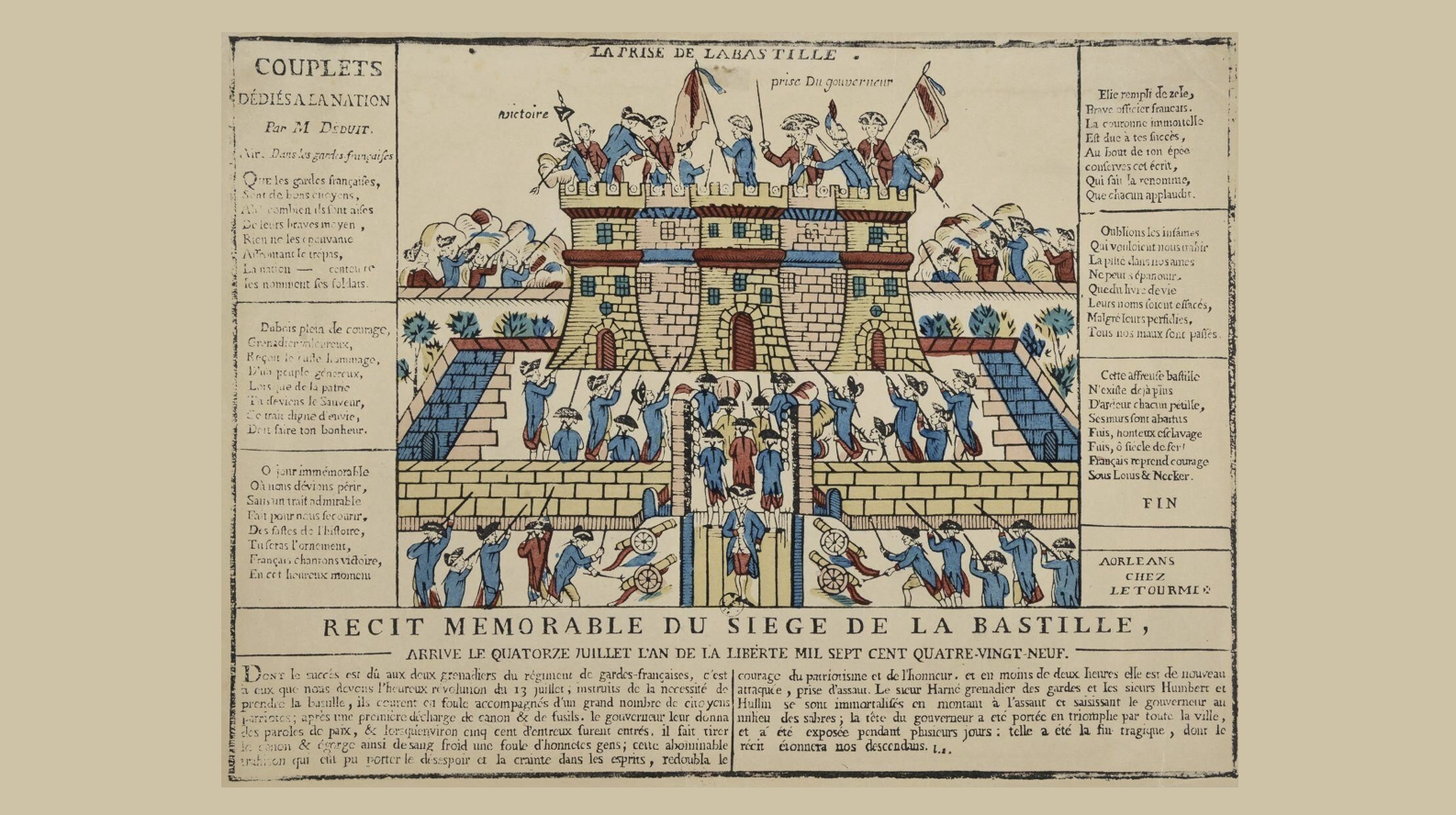
On July 14, 1789, a crowd of Parisians stormed the royal prison of the Bastille, the quintessential symbol of despotic power. After hours of clashes and a brief exchange of bloody fire, the fortress fell. Its governor was captured, then beheaded. His head was displayed in the streets, impaled on a pike. In a few days, the news spread throughout France. For contemporaries, the message was unequivocal: the king’s power had definitively eroded, and the hour had come for the people to rise up.
In collective memory, this day stands as a symbol of rupture and a call for the revolution that was just beginning: the people had risen against a monarchy that had long been unpopular. Yet, the storming of the Bastille did not, by itself, trigger the Revolution. The Estates-General had been in crisis for weeks and the National Assembly had already proclaimed itself sovereign. This event gave the revolutionary moment its dramatic dimension and reinforced the revolutionaries in their project.
The revolutionary mechanism beyond the imaginaries
This image of rupture and a people who suddenly express their exhaustion with an authoritarian and abusive power remains powerful in our imagination. It is what continues to shape our sense of what a revolution can be: a moment when history tilts and when existing social and political structures are questioned. But let us not underestimate the deceptive character of this emblem: if we decenter its point of view and no longer look only at Paris in July 1789, we realize that villages, towns, and rural parishes across France also played a role in the preceding decades, and that the Revolution is less a rupture than a process. A different vision thus emerges. In the countryside, discontent had already been simmering for a long time, notably because the royal power sought to extend the state’s reach into the territories.
The very infrastructures that made France more governable also made it more explosive.
Michael Albertus and Victor Gay
That is precisely the paradox our research reveals when we analyze social disturbances and the expansion of monarchic instruments of power across the entire French territory: throughout the 18th century, the more the monarchy tried to extend its grip on the territory, the more it encountered resistance. This tension lies at the heart of the Old Regime. To illustrate with a concrete example, consider the horse-relay post network, an institution central to the royal state-building strategy at that time. The data we examined suggest that this state communications infrastructure, rolled out progressively across the kingdom during the 18th century, was systematically associated with a rise in local rebellions in its path.
The modernization of the monarchy did not pacify the population, nor did it meet its growing needs. On the contrary, it disrupted the daily lives of the inhabitants while fueling a series of deeper grievances.
This fact invites reflection on a stubborn paradox that remains deeply relevant: the construction of the state and that of social order are not one and the same project. The very infrastructures that made France more governable also made it more explosive.
This perspective enriches traditional interpretations of the French Revolution. Classic narratives emphasize the monarchy’s depleted finances, the diffusion of Enlightenment ideals, the drought of 1788 and its consequences on bread prices, and the rising bourgeoisie’s desires for emancipation. Yet one must add a territorial and infrastructural dimension, often overlooked. The Revolution did not merely take shape in Parisian salons or through philosophical pamphlets: it also fed on long-standing experiences of rural resistance, reinforced by the expansion of the State itself.
The forgotten infrastructure of the Revolution
The kingdom of France was, in the 18th century, a vast, heterogeneous, and fragmented territory. Many provinces enjoyed their own fiscal, judicial, and religious prerogatives. The pays d’États— Brittany, Burgundy, Languedoc, and others— had negotiated special rights with the Crown and enjoyed a certain degree of autonomy. The zones lying between different fiscal regimes, especially those governed by the gabelles, which varied considerably from region to region, were hotbeds of smuggling and passive resistance. The upshot is that the image of an all-powerful absolutist state is largely a fiction, both projected by the monarchy itself and echoed in their meta-narrative by 19th-century historians. In reality, there was often a vast gulf between what the king ordered from Versailles and what actually happened in a village hundreds of kilometers away.
This gap is precisely what the monarchy sought to bridge throughout the 18th century, through a series of investments in communication and administrative infrastructures. The expansion of the horse-relay post network was among the most ambitious projects.
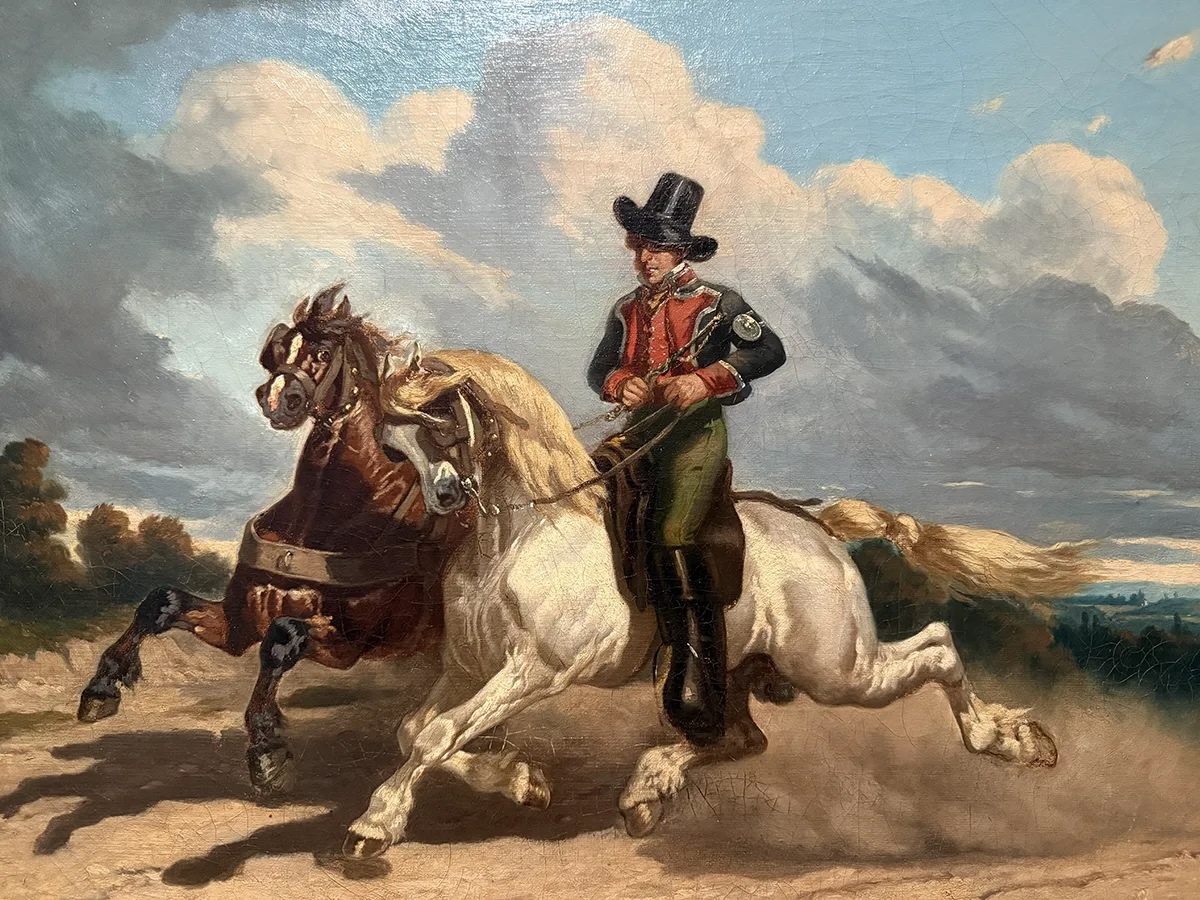
Created under Louis XI at the end of the 15th century, this network served to transmit the king’s messages and administrative directives as quickly as possible. Its postillions, recognizable by their royal blue uniforms, black boots, and horses bearing a distinctive royal mark, rode from relay to relay, spaced ten to fifteen kilometers apart, regularly changing horse on routes to maintain high speeds. Only couriers authorized to gallop on the routes connecting the relays operated within a strict state monopoly: it was forbidden for those renting horses privately to run on these same routes.
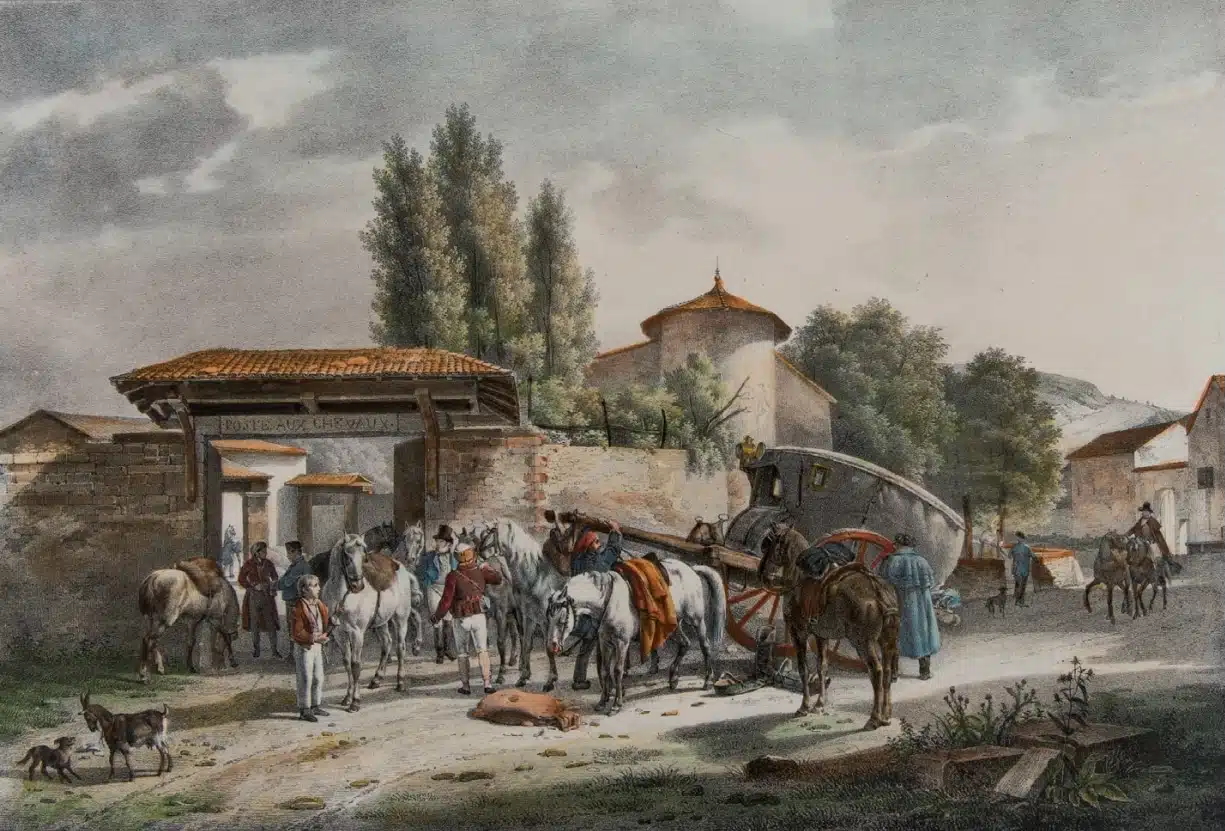
At the beginning of the century, this network counted about 841 relays covering some 11,000 kilometers of postal routes. Just before 1790, on the eve of the Revolution, it had almost doubled: 1,403 relays covering 24,000 kilometers. The average distance a traveler had to cover between two relays in 1714 was 22 kilometers; by the end of the 18th century it had fallen to 13. The proportion of parishes located in the immediate vicinity of a relay had likewise risen from 18 to 31%.
This expansion fit into the logic of the State. It connected administrative centers with each other and allowed the intendants stationed in the hinterland to receive the orders from Versailles and transmit their execution to the lower reaches. It, in turn, helped coordinate tax collection, facilitate military recruitment, and monitor the movement of people and goods. The head of each relay, who were drawn from the local wealthy notables of towns and villages, were tasked with watching passing travelers and signaling notable political events to their intendant. They thus became important local agents of a state that was undergoing centralization.
The construction of the State and that of social order do not constitute a single and the same project.
Michael Albertus and Victor Gay
In the 17th century, the network had developed more toward the kingdom’s borders, driven by military and strategic priorities. In the 18th century, the dynamic shifted toward a densification of the internal network, with the emergence of genuine regional centers such as Bordeaux, Lyon, Dijon, Toulouse, and Rennes, and gradually extended to regions previously isolated, like Brittany or Languedoc. It is in these regions that the State had previously been the least visible, and were therefore more at risk of being perceived as intrusive.
Our data, which we assembled from successive editions of the General List of Posts of France published since 1714, allow, for the first time, a reconstruction, decade by decade and parish by parish, of this expansion. Coupled with the formidable database on rebellions by Jean Nicolas — which records more than 6,000 insurrectional events against state authorities between 1714 and 1789, drawn from decades of archival research — these data enable a rigorous statistical analysis of the relationship between the expansion of the State and popular resistance. By comparing the evolution of rebellions in parishes that had a relay installed with those in places where none existed yet, we find that the establishment of a postal relay is associated with a notable increase in local revolts in the following decades. This increase represented roughly twice the average rebellion frequency. Several years elapsed before these effects became truly visible, because several causes of discontent accumulated over time.

It should be noted that, unlike roads accessible to all—by intermediaries of the State as well as merchants—the routes of horse-relay posts were exclusively reserved for royal couriers and for the head postmasters under their authority. Ordinary subjects could not use this network to coordinate among themselves, organize collective resistance, or speed the diffusion of their demands across the territory. This infrastructure served the State. This asymmetry makes it useful from an analytical standpoint: it allows us to isolate the effects of a unilateral penetration of the State from the potentially multi-directional benefits that a more open infrastructure might have generated.
The paradox of modernization
Jean Nicolas’ data also allow us to classify rebellions according to their targets, motivations, and protagonists, helping us understand who rebelled, against whom, and for what reason.
The vast majority of rebellions tied to the expansion of the horse-relay network targeted representatives of the royal State. Of these, more than 60% of rebellions against state authority were motivated by fiscal grievances, typically related to the taxation and its collection. Next came military figures: officers involved in recruitment, the maréchaussée patrolling the roads, soldiers seeking local provisioning, and judicial officers.
Rebellions against non-state authorities such as the nobility, the Church, and municipal powers were not linked to the expansion of the network. Indeed, the new relays did not weaken local lords in favor of peasants. They actually strengthened the central State’s ability to assert its rights over the people and the revenues of its subjects. In particular, the acceleration of communications between Versailles and provincial intendants, then between the intendants and local tax collectors, and between tax agents and their superiors, allowed a more efficient coordination of the Crown’s extractive pressures. Conscription orders circulated more quickly and targeted their recipients more reliably. Investigations into salt smuggling intensified in the border zones between different gabelle regimes.
The State does not provoke resistance because it is powerful, but because it is in the process of becoming so.
Michael Albertus and Victor Gay
The case of Mirande, in the generality of Auch, illustrates this dynamic well. In the early 1770s, a new relay was established in this part of the southwest, which had previously been among the least militarized regions of France. This allowed the State to more effectively inventory the number of men of military age. In 1781, as war with England intensified the demand for recruits, the local sub-delegate, military officers, and local notables gathered in Mirande to conduct a conscription draw. From the surrounding woods, peasants organized themselves and, armed with clubs and knives, called for the massacre of all present representatives. The clash ended in several arrests. The relay post, by enabling the State to recruit more men, turned them into easy targets. These rebellions, like Mirande, were not the result of a particular strategic motive by their actors, who opposed the new relay posts per se. It was gradually, as the emergence of these relays made local populations more controllable by the State, that they understood what these infrastructures really meant to them and reacted accordingly.
A rebellion that occurred in 1783 in the coastal town of Blaye, at the Gironde estuary, a mere three years after a relay post was set up, offers another revealing example. Agents of a pataches brigade—these itinerant tax collectors who were feared for collecting the gabelle and seizing contraband—attempt to inspect the cargo of a Breton ship. The crew resists and stirs the region’s inhabitants, who end up stoning the inspectors. The protesters denounced this brigade as an “enemy of society” who came to “harrass the citizens” who were simply going about their everyday business. The tightening of maritime surveillance along the estuary, made possible by a series of new relays linking La Rochelle to Bordeaux, strengthened fiscal control and thus triggered a wave of local discontent.
The monarchy did not fall because the people suddenly woke up; it fell because the memory of rebellions had accumulated over decades.
Michael Albertus and Victor Gay
These rebellions were not the preserve of the most deprived in society. Local notables were also among the protagonists of resistance to the expansion of the relay network. The Crown’s monopoly on the routes served by the relay exerted pressure on those who rented horses privately, as well as on innkeepers located outside the postal axes and thus disadvantaged. It also compelled local farmers to prioritize supplying hay and fodder for the relays before addressing the needs of their own beasts. Many of those who had grown wealthy within the context of a fragmented Ancien Régime governance—merchants, craftsmen, and small landowners who dominated local exchanges—found that the centralized State was not a protector but a competitor. There was indeed a real link between the multiplication of these relays and rebellions encouraged by local notables: this infrastructure threatened the private interests that had previously ruled commercial and logistical activity along key arteries.
The spatial variation of rebellions is also worth examining. The reaction to the new relays was markedly stronger in regions where royal authority had historically been least present or most contested, notably in pays d’États such as Brittany, Languedoc, or Burgundy, as well as in parishes along the border zones where the gabelle was collected. This sudden intrusion of the State where it had previously imposed itself the least was experienced by local actors as more brutal. The contrast is striking between, on one hand, the pays d’élection, directly subjected to the Crown’s fiscal authority for generations, and on the other, peripheral territories: the effect of relays on rebellions in the pays d’États and in taxed regions is nearly three times greater than the corresponding effect in historically more centralized areas.
This geography of resistance highlights a fundamental aspect of state-building: it is not necessarily the most oppressed places that resist most fiercely, but those where the contrast between prior autonomy and sudden intrusion is the sharpest. The State does not necessarily provoke resistance because it is powerful. It provokes resistance because it is becoming powerful, at a pace that outstrips its capacity to legitimize this growing authority.
From rebellion to revolution
The thousands of local rebellions, most of them suppressed, that erupted across the French countryside unquestionably helped lay the groundwork for the Revolution that broke out in 1789. The link between this event and the expression of growing anger in the provinces runs far deeper than a simple relation between the storming of the Bastille and the economic crisis, poor harvests, or the spread of ideas from the American Revolution.
Parishes where a new relay post had been installed in the preceding decades—and thus where rebellions had increased for this reason—were more likely to develop contestatory political groups during the Revolution itself. These societies or clubs, the Jacobins being the best known, played a central role in mobilizing the Revolution: these were places where reforms were debated, local action coordinated, and new political ideas circulated in towns and countryside throughout the country, well beyond Paris.
The grievances crystallized by the expansion of the relay network did not vanish once the rebellion was suppressed. On the contrary, they were indelibly inscribed in local memories and in the repertoires of collective action, in various ways of expressing discontent and community anger. As soon as the opportunity arose, these tools and levers could be reactivated in a more organized political form. This opportunity came with the late-1780s fiscal and political crisis and the summoning of the Estates-General. It was the groups and parishes that had expressed the most discontent who were best able to transform it into political demands and concrete actions.
Legitimacy does not automatically spring from the authority conferred by power. Order does not mechanically arise from governability.
Michael Albertus and Victor Gay
Historical research has shown, in other contexts, how a population can forge, from a lived trauma and its lasting memory, its own capacities for resistance. For example, in parishes where many clashes with tax collectors or with those responsible for conscription had occurred in previous years, the population proved more receptive and more capable of taking action during the Revolution.
We do not claim that these rebellions against relay stations were the triggering event of the Revolution. They were neither coordinated nor unified by a common political project, and most targeted local state officials rather than the monarchy as an institution. But they nevertheless help map a geography of these popular grievances, which, when circumstances favored, became politically explosive.
It is striking, in this regard, that Shapiro and Markoff’s research on the Cahiers de doléances—the documents in which inhabitants of the kingdom expressed their grievances and desires at the time of the Estates-General of 1789—shows that complaints about royal taxation, conscription, and judicial abuses occupy a central place. These are precisely the fault lines we associate with rebellions against the expansion of the postal network.
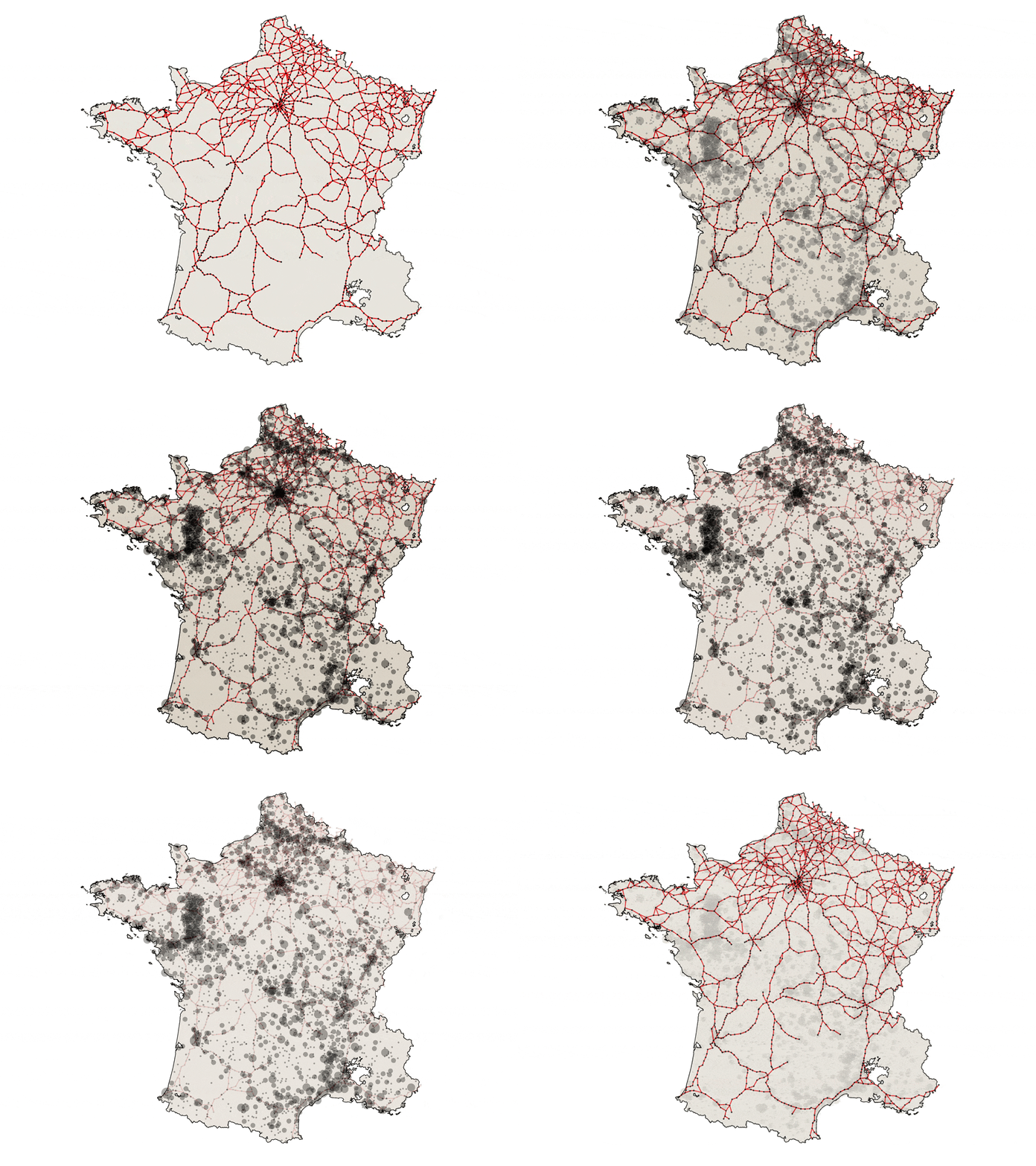
Nor is it a coincidence that the parishes where the relay network generated the most disturbances were disproportionately those in regions that had historically opposed the strongest resistance to royal authority, such as Languedoc and other later-integrated peripheral territories. These were communities with long traditions of negotiation, evasion, or even outright rejection of the State’s demands. When this new communication infrastructure pushed the State to their doorstep with greater force than before, it reactivated a repertoire of collective action deeply rooted. The Jacobin clubs that later developed in these regions were the organizational heirs of decades of local conflicts.
This dynamic allows us to develop a broader reflection on political mobilization. Revolutionary moments rarely summon political communities from scratch. They are the heirs of a history marked by episodes of collective resistance, by networks of solidarity forged from conflicts and shared experiences against rivals or state authorities. The organizational capacity that political societies displayed during the Revolution drew, in many cases, on the know-how gained from confrontations with the expanding Bourbon monarchy apparatus.
State consolidation against social order
On the national day, parades and fireworks will, as every year, celebrate this tireless pursuit of freedom. Our research, however, allows us to enrich these commemorations with an additional layer, rich in lessons for today’s world.
The history of the relay-post network reveals a fundamental paradox of state-building: this same infrastructure that made France a more structured state also made it more eruptive. Indeed, by improving communications, the monarchy did not merely create a more efficient state. It also created subjects who were more directly exposed to the demands of that state, which led to exasperation and resistance. This produced large-scale unintended consequences. A state that sought to impose order discovered, in the process, that it had created the conditions for disorder.
The distinction this reveals is important: state-building and the maintenance of social order do not constitute a single project. In the long run, they often reinforce each other. But, in the medium term, during the difficult transitional period when a state extends its grip into new territories and new spheres of social life, that relationship can tilt in the opposite direction. A stronger state presence implies more levies and coercive measures, which disrupt the status quo and can trigger some seismic shocks. This is the dilemma that confronted the French monarchy in a particularly pronounced way.
Governments that extend their reach rapidly and unevenly into territories where authority is weak or contested take a risk. The order they impose may contain the seed of future disorder.
Michael Albertus and Victor Gay
This dilemma extends far beyond the borders of historical France. In many countries today, efforts to extend the State’s capabilities—to build roads in remote areas, to deploy communications infrastructure, to strengthen the tax administration, and to formalize property rights where informal arrangements prevailed—can provoke resistance if the population does not consent. Legitimacy does not automatically arise from the authority conferred by power. Order does not mechanically result from governability. And the losers of state expansion—the ones whose prior autonomy, local organizational modes, or private interests are upended by the centralizing State—do not simply disappear.
The grievances that the relay-post network had crystallized in mid-to-late 18th-century France remained relevant in the 1789 Cahiers de doléances. They resurfaced in the political societies that mobilized the revolutionary movement at the local level. They determined which communities participated most actively in transforming the Old Regime into something new.
The takeaway is not that oppressed populations inevitably find the path to organized resistance, nor that government overreach necessarily creates the conditions for its own downfall. The moments chosen, as well as the geography of political action and dissent, depend on a whole series of preceding conflicts that shape them in one way or another. These entanglements are such that protest movements can sometimes seem hard to decipher, both by their actors themselves and by those who hold power and exercise it.
The Bourbon monarchy interpreted the mid-18th-century rebellions as circumstantial and bounded disturbances that would be easy to repress and then forget. In reality, however, they represented a genuine political debt that these repressions quickly ran up against. Governments that extend their reach rapidly and unevenly into territories where authority is weak or contested take a risk. The order they impose can contain the seed of future disorder.
The monarchy did not fall because the people suddenly woke up and decided to seize power. It fell because, over decades, in thousands of parishes, the men and women who had opposed royal agents learned from their repression by the State and remembered it. The fuse the monarchy had lit by deploying its relays and postillons across the realm had been burning for a long time. The Revolution represented its final flare.