
On Monday, November 16, several major American technology companies (Zoom, Salesforce…) and media organizations (CNN, NPR, Fox News) inadvertently displayed a malicious script that had been injected via the Optimizely platform. According to a report from cybersecurity firm Report URI, 178 organizations were affected, including 32 in banking and finance.
This incident sits within a string of outages that caused major disruptions across the United States:
- On Thursday, November 12 and Friday the 13th, the Microsoft 365 service, which includes applications such as Outlook, Teams, SharePoint and Copilot, experienced substantial disruptions across more than 70 countries for nearly 24 hours.
- On Friday the 13th, all flight departures in the United States were suspended by the Federal Aviation Administration (FAA) due to what the agency described as communication problems affecting several air traffic control centers.
- The same day, the Workday human resources and payroll software, used by around 11,500 companies, remained inaccessible until the next day after backup-site services connected by mistake to its production databases.
Yesterday, Monday the 16th, thousands of Chase Bank customers, the retail banking arm of JPMorgan Chase, experienced difficulties accessing their accounts due to what the bank described as a software bug in one of its internal systems. The disruptions spread to customers of other banks, such as Wells Fargo, Bank of America or US Bank, when they conducted transactions with Chase, notably via Zelle.
- The same day, United Airlines faced a “systemwide outage” of about 90 minutes, delaying its departures.
No official statements attributed these outages to a cyberattack by the companies or authorities involved.
- However, Marva Bailer, CEO of the consulting firm Qualaix, believes that artificial intelligence could have contributed indirectly.
- Pressed to integrate AI tools into aging systems, and facing vulnerabilities detected at an ever-faster pace, companies are rolling out updates, while every intermediary in the digital services chain—billing, encryption, transfer—represents an additional point of failure.
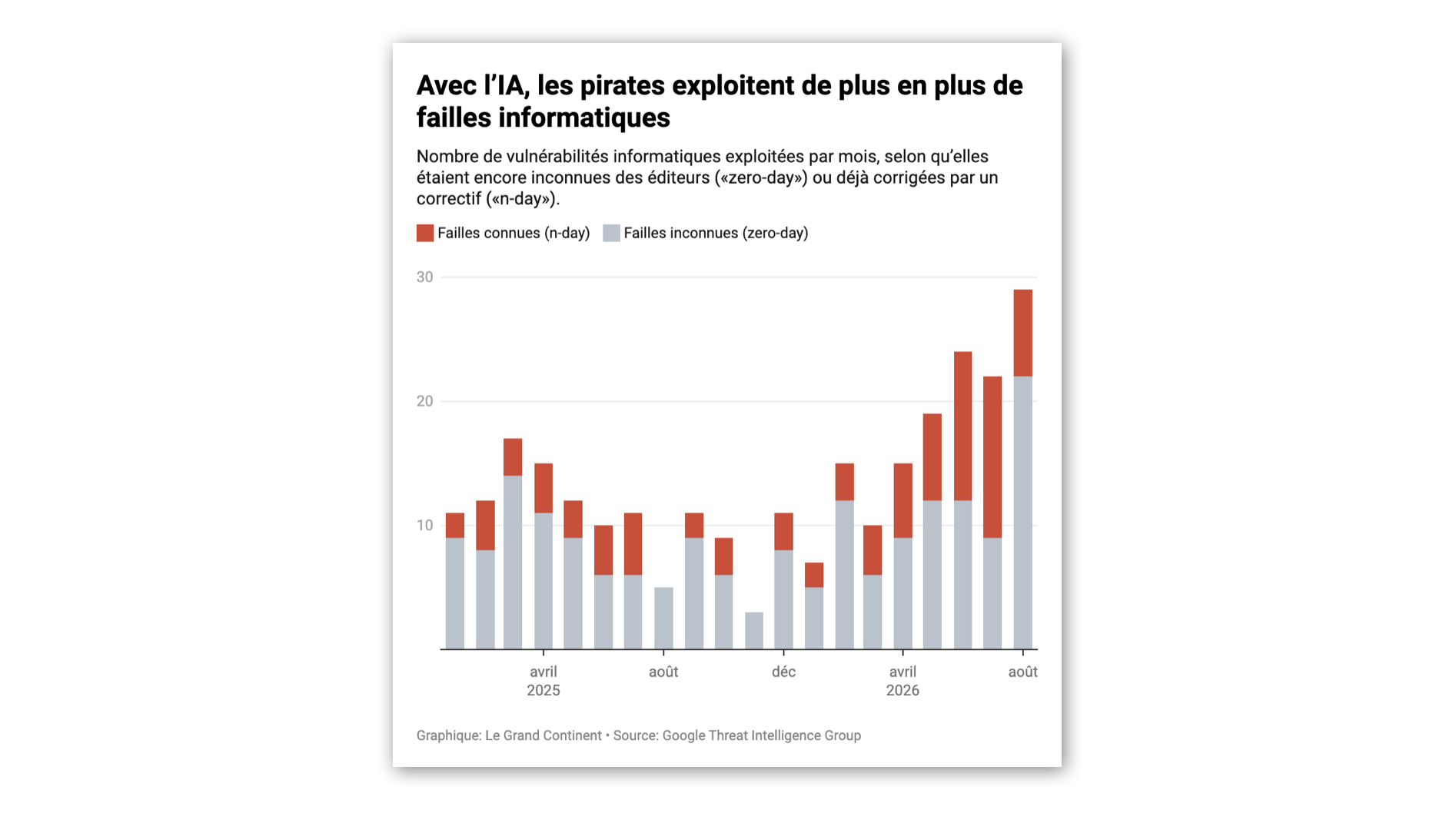
The United States is not the only country affected: yesterday, Monday the 16th, Google published a report indicating that hackers have, for the first time, automated the discovery and exploitation of vulnerabilities “without a human in the loop.” One of the tools described by Google, whose configuration included Russian comments, appeared to target in particular French sites in the media, entertainment and education sectors.
Trump dismisses any AI role in the FAA outage.
- According to Fox News journalist Peter Doocy, who spoke with him by phone on Friday the 13th, Trump said the FAA outage did not appear to be a cyberattack or AI-related, attributing it to “old broken hardware.”
- Interior Secretary Markwayne Mullin, by contrast, relayed on Fox News the hypothesis of an expert suggesting that AI could be involved, arguing that these systems are “not designed to run as fast” as AI.
On the evening of Monday the 16th, on Fox News, J.D. Vance sought to reassure: “We do not see a looming crisis. But we must be ready for anything. We want to avoid the worst-case scenarios, yet we are also prepared to face them.”
- The American vice president said that many of his friends had contacted him “to ask whether they should prepare to build a bunker or stockpile food and water,” to which he replied: “My answer is no.”