
Test the Grand Continent. The ideas and analyses you won’t find anywhere else. But you will see them everywhere soon. In your inbox from 8 euros per month
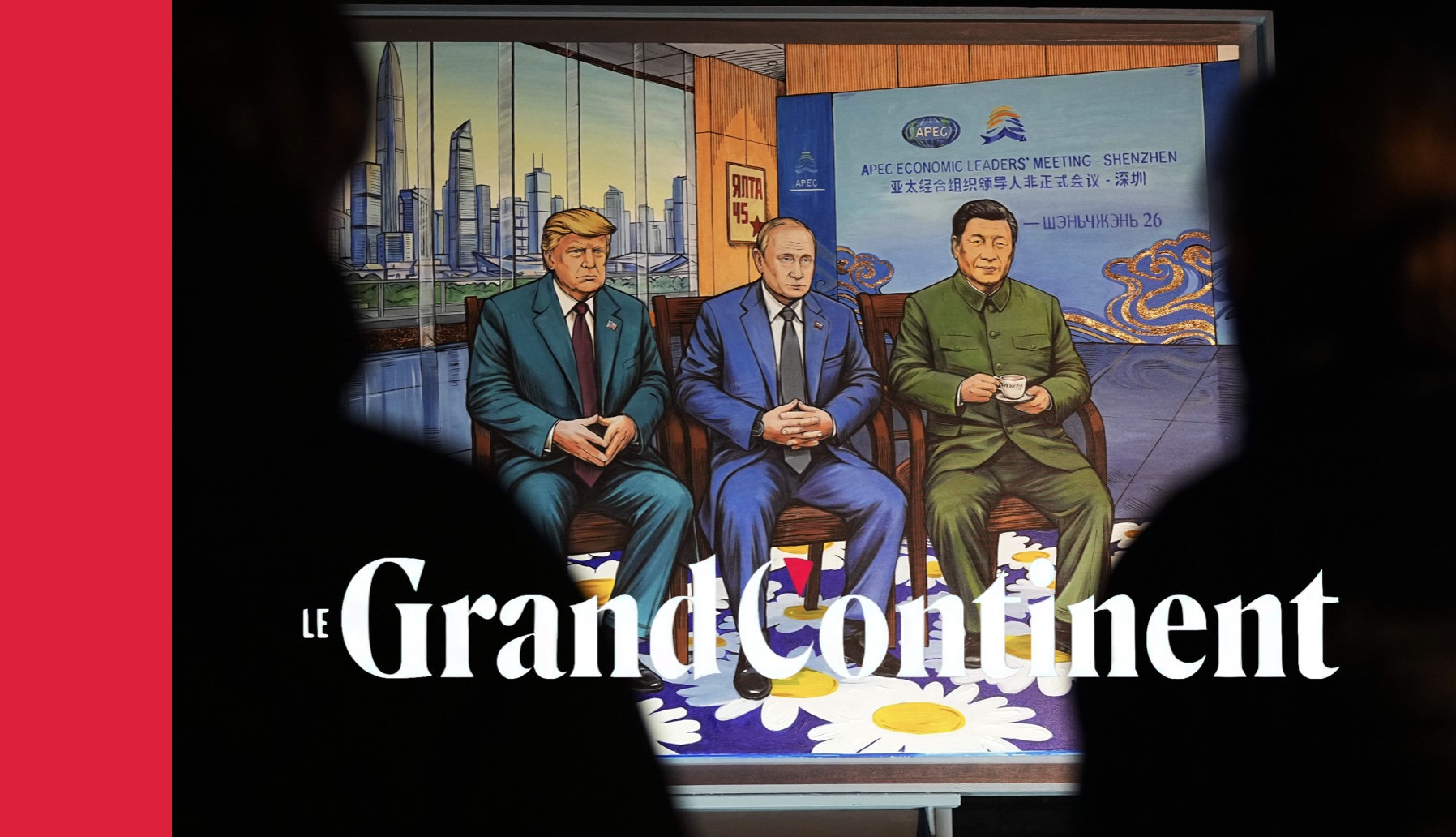
The Russian Eurasianist ideologue Alexander Douguine published on November 16, 2026 on the social network X a world map that he presents as “found on the Internet.” In the English paraphrase he wrote to accompany it, he describes it as a timely document “on the eve of the tripolar world summit.” He thus refers to the meeting that is to take place this Thursday, November 19, in Shenzhen, on the fringe of the APEC summit, between presidents Vladimir Putin, Xi Jinping and Donald Trump.
Appearing with all the trappings of an AI-generated map (Russia appears in the map both in red and in blue), this map whose caption is written in Portuguese illustrates a world divided into three large zones dominated respectively by the United States (which controls the American continent, Greenland and Japan), Russia (which controls, in addition to its own territory, Europe, Africa, and the Middle East) and China (which controls all of South Asia).
This vision of a world shared among a handful of great powers is a classic of 20th-century geopolitical theories. It has been regularly revived for decades, the only variable being the number and the identity of the powers expected to share the planet, according to the circumstances of their making and the identity of those who design them.
These geopolitical projects trace their theoretical origins to two central figures of the German conservative revolution: the jurist and political scientist Carl Schmitt and the theorist and propagandist of geopolitics Karl Haushofer. Both share a common hatred of universalism and, to prevent the hegemonic domination of a single power over the entire world, argue for a division of the world among a few great powers each ruling over a space large enough to guarantee to all the means of their autarkic prosperity and their peaceful coexistence.
Le projet géopolitique d’une division du monde en vastes sphères d’influence est toutefois plus schmittien que haushoférien. Car à la logique de tripartition ou de quadripartition du globe, Haushofer préférait une approche dialectique de la géopolitique. Inspiré par la pensée mackindérienne, il plaidait en effet non pour un partage, mais pour une unification de l’Eurasie – sous domination allemande évidemment – afin de donner naissance à un « bloc continental » eurasiatique à même de faire contrepoids aux puissances thalassocratiques anglo-saxonnes. Ce en quoi sa pensée recoupe celle développée par Alexandre Douguine qui théorise de longue date une consolidation géopolitique de l’Eurasie – sous égide russe cette fois – pour mieux affaiblir les États-Unis en les coupant de leurs têtes de pont eurasiatiques (leurs alliés d’Europe de l’Ouest et d’Asie orientale).
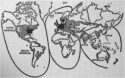
Ces théories allemandes de l’entre-deux-guerres prônant un partage du monde entre grandes puissances rencontrent très tôt un écho favorable chez certains penseurs états-uniens. Ainsi de l’ancien trotskiste James Burnham qui, dans son essai L’Ère des organisateurs (The Managerial Revolution, 1941) soutient la nécessité d’une rationalisation de la carte politique du monde. Selon lui, la réduction drastique du nombre des États souverains permettrait à ceux qui le restent d’être plus efficaces car « l’expérience a prouvé que l’existence d’un grand nombre de nations souveraines (…) est incompatible avec les besoins économiques et sociaux de notre époque. (…) La division complexe du travail, les courants commerciaux et l’afflux de matières premières que la technique moderne rend possibles et exige se sont retrouvés étranglés par la multitude des tarifs, des lois, des changes, des passeports, des frontières, des bureaucraties et des armées indépendantes des différents pays. »
Parce que l’État moderne, pour fonctionner efficacement, doit selon Burnham régner sur un vaste espace économique intégré, il faut profiter de la guerre mondiale en cours pour remodeler le monde et le partager entre une poignée de super-États : « Les nombreuses nations souveraines sont remplacées par un nombre restreint de grandes nations, ou “super-États” qui vont se partager le monde. Quelques-unes des nations qui sont éliminées dans les faits subsisteront dans la forme ; on les conservera en tant que subdivisions administratives, mais elles seront dépouillées de leur souveraineté. Seuls les quelques super-États seront souverains. Leur nombre ne saurait être prédit (…). Toutefois, les grandes lignes de cette évolution et son résultat final sont déjà clairs. (…) L’industrie avancée est concentrée dans trois, et seulement trois, zones relativement peu étendues : les États-Unis, particulièrement les régions du Nord-Est et du Centre-Nord ; l’Europe, particulièrement celle du Nord et du Centre (Allemagne, Pays-Bas, Belgique, le Nord de la France et l’Angleterre) ; et les îles japonaises avec une partie de la Chine orientale. (…) La carte économique suggère dramatiquement ce que d’autres considérations rendent probable : le système politique mondial comprendra trois super-États principaux, appuyés chacun sur l’une de ces trois zones d’industrie avancée.»
Une prophétie qui n’échappe pas à George Orwell, auteur en 1946 d’une recension du livre de Burnham, dont il reprend l’intuition centrale pour dessiner l’arrière-plan géopolitique de son roman 1984 paru en 1949. Le monde y est partagé entre trois super-États : Océania, Eurasia et Eastasia.
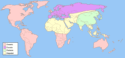
Thus, the cartographic fantasies propagated by Alexandre Douguine have a long history and align with his geopolitical vision of a world structured around a Eurasia dominated by a Russia that would reign there as master alongside China. In the context of the Shenzhen tripartite meeting, these fantasies mainly serve to cradle Russians in the illusion that their country could be a global superpower of rank equal to China or the United States. The reality is less glorious, and there is a certain irony in seeing a Russian imperialist imagine that his country, whose army has proven unable to conquer Ukraine for four years, could see Europe, Africa, and the Middle East fall under the Kremlin’s sway. One might even read in the AI’s graphical hallucination coloring half of Russia’s territory red (the color symbolizing, on this map erected as a model by Douguine, the Chinese imperial sphere) a troubling omen revealing the balance of power between the Sino-Russian axis.