
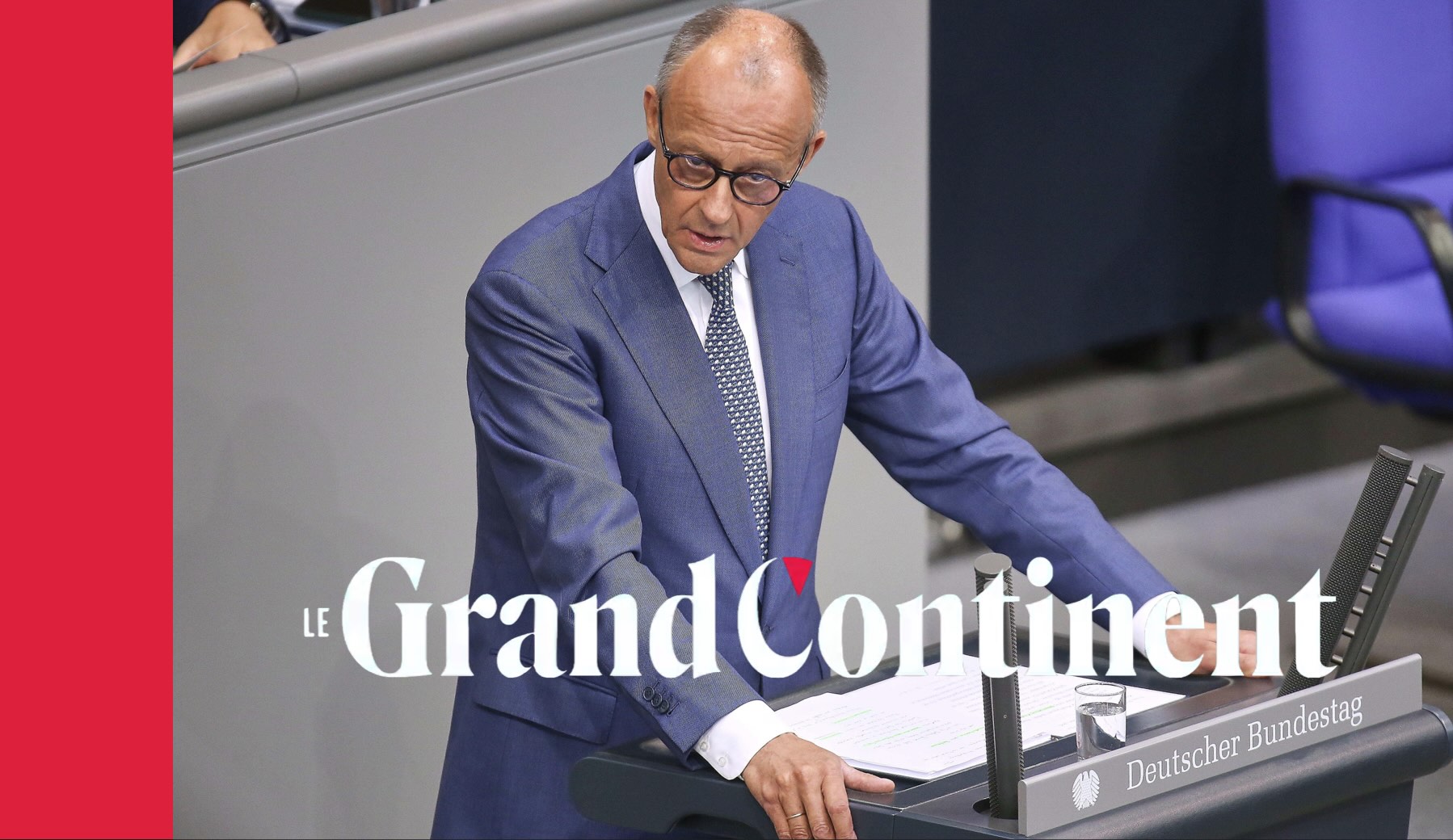
Three days after the nationalist far-right victory in Saxony-Anhalt, Friedrich Merz delivered a combative address in the Bundestag against the AfD.
In an aggressive atmosphere marked by numerous attempts by the AfD parliamentary group to interrupt his speech, the chancellor chose to stake out a clear opposition with the nationalist right. In Saxony-Anhalt, the party led by Alice Weidel refuses for the moment any parliamentary compromise and intends to implement its programme in full, which runs counter to Germany’s coalition-building political culture.
Friedrich Merz knows his grip on power is weakening and that the question of his replacement as chancellor is being raised more openly within his party. He insists that implementing the reform programme decided in 2025 by the coalition agreement remains his objective, brushing aside the SPD’s calls for a moratorium on pension reform following Sunday’s devastating results in Saxony-Anhalt.
Although Merz does not spell out a “cordon sanitaire” (the Brandmauer), the chancellor does highlight several deeply ingrained lines of incompatibility between the AfD and the other parties represented in the Bundestag. He identifies, first, the stance on Ukraine and accuses the AfD, which repeatedly yields to Vladimir Putin’s demands, of reversing victim and aggressor in this conflict. Second, he denounces the AfD’s approach to hybrid attacks that are increasingly directed at Germany from Russia, as well as their indifference to climate change which has caused droughts and fires. Third, and while underlining the economic absurdity of this measure in light of current demographic needs, by for the first time labeling “remigration” as “ethnic cleansing” (ethnische Säuberung), the government’s leader makes an accusation of a gravity unseen since the end of the Nazi regime.
But Merz refrains from going further and addressing the debate around a ban on the AfD, which had, since Sunday, returned to the heart of the discussion. Hendrik Wüst, the minister-president of the most populous region, North Rhine-Westphalia, and a potential rival to Merz for the chancellorship, has called for the creation of a working group between the federal government and the Länder to consider the possibility of a ban.
The government also benefits from somewhat more favorable-than-expected economic data, which it sees as evidence that the massive investment plans made possible in spring 2025 by relaxing the constitutional debt brake are starting to bear fruit.
The mea culpa remains nonetheless partial and indirect from the chancellor, whose popularity is extremely low in Germany. Merz acknowledges that he has had difficulty presenting the government’s reforms and proposes framing them under the banner of intergenerational justice, so that younger generations can also participate in the country’s overall prosperity. The conclusion of the speech is devoted, in an almost theological spirit, to urging learning from mistakes and forgiving, which can be read as a promise to correct the rhetoric perceived as harsh and arrogant by the chancellor, especially on labor-law questions.
Address by German Chancellor Friedrich Merz, September 9, 2026
Madam President, dear colleagues,
Madam Weidel, you are bursting with energy today, you achieved a remarkable electoral result in Saxony-Anhalt in every respect, and no one can accuse you of concealing your true intentions. However, I must point out that you did not achieve your electoral objective in Saxony-Anhalt, namely a majority of the seats. Ladies and gentlemen, 56% of Saxony-Anhalt voters did not vote for you.
And the polling stations had not even closed for six hours before you urged your candidate in Saxony-Anhalt to commit the first act of electoral fraud, asking him to seek a majority, even though he had promised during his campaign to govern only with an absolute majority of seats. Madam Weidel, yes, it may not be mere coincidence that you did not reach that objective. The voters spoke unequivocally. They have also delivered to us, including to me, a clear message. But you do not have the absolute majority, and you will not obtain it in Germany with this policy. You are and will remain, Madam Weidel, a destructive force.
And you have just proven it once again in your statement on Ukraine. Ladies and gentlemen, for four and a half years this country has fought for its survival, and no one has… [Julia Klöckner: Excuse me, Mr. Chancellor, to interrupt briefly, but this is addressed to all AfD members. Your leader has just spoken, and everyone listened. I urge you to face yourselves. It is also reasonable to expect that you listen to others. Opinions may diverge, and listening is an integral part of the process. The AfD will have the floor later, so you can include everything you interrupt now. Mr. Chancellor, please.]
Thank you, Madam President. I want to repeat this calmly: we support Ukraine and we will continue to support it because it also defends our freedom here at the heart of our European continent.
Ladies and gentlemen, your reactions merely confirm your intention to perpetuate this grotesque reversal of roles between oppressor and victim. No one, absolutely no one, has threatened Russia. Neither NATO, nor the European Union, nor Germany, and your reactions perfectly reflect your view. Ladies and gentlemen, the only thing that truly threatens Russia and Putin is the power of democracy.
Ukraine was on the verge of joining the European democratic family, and that is precisely where the real danger lies for Putin’s regime in Russia. You, in the AfD, know this all too well. And yet you clearly remain on Russia’s side when it comes to defending our freedom here as well. And that is precisely where the deep rift lies between you and us—deep splits in foreign policy, in European policy, and also in social and peace policy.
Ladies and gentlemen, the majority of the German Bundestag does not follow the path you are laying down, no more than the majority of the population of the Federal Republic of Germany. We will continue to defend our freedom in the future, and we must do so not only across Europe but also here in Germany. We had to learn this lesson in a completely unprecedented way on August 4.
Not a word from you, Madam Weidel, about what happened at Leipzig airport on August 4. [Outbursts from AfD benches]
You laugh. A clear attribution, which you know well, that this attack in Russia was planned for months and aimed specifically at Germany, and only pure chance prevented greater material damage and injuries. You laugh, ladies and gentlemen. That says a lot about your way of thinking and your position.
Not a word from you about the considerable threat to our data networks and our cybersecurity. Not a word from you about the disinformation campaigns orchestrated from Russia and backed by you, which companies have been conducting for weeks, months, or even years, to destabilize our country, our society and our democracy.
Ladies and gentlemen, you are an integral part of the problem we face in Germany, and we will do everything possible to prevent you from persisting in this path. We must become more resilient, more capable of defending ourselves, better at protecting our security. We have seen this recently with the large-scale attacks against our digital infrastructure in Germany, and notably what happened here in Berlin a few days ago. Ladies and gentlemen, not a word from you about what is happening in our country right now. Yet it is the reality for the people, the institutions and the authorities of our country. What characterizes them is a contempt for our democratic institutions and a constant personal attack on the representatives of our state. That is the mark of your policy and your actions, ladies and gentlemen.
Yes, we must continue to protect ourselves. We must also better protect our people. Civil protection, civil defense, disaster relief: these are issues that have deeply concerned and tested us this summer.
Yes, ladies and gentlemen, we created a special fund for investments and climate protection. We promised €100 billion to the German states, i.e., €8 billion per year, so that civil protection, disaster relief and emergency preparedness could also be implemented in these Länder. And we have seen the necessity of this measure, especially with the numerous wildfires this summer. Not a word from you, Madam Weidel, about what happened in our country this year. Not a word from you about the causes. These causes are, of course, climate change that you deny. These are the causes that the population is directly experiencing today. Not a word either about the fate of those affected by these fires.
Admittedly, I was criticized for not being on the scene of a major fire immediately. [AfD MP: You were on vacation for four weeks, it’s unbelievable!]. Ladies and gentlemen, allow me to repeat this clearly: I was on site on August 13, 14 and 15. In close coordination with the Minister-President of North Rhine-Westphalia and the district administration concerned, who explicitly asked me not to come on-site during the firefighting operations, but also to return a few days later to assess the damage.
Ladies and gentlemen, I would like to once again offer heartfelt thanks from the bottom of my heart to the emergency services that worked there and elsewhere this year: the firefighters, the German armed forces, the Federal Agency for Technical Assistance, the German Red Cross, the agricultural sector, the forestry sector and the numerous volunteers who offered their help. We witnessed a truly magnificent display in our country.
I would also add that we must do even more in the coming years in the field of civil protection—primarily the federal government’s responsibility—and disaster relief, a responsibility shared by the Länder. We want to do more in this area. We must do more so that our society as a whole becomes safer. Because that is what Germans rightly expect from their political leaders: safety. They want protection from external threats. They want protection from internal threats.
But they also want protection from events like the ones we experienced this year. We will only be able to solve all these problems if our economy regains strength. If Germany experiences growth. And you, Madam Weidel, have said nothing about it. We did not expect growth higher than 1% until next year.
We have already achieved it this year. A growth rate of 1.3% for 2026 shows that our initial measures are bearing fruit, that we are on the right track, that we have made decisions that will allow Germany to resume growth. But it is equally true that this growth will be sustainable only if we launch and implement new reforms in Germany, and if we ensure that the economy as a whole can keep pace with the world’s rapid structural changes. That is the only way to succeed. We must be a modern country, have a modern industry and rekindle economic growth. And, ladies and gentlemen, yes, we have taken the first decisions, largely in spite of your vehement opposition. We have had a reform of compulsory health insurance adopted.
It is decided; the second part will follow this autumn. We have received proposals for a comprehensive reform of the pension system in Germany, and of course there will be discussions on this, and we will have to examine the details. More precisely, the question of how to treat people who worked and contributed to pension insurance for 45 years is a topic we will address without fail.
But, ladies and gentlemen, the main objective is to implement a pension system that, in the long term, allows the younger generations to build wealth. This is the true core of the Pension Reform Commission’s proposals: a broad accumulation of wealth for the younger generations, which is only possible if we actually implement these reforms.
Ladies and gentlemen, you have mentioned the energy supply, Madam Weidel. That is correct, and I acknowledge it without hesitation. Serious mistakes were made in the past in Germany’s energy policy. Closing power plants in Germany, notably nuclear plants, at a moment when reserve capacities were not yet available, was, to say the least, doing things the wrong way. Ladies and gentlemen, you completely forget that today we are taking precisely the right decisions to guarantee our country’s energy supply. We are correcting the mistakes of our energy policy.
We are ensuring that the construction of gas-fired plants is possible in Germany. Calls for tenders are underway and building permits have been granted. We guarantee Germany a secure energy supply in the future, thanks to renewables, and not without them, nor against them, as you constantly claim.
Now, let us turn to the question of gas supply. We are of course closely monitoring storage levels, we are in contact with the managers of the storage facilities, and we are anticipating winter and next year. Be assured that the federal economy minister, in consultation with the members of the federal government, is taking all necessary measures to guarantee gas supply this winter. Initiating frenzied public purchases, as you propose, Madam Weidel, would only trigger a price surge in gas so brutal that we simply could not allow it. And that would affect not only public finances but German consumers as well. What you demand runs contrary to what is fair for German consumers. We have clear indications that energy, and especially gas, supply is secured throughout the winter in Germany, and it is precisely on this point that the federal government bases its supply strategy. However, we do not act like you, with grandstanding; we act responsibly, in the interest of public and private budgets. That is our approach, and not otherwise.
Ladies and gentlemen, we are actively working on a strategy for the use of artificial intelligence. We discussed it in a closed-door meeting. [AfD interruptions] How is this supposed to work without any natural intelligence? I could quote Dieter Nuhr, but I will refrain. Read instead his remarks.
Ladies and gentlemen, we have established a working group within the federal government, which recently presented strategy proposals for Germany regarding the use of artificial intelligence. We intend to implement them.
We will approve this text in the Cabinet in a few days, but we also know that decisions by the federal government alone are not enough for concrete implementation. All German businesses – services, trade, industry, SMEs – will be affected by this fourth industrial revolution. We want Germany to also be at the forefront of technological development in this area. That is why we have already worked on building large-scale data centers in Germany. We want to build these data centers to have the energy and storage capacity needed.
And yet, we continue to take business proposals seriously. And I would like to cite here in particular the person who represents the largest part of our economy, namely the Central Association of German Crafts, its president, Jörg Dietrich, who outlined for us yesterday during a government meeting the problems faced by skilled trades: bureaucracy, high labor costs, high energy costs and heavy taxation. We are working daily to lighten this burden on businesses, especially on small and medium-sized enterprises.
Ladies and gentlemen, millions of people with immigrant backgrounds also work in skilled trades. If what you advocate—remigration—were to materialize, it would be no more than ethnic cleansing based on skin color and origin!
[AfD interruptions]
Ladies and gentlemen, the word “remigration” is simply a synonym for ethnic cleansing based on origin and skin color!
[Applause from the benches of the CDU, the SPD and Bündnis 90/Die Grünen, as well as from a part of Die Linke]
Mr. Chrupalla, you yourself come from the crafts sector; if your wish comes true, one in six workers in the sector would hold a foreign passport. If those who work in Germany must leave the country because you advocate remigration, then the crafts sector cannot continue to exist in Germany. No retirement home would be able to operate. Not a single clinic could function in Germany. Not a single restaurant would be viable. That would be the consequence of your remigration policy.
Ladies and gentlemen, this would deeply divide our society. Our immigration problems, the large number of people who do not have the right to reside in Germany and the need to expel more people, are a point of consensus within the coalition, but we make a rigorous distinction between those who work in Germany, who contribute to our prosperity and who are welcome, and those who do not have the right to reside in Germany and who must leave our country. Unlike you all, we make this distinction with the greatest care.
Permit me also to take this opportunity to address the studies on the level of education in our schools. We received a new PISA study yesterday. Yes, ladies and gentlemen, the results are concerning and we know a substantial effort is required, particularly in education policy. I would explicitly propose to the Länder that we join forces again to launch a major effort to improve the educational situation in Germany.
Ladies and gentlemen, another crucial point: education and instruction of children cannot be outsourced to the state. Families, and parents in particular, are also involved and have a responsibility. If we recognize this together, we can solve the problem. But if we proceed as you always want, as you propose, the problem will not be solved. I explicitly propose to the Länder, and I also say it on behalf of the federal government: yes, we know that ensuring access to opportunities for children and youth is one of our country’s essential missions.
And this brings me to a question we are often asked, a question I am also asked:
Why all this? What is the overarching framework, so to speak, or the narrative? What is the aim of the reforms? Well, ladies and gentlemen, perhaps this is the question on which we have stumbled the most so far. I share this critique. We will have to answer, especially to the younger German generation, because they are the voters who supported your party the most.
We must give the younger generation a convincing answer about the values of our country and the direction our society must take.
[Julia Klöckner addresses the AfD again: Interruptions are part of the parliamentary process, but constantly interrupting an speaker is not. One must also accept that there are other opinions. What you claim for yourself, you must also be prepared to offer to others. I beg you, Mr. Chancellor.]
Thank you, Madam President, but that will remain a dead letter, and this faction will continue to try to do more than simply disrupt the debates. You see, this will start again soon. Listening is not their strength. They want to destabilize our country. Their total contempt for the German Bundestag is also evident in this behavior. You see, we are there again. This is exactly what we have always said. They do not want dialogue here.
[Julia Klöckner: What are you doing with your arms outstretched? We’re not on a football field here. Save it for the weekend. If this kind of conduct repeats itself, I’ll have you removed. I’ve had enough.]
I would actually have preferred to spare you the quotation, but your regional leader in Saxony-Anhalt, Mrs. Weidel, addressed the youth organization about Germany, the country you are supposed to love so much, just a few days before the elections. And here is what he said about Germany: “Germany, he said, is an anti-social, lazy and weed-smelling country.” He said that about Germany. He said that about Germany, and it shows how you think and speak about our country, and you did not contradict him.
But ladies and gentlemen, let us return to our task. For three generations in Germany, after World War II, one could rely on the fulfillment of the prosperity promise offered by the market economy. Germany had the enormous fortune of living in freedom, in peace, in prosperity and with ever greater social justice for nearly 80 years. Today, the younger generation questions this prosperity promise, and that is precisely why we must renew it. We must offer the younger generation the prospects that at least three generations before them in Germany benefited from. This is the objective of our policy. This is the challenge we must meet together today, ladies and gentlemen. And the achievement of this mission must be reflected in each of our actions more clearly than ever before. Reforms are not mere economic textbooks, nor simple mathematical concepts. Reforms serve cohesion, progress and the ongoing development of our country, in freedom and peace.
And, ladies and gentlemen, I would like to conclude by quoting a letter I received a few days ago from the rector of the theology faculty at the University of Giessen, who wrote to me with much reflection and conviction, deeply concerned about the state of our country. But he goes on to say that there are still German-made inventions, model enterprises, people working for social cohesion, charitable organizations, neighborly support, day-care centers for children, food banks, and many other things. Despite all the problems, he writes, Germany still brims with opportunities and possibilities.
And he ends with these words: “It is only if we stay united, if we address the problems together, if we even make mistakes together (and if we forgive them), it is only in that way that we will have a future. Ladies and gentlemen, dear colleagues, these words move me; they motivate me to make mistakes, to forgive, to rise, to shape the future of our country. Ladies and gentlemen, this is our mission: to rise, to forgive our mistakes and to shape the future of Germany, even in the face of adversity. We will take the future of our country into our own hands, we will shape it, we will make it better than it has been in recent months, and we will ensure that our children and grandchildren regain hope, that they again have a perspective for the future, that they perceive the promise of revival and prosperity for our country, not only with the hindsight of 80 years, but also by looking forward to the years and decades to come. That is the meaning of our shared commitment. Thank you.